
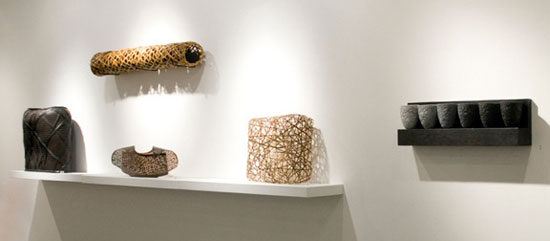
Jiro Yonezawa, Nancy Moore Bess, Hisako Sekijima at Cavin-Morris Gallery Exhibit photo courtesy of Cavin-Morris Gallery
Through January 22, 2011, the Cavin-Morris Gallery in New York is exhibiting a remarkable grouping of eclectic cross-cultural, multi-genre objects. The exhibition, entitled, Contained Excitement – Pleasures of the Void, includes work by several artists represented by browngrotta arts, including Dorothy Gill Barnes, Nancy Moore Bess, Lizzy Farey, Mutsumi Iwasaki, Jennifer Falck Linssen, Hisako Sekijima, Kay Sekimachi, Jiro Yonezawa and Masako Yoshida, deftly combined with ceramics, boxes, bowls, books and furniture and more.
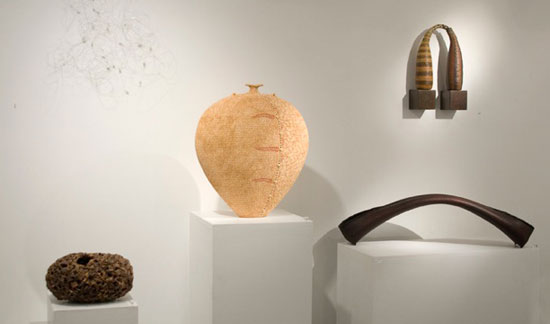
Hisako Sekijima and Jiro Yonezawa at Cavin-Morris Gallery Exhibit photo courtesy of Cavin-Morris Gallery

Mutsumi Iwasaki at Cavin-Morris Gallery Exhibit photo courtesy of Cavin-Morris Gallery

photo courtesy of Cavin-Morris Gallery

photo courtesy of Cavin-Morris Gallery
The exhibition focuses on the way the artists control the sensual expectations of space in an object, which may or may not take leave of its utilitarian purpose. The exhibition features Art Brut, ancient and contemporary ceramics, New Basketry, and other media. Included are Chinese ceramic reliquaries for keeping wrapped sutr as, the transformation of Native American Sweetgrass into deconstructions of molecular perfection in Debora Muhl’s work; the nervous and dark recycling in the forms made by Jerry Bleem and John Garrett; the beckoning toward initiatory revelation in Susan Kavicky and Lissa Hunter; the brooding presence in the lithops-like ceramic sculptures of Kenji Gomi; the Zen poems inscribed in the early ceramics of the Buddhist nun Rengetsu; hidden books of healing and magic from the tribal peoples in Southern China; the incredible repression and resultant freedom in the ceramics boxes of Shuji Ikeda where the clay is woven like bamboo; the opening of soul to the elements of wind and light in the sweeping bamboo constructions of Charissa Brock met by the dark compression of clay into Place and Mortality in the ceramics of Tim Rowan; the erotic beckoning of release through restraint and role-play in the bondage bed made by Sullivan Walsh; the New Baskets of JoAnne Russo and Nancy Moore Bess; and the ancient feminism of the ceramics of Avital Sheffer. A special inclusion will be an installation of Choson-period tea bowls from Korea and two intricate and rare woven rattan shields from early Kongo.
Also included are: Emogayu, Jill Bonovitz, Polly Jacobs Giacchina, Deirdre Hawthorne, Mei-Ling Hom, Kentaro Kawabata, Gerri Johnson-McMillin, Shozo Michikawa, Drew Nichols, Akira Satake, Hyungsub Shin, Polly Adams Sutton, Akiko Tanaka, Tyrome Tripoli, and Shannon Weber. The Gallery is at 210 Eleventh Avenue, Suite 201, between 24th and 25th, For more information contact: Shari Cavin, Randall Morris, or Mariko Tanaka: 212-226-3768 or email: mtanaka@cavinmorris.com; www.cavinmorris.com.
 by Germain Bazin, curator of the Louvre (Simon Schuster, NY, 1962) probably way out of print! The book is beautiful and I have it and love it still.
 (with Alexandra Quinn, Gibbs Smith, 2008). It is a wonderful book. He collects street trees and mills them and uses them in his work so he is dear to my heart.
 IF (Getty Publications; J. Paul Getty Museum; First Edition edition 1995) by another artist friend of mine, Sarah Perry.
 (The Museum of Modern Art, New York 2007) by John Elderfield, Elizabeth Reede, Richard Powell, Michael Auping, Martin Puryear.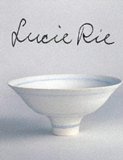
 by Tony Birks (Marston House 1994). I feel this book documents her work very well. I am always amazed at the “drawing” she could do with glaze.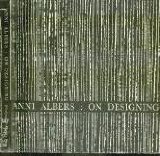
 (Wesleyan 1971). It was my weaving “Bible”. In fact everything she wrote makes so much sense to me.
 by Mildred Constantine/Jack Larsen (Van Nostrand Reinhold 1972) it just turned my ideas and work upside down. I saw what was possible with the materials I was using and what else was out there. That book opened up a whole new world to me.
 by Soetsu Yanagi (Kodansha International, Revised edition, 1990). One of my first trips after arriving in Tokyo three weeks ago was to the Mingeikan, Yanagi’s museum and home. It was a delight, after so many years, to see some of the work pictured in the book. Yanagi’s theory that hard, repetitive practice resulted eventually in the disengagement of self and led to work of merit produced with ease was an inspiration to me. I was a young grad student when I first read the book and at the time every day was a struggle.
 by Claude Levi-Strauss (University Of Chicago Press, 1968). The introduction made me think about the role of an artist and about materials.