Another month of interesting works we’ve brought to your attention each Monday in New this Week on instagram.
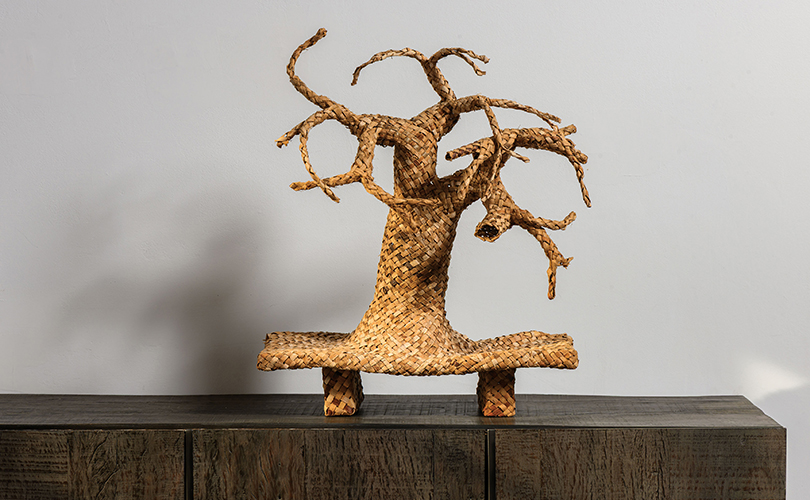
In Just Past Dead Center, the late John McQueen, plaited elm bark to create a whimsical tree sculpture. Originally a part of the Hechinger Collection, it was exhibited at City Museum, Saint Louis, Missouri, (and elsewhere) in Tools as Art: The Hechinger Collection. The work also appears in the book, Tools as Art: The Hechinger Collection, by Pete Hamill, New York, 1995. Throughout his career, McQueen created objects that explored the idea of what a basket truly is with wit and wordplay.
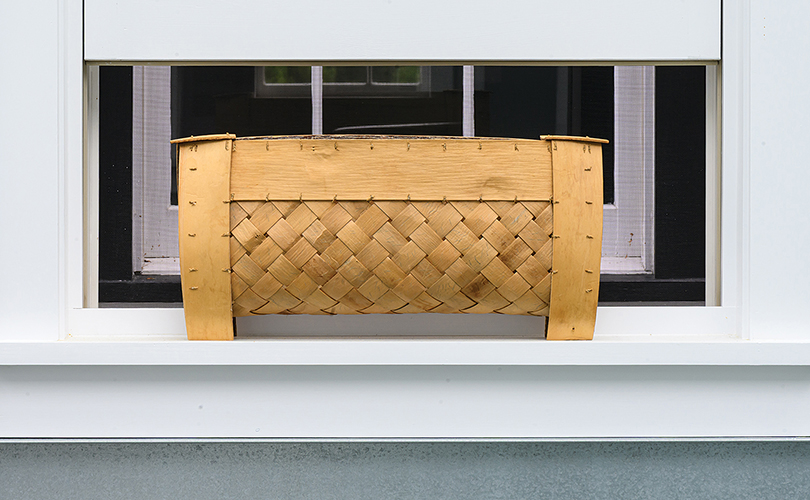
Linda Bills transforms tulip poplar bark into elegant sculptural baskets that honor the material’s natural beauty. In Arrowhead #2 (Algoma Basket), she has used peeled and unpeeled bark, subtle color, and waxed linen stitching to create a vessel that is both refined and deeply rooted in nature. The woven panels are marked and lightly colored and the stitched knots are made of waxed lined thread. The inside of the bark is on the outside. Bills scrubbed the bark, with plain water, to remove the dirt accumulated during its life in the woods. Introduced to bark as a basketry material by John McQueen in the 1980s, Bills has gone on to expand her practice into large-scale sculpture, drawing, and printmaking—allowing each medium to continually inspire the next. Some of Bills’s sculptures created shadow drawings on the floor or wall which peaked her interest. In the mid-2000s she began making actual drawings, on paper. Prints followed. Ultimately, inspiration came full circle, sculpture inspiring drawings and prints and those, in turn, inspiring sculpture and installations.
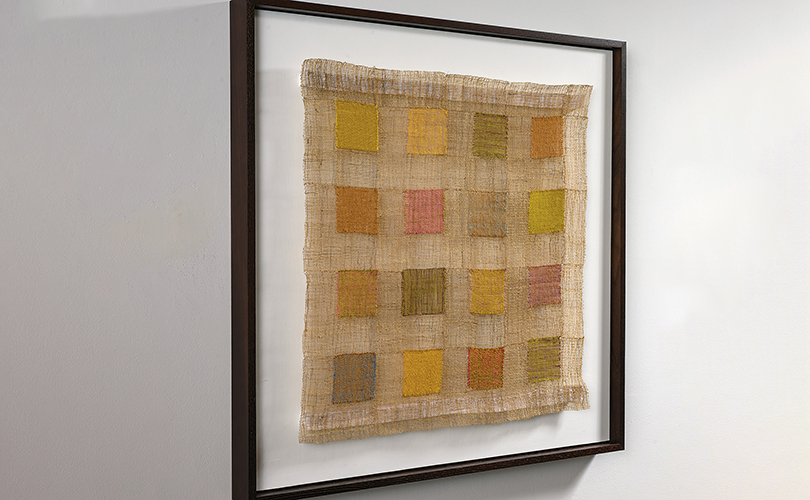
In The Yarns I’ve Carried series, James Bassler has developed a contemplative method for weaving more than 65 years of leftover warp and weft yarns into a quiet meditation on color, memory, and time. The series reflects what Bassler learned in his first “Color” class at UCLA in 1953 and references Josef Albers’s Color Theories, which Bassler later taught at UCLA for 25 years. The works transform wool, silk, linen, cotton, ramie, and handspun fibers into a vivid study of complementary color. As Bassler notes, this four-selvaged weaving is a work that rewards slowing down — and truly looking.
Bassler works with no end of warp and weft threads — wool, silk, linen, ramie, agave, sisal, Oaxaca brown cotton, coyuchi, and a contemporary, warmer brownish orange, coyuchi spun on the spinning device designed by Mohandas Gandhi in India. The pieces in The Yarns I’ve Carried series are very quiet. “Most of the interest, for me, Bassler says, “is focused on the vibrancy of the complementary color squares. Viewers will have to put down their phones to concentrate on it though I don’t know if that is still possible in our contemporary society.”
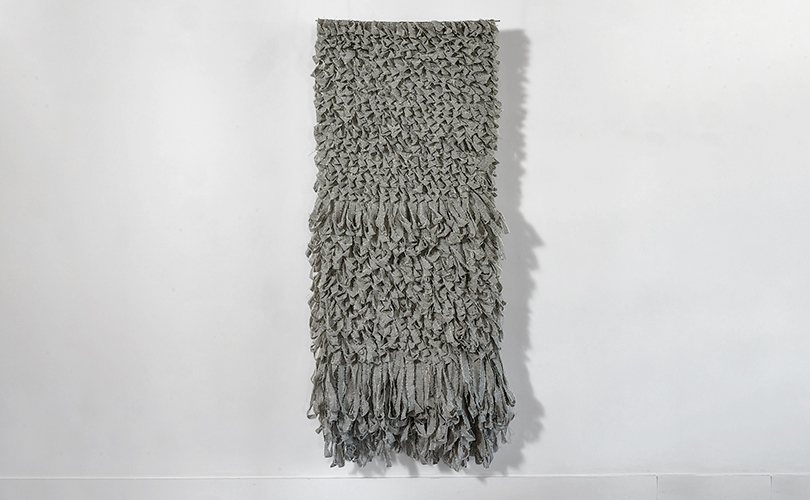
Aby Mackie is a textile artist who works with repurposed and existing materials through a material-led methodology. Through processes including layering, cutting back, stitching, gilding, and reconfiguration, Mackie transforms materials while often preserving aspects of their original character within the final composition. Much of her repurposed material comes from the Encants Vells market in Barcelona, Spain. In works like From Order to Chaos, 6, Mackie combines traditional and non-traditional textile techniques with a fine art approach. Each piece evolves through a sequence of material-led decisions, where every intervention informs the next, resulting in works that reflect an ongoing dialogue between process, material and form.
Watch for more highlights in August!