
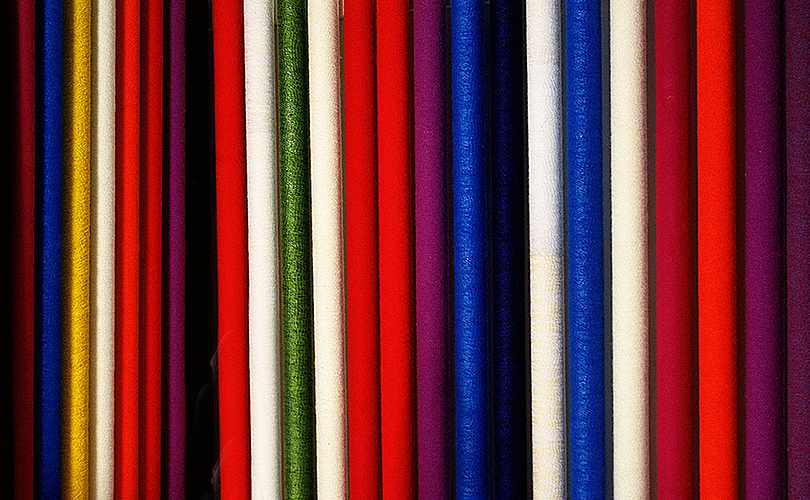
Color is a constant in art, while its potential for new and unique applications is limitless. Artists at browngrotta arts have taken the challenge to heart — finding inspiration in the teachings of Josef Albers, the art of Color Fields painter Mark Rothko, and systems of their own design.

In Bauhaus artist and teacher Josef Albers’s universe, color seduced and beguiled (The Josef and Anni Albers Foundation: https://www.albersfoundation.org/alberses/teaching/interaction-of-color). “These characteristics made color the most fascinating of art’s formal elements. Albers’s passion for color prompted his decision to launch what was possibly the first full-blown course in color ever given anywhere, and certainly the first based exclusively on direct observation of color’s behavior. . . . Color behaved. Color was magic.”
At Black Mountain College in the 1930s he introduced a color course unique at the time, followed by courses at Yale University and the publication of Albers’s landmark Interaction of Color in 1963, which crowned 30 years of effort. His exercises focused on color in specific contexts, showing that if you put color A next to color B, or these colors next to those, you could anticipate certain results. Moving from simple to complex, with many exercises exploring the ramifications of a previous one, the course awakened the students to the quirks and variables of color behavior. The course was not a fixed body of color wisdom, but rather an ongoing inquiry in which solutions were not conclusions, but steps on an endless path.
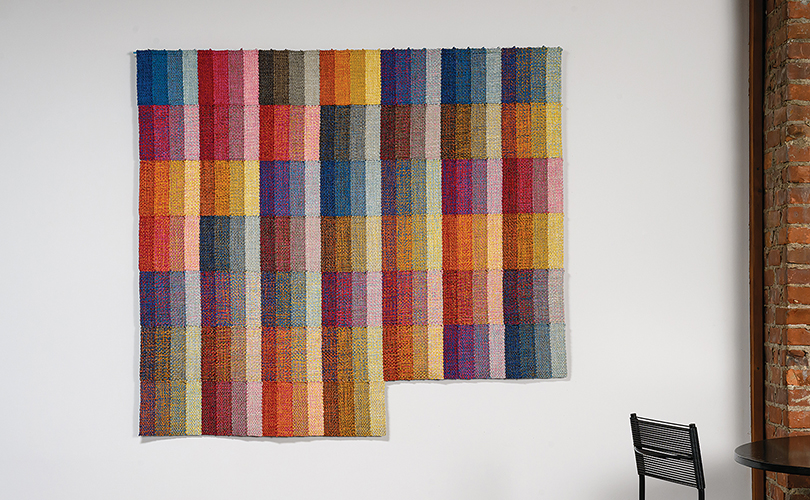
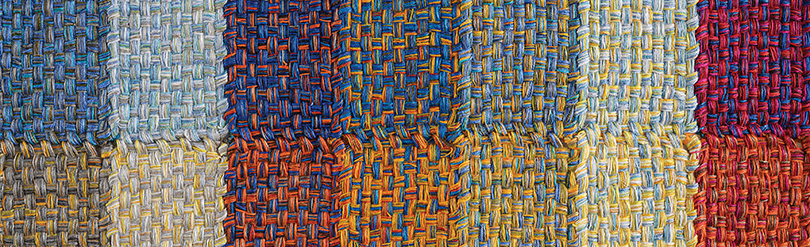
Merja Keskinen engages in color experiments of her own navigating between following a system, as Albers did, and making room for discovery. Keskinen describes this generative uncertainty: “I work to see. The joy of discovery and the delight of experiencing colors are essential to me. The unpredictability and always-surprising color tones captivate me. I interpret life and the surrounding world with colors and explore the factors that influence color perception.” In works like, Rhythm of Colors, Keskinen works with a self-developed weaving technique, combining different-colored threads according to her preselected system, creating geometric square and rectangular shapes in various sizes whose surfaces produce a pixel-like optical blending — distinguishable as individual threads up close, but merging into wholly unexpected color combinations from a distance. Her work demonstrates that even the most rigorously systematic approach — mathematics applied to thread — contains inevitable surprise. The material collaborates, producing results the artist could not fully predict.
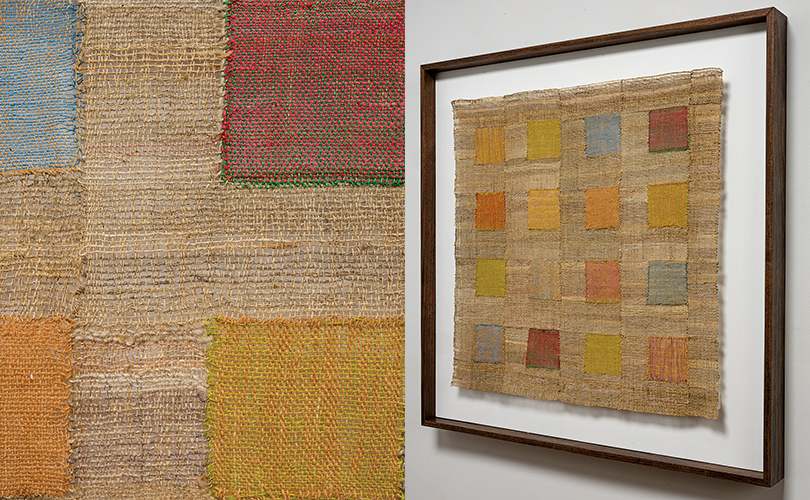
In his Threads I’ve Carried series James Bassler takes Albers’s Color Theory as a literal influence. The works reflect what the artist learned in his first “Color” class at UCLA in1953 once he realized that there was an “Art Department.” The head counselor at Santa Monica HighSchool had refused to allow him to take a Ceramics class because his GPA was too high. He pursued art, despite that first obstacle, and later Bassler would teach Josef Albers’s Color Theory at UCLA for some 25 years. This work is made of left-over warp and weft yarns from the past 65 years, including handspun and manufactured material, natural and synthetic dyed wool, silk, linen, cotton, and ramie. The result, is a four-selvaged weaving, a color study using complementary colors, In works from the series, Bassler explored a new bag of saved yarns, which presented new thoughts. “How bright or dark can I go before it upsets the whole idea,” he asks. “In this piece I pushed the subtle to almost disappear and the bright to almost overwhelm.”
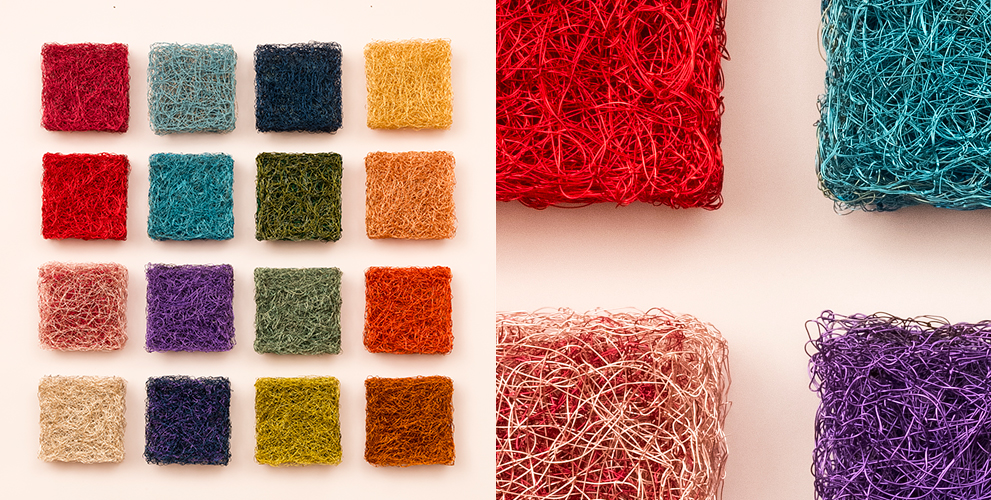
Nancy Koenigsberg’s Chroma is the artist’s version of a painter’s palette which took her more than six months. to complete. The sculptural artwork of coated, colored copper wire is comprised of four horizontal rows of small squares and four vertical rows, occupying an area 26 inches square. Each individual square is created by sewing and weaving coated copper wire and building layers of the color to a depth of 2.5 inches. The color combinations and contrasts challenge and engage the viewer both visually and conceptually.
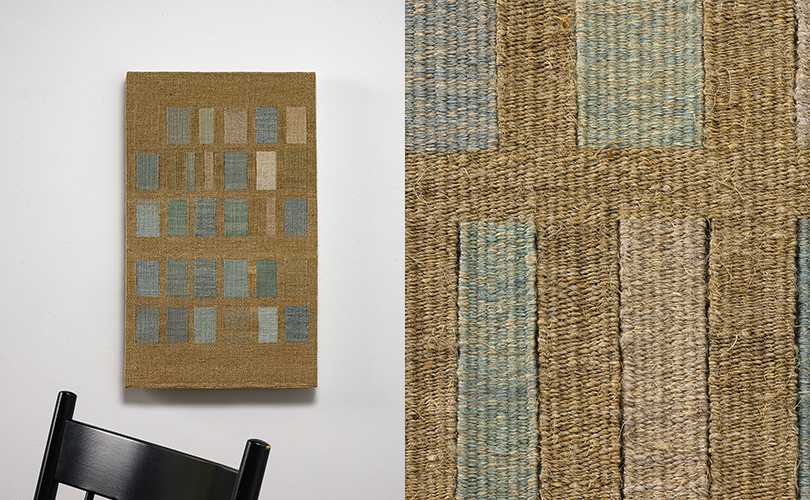
37sl Dictionary – Light Indigo, Sue Lawty indigo-dyed, natural hemp, linen, 21.5 x 13, 2026. Photo by Tom Grotta
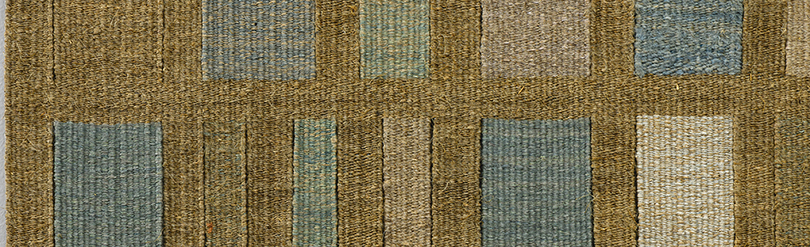
In her Indigo Cloth series, Sue Lawty explores the innumerable variations of blue. In one series, Notes on Blue, Lawty commissioned a range of linen and hemp hreads to be hand dyed with indigo by Jeanette Orrell in Wales. Lawty purposely requested a range of unevenly dyed shades across the tonal spectrum and then worked intuitively, reading the weaving line by line as it progressed. In Dictionary – Light Indigo Woven Tapestry, she explores more gradations of blue. Lawty pursues the inherent qualities of any material with which she works, seeking “an understated restraint, balance, tension, rhythm: an essential stillness.” In Lawty’s practice, color feels less applied than absorbed — as though the fiber had always held it within.
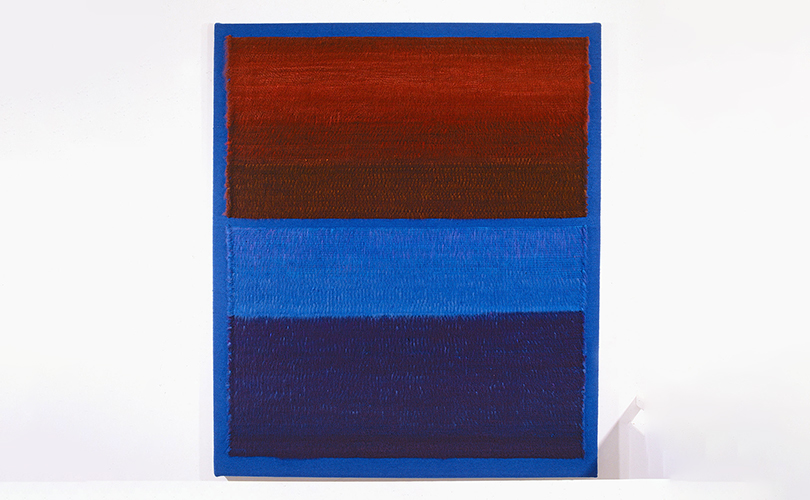
Experiments in color were the hallmark of members of the Color Fields movement of the 1950s and 60s. Color Fields artists, among them Mark Rothko, created abstract paintings featuring large areas of solid color, flat surfaces, and a unified single-image field. Rothko’s work with color was a potent influence for fiber artist Mariette Rousseau-Vermette. The Canadian artist saw an exhibition of the Rothko’s works in Italy in 1958. It was pivotal in inspiring her “to produce strictly artistic works in weaving,” Anne Newlands wrote in Weaving Modernist Art: The Life and Times of Mariette Rousseau-Vermette (Firefly Books, Richmond Hill, Ontario, 2023, p. 32). Throughout Rousseau-Vermette’s life, Newlands says, Rothko triggered “compositions with floating blocks of color, soft edges and her signature brushed wool technique to create a blending of colors and a sense of inner light.” Her interest in Rothko “marked her as a colorfield artist-weaver, fueling her ambition to create large-scale tapestries that would engulf the viewer and employ powerful chromatic contrasts of light and dark to evoke an emotional response.”
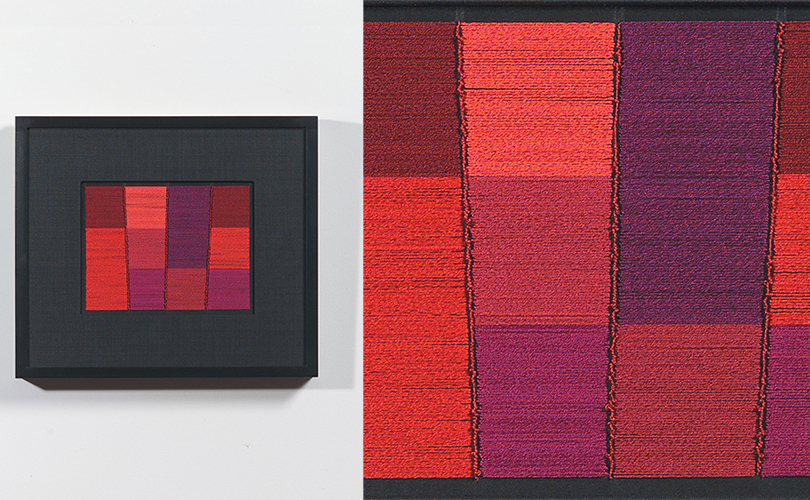
12.75″ x 14.75″, 2002
Scott Rothstein also works in fields of color in vivid embroideries of silk like Untitled #71. “I have felt compelled to explore the subtleties of basic visual elements for 20 years,” he explains. “I find the simplest elements to be the most profound. A line, created by twisting threads, can have infinite possibilities. Two areas of color, in equal amounts, placed consecutively, might suggest harmony or contradiction.”
However articulated, these explorations of color and its potential intrigue and engage the viewer just as they the artist.