Monthly archives: April, 2026

The Moon as Muse

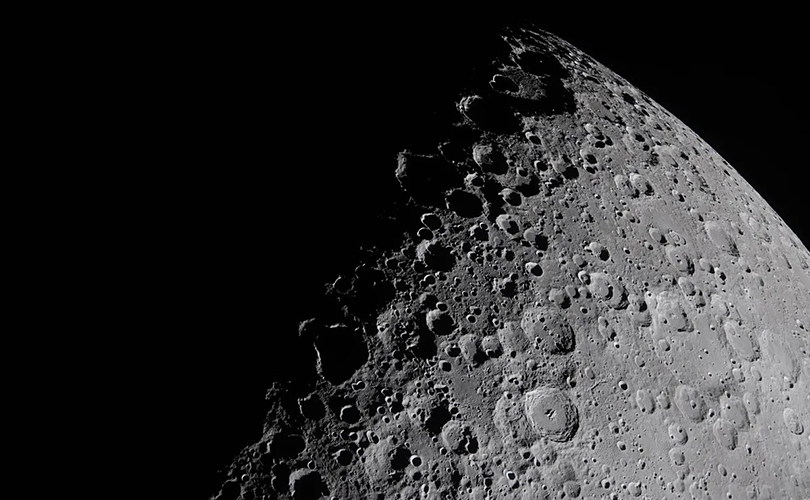
The Guardian said it well: “If you’ve been looking up at the moon with childlike wonder these past few days, you aren’t alone. NASA’s Artemis II lunar mission has captured imaginations at a time when wonder and optimism are in short supply.” The photographs of the moon in IRL that resulted from the mission are breathtaking.

The dark side of the Moon NASA
Shadows at the Edge of Lunar Day: The edge of the Moon’s night and day creates shadows across the surface (Image credit: NASA)

Man has also looked to the moon for artistic inspiration through millennia. Artists who work with browngrotta arts not immune to celestial charm; we’ve gathered some examples here.

The travel website Fly Me to the Moon, lists possible reasons for the moon’s appeal. It could be the subconscious connection with the amorous ancient Greek goddess of the moon, Selene, or the moon’s association with fertility. 
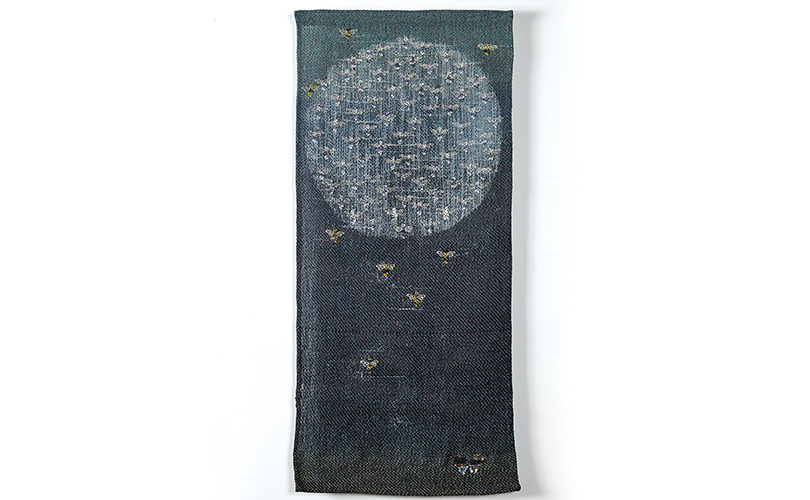
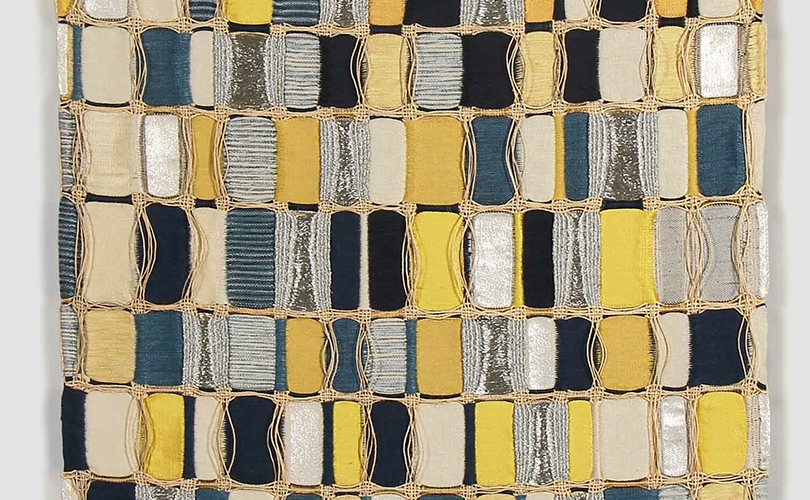
Dark Moon tapestry, Laura Foster Nicholson
19lf Dark Moon, Laura Foster Nicholson, wool with cotton, metallic, angelina fiber, ink, 34.5″ x 16″, 2017. photo by Tom Grotta

It could also be her ever changing nature that captures our attention. Her light illuminates our quietest and most contemplative hours. “In a dark sea of instability, the full moon in a richly deep blue sky is both reassuring and evocative,” says Laura Foster Nicholson. “Hints of reflective threads in Dark Moon aim to bring split seconds of insight and imagination, as do the stars.”

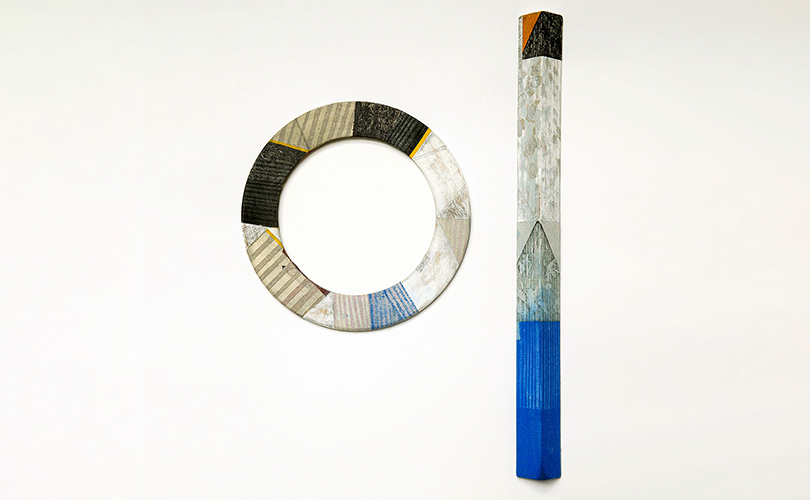
Or perhaps it’s simply the spectacle of moonlight. Paul Furneaux’s visit to the Norwegian fjords led to Fractured Moon, Fractured Mountain. He was particularly taken by the drama played on the fjords by the change of light, one half often shadowing the other — when translated to Fractured Moon, Fractured Mountain, it’s reminiscent of the drama of the familiar light and enigmatic sides of the moon.

Paul Furneaux sculpture
5pf Fractured Moon-Fractured Mountain, Paul Furneaux, Wood, gesso, Mokuhanga, graphite,card ,rice paste and acrylic, 15.75″ x 13.75″. photo courtesy Paul Furneaux

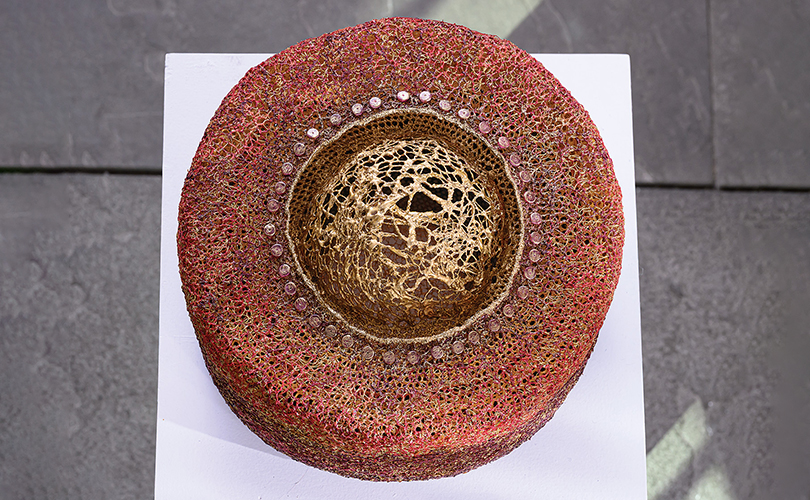
It’s also magical, and mystical. Golden Moon, by Norma Minkowitz, has a large, intricate orb rising up. It is a symbol of illumination, insight and mystery. “The moon is a metaphor for beauty in this world,” she says, “as well as acting as a source of light in the darkness”. Golden Moon is one of a series of vessel forms that Norma Minkowitz been creating since the 1990’s. The vessels represent containers of different thoughts: some dark, some optimistic and some, like Golden Moon, ethereal.

Norma Minkowitz Golden Moon
115nm Golden Moon, Norma Minkowitz, fiber, mixed media, 7.5” x 12” x 12”, 2024. photo by Tom Grotta

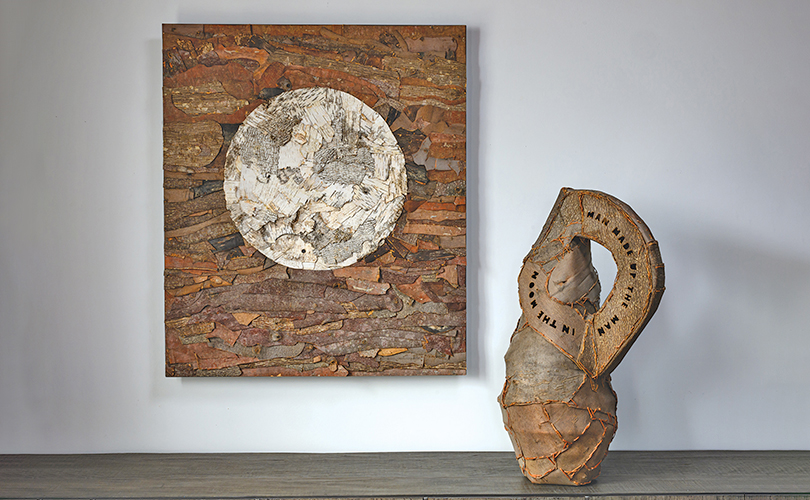
The moon has been used by artists to express “longing, change, the spiritual, the mysterious, and the sorrowful, according to WikiArt, the Visual Art Encyclopedia. In When Darkness Comes Calling, John 
McQueen wanted to capture that magical moment when a full moon comes out in a dark sky. The light and dark contrast is achieved by surrounding the white birch bark of the moon with the darker back sides of the pine and birch barks. The title of the piece comes from the lyrics of a song by Lily Kershaw, As It Seems. In The Other Side of the Moon, McQueen makes a tongue-in-cheek observation about our obsession with the moon. One side of the vessel reads: Man made up the man in the moon. The second side says: The first self-serve in no man’s land.

John McQueen moon sculptures
34jm After Dark Comes Calling, John McQueen, white pine and birch bark, 42’ x 36 x3″, 2017 and 62jm The Other Side of the Moon, Jon McQueen, bark and vine, 32″ x 18″ x 14″, 1993. photo by Tom Grotta

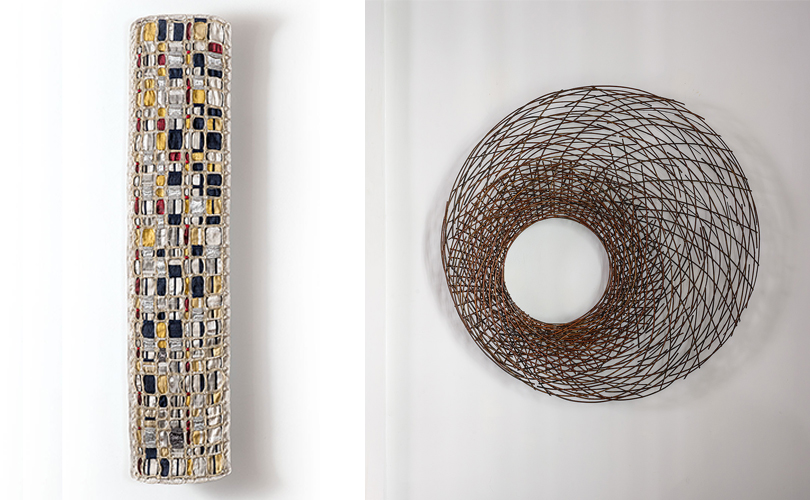
Works inspired by the moon that reflects a visual language that crosses geography and history. Here are moon-inspired works from artists in Venezuela and the UK. Eduardo Portillo and María Davila use indigo to illustrate the night, the moon, the sky, the clouds, the dawn; moments of every day; moments filled with blue. 

Eduardo Portillo & Maria Davila tapestry and Lizzie Farey willow sculpture
8pd Codigo Lunar (Moon Code), Eduardo Portillo & Maria Davila, silk, moriche palm fiber, alpca, silver leaf triple weave, 55.5″ x 12″, 2018   23lf Mignight Moon, Lizzie Farey, willow, wire, 33″ x 33″, 2024, photos by Tom Grotta

Wishing you many lunar interludes and the mystical magic that accompany them.


Materials Matter: Indigo at Transformations this May (9-17)

William Morris, pillar of the arts-and-crafts movement in the 1880s opined, “There is only one real dye: indigo.”

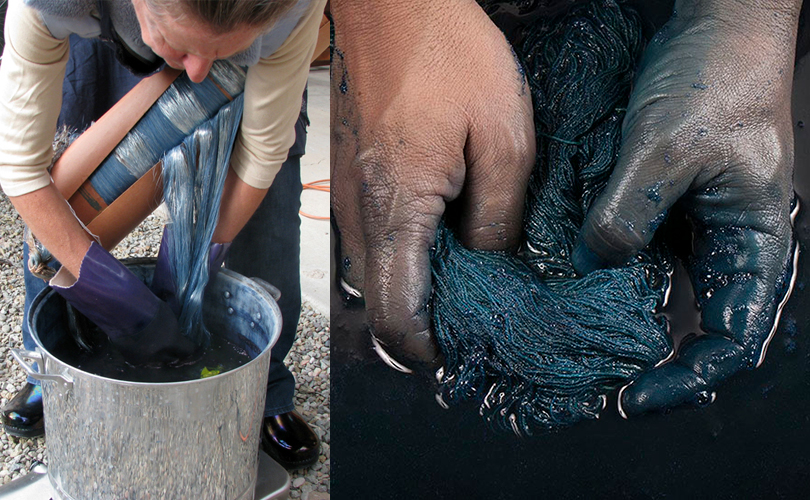
Polly Barton and Eduardo Portillo & Mariá Dávila working with indigo
Polly Barton and Eduardo Portillo & Mariá Dávila working with indigo. Photos courtesy of the artists.

Transformations: dialogues in art and material this May 9 – 17th at browngrotta arts will feature works from Japan, Korea, Venezuela, the UK, and the US that incorporate indigo. Every culture that discovered indigo seems to have felt the transformation as something more than chemical: the cloth goes into the vat one color and emerges another, steeped in a blue that belongs simultaneously to sky and sea and shadow. The plant’s leaves are dark green, and the mystical blue color is unveiled through a fermentation process — when a dyed article is exposed to air, the color transition occurs, starting from yellow to green, and ultimately resulting in the well-known indigo shade. 

What connects the artists in Transformations  who work in indigo — across continents and generations and very different formal concerns — is a relationship with the material that goes beyond color preference. Each has submitted to the discipline the dye demands. Indigo is not a paint you squeeze from a tube. It requires a living vat, careful chemistry, patience, and what practitioners often describe as ritual. It is a dye that demands discipline to use, with some indigo textiles taking thousands of hours to produce, requiring prolonged concentration akin to a meditative state. 

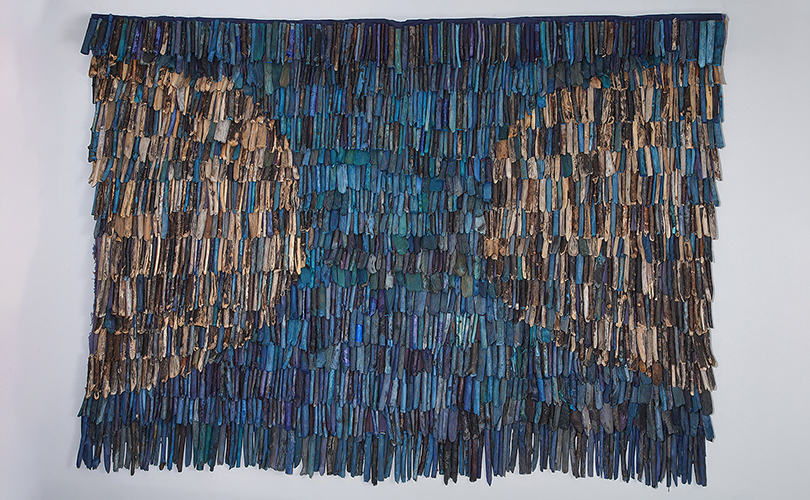
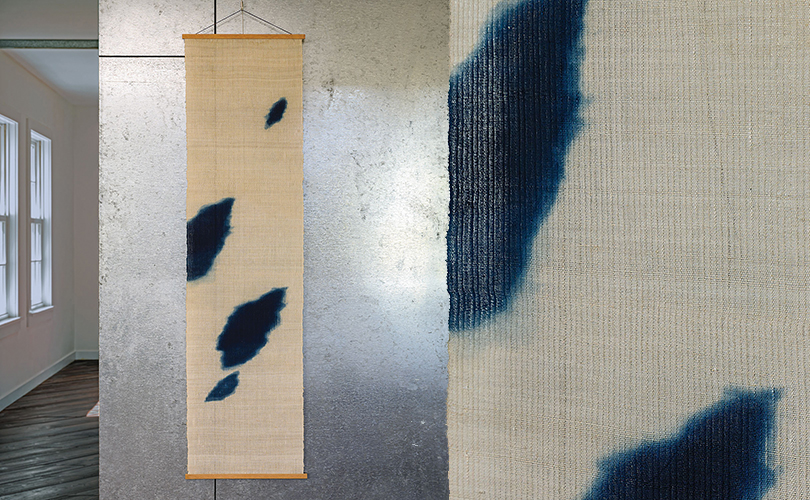
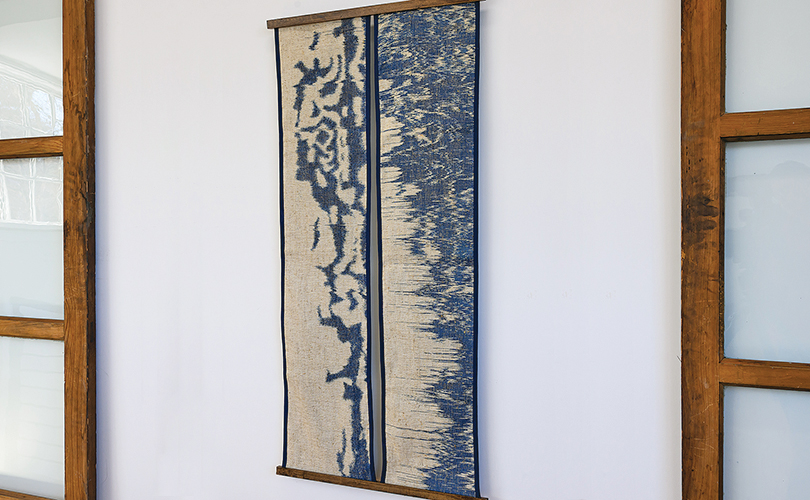
Wall Hanging, Hiroyuki Shindo
34hsh Wall Hanging, Hiroyuki Shindo, linen, indigo, 72.5″ x 19″, 1990s. Photo by Tom Grotta

Hiroyuki Shindo discovered the dye as a student: he first encountered indigo while at Kyoto City University of Fine Arts in Japan in the late 1960s, when an older artisan told him he was the last of 14 generations of indigo dyers. Shindo was determined to prevent the art form’s extinction. Over decades, Shindo maintained indigo vats in Kyoto and developed a distinctive technique entirely his own. He developed his own system, utilizing wide flat troughs in which he laid small stones, watching carefully as the indigo was drawn slowly into the fabric, creating gradations of hue — from nearly invisible shadows to areas of nearly black — through a combination of natural process and his own invention. The white of the cloth, Shindo insisted, was as important as the dyed portions.

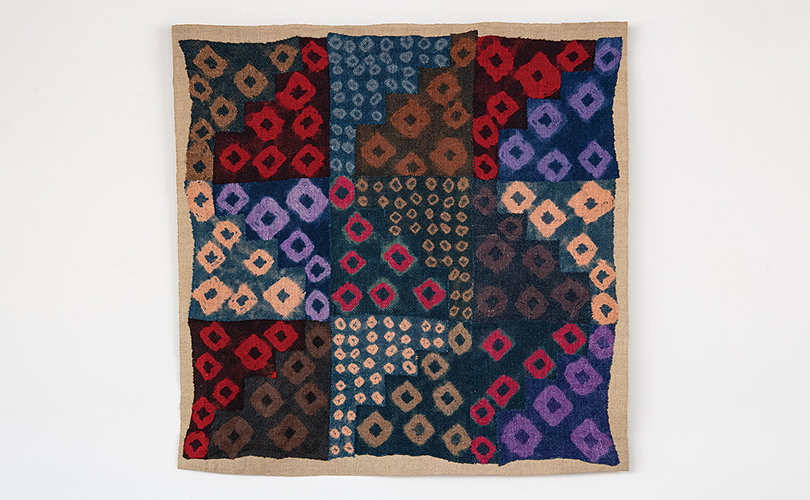
James Bassler, Cumbe
3jb James Bassler, Cumbe, linen, balance plain weave; discontinuous warp, synthetic and natural dye (indigo); 40.5″ x 40.5” including natural color linen binding around entire perimeter, 2009. Photo by Tom Grotta

James Bassler took a journey to indigo. In 1960, a voyage home from a civilian job in England via a cargo ship through Asia proved transformative. On this journey he witnessed the importance of world crafts and their essential role in cultures — a spinning and weaving demonstration in Bombay and the dyeing processes of Indonesia and Japan. Bassler has since explored the wedge-weave structure of the Navajo, shibori from Japan, and the scaffold weave of pre-Columbian cultures in his textile work. Indigo is threaded through decades of his practice. In works, such as Cumbe, he has used indigo-dyed silk and linen warps in combination with an array of other natural fibers — ramie, sisal, pineapple, nettles — creating textiles that feel like accumulated knowledge made visible.

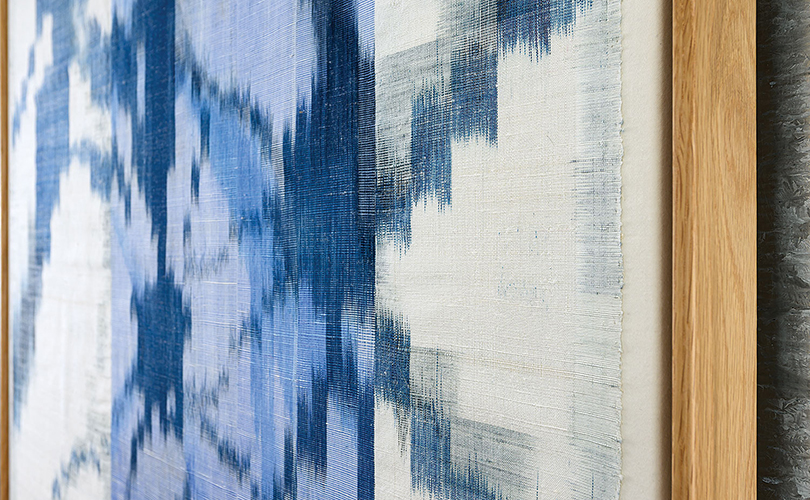
Synapse, Polly Barton
1pb Synapse, Polly Barton, silk, double ikat, 56” x 31”, 2016. photo by Tom Grotta

Japan and paint were Polly Barton’s route to indigo. As a young artist, she worked as a personal assistant to abstract expressionist painter Helen Frankenthaler, from whom Barton says she gained “permission” to build up layers of color in her own work. In 1981, she moved to Kameoka, Japan to study with master weaver Tomohiko Inoue, living in the religious heart of the Oomoto Foundation. Barton has spent over four decades exploring ikat, the ancient technique of binding skeins of yarn in calculated patterns before dyeing, which produces the distinctive blurred, feathered color transitions characteristic of the form. Indigo is central to her palette. Her work uses indigo alongside pigment, sumi ink, soy milk, and metal and silver leaf — materials that she layers to create luminous, meditative surfaces.

Blue Edge Ikats, Ed Rossbach
194r Blue Edge Ikats, Ed Rossbach, ikat, 43.5″ x 21″ x .625″, c 1970. Photo by Tom Grotta

One of the foundational figures of American fiber art — and one of its great iconoclasts — Ed Rossbach taught for nearly three decades at the University of California, Berkeley, where he created works in almost every known textile technique during his five-decade-long career, experimenting with labor-intensive techniques such as Andean discontinuous warp weaving, Native American coiled basketry, European lace, and Indonesian ikat. Indigo appeared in his work as part of his deep engagement with global textile traditions. He used the dye not as an element in a restlessly curious practice that moved between the ethnographic and the anarchic — making a basket from plastic, a hanging from newspaper, a piece from tundra grass. Indigo was part of that global inventory, a dye he understood as one of humanity’s great shared materials.

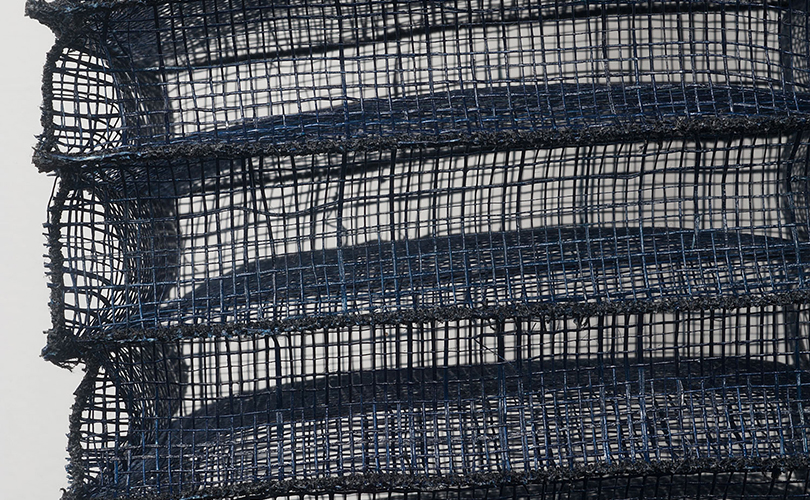
Detail: 13yc
Detail: 13yc Matrix II 201022, Chang Yeonsoon, indigo dyed fiber, 51.75″ x 10″ x 12.75″, 2010. Photo by Tom Grotta

Yeonsoon Chang takes indigo into the realm of philosophy. The Korean artist is known for creating ethereal works of starched indigo and was named Artist of the Year at the National Museum of Contemporary Art in Seoul in 2008. Chang’s signature material is abaca — a fiber derived from a species of banana plant — which she subjects to an elaborate 12-step process that includes starching, In her Matrix III series, she dyes the abaca fabric with indigo blue over thirty times, creating tightly stiffened material that pays homage to its disciplined creation. The Matrix series, she has said, illustrates the Asian perspective of the human mind and body as unified rather than separate — and the repeated dyeing, the compulsive labor, the rigid geometry are all in service of that idea.

Clev 1, Eduardo Portillo & Mariá Dávila
Detail: 14 pd Clev 1, Eduardo Portillo & Mariá Dávila, silk, alpaca, moriche, metallic fiber, silver leaf, natural dyes, 82.25” x 24.75”, 2019. Photo by Tom Grotta.

The Venezuelan partnership of Eduardo Portillo and María Dávila may have traveled the furthest — literally and conceptually — to arrive at indigo. Working together since 1983, they have been dedicated to exploring the intricacies of the material production of textiles, traveling extensively in China and India to study the traditional techniques of indigo dye making, silk sericulture, and hand-weaving. Indigo became central to a pivotal body of work rooted in place and longing. Looking for blue in their mountain landscape and realizing they could only find it in the sky, they merged their previous projects — the silk, the vegetable fibers, the natural dyes — into a series called Azul Indigo, exhibited in 2012, recreating the hours of the day: sunrise, noon, sunset, night, and the night’s shadows — their interest in blue shifting with the intensity of light according to the hour.

That labor-intensive nature of indigo, paradoxically, is part of its appeal for contemporary artists working in an era of infinite digital speed. The vat slows you down. It insists on process. It connects you — through fermented indigo leaves and wooden mallets and resist-tied threads — to every dyer who has stood at a vat in Kano or Kyoto or the Carolina Lowcountry, watching cloth transform in the air. William Morris was right. There is only one real blue dye. And in the hands of artists like these, its presence is spell binding.

Join us to see their work at Transformations:dialogues in art and material (May 9-17). 


Art Assembled for March

Our New this Week instagrams and browngrotta-created artlive videos in March were populated with works that evidence singular intention and mastery of a variety of materials. The featured artists reinvisioned everything from paper straws, to repurposed textiles, to willow branches with catkins intact. 

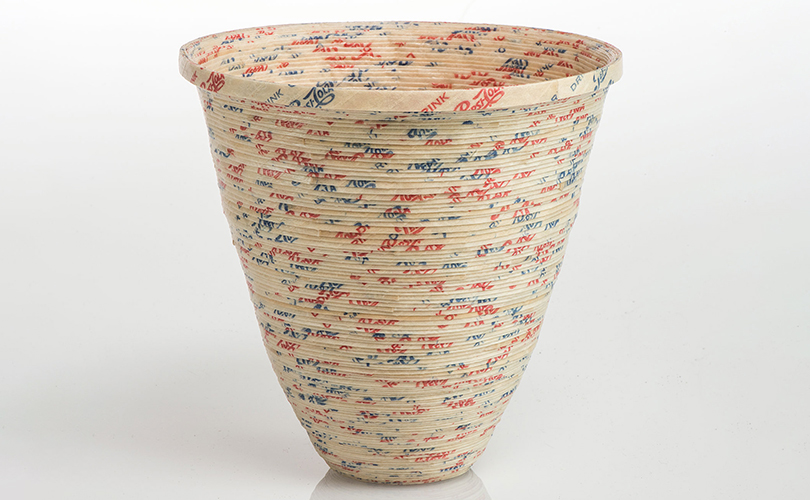
Pepsi Cola Faux Pot by Karyl Sisson
93ks Pepsi Cola Faux Pot, Karyl Sisson, vintage paper drinking straws and polymer, 5.75″ x 6″ x 6″, 2015. photo by Tom Grotta

The first work we highlighted was Karyl Sisson’s Pepsi Faux Pot. For years, Karyl Sisson has been collecting things like sewing notions — buttons and zippers, womenʼs vanity items — bobby pins, hair pins, and curlers, and paper drinking straws like the straws in Pepsi Cola Faux Pot. “I like the idea and practice of recycling and am drawn to undervalued and overlooked materials,” Sisson says. “These common, manufactured objects, reminiscent of my childhood, are the building blocks of my sculptures and wall art, while simple interlocking techniques found in basketry and needlework are usually the method of construction.”

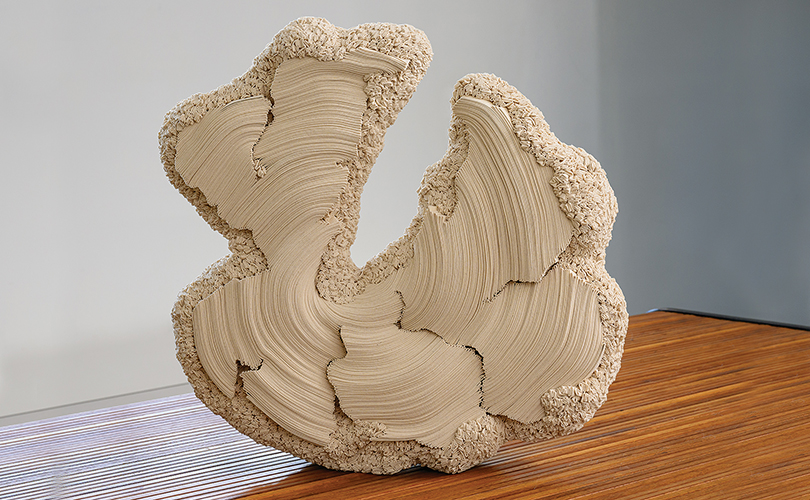
Simone Pheulpin cotton sculpture
42sp Tom, Simone Pheulpin, cotton, 17.75” x 14.5” x 11.25”, 2023. Photo by Tom Grotta

Our video of Simone Pheulpin’s Nova, part of the Eclipse series, gives viewers an opportunity to see up close the remarkable alchemy involved in this artist’s work. In Pheulpin’s hands humble strips of cotton become remarkable objects that evoke natural phenomena. She uses a method of her own devising, using neither glue or stitches. “I’m very, very interested in the roots, the layers, everything that is natural,” Pheulpin says. “The concretions, the accumulations, I love that, that’s the basic nature, the basis of my inspiration. I really like everything that is linear, everything that is repeated, piles of wood, walls. I love the walls, also by the sea, for example, the flowing water, the marks in the sand, the desert, the dunes, all that.” Pheulpin’s work will be part of a deep dive into materials in our upcoming exhibition, Transformations: dialogues in art and materials (May 9 – 17, 2026). 

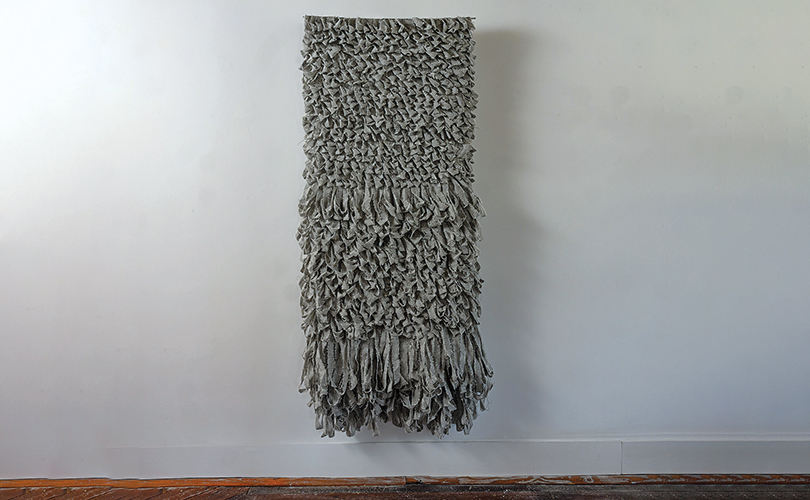
Aby Mackie textile
10am Between Order and Chaos, Aby Mackie, reconstructed domestic textiles 6, 83″ x 37″ x 6″, 2022. Photo by Tom Grotta

Barcelona-based artist Aby Mackie also approaches “humble” material in innovative ways — in her case, discarded textiles and household remnants are repurposed as fine art. Sourced from the streets of Barcelona, in works like Between Order and Chaos, she reimagines overlooked materials as powerful reflections on memory and value. In Barcelona, the contents of entire homes are often either thrown into the streets or auctioned off at Encants Vells market. The creation of Mackie’s work is driven by the selection and repurposing of objects and textiles from these sources in order to explore ongoing cultural themes, including materialism and consumerism. Mackie’s work will also be included in Transformations in May.

Lizzie Farey Willow basket
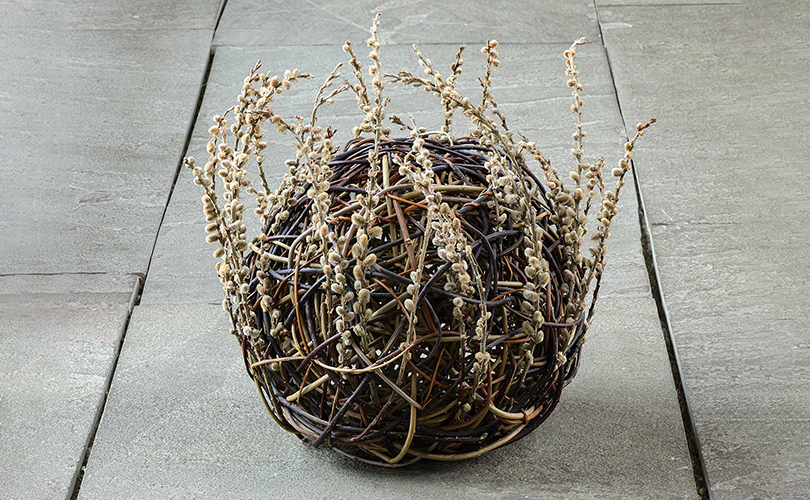
3lf.1 Willow Ball 2, Lizzie Farey, willow, 18” x 18” x 18”, 2000. Photo by Tom Grotta

The inspiration for Lizzie Farey’s work comes from the inherent qualities found in the natural materials around her Scotland location. Using willow, birch, heather, bog myrtle, and many other locally grown woods, her work ranges form traditional to organic sculptural forms — much of it pushing the boundaries of traditional technique.  In Willow Ball – 2 and Pussy Willow Bowl, willow seems to have been plucked unchanged from its natural surroundings, yet, with shape and color, the artist adds more. The works achieve Farey’s aim, to create baskets as reminders of the intense pleasure of nature – taking viewers to a place and a time that is universal.

Mariette Rousseau-Vermette tapestry
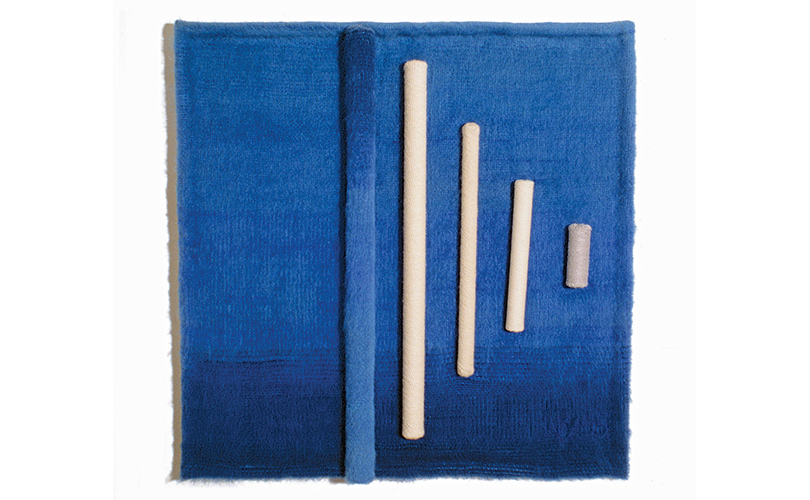
600mr Verticles mdans le Bleu, Mariette Rousseau-Vermette, wool and aluminum , 38” x 38”, 1995. Photo by Tom Grotta

Mariette Rousseau-Vermette was a noted Quebec-based Canadian tapestry artist who pioneered innovations in fiber art during the 1960s, 70s and 80s. Rousseau-Vermette created weavings in which she experimented with scale, form, material, and color, which became known as tapestry-paintings. In Verticles dans le bleu the artist incorporates metal tubes wrapped in wool to create dimension and interest. Rousseau-Vermette’s work mixing optical fibers and wool will be included inTransformations in May.

John Garrett basket
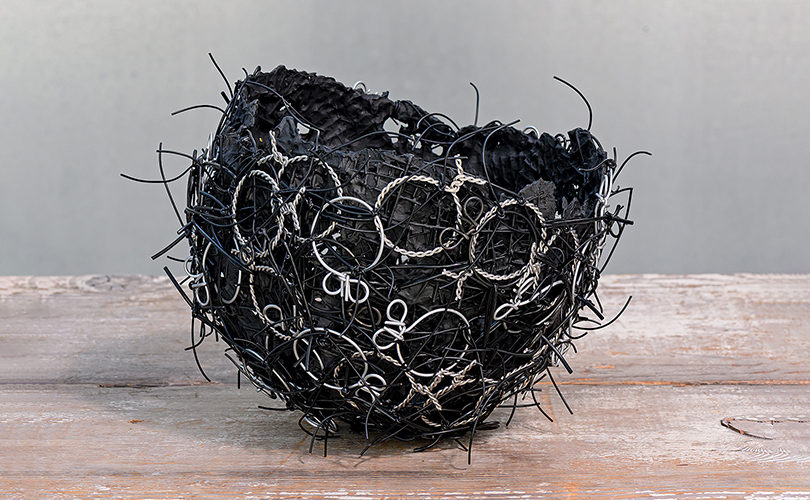
38jg Charred Black 2, John Garrett, Hardware cloth scrap, paper pulp, acrylic paint, rebar tie circles, aluminum rings, black rubber lacing, plastic covered electrical wire, 6.5″ x 8″ x 8″, 2025. Photo by Tom Grotta

In Charred Black 2, part of his Seven Baskets series, John Garrett fashions welded wire mesh into a vessel shaped by conflict and renewal. Inspired by images of war-torn landscapes, layers of paint, metal leaf, and bound wire evoke structures scarred and rebuilt, holding both destruction and resilience within their forms. “I had seen many pictures of the destruction of wars in Sudan, Ukraine, Israel, and Gaza,… Piles of debris littered landscapes,” Garrett says. “My painted paper baskets looked to me like structures distressed and damaged and covered in dust.”  Forms were painted and repainted and became new again while speaking of horrors between the layers. Shiny metal leaf covered the interiors and exteriors of others. Charred Black 2 was wrapped with rings of plied wire and tied down with more wire or fabric, bringing to mind a structure awaiting more layers of concrete or plaster. 

Dorothy Gill Barneslooking glass sculpture
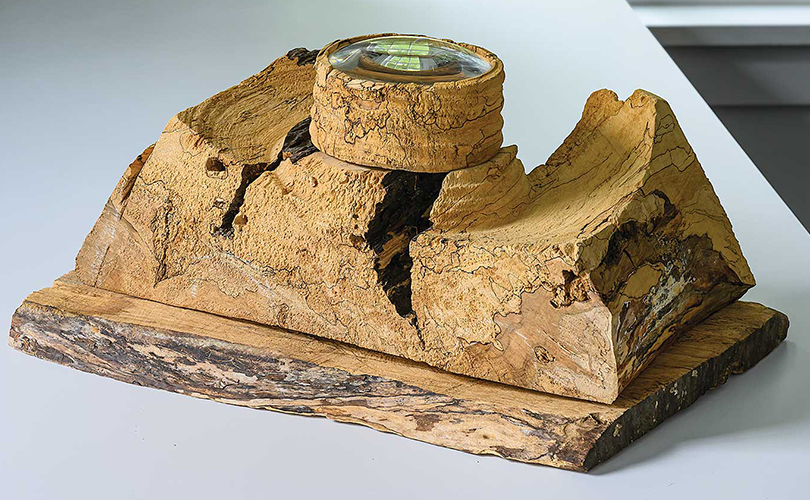
102dgb Spalted Maple Looking Glass, Dorothy Gill Barnes, spalted maple, glass lens, 9” x 18” x 14”, 2005-2013. Photo by Tom Grotta

In the 1970s, when she was in her 40s and early 50s, Dorothy Gill Barnes taught herself basketry through books, independent study, occasional classes, and connections with traditional makers, also drawing inspiration from contemporary artists and emerging developments in the field. Within a decade, her strikingly original works—crafted from natural materials—gained national and international recognition. Barnes delighted in revealing the ingenuity of nature, from animal-made forms to processes of growth and decay. Her work invites viewers to slow down and truly notice. In Spalted Maple Looking Glass, she has created an interactive experience: a glass lens, frames a small twig, magnifying both the object and its hollow. Through the lens, the tiny scene appears vast — refashioning something ordinary into a moment of wonder.

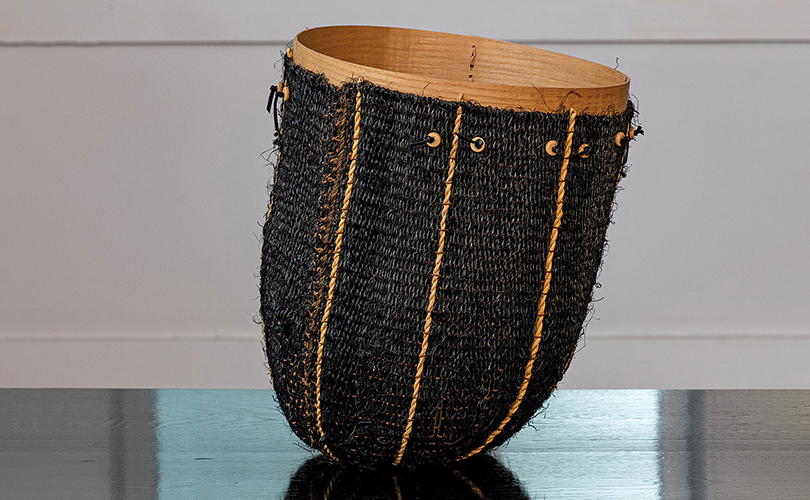
41mh #165r, Marion Hildebrandt, black sisal twine, brown waxed linen warp, hand twined rush, ash strip, wood rounds with leather ties, 9.5″ x 8″ x 8″, 2000. Photo by Tom Grotta

Marion Hildebrandt studied at the University of California, where she received degrees in the decorative arts and home economics. The artist lived and worked in Napa Valley, California, where she collected the plants — grasses, branches, pine needles, and bark — that she used to make her baskets. She employed the same materials that Native Americans used when they inhabited the area. Like them, Hildebrandt appreciated the natural materials that surrounded her, utilizing her artistic vision to create artistic art forms into structural objects like #r165.