Tag: Simone Pheulpin

Art Assembled for March

Our New this Week instagrams and browngrotta-created artlive videos in March were populated with works that evidence singular intention and mastery of a variety of materials. The featured artists reinvisioned everything from paper straws, to repurposed textiles, to willow branches with catkins intact. 

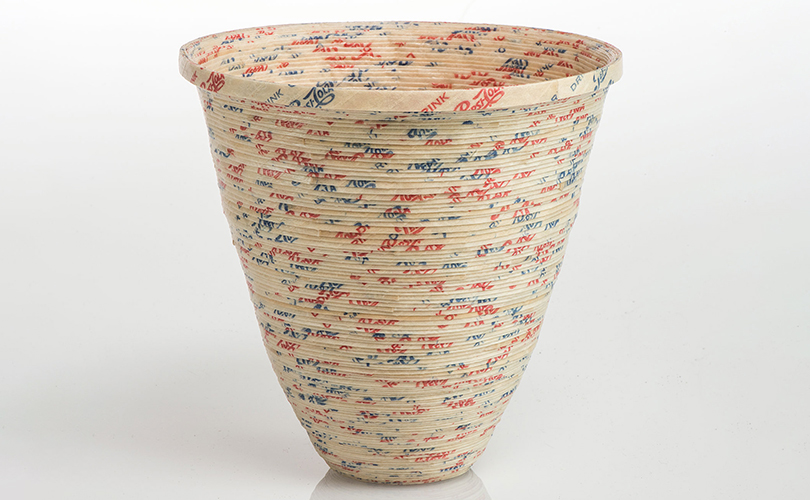
Pepsi Cola Faux Pot by Karyl Sisson
93ks Pepsi Cola Faux Pot, Karyl Sisson, vintage paper drinking straws and polymer, 5.75″ x 6″ x 6″, 2015. photo by Tom Grotta

The first work we highlighted was Karyl Sisson’s Pepsi Faux Pot. For years, Karyl Sisson has been collecting things like sewing notions — buttons and zippers, womenʼs vanity items — bobby pins, hair pins, and curlers, and paper drinking straws like the straws in Pepsi Cola Faux Pot. “I like the idea and practice of recycling and am drawn to undervalued and overlooked materials,” Sisson says. “These common, manufactured objects, reminiscent of my childhood, are the building blocks of my sculptures and wall art, while simple interlocking techniques found in basketry and needlework are usually the method of construction.”

Simone Pheulpin cotton sculpture
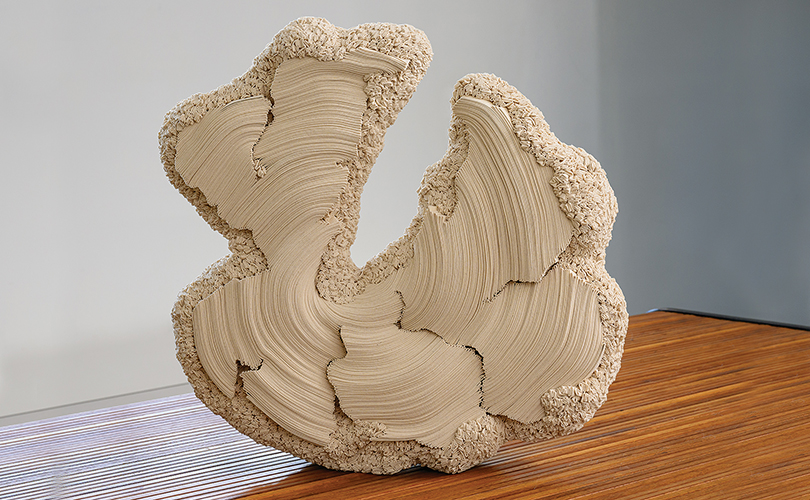
42sp Tom, Simone Pheulpin, cotton, 17.75” x 14.5” x 11.25”, 2023. Photo by Tom Grotta

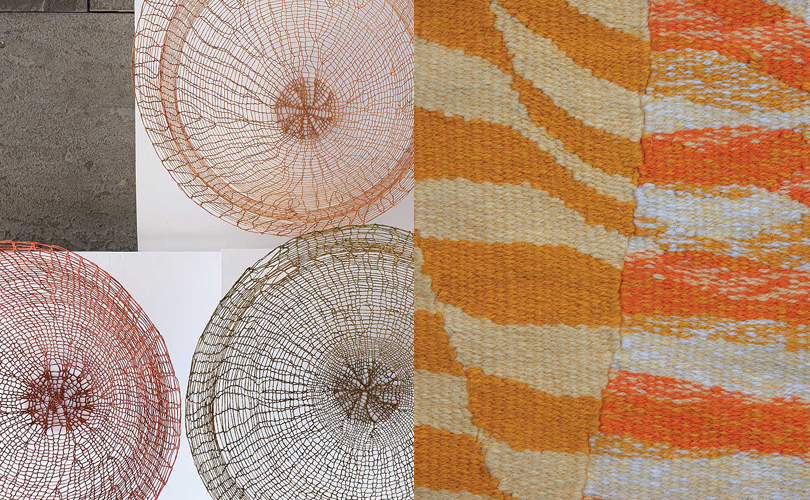
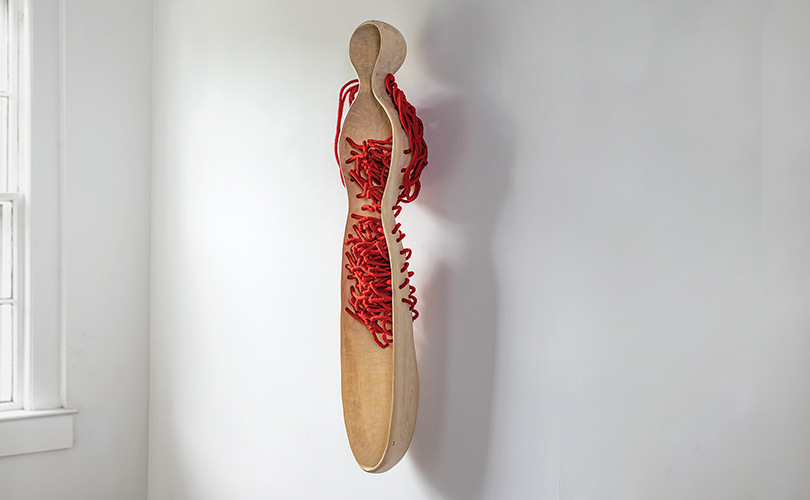
Our video of Simone Pheulpin’s Nova, part of the Eclipse series, gives viewers an opportunity to see up close the remarkable alchemy involved in this artist’s work. In Pheulpin’s hands humble strips of cotton become remarkable objects that evoke natural phenomena. She uses a method of her own devising, using neither glue or stitches. “I’m very, very interested in the roots, the layers, everything that is natural,” Pheulpin says. “The concretions, the accumulations, I love that, that’s the basic nature, the basis of my inspiration. I really like everything that is linear, everything that is repeated, piles of wood, walls. I love the walls, also by the sea, for example, the flowing water, the marks in the sand, the desert, the dunes, all that.” Pheulpin’s work will be part of a deep dive into materials in our upcoming exhibition, Transformations: dialogues in art and materials (May 9 – 17, 2026). 

Aby Mackie textile
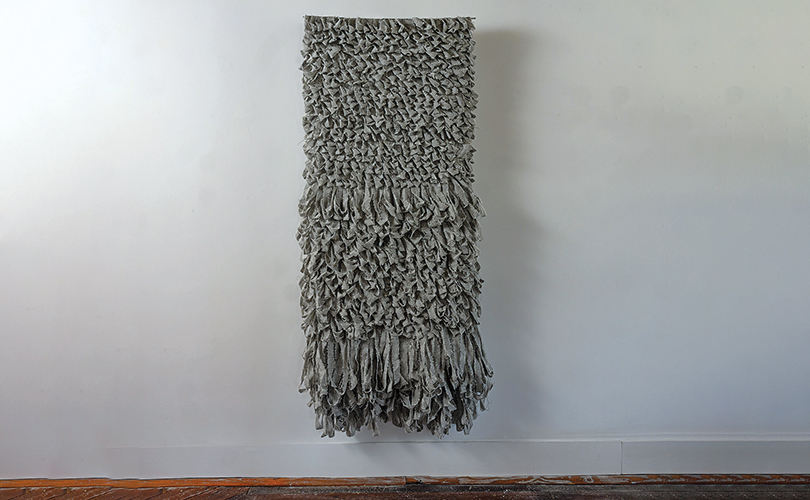
10am Between Order and Chaos, Aby Mackie, reconstructed domestic textiles 6, 83″ x 37″ x 6″, 2022. Photo by Tom Grotta

Barcelona-based artist Aby Mackie also approaches “humble” material in innovative ways — in her case, discarded textiles and household remnants are repurposed as fine art. Sourced from the streets of Barcelona, in works like Between Order and Chaos, she reimagines overlooked materials as powerful reflections on memory and value. In Barcelona, the contents of entire homes are often either thrown into the streets or auctioned off at Encants Vells market. The creation of Mackie’s work is driven by the selection and repurposing of objects and textiles from these sources in order to explore ongoing cultural themes, including materialism and consumerism. Mackie’s work will also be included in Transformations in May.

Lizzie Farey Willow basket
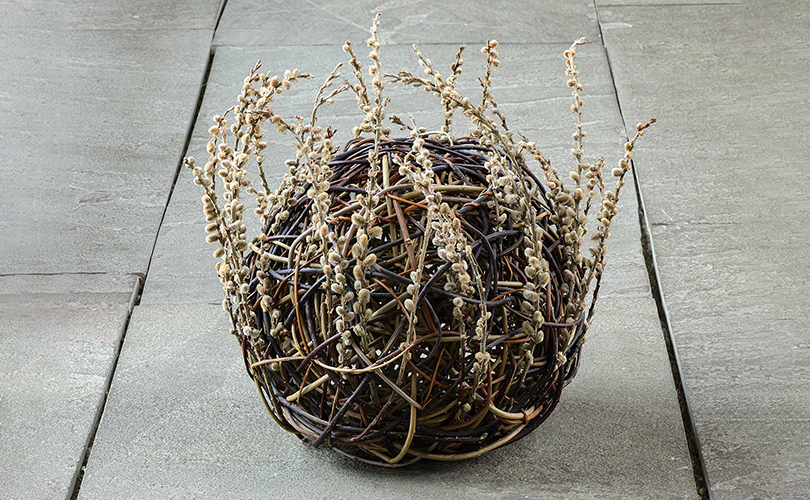
3lf.1 Willow Ball 2, Lizzie Farey, willow, 18” x 18” x 18”, 2000. Photo by Tom Grotta

The inspiration for Lizzie Farey’s work comes from the inherent qualities found in the natural materials around her Scotland location. Using willow, birch, heather, bog myrtle, and many other locally grown woods, her work ranges form traditional to organic sculptural forms — much of it pushing the boundaries of traditional technique.  In Willow Ball – 2 and Pussy Willow Bowl, willow seems to have been plucked unchanged from its natural surroundings, yet, with shape and color, the artist adds more. The works achieve Farey’s aim, to create baskets as reminders of the intense pleasure of nature – taking viewers to a place and a time that is universal.

Mariette Rousseau-Vermette tapestry
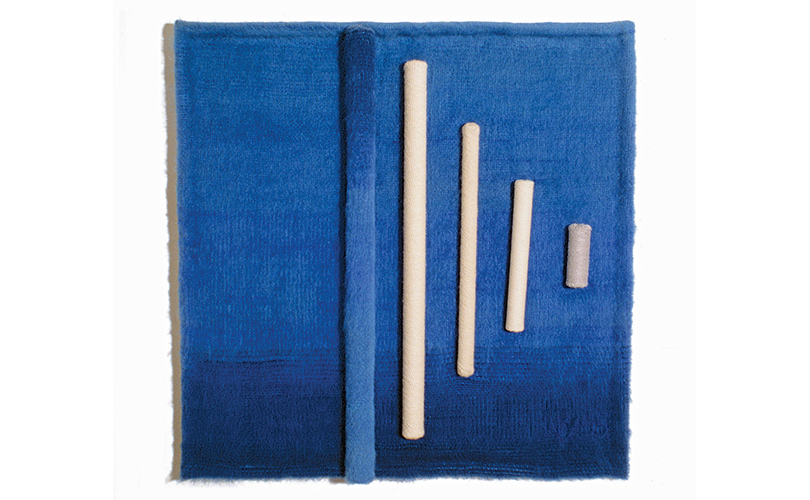
600mr Verticles mdans le Bleu, Mariette Rousseau-Vermette, wool and aluminum , 38” x 38”, 1995. Photo by Tom Grotta

Mariette Rousseau-Vermette was a noted Quebec-based Canadian tapestry artist who pioneered innovations in fiber art during the 1960s, 70s and 80s. Rousseau-Vermette created weavings in which she experimented with scale, form, material, and color, which became known as tapestry-paintings. In Verticles dans le bleu the artist incorporates metal tubes wrapped in wool to create dimension and interest. Rousseau-Vermette’s work mixing optical fibers and wool will be included inTransformations in May.

John Garrett basket
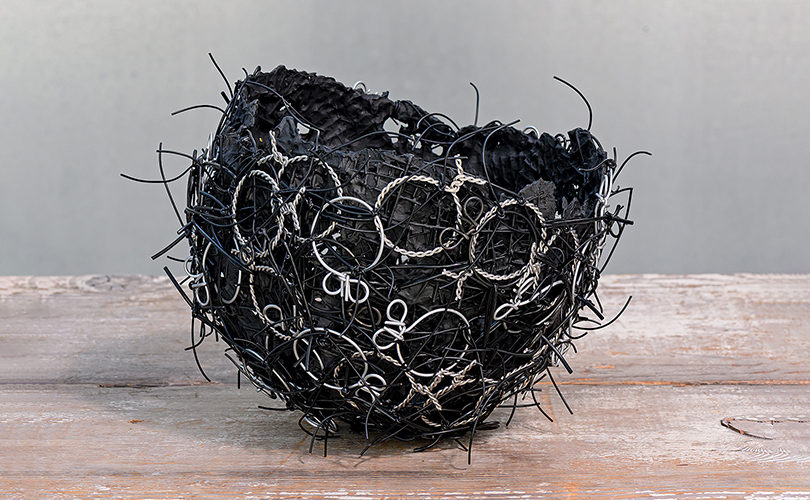
38jg Charred Black 2, John Garrett, Hardware cloth scrap, paper pulp, acrylic paint, rebar tie circles, aluminum rings, black rubber lacing, plastic covered electrical wire, 6.5″ x 8″ x 8″, 2025. Photo by Tom Grotta

In Charred Black 2, part of his Seven Baskets series, John Garrett fashions welded wire mesh into a vessel shaped by conflict and renewal. Inspired by images of war-torn landscapes, layers of paint, metal leaf, and bound wire evoke structures scarred and rebuilt, holding both destruction and resilience within their forms. “I had seen many pictures of the destruction of wars in Sudan, Ukraine, Israel, and Gaza,… Piles of debris littered landscapes,” Garrett says. “My painted paper baskets looked to me like structures distressed and damaged and covered in dust.”  Forms were painted and repainted and became new again while speaking of horrors between the layers. Shiny metal leaf covered the interiors and exteriors of others. Charred Black 2 was wrapped with rings of plied wire and tied down with more wire or fabric, bringing to mind a structure awaiting more layers of concrete or plaster. 

Dorothy Gill Barneslooking glass sculpture
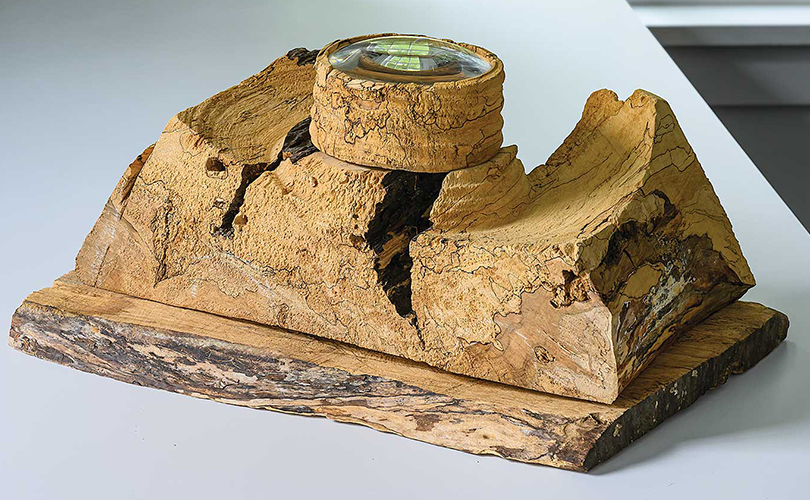
102dgb Spalted Maple Looking Glass, Dorothy Gill Barnes, spalted maple, glass lens, 9” x 18” x 14”, 2005-2013. Photo by Tom Grotta

In the 1970s, when she was in her 40s and early 50s, Dorothy Gill Barnes taught herself basketry through books, independent study, occasional classes, and connections with traditional makers, also drawing inspiration from contemporary artists and emerging developments in the field. Within a decade, her strikingly original works—crafted from natural materials—gained national and international recognition. Barnes delighted in revealing the ingenuity of nature, from animal-made forms to processes of growth and decay. Her work invites viewers to slow down and truly notice. In Spalted Maple Looking Glass, she has created an interactive experience: a glass lens, frames a small twig, magnifying both the object and its hollow. Through the lens, the tiny scene appears vast — refashioning something ordinary into a moment of wonder.

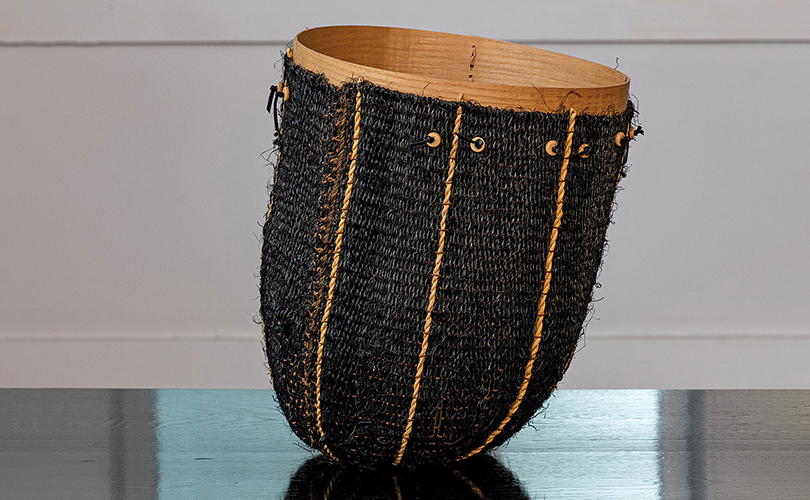
41mh #165r, Marion Hildebrandt, black sisal twine, brown waxed linen warp, hand twined rush, ash strip, wood rounds with leather ties, 9.5″ x 8″ x 8″, 2000. Photo by Tom Grotta

Marion Hildebrandt studied at the University of California, where she received degrees in the decorative arts and home economics. The artist lived and worked in Napa Valley, California, where she collected the plants — grasses, branches, pine needles, and bark — that she used to make her baskets. She employed the same materials that Native Americans used when they inhabited the area. Like them, Hildebrandt appreciated the natural materials that surrounded her, utilizing her artistic vision to create artistic art forms into structural objects like #r165.


Dispatches: Paris

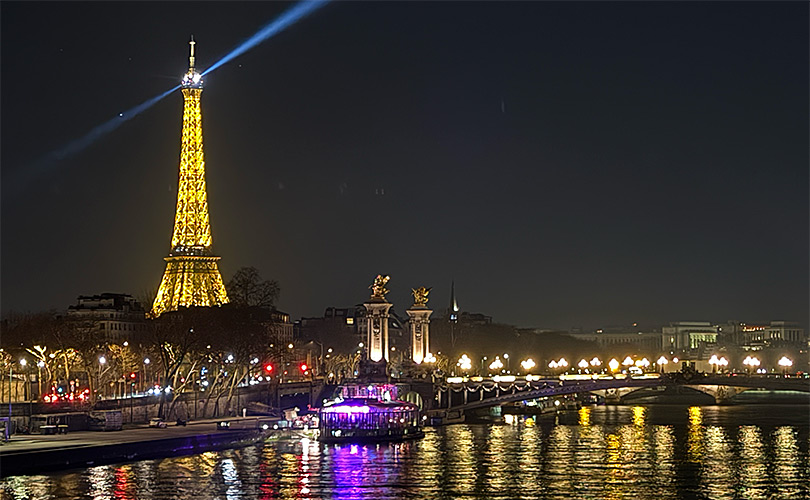
Paris at night. Photo by Tom Grotta

Tom and Carter Grotta and I (Rhonda Brown) had the opportunity to travel to Paris last week for art-related activities. We were on a mission — we wanted to restart our project photographing artists in their studios. We had traveled to visit several artists in the US, and several more in Great Britain, Scotland, Belgium, and the Netherlands when the project was derailed by the pandemic. 

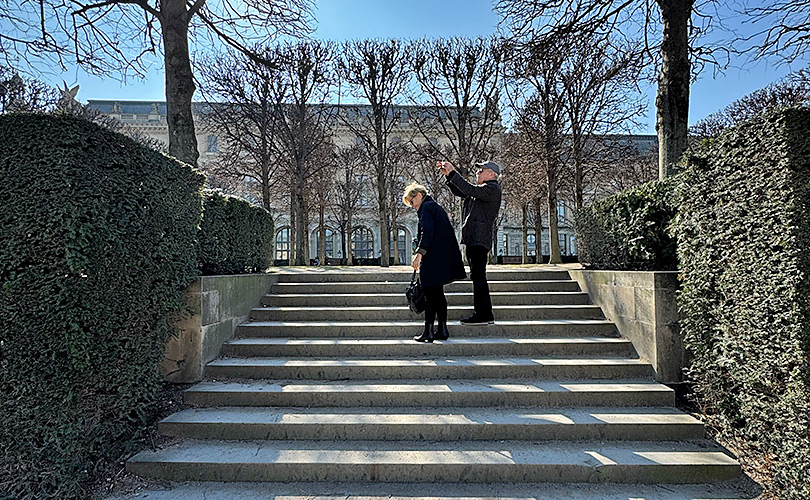
Rhonda defers to art creation at the Tuileries. Photo by Carter Grotta

This year, we thought we’d start slow — we’d meet Florence and Paul Bernard, Simone Pheulpin’s remarkable gallery representatives in Paris, visit Simone in her studio just outside the city, take in the Olga d’Amaral exhibition at the Cartier Foundation before it closes on March 16th, and experience the endless visual and epicurean delights of the city.

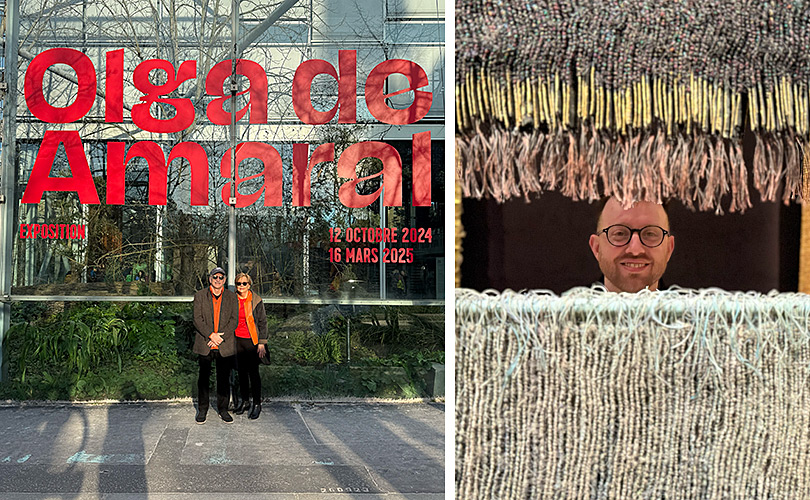
Visiting Olga de Amaral at the Cartier Foundation. Photos by Carter and Tom Grotta.

The Olga de Amaral exhibition was as glorious as advertised.

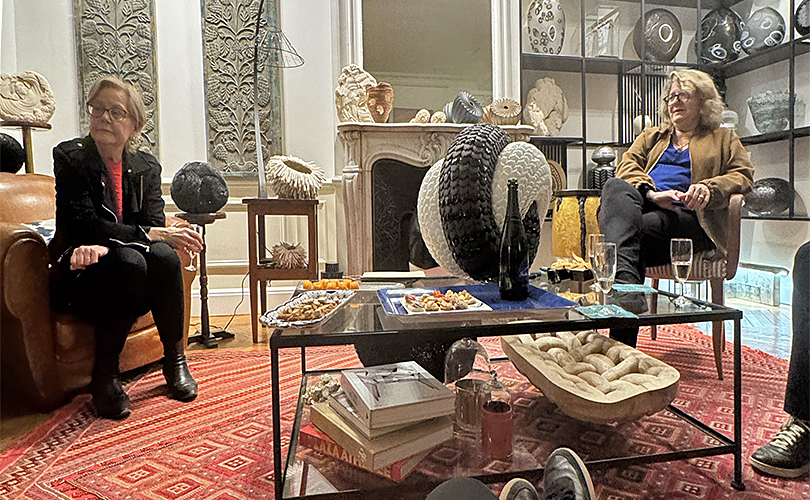
Visiting the Maison Parisienne annex; meeting Florence and Paul Bernard. Photo by Carter Grotta.

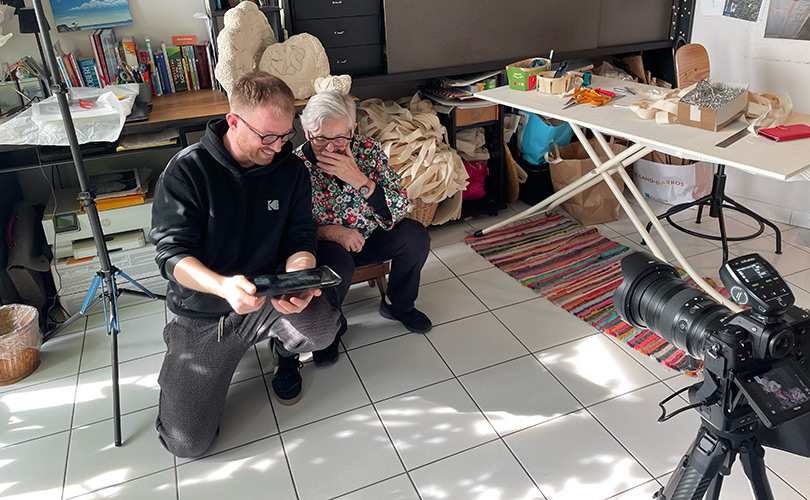
We were graciously feted by Florence and Paul Bernard at the annex of Maison Parisienne, Simone Pheulpin’s Paris gallery and at a memorable dinner with Florence, Paul, Simone and François Bernard, and at Simone’s home/studio the next day. 

Carter Grotta and Simone Pheulpin at our photo shoot. Photo by Rhonda Brown.

In between, we enjoyed traveling again and the charms of Paris. 

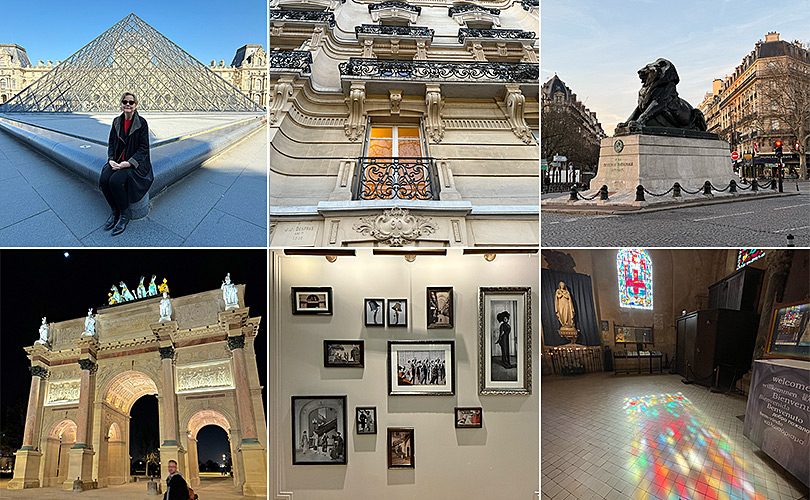
We took in the sites — the Louvre, Montmarte, Marais, Musée des Decoratifs, the Seine, and the delights of endless exceptional architecture and design at every turn

The Pyramid at the Louvre, outside the Maison Parisienne annex in the 17th arrondissement, Lion de Belfort by Auguste Bartholdi (sculptor of the Statue of Liberty; Arc du Triomphe du Carrousel, salon wall at Le Clef Louvre Hotel, Saint Pierre de Montmartre. Photos by Tom Grotta and Rhonda Brown.

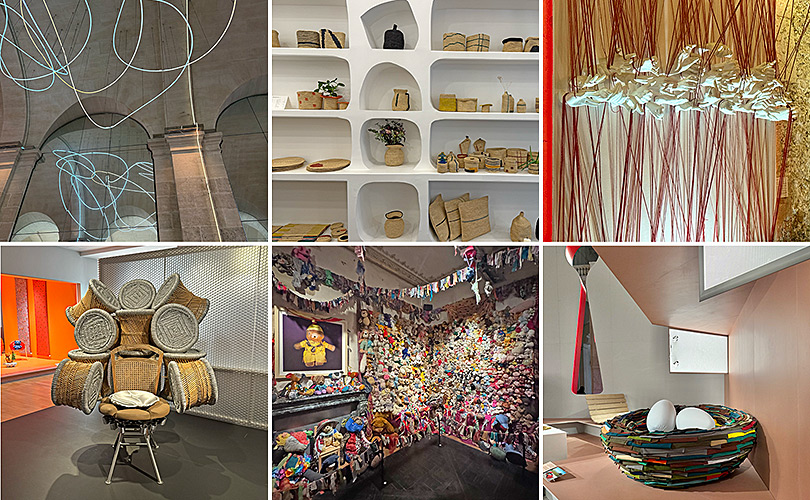
As we do on all trios, we looked for fiber art and fiber-related and fiber-inspired items. 

Loopy lights in the Louvre; baskets from Madagascar; great sculpture in a taco restaurant; three views from the Musée des Arts Décoratifs — a basket chair; an ode to Teddy Bears (Mon ours en pelouche) the “king of toys,” and a nest made of felt by Gianni Ruffi. Photos by Tom Grotta and Rhonda Brown

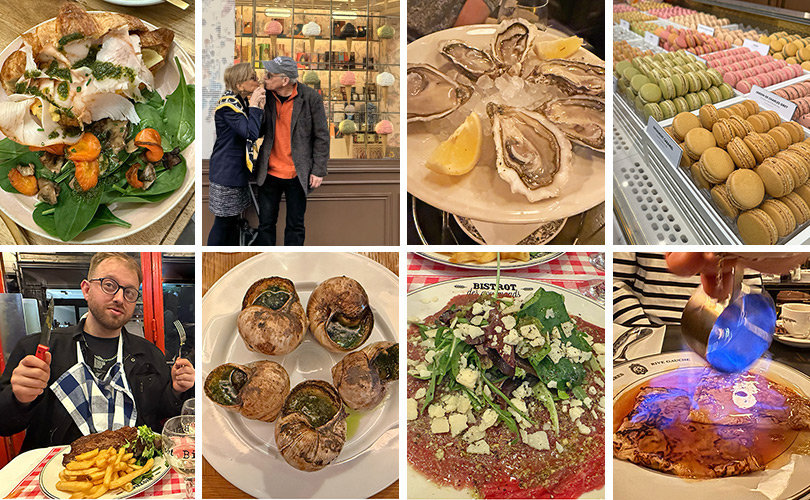
And we totally immersed ourselves in French cuisine.

We sampled endless epicurean delights of France, lemon soufflé, frogs’ legs, decroix, haricots vert salade, surprise sandwich, fried squid, Quiche Lorraine. Pictured: Crazy croissant with roasted mushrooms, carrots, eggs, pastrami, and fresh spinach; gelato topped with a macaron; oysters; more macarons; steak and frites; escargot; carpaccio; and crepes suzette. Photos by Tom and Carter Grotta.

Nous avons vécu aventure exceptionelle!


Linkages – can you make a match?

# 1 Lia Cook, Legs. #2 Federica Luzzi, White Shell

In January, the Metropolitan Museum of Art launched a new short-session game, Art Links, that invites players to identify common threads and intriguing connections between works of art from The Met collection. 

# 3 Gertrud Hals, Terra 8. #4 Wlodzimierz Cygan, Trap IV 

We thought we would give arttexstyle readers a chance to make material Links between works from artists who work with browngrotta arts.

Materials to match: A) IRON – B) WOOL – C) STEEL – D) LINEN – E) COTTON – F) PAPER – G) LIGHTH) SILK

# 5 Adela Akers, Rain and Smoke. #6 Mariette Rousseau-Vermette, Elegante

# 7 Mary Merkel-Hess, Dark Woods. #8 Axel Russmeyer, Bits

There are 16 images in this post — 8 pairs. Based on the major materials utilized, match two art works to create a pair based the material they share. Note — We’ve cheated a bit on the names in some cases to preserve the mystery.

# 9 Simone Pheulpin, Megalith IV and VI . #10 Agneta Hobin, En Face

There are artworks by fourteen artists for you to match.

#11 Birgit Birkkjaer, Folded Baskets. #12 Glen Kaufman, Odd Man In

Here are the final two.

# 13 Hideho Tanaka, Vanishing II. #14 Kiyomi Iwata, Red Aperture

#15 Mary Giles, Fog Break. #16 Jeannet Leenderste, Amber Pleats

Here is the LINKS Key:
IRON:   3 and 15 
STEEL:  10 and 13
SILK: 14 and 16
WOOL:  8 and 12 
LINEN:  5 and 11 
COTTON:  1 and 9 
PAPER:  2 and 7 
LIGHT:  4 and 6 

And the Winner Is … Loewe Celebrates Art and Artisans

Polly Adams Sutton Loewe
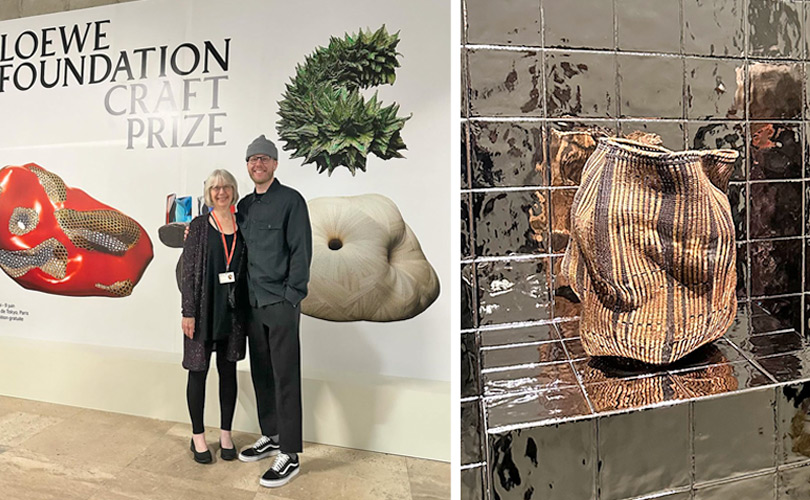
Ebb Tide in Loewe exhibition in Paris, France. Photo by Polly Adams Sutton. 

Too often we hear about corporations that are using creators’ works — art and music — without permission (https://www.artsy.net/article/artsy-editorial-graffiti-artists-fighting-brands-steal-work). Many raise concerns about AI borrowing and boosting artwork without attribution or compensation (https://www.newyorker.com/culture/infinite-scroll/is-ai-art-stealing-from-artists). So it’s gratifying to learn about the efforts of Loewe, a corporation that celebrates and collaborates with artists rather than cannibalizing their work. 

Loewe is a luxury fashion house founded in 1846 by a group of Spanish leather craftsmen. Loewe’s efforts to support the arts are severalfold — it organizes exhibitions, promotes a prestigious international art competition, and creates artist-inspired capsule collections. It created a foundation in 1988, which supports international prizes for craft and poetry, collaborates with major arts festivals, and also supports other art, photography, and dance. The Foundation sponsors the Loewe Foundation Craft Prize, an international award celebrating exceptional craftsmanship. Through the Prize, the Foundation aims to discover uniquely talented artisans with the vision and innovative drive to set new standards for the future of craft. The Prize ecognizes those who combine tradition, modernity, and a unique artistic concept. Like browngrotta arts aims to do, the Loewe Prize elevates artists who contribute continuously to contemporary culture through a contemporary reinterpretation of tradition. 

Jiro Yonezawa, leather basket
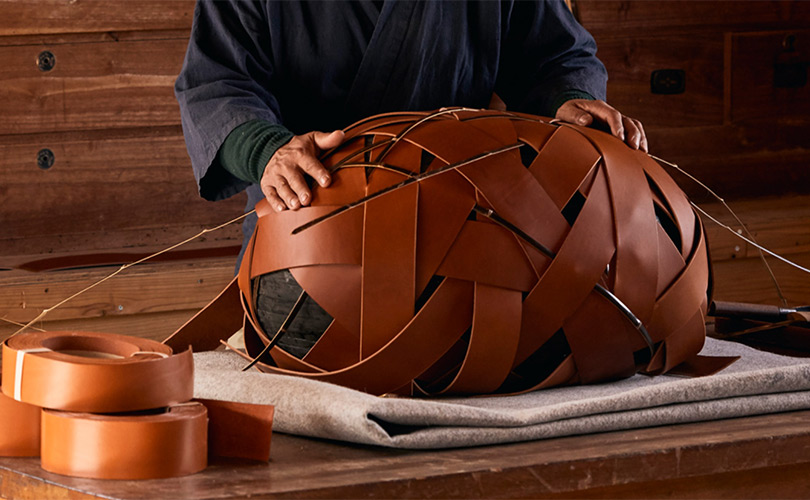
Jiro Yonezawa crafting LOEWE leather into unique pieces at milan design week 2019. Photo courtesy of Loewe.

In 2019, for example, as part of Milan Design Week, Loewe installed an exhibition that placed a spotlight on basketmaking, divided into two installments — inspiration and collection. As part of that project, Loewe’s creative director, Jonathan Anderson, invited Japanese artist Jiro Yonezawa to creaft one off pieces in which he swapped the strips of bamboo, with which he usually works, for naturally dyed Loewe leather.

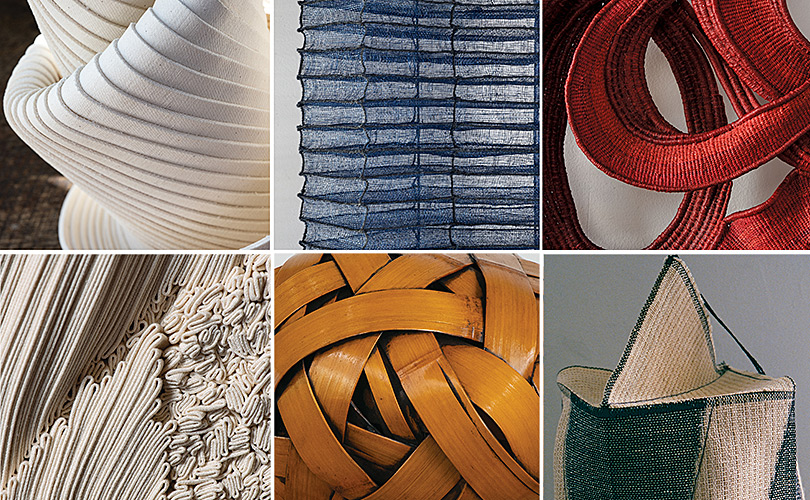
Mercedes Vicente, Yeonsoon Chang, Gerne Jacobs, Simone Pheulpin, Jiro Yonezawa, Kay Sekimachi
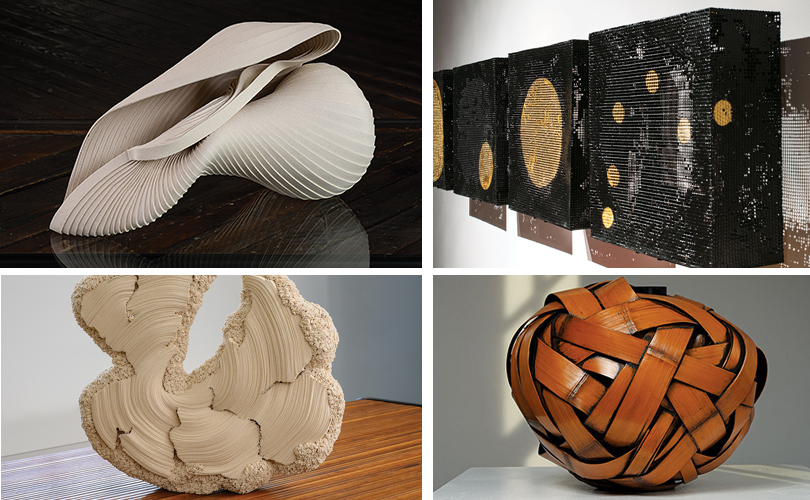
clockwise details of works by: Mercedes Vicente, Yeonsoon Chang, Ferne Jacobs, Simone Pheulpin, Jiro Yonezawa, Kay Sekimachi. Photos by Tom Grotta

Several of the artists that work with browngrotta arts have made the Loewe Foundation Craft Prize short list, including Mercedes VicenteYeonsoon Chang, Ferne Jacobs, and Simone Pheulpin, who was awarded the Honor Prize in 2018. Finalists are brought to Europe for the award presentation. For Polly Adams Sutton, who made the short list in 2024, that meant a trip to Paris to see her work installed. “What an amazing privilege it was!” she says of the competition. “By providing a means for craft artists of all mediums to be recognized as Art, Loewe elevates the crafts as legitimate forms of art. Loewe creations may use craft as inspiration for their work but the craft prize has been created solely for the artists to be honored and to give craft its place in the art world.”

Kay Sekimachi Loewe bags
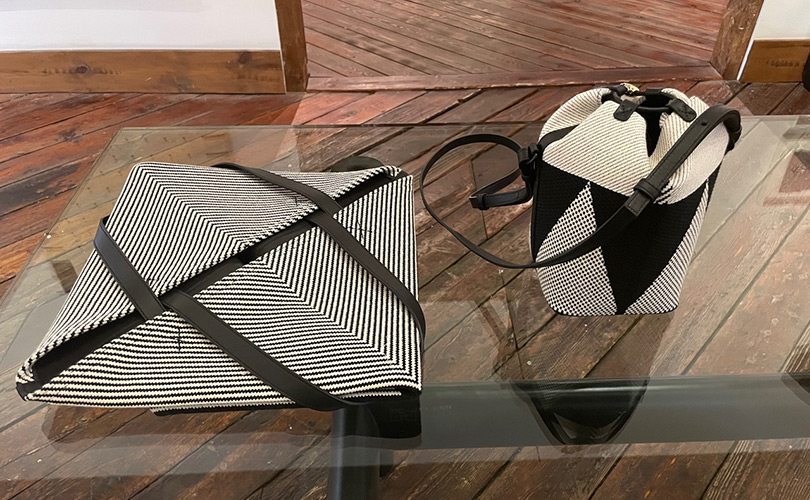
Loewe bags inspired by Kay Sekimachi’s work. Photo by Tom Grotta

Loewe also works with artists to create specially curated collections, inspired by the artists’ work. This year, Loewe partnered with Kay Sekimachi to create a limited-edition collection of handbags that showcase her pioneering work in loom weaving and draw upon Sekimachi’s 1999 “Takarabako” series. The Puzzle Fold Tote and Bucket Bag are crafted in cotton jacquard with a calfskin base and details, and feature a gold embossed motif with Sekimachi’s name. The project was licensed by Artists Rights Society.

Kudos to the artists honored and to Loewe and its commitment to craft.


Congratulations: The Loewe Foundation Craft Prize Short List!

Congratulations to Polly Adams Sutton and Ferne Jacobs who have been sort listed for the 2024 Loewe Craft Prize!

Polly Sutton basket and Ferne Jacobs Fiber Sculpture
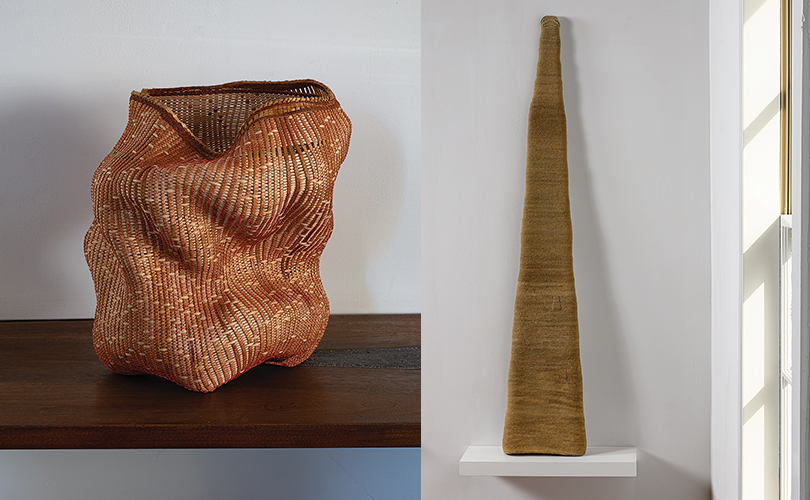
14ps Berry, Polly Sutton, cedar bark, ash, wire, yellow cedar outer bark, 13″ x 12″ x 12″, 2022
7fj Shadow Figure, Ferne Jacobs, coiled and twined linen thread, 61″ x 11″ x 3″, 1980s. Photos by Tom Grotta

Loewe was founded in 1846 as a collective of artisans dedicated to leather making. Some of their leather artisans have been with Loewe for as many as 50 years. The Loewe School of Leather Craft in Madrid ensures these time-honored skills are passed on to new generations.

The Loewe Foundation Craft Prize was launched 70 years later in 2016 to illuminate excellence, innovation, and artistic vision in contemporary craftsmanship. Finalists represent makers of all ages, cultures and disciplines, selected by experts reviewing submissions from over 100 countries. “Craft is the essence of Loewe,” the firm quotes its creative director, Jonathan Anderson. “It is where our modernity lies, and it will always be relevant.” 

The Loewe Prize acknowledges international artisans over 18, of any gender, who demonstrate an exceptional ability to create objects of superior aesthetic value. All entries should: 1) fall within an area of applied arts, such as ceramics, bookbinding, enamelwork, jewellery, lacquer, metal, furniture, leather, textiles, glass, paper, wood, etc; 2) be an original work, handmade or partly handmade; 3) have been created in the last five years; 4) be one-of a-kind; 5) have won no prizes previously; and 6) demonstrate artistic intent. A jury composed of 13 leading figures from the world of design, architecture, journalism, criticism and museum curatorship — including a curator from the Metropolitan Museum of Art in New York City and the Director of the Design Museum in London — will select the winner of the 2024 Craft Prize from the short list of 30 artists. The prize awarded to the winner is 50,000 Euros in cash. The announcement will be made in the Spring of 2024.

works by Mercedes Vicente, Yeonsoon Chang, Jiro Yonezawa and Simone Pheulpin
clockwise: works by Mercedes Vicente, Yeonsoon Chang, Jiro Yonezawa and Simone Pheulpin. Photos by Tom Grotta

The Loewe Prize short list in other years has recognized many interesting artists including Joe Hogan of Ireland and Tanya Aguiñiga of the US.  Besides Sutton and Jacobs, other artists that browngrotta arts works with have been recognized through these competitions.  Mercedes Vicente of Spain and Yeonsoon Chang of Korea have both appeared on the short list in previous years. Simone Pheulpin of France was short listed and received a Special Mention award. Her work was displayed in the Design Museum in the UK. And Jiro Yonezawa of Japan has been involved in a Loewe creative initiative in which he created works of leather, adapting some of the techniques he uses to create bamboo sculptures.

Good Luck to Polly and Ferne!


Save the Date! Spring Art in the Barn at bga April 29 – May 7, 2023

29ddm Mourning Station #4, Dominic Di Mare, hawthorn, handmade paper, silk, bone, bird’s egg, feathers, gold and wood beads, 13″ x 7″ x 7″, 1981. Photo by Tom Grotta

For Spring 2023, browngrotta arts is pleased to announce a wide-ranging exhibition of work by noted artists from around the world. Acclaim! Work by Award-Winning International Artists (April 29 – May 7) will highlight mixed media, fiber sculpture and contemporary textile artists artists creating and advancing the field of fiber arts now and throughout the last six decades, including Sheila Hicks, Dominic Di Mare, Kay Sekimachi, Jiro Yonezawa, Carolina Yrarrázaval and Ed Rossbach.

5pco Microgauze 84, Peter Collingwood, Warp: Black and natural linen; Weft: natural linen, 72″ x 8.375″ x .125″, 1970. Photo by Tom Grotta

Awards by the dozen
The nearly 50 artists in Acclaim! Work by Award-Winning International Artists, have each achieved formal art acknowledgement in the form of an award or medal or selective membership. In the US, that may mean the award of a Gold Medal from the American Craft Council — 10 of the artists in Acclaim! belong to that group. In Canada, it means membership in the Royal Canadian Academy of the Arts, which three of our artists have achieved. The late masterweaver Peter Collingwood received an OBE, Order of the British Empire. Yeonsoon Chang of Korea was selected Artist of the Year by the Contemporary Art Museum in Seoul. In France, Simone Pheulpin was awarded the Grand Prix de la Création de la Ville de Paris. Grethe Sørensen of Denmark and Agneta Hobin of Finland received the Nordic Award in Textiles. Sheila Hicks of the US,  was awarded the French Legion of Honor and a Lifetime Achievement Award from the International Sculpture Center; Helena Hernmarck received the American Institute of Architects, Craftsmanship Medal and the Prins Eugen Medal conferred by the King of Sweden for “outstanding artistic achievement.”

26yc The Path which leads to the center II, Yeonsoon, Chang, teflon mesh, pure gold leaf, eco resin, 25″ x 50″ x 6″, 2022. Photo by Tom Grotta

Results of recognition
Receiving an award can provide important affirmation for an artist. “There are no other large prizes in the UK for artists working in this medium,” says Jo Barker, winner of the Cordis Prize. “So what winning mostly felt like to me was a real validation of the career that I’ve had so far.” Such recognition can influence the direction of an artist’s work. Lia Cook’s Gold Medal from the American Craft Council provided her support for her process — particularly, she says, for “my continued interest in following the unexpected.” Once selected as Artist of the Year by the National Museum of Contemporary Art in Seoul, Korea, Yeonsoon Chang saw her textile work in the broader scope of contemporary art. “Objective recognition gave me courage to work and a sense of responsibility,” she says. For Chang, the award also meant expanded interest in her work from museums, galleries, and collectors. Winning Best Visual Arts Exhibition of the Year from the Circle of Critics of Art in Chile was a recognition of 40 years of work  for Carolina Yrarrázaval  and a confirmation for all those who believed in her work, clients, galleries and museums. More importantly, Yrarrázaval says, it was the first time that textile art received this award in Chile, placing it on par with all disciplines in visual arts. “It was not only a recognition of my personal contribution,” she says, “but also to this discipline, which for a long time was seen as a minor art.”

25cy Deseos Ocultos, Carolina Yrarrazaval, jute, linen, paper and raffia, 60.5″ x 30.5″ x 1″, 2023. Photo by Tom Grotta

Art undeterred
After some years of being overlooked and undervalued, contemporary textile art has finally been embraced (again) in the last several years by a wider world of museums and galleries. The current focus on artists working in fiber finds complex, thoughtful and accomplished work – some produced today and some in years when gallery and museum attention was slight. “What may appear to be an explosion of textile producers, from a historical perspective, is an explosion of interest and awareness of a tradition that has always been important, deep and rich,” Adam Levine, director of the Toledo Museum of Art told Art News last year. (Katya Kazakina, The Art Detective: Textile Artists Are Back in the Public Spotlight in Museums and Galleries. Art Collectors? They’re Still Catching Up, February 4, 2022). in other words, even when out of popular favor, fiber artists were undeterred, continuing to create exceptional work.

A through line — then and now
The work in Acclaim! creates a through line from the movement’s early days to its current creative explosion, highlighting the importance of persistence and the benefits of recognition along the way. Fiber art’s revival in museums, galleries and with collectors is built upon the dedication and extraordinary talent of artists like those featured in Acclaim!

Join us next month
browngrotta arts
276 Ridgefield Road Wilton, CT 06897

Artist Reception and Opening: April 29, from 11am to 6 pm

Remaining Days
Sunday, April 30th: 11AM to 6 PM (40 visitors/ hour)

Monday, May 1st – Saturday, May 6th: 10AM to 5PM (40 visitors/ hour)
Sunday, May 7th: 11AM to 6PM [Final Day] (40 visitors/ hour)

Safety protocols 
Eventbrite reservations strongly encouraged • No narrow heels please (barn floors)

Reserve a spot here: RESERVE


Art for a Cause to Benefit World Affairs Forum this Saturday, October 15th, 4 pm to 7 pm

3jh Wings, Jan Hladik, wool, 1973; 4jh Der Rote Gobelin, Jan Hladik, wool, 1966. Photo by Tom Grotta

Join browngrotta arts for a private Tour and Reception in Saturday, October 15th from 4 pm to 7 pm to benefit World Affairs Forum. The event will be our Fall 2022 Art for a Cause.

The Details
At 4PM, Tom Grotta will host a Private Tour of the exhibition Allies For Art: Work from NATO-related Countries. From 5 to 7PM, there will be brief Remarks by speakers from WAF and browngrotta arts will host a Reception, with exhibition-themed canapés and a curated cocktail where guests can socialize, view and learn more about the exhibition’s works of art.

The Speakers

Two experts on art and culture will speak briefly about making and protecting art in conflict zones. Cindy Maguire, PhD is a researcher and professor, and co-author of the book “Arts and Culture in Global Development Practice,” also with Ann Holt, PhD. Rob McCallum, PhD is both a practicing artist who has exhibited his work at numerous international solo and group shows, as well as a global educator with a PhD in Art Education. 

left to right:
82mk, Markku Kosonen, Curly Birch 5.2,  2001; 69mk, Markku Kosonen, Object No. II, birch, metal, 2000, 17ak Anda Klančič, Human Presence, 2019; 40sp Simone Pheulpin, Ondes, 2016. Photo by Tom Grotta. 

Register Here to attend.


The Cause/World Affairs Forum
In addition to 100% of the proceeds from public ticket sales, 10% of the proceeds from all sales of art, books, or catalogs at this Art for a Cause event will be donated to World Affairs Forum, an independent, nonpartisan organization dedicated to engaging the public and leading voices to better understand the world. Since 1946, World Affairs Forum in Stamford, CT has been providing top-level and thought-provoking presentations, debates, and discussions of foreign policy and global affairs featuring world leaders, economists, diplomats, scholars, business luminaries, corporate change-makers, authors, journalists, and Nobel laureates. Its mission is to create conversations in our community about global affairs, foreign policy, and America’s role in the world.

19sj Carapace, Stéphanie Jacques, wood, wool 46” x 12” x 6.5”, 2010-2011. Photo by Tom Grotta

The Exhibition:
Allies for Art: Work from NATO-related countries (October 8 – 16) features over 130 pieces from nearly 50 artists, and will highlight work from 21 countries in Eastern and Western Europe made from the 1960s to the present. The diverse fiber works and sculpture in the exhibition were created by artists who fled repressive regimes, who have worked under and around government restrictions and who have been influenced by current conditions. 

Signing Up
Public registration for the general reception, from 5pm to 7pm, is $25. Public registration for the 4pm private tour + general reception from 5pm to 7pm is $50.
Click to register: Art for a Cause.


Note:
We will be closing registration when the gallery venue reaches capacity, so please register as soon as possible to secure your tickets.

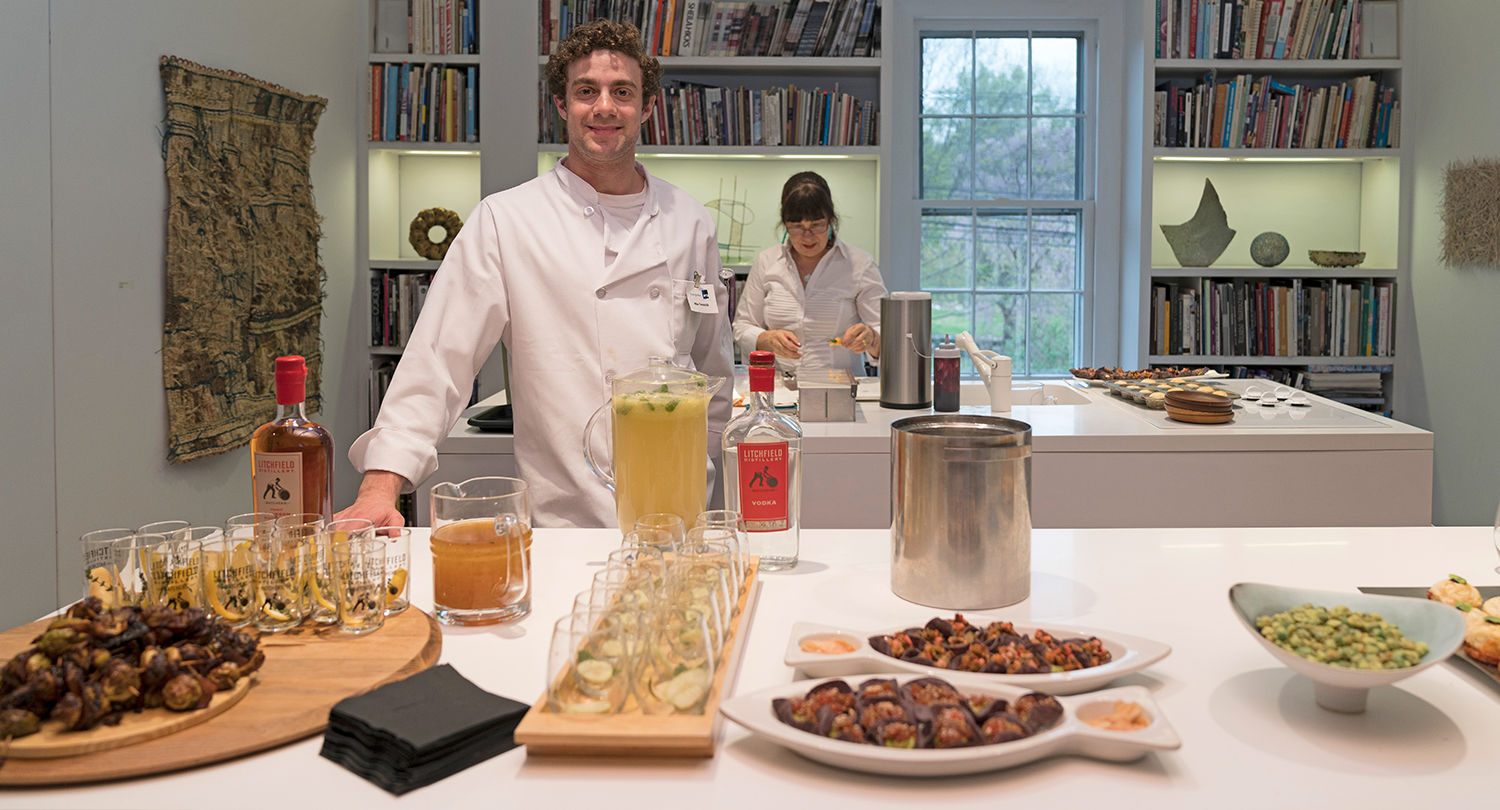
Our Art for a Cause mixologist and master chef, Max Fanwick and expert assistant Suzanne.

Address:
276 Ridgefield Road Wilton, CT 06897

Safety protocols:
Eventbrite reservations strongly encouraged • We will follow current state and federal guidelines surrounding COVID-19 • As of October 1, 2022, masks are not required • No narrow heels please (barn floors.)


Acquisition News – Part II, Abroad

More on museum acquisitions of works by artists from browngrotta arts in the last two years. We have 18 works to report on that have been acquired by institutions outside the US — from Norway to Lithuania to Italy to Japan and places in between.

Heidrun Schimmel
One of two works that comprise Hanging by a thread IV, handstitched by Heidrun Schimmel, 1986-1987, acquired in 2021 by the Diocesan Museum in Bamberg, Germany. Photo by: Monika Meinhart.

Heidrun Schimmel

Seven works by Heidrun Schimmel have been acquired since 2020. Two by the Staatliche Kunstsammlungen in Dresden, two by Museum of Applied Art, Frankfurt and three by the Diocesan Musuem in Bamberg.

Kyoko Kumai
Furious Anger by Kyoko Kumai acquired by the Janina Monkute-Marks Art Museum in Kedainai, Lithuania. Photo by Takashi Hatakeyama

Kyoko Kumai

One work by Kyoko Kumai was acquired by the Angers Museums in Angers, France (Jean-Lurçat and the Museum of Contemporary Tapestry) and another by the Janina Monkute-Marks Art Museum in Kedainai, Lithuania.

Carolina Yrarrázaval
Medioevo, jute and linen, Carolina Yrarrázaval. One of two tapestries acquired by the National Museum of Contemporary Art in Kyoto. Photo by Patricia Novoa.

Carolina Yrarrázaval

Two tapestries were selected on May of this year at Yrarrázaval’s exhibition in Kyoto by the National Museum of Contemporary Art in Kyoto.

Åse Ljones

Åse Ljones

Åse Ljones‘ work, Atterskin, was purchased by Nordenfjeldske Art and Craft Museum in Trondheim , Norway in 2020 and Mylder was purchased The National Museum of Art, Architecture and Design in Oslo, March 2021. 

Federica Luzzi
Federica Luzzi’s work acquired by the Museum of Contemporary Art, Salerno, Italy. Photo by Federica Luzzi.

Federica Luzzi

An encased textile, Shell-Omaggio a Costanino Dardi, by Federica Luzzi was acquired by the Museum of Contemporary Art, Salerno, Italy for a collection curated by Fondazione Filiberto e Bianca Menna – Centro Studi D’Arte Contemporanea.

The textile object is suspended and anchored with nylon thread in a plexiglass box. Like a seed, with an aerodynamic shape that is structured for long movements and transport, it is closed in a box that prevents its natural and complete movement, it is trapped in it. “This work was done just before the outbreak of the pandemic,” Luzzi says. “So without knowing what would happen, but continuing my research on envelopes, I visualized even better the containment condition of a body.”

Simone Pheulpin
Eclosion Epingles by Simone Pheulpin, photo courtesy of Galerie Maison Parisienne.

Simone Pheulpin

Two artworks by Simone Pheulpin have been acquired by the Musée des Arts Décoratifs i(MAD) inn Paris in December 2019: Jéromine, Série Eclipse (2019); Eclosion Epingles (2019). Another, Détail VII (2021), will be acquired by the same museum in 2021. The acquisitions were organized by the Galerie Maison Parisienne in Paris.

Wlodzimierz Cygan
Organic by Wlodzimierz Cygan, acquired by TAMAT in Brussels, Belgium. Photo by This Way Design.

Wlodzimierz Cygan

In 2021, Organic (2018) by Wlodzimierz Cygan was acquired by the Musée de la Tapisserie et des Arts Textiles de la Fédération Wallonie-Bruxelles (TAMAT) in Tournai, Belgium.


Wishing You the Magic of the Season and an Artful New Year!

Megalith IV & V, Simone Pheulpin, 2001 photo by Tom Grotta


Art Acquisitions: Part 2

A few weeks ago we published the first installment of our Art Acquisition series. Just as the first one did, the second installment reviews pieces browngrotta arts artists have had acquired by major institutions over the last year.

Studium Faktur, Magdalena Abakanowicz, sisal, 54" x 43" x 9", 1964. Photo by Tom Grotta.

Studium Faktur,
Magdalena Abakanowicz, sisal, 54″ x 43″ x 9″, 1964. Photo by Tom Grotta.

Norma MinkowitzMuseum of Texas Tech University and Boston Museum of Fine Arts , Massachusetts

Norma Minkowitz has had several pieces go to major institutions in the last year. Minkowitz’  piece Journey was acquired by the Museum of Texas Tech University, which is located in Lubbock, Texas. Minkowitz’ piece The Gamble,  which was part of the Daphne Farago Collection, has moved to the Boston Museum of Fine Arts.

Magdalena Abakanowicz – Boston Museum of Fine Arts and Minneapolis Institute of Arts, Minnesota

Magdalena AbakanowiczStudium Faktur was acquired, through browngrotta arts, by the Boston Museum of Fine Arts. Studium Faktur, which was one of Abakanowicz’ earlier works (made in the 1960s), was originally part of weaver Mariette Rousseau-Vermette’s collection. Additionally, Abakanowicz’ piece Montana del Fuego was acquired, also through browngrotta arts, by the Minneapolis Institute of Art. Montana del Fuego is a strong example of how Abakanowicz was able to fuse weaving and sculpture to create a spectacular three-dimensional wall hanging. The work was part of the Anne and Jacques Baruch Foundation Collection.

Simone Pheulpin at The Design Museum in London. Photo: Maison Parisienne

Simone Pheulpin at The Design Museum in London. Photo: Maison Parisienne


Maria Laszkiewicz – Minneapolis Institute of Art, Minnesota

Maria Laszkiewicz’s Mask, also a part of the Baruch collection, was acquired, through browngrotta arts, by the Minneapolis Institute of Art.  Laszkiewicz, born in 1898, encouraged a generation of textile artists (such as Abaknaowicz), and was an innovator in the tapestry field.

Simone Pheulpin – V&A, London and Chicago Art Institute, Illinois 

Morphus vii, Gizella K Warburton. Photo: Chris Large

Morphus vii, Gizella K Warburton. Photo: Chris Large

The Victoria & Albert Museum in London recently acquired a piece from Simone Pheulpin’s Eclipse series. One of the textile sculptor’s works was also acquired by the Chicago Art Institute.

Jiro Yonezawa – Musée du Quai Branly-Jacques Chirac, Paris

The most recent acquisition is a piece by Jiro Yonezawa by the Musée du Quai Branly-Jacques Chirac, Paris, France. The museum has commissioned a piece for an exhibition of Japanese bamboo art that opens in November of this year (November 27 – April 9).

Gizella K Warburton – Fitzwilliam Museum, Cambridge, England

The Fitzwilliam Museum acquired Gizella Warburton’s piece Morphus vii. The wrapped and sculpted vessel forms in Warburton’s ‘Morphus’ series are “quietly resonant of internal and external skins, of scarred and fissured surfaces, of abrasions, bindings and sutures.”

Jennifer Falck LinssenTexas Tech University in Lubbock Texas

The Museum of Texas Tech University has also acquired a wall sculpture by Jennifer Falck Linssen. The sculpture, titled Acumen, was acquired for a new building underway at the university.