Category: Tapestry

Color Stories

584mr Carter’s Color Lesson, Mariette Rousseau-Vermette, wool and silk, 7′ x 2′ and 7′ x 4′ x 3″, 1993. Photo by Tom Grotta

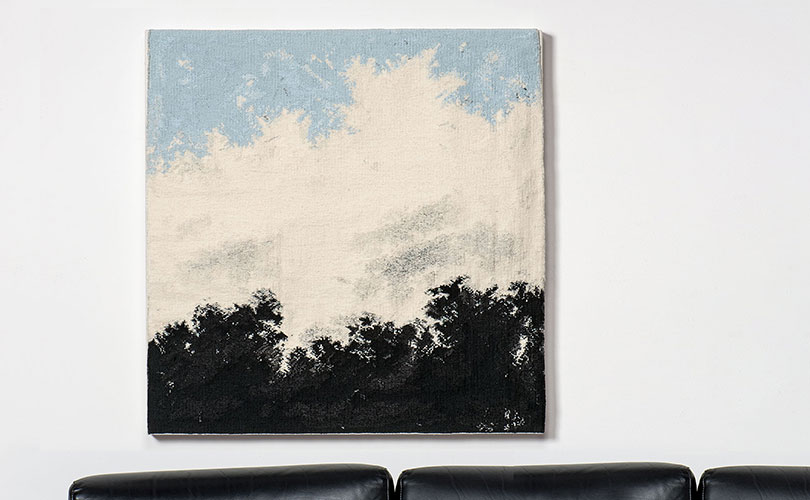
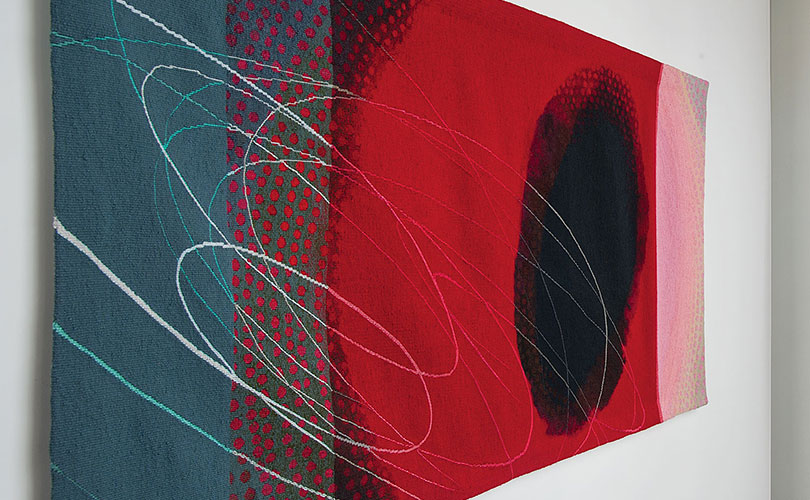
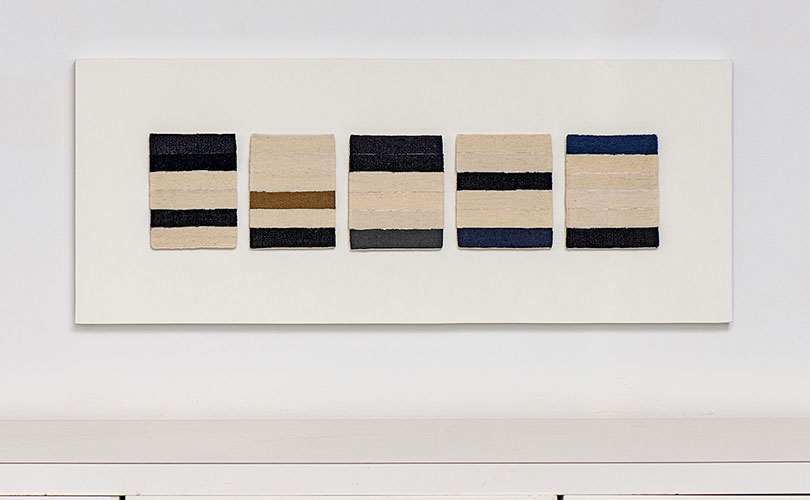
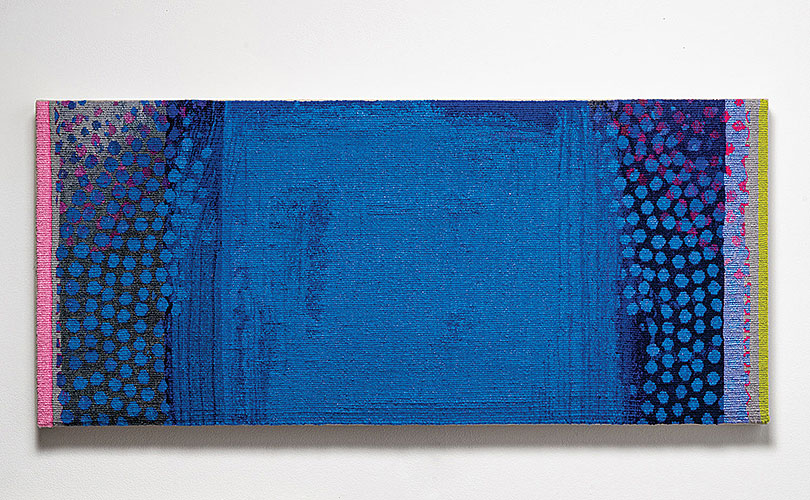
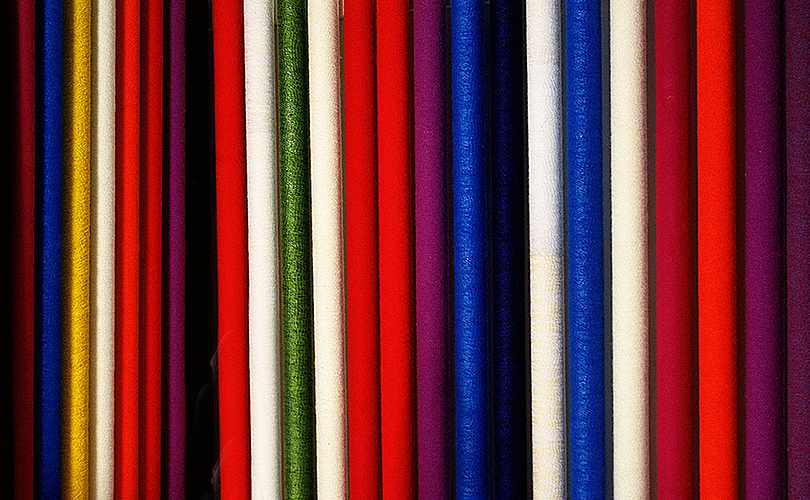
Color is a constant in art, while its potential for new and unique applications is limitless. Artists at browngrotta arts have taken the challenge to heart — finding inspiration in the teachings of Josef Albers, the art of Color Fields painter Mark Rothko, and systems of their own design.
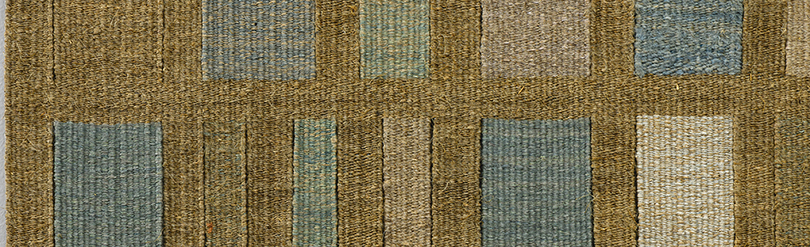
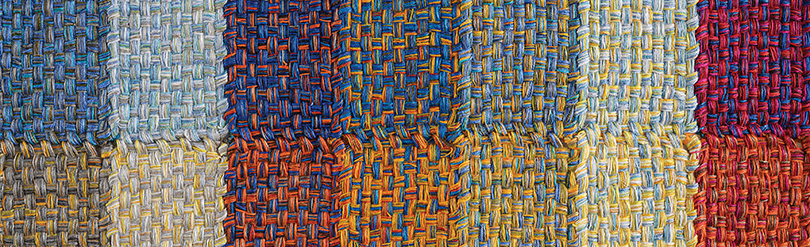
Detail: 37sl Dictionary – Light Indigo, Sue Lawty indigo-dyed, natural hemp, linen, 21.5 x 13, 2026. Photo by Tom Grotta
Detail: 1mkes Rhythm of Colors, Merja Keskinen, 80% linen, 20% cotton, 56″ x 62″, 2022. Photo by Tom Grotta
Detail: 22jbas The Yarns I Have Carried # 2, James Bassler, four selvaged weaving: left over warp and weft yarns from the past 65 years, including handspun and manufactured material, natural and synthetic dyed wool, silk, linen, cotton and ramie, 30″ x 31″ x 2.5″, 2025. Photo by Tom Grotta

In Bauhaus artist and teacher Josef Albers’s universe, color seduced and beguiled (The Josef and Anni Albers Foundation: https://www.albersfoundation.org/alberses/teaching/interaction-of-color). “These characteristics made color the most fascinating of art’s formal elements. Albers’s passion for color prompted his decision to launch what was possibly the first full-blown course in color ever given anywhere, and certainly the first based exclusively on direct observation of color’s behavior. . . . Color behaved. Color was magic.”

At Black Mountain College in the 1930s he introduced a color course unique at the time, followed by courses at Yale University and the publication of Albers’s landmark Interaction of Color in 1963, which crowned 30 years of effort.  His exercises focused on color in specific contexts, showing that if you put color A next to color B, or these colors next to those, you could anticipate certain results. Moving from simple to complex, with many exercises exploring the ramifications of a previous one, the course awakened the students to the quirks and variables of color behavior. The course was not a fixed body of color wisdom, but rather an ongoing inquiry in which solutions were not conclusions, but steps on an endless path.
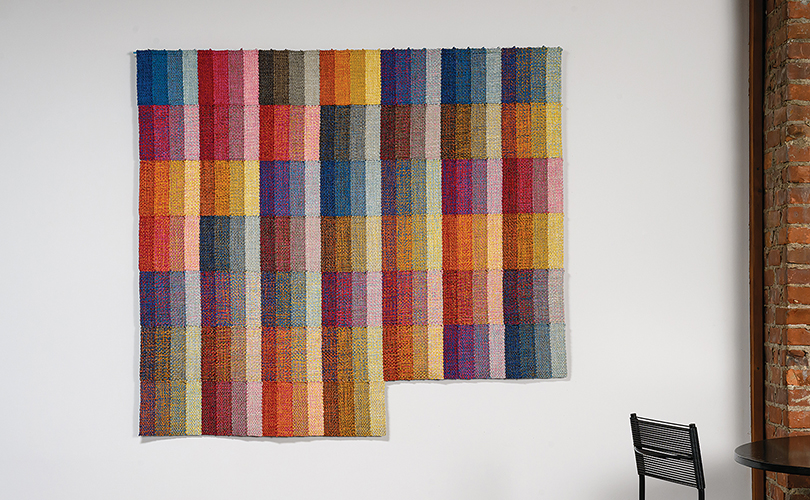
1mkes Rhythm of Colors, Merja Keskinen, 80% linen, 20% cotton, 56″ x 62″, 2022. Photo by Tom Grotta

Merja Keskinen engages in color experiments of her own navigating between following a system, as Albers did, and making room for discovery. Keskinen describes this generative uncertainty: “I work to see. The joy of discovery and the delight of experiencing colors are essential to me. The unpredictability and always-surprising color tones captivate me. I interpret life and the surrounding world with colors and explore the factors that influence color perception.” In works like, Rhythm of Colors, Keskinen works with a self-developed weaving technique, combining different-colored threads according to her preselected system, creating geometric square and rectangular shapes in various sizes whose surfaces produce a pixel-like optical blending — distinguishable as individual threads up close, but merging into wholly unexpected color combinations from a distance. Her work demonstrates that even the most rigorously systematic approach — mathematics applied to thread — contains inevitable surprise. The material collaborates, producing results the artist could not fully predict.
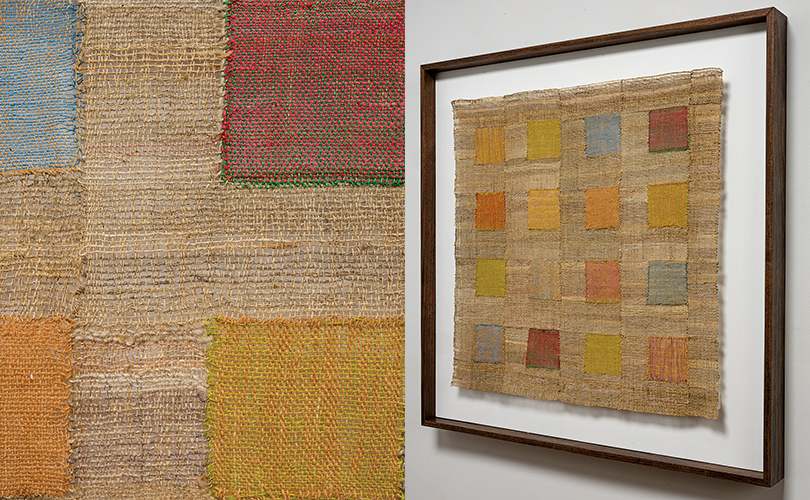
22jbas The Yarns I Have Carried # 2, James Bassler, four selvaged weaving: left over warp and weft yarns from the past 65 years, including handspun and manufactured material, natural and synthetic dyed wool, silk, linen, cotton and ramie, 30″ x 31″ x 2.5″, 2025. Photo by Tom Grotta

In his Threads I’ve Carried series James Bassler takes Albers’s Color Theory as a literal influence. The works reflect what the artist learned in his first “Color” class at UCLA in1953 once he realized that there was an “Art Department.” The head counselor at Santa Monica HighSchool had refused to allow him to take a Ceramics class because his GPA was too high. He pursued art, despite that first obstacle, and later Bassler would teach Josef Albers’s Color Theory at UCLA for some 25 years. This work is made of left-over warp and weft yarns from the past 65 years, including handspun and manufactured material, natural and synthetic dyed wool, silk, linen, cotton, and ramie. The result, is a four-selvaged weaving, a color study using complementary colors, In works from the series, Bassler explored a new bag of saved yarns, which presented new thoughts. “How bright or dark can I go before it upsets the whole idea,” he asks. “In this piece I pushed the subtle to almost disappear and the bright to almost overwhelm.”
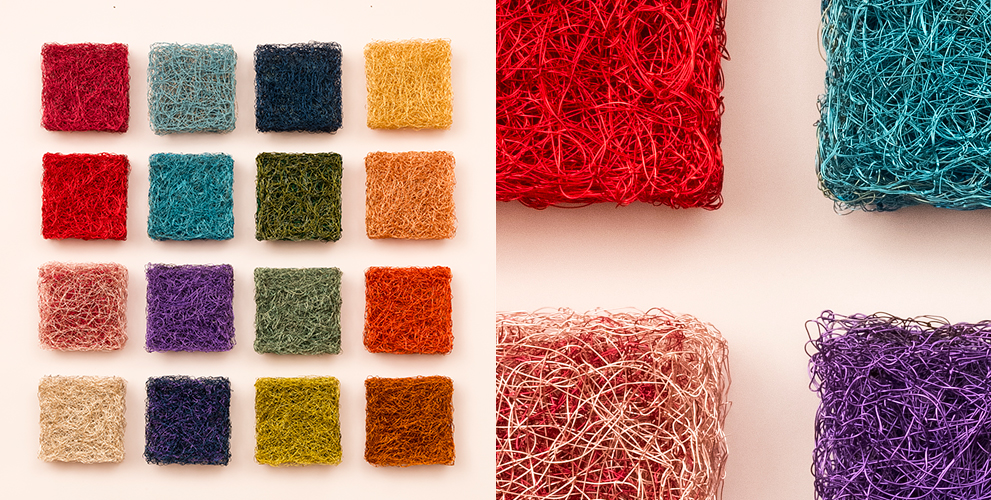
Chroma, Nancy Koenigsberg, coated copper wire 26 .5″ x 26.5″ x 2″, 2024. Photo courtesy of Nancy Koenigsberg

Nancy Koenigsberg’s Chroma is the artist’s version of a painter’s palette which took her more than six months. to complete. The sculptural artwork of coated, colored copper wire is comprised of four horizontal rows of small squares and four vertical rows, occupying an area 26 inches square. Each individual square is created by sewing and weaving coated copper wire and building layers of the color to a depth of 2.5 inches. The color combinations and contrasts challenge and engage the viewer both visually and conceptually.
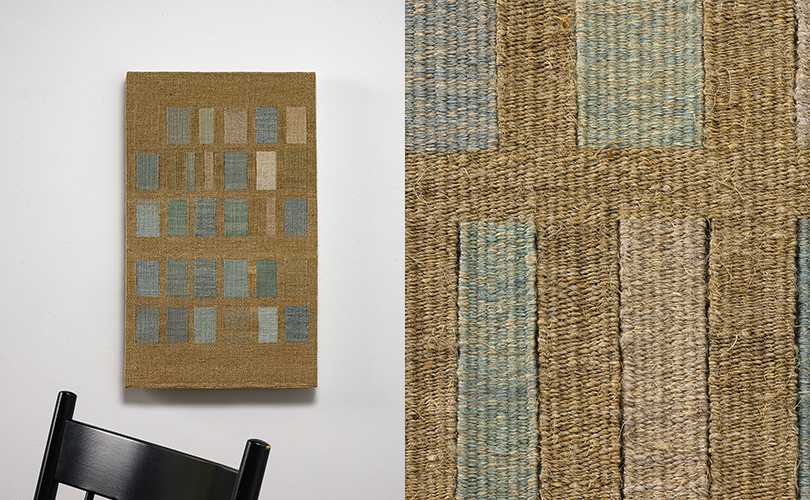
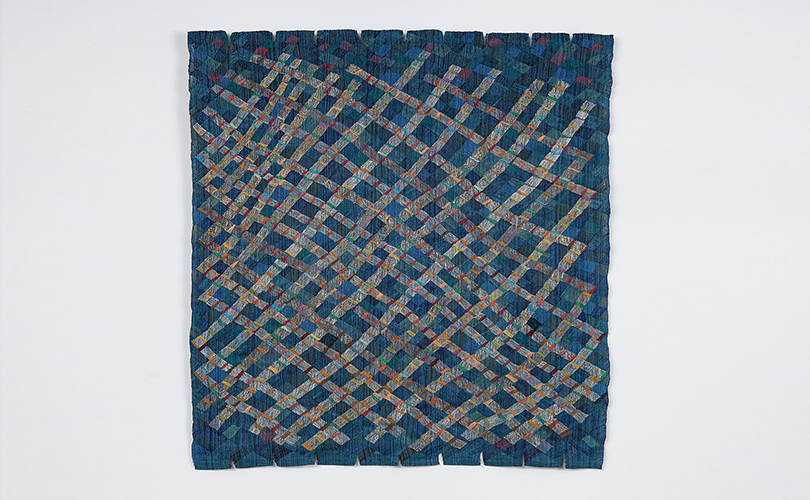
37sl Dictionary – Light Indigo, Sue Lawty indigo-dyed, natural hemp, linen, 21.5 x 13, 2026. Photo by Tom Grotta

In her Indigo Cloth series, Sue Lawty explores the innumerable variations of blue. In one series, Notes on Blue, Lawty commissioned a range of linen and hemp hreads to be hand dyed with indigo by Jeanette Orrell in Wales. Lawty purposely requested a range of unevenly dyed shades across the tonal spectrum and then worked intuitively,  reading the weaving line by line as it progressed. In Dictionary – Light Indigo Woven Tapestry, she explores more gradations of blue. Lawty pursues the inherent qualities of any material with which she works, seeking “an understated restraint, balance, tension, rhythm: an essential stillness.”  In Lawty’s practice, color feels less applied than absorbed — as though the fiber had always held it within. 
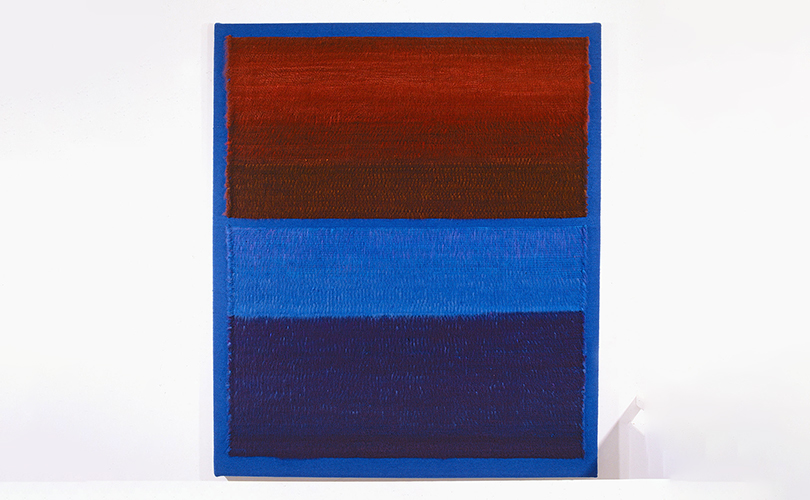
Mariette Rousseau Vermette wool tapestry
613mr Si Rothko Métait Conté, Mariette Rousseau-Vermette, wool, 94” x 80”, 1997. Photo by Tom Grotta

Experiments in color were the hallmark of members of the Color Fields movement of the 1950s and 60s.  Color Fields artists, among them Mark Rothko, created abstract paintings featuring large areas of solid color, flat surfaces, and a unified single-image field.  Rothko’s work with color was a potent influence for fiber artist Mariette Rousseau-Vermette. The Canadian artist saw an exhibition of the Rothko’s works in Italy in 1958. It was pivotal in inspiring her “to produce strictly artistic works in weaving,” Anne Newlands wrote in Weaving Modernist Art: The Life and Times of Mariette Rousseau-Vermette (Firefly Books, Richmond Hill, Ontario, 2023, p. 32). Throughout Rousseau-Vermette’s life, Newlands says, Rothko triggered “compositions with floating blocks of color, soft edges and her signature brushed wool technique to create a blending of colors and a sense of inner light.” Her interest in Rothko “marked her as a colorfield artist-weaver, fueling her ambition to create large-scale tapestries that would engulf the viewer and employ powerful chromatic contrasts of light and dark to evoke an emotional response.” 
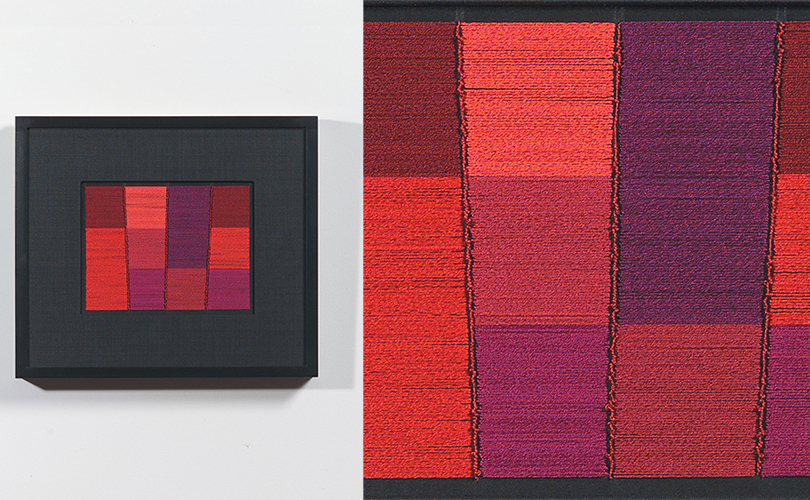
Scott Rothstein stichöd weaving
26sr Untitled Red #71, Scott Rothstein hand stitched silk thread on silk ground, black frame with denglass
12.75″ x 14.75″, 2002

Scott Rothstein also works in fields of color in vivid embroideries of silk like Untitled #71. “I have felt compelled to explore the subtleties of basic visual elements for 20 years,” he explains. “I find the simplest elements to be the most profound. A line, created by twisting threads, can have infinite possibilities. Two areas of color, in equal amounts, placed consecutively, might suggest harmony or contradiction.” 

However articulated, these explorations of color and its potential intrigue and engage the viewer just as they the artist.
Noteworthy: Scottish Tapestry by Jo Barker and Sara Brennan

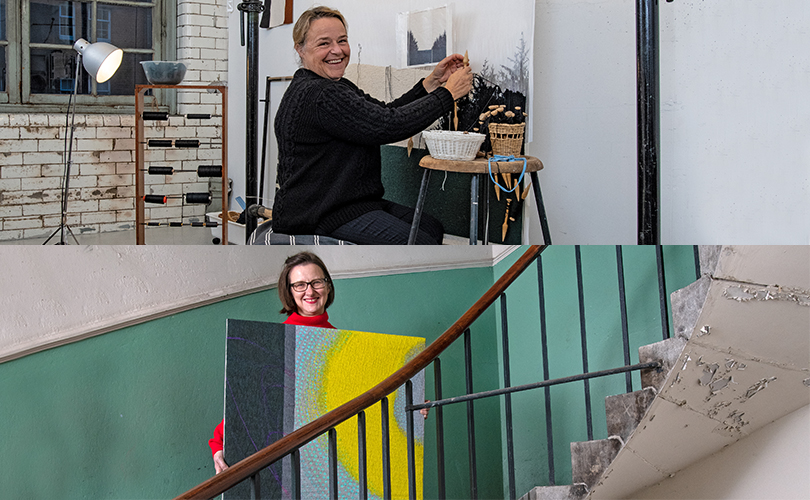
Sara Brennan and Jo Barker portraits by Tom Grotta

Welcome to Noteworthy, the first in an occasional series on topics we think are worth a closer look. In number one, our focus is on Jo Barker and Sara Brennan, two contemporary tapestry artists from Scotland.

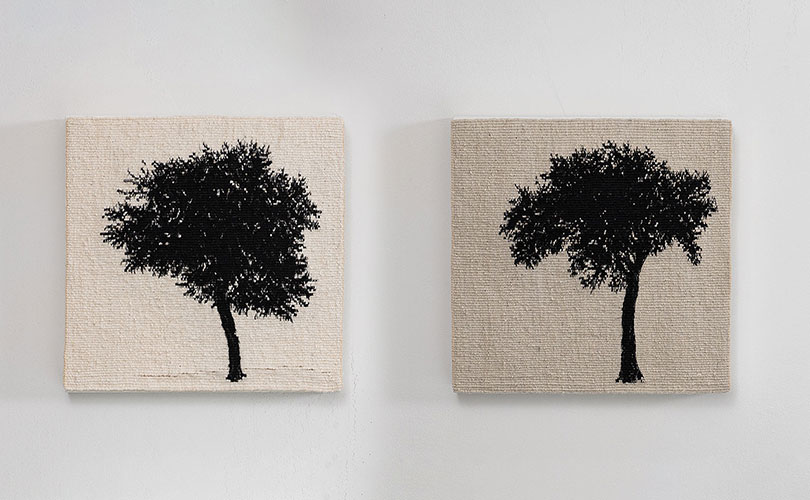
Sara Brennan, Journey Trees III and IV, linens and swing threads, 8″ x 8″ x 1″ (each), 2021. Photo by Tom Grotta

Scotland has a storied tapestry tradition, from the well-regarded Dovecot Tapestry Studio, founded in 1912, to the program at the College of Art at the University of Edinburgh. The country’s most ambitious entry is the Great Tapestry of Scotland (though technically an embroidery). It was hand stitched on linen woven by Peter Greig & Co in Kirkaldy, who have been at it since 1825. It involved 1000 people from across the country, 160 linen panels, and 300 miles of wool – enough to stretch the entire length of Scotland. 

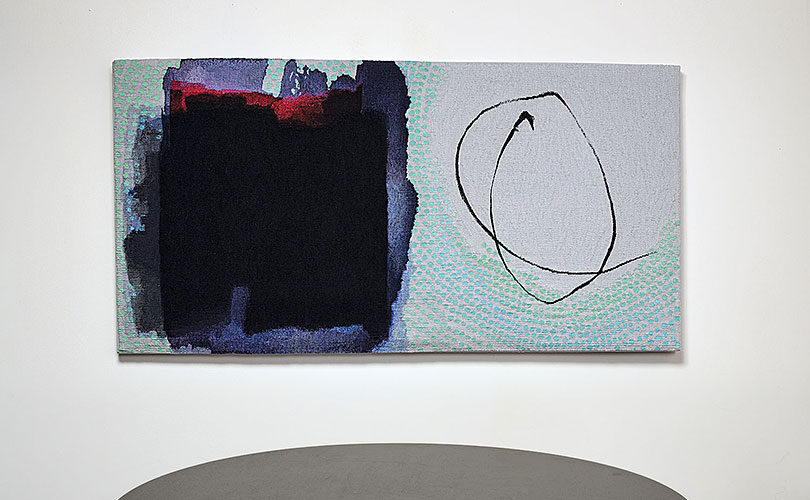
11jb Flow, Jo Barker
cotton, wool, woven, linen, silk and embroidery threads, 28.5” x 54”, 2015, photo by Tom Grotta

Two of the artists that work with browngrotta artists, Jo Barker and Sara Brennan, studied together at the College of Art in Edinburgh where the basic assumption is that tapestry can be used as a visually rich and dynamic medium in contemporary art practice. 

38b Broken White band with Pale Blue II, Sara Brennan, linen, wool and cotton, 30″ x 30″ x 2″, 2012. Photo by Tom Grotta

Barker and Brennan were born in the same year and their studios are in the same building in Edinburgh now. They exhibited together in A Considered Place at Drum Castle in Aberdeenshire a few years ago. Both artists are accomplished and well recognized — Barker is a recipient of the Cordis Prize for Tapestry. Each creates elegant, evocative works that provide a painterly experience from a distance and a remarkably tactile encounter up close. Their approaches to tapestry, however, vary, particularly their use of color. 

9jb Resonance, Jo Barker, woven on cotton warp using wool, cotton, linen, silk and embroidery threads, 41″ x 67.25″, 2009. Photo by Tom Grotta

Jo Barker begins by taking photographs and drawing designs — often influenced by the Scottish countryside where she likes to walk. She builds collages with her images, manipulating them online and capturing gestural movement and deep color. The artist is interested in qualities and patterns of light: transient and ephemeral starting points translated slowly into woven form. She sees contradictions between the flowing nature of ink and paint and the illusion of fluidity translated into soft, richly colored yarns. “The finished images are consciously abstract and ambiguous. I want to create a sense of something as opposed to an identifiable object or picture,” she says. 

40sb Old Blue and Brown Bands – Series I , Sara Brennan, wools, linens and silk, 14” x 35” x 1.25”, 2020. Photo by Tom Grotta

Sara Brennan is also inspired by landscape, responding with a very simplified and reduced use of form. “My work has vertical and horizontal blocks,” she says, “lines and areas that can be traced back through all my work. There is also a consistent color palette. One or two predominant colors, a slight twist to some of the lines, a hidden line of red and yellow giving a subtle definition. I use different whites to change the planes ,..” Brennan weaves from her own drawings, no digital manipulation is involved. “Choosing each yarn is as important to me and the tapestry as making the original drawing,” she explains. “The yarn must work to help balance and convey the feel and mood. It is vital in the interpretation of the drawing, bringing the tapestry to life …”

13jb Cobalt Haze, Jo Barker, woven on cotton warp using wool, cotton, linen, silk and embroidery threads
15” x 33.5”, 2010. photo by Tom Grotta

You’ll find more about these artists at browngrotta.com.


Sneak Peek: Acclaim! Opens Saturday

Colorful Jane Sauer fiber sculpture
15js Genesis, Jane Sauer, waxed linen and pigment, 11″ x 17″ x 8″, 2001. Photo by Tom Grotta.

Here are more images to pique your interest in our Spring “Art in the Barn” exhibition. Acclaim! Work by Award-Winning International Artists features more than 40 artists who have created art textiles, fiber sculpture and mixed media work from the 60s to the present. Each has received accolades, recognition, and awards. Among the works that will be included are several very rare and special works from the resale market.

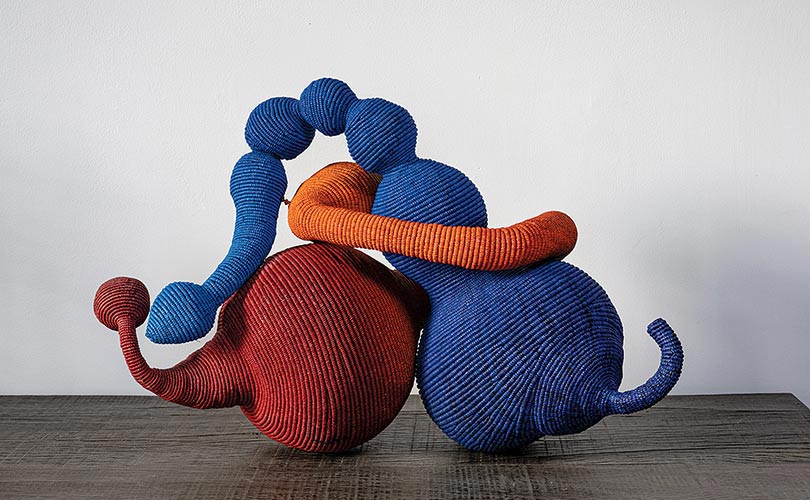
Among these special works are Genesis, a colorful and whimsical work from 2001 by noted artist and gallerist Jane Sauer. The Smithsonian says that Sauer’s pieces “reflect her life as a mother to her children and as a productive, professional artist. [Her] closed baskets symbolize these different roles, evoking the sheltering environment of the womb and the ‘personal space’ that all artists require to create their work.”

Two Cynthia Schira textiles
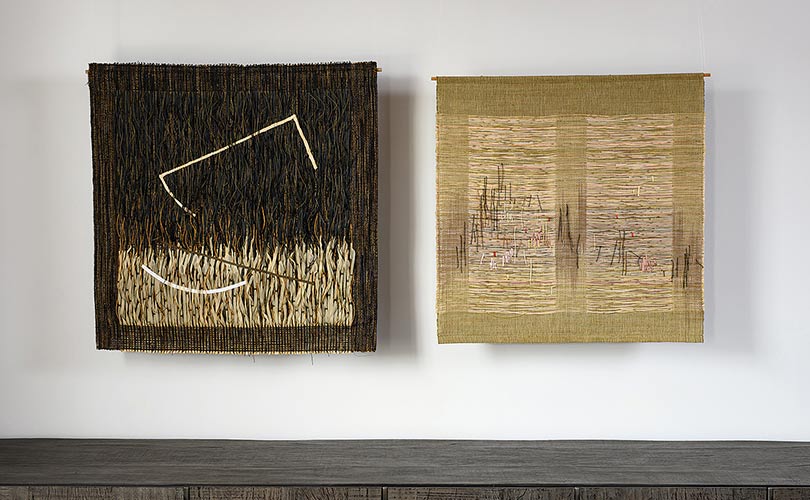
1csh Nightfall, Cynthia Schira, cotton and linen with fabric backing, 28.5 x 28.5, 1979 and 2csh Spring Lyric, Cynthia Schira, cotton and linen with rod, 27″ x 26″, 1979

Another artist whose work we are excited to be including in Acclaim! is Cynthia Schira. Schira’s work often draws imagery from the notational codes, ciphers, and diagrams that visualize systems of knowledge in different disciplines and professions. The works in Acclaim!, Nightfall and Spring Lyric have that sense; they resemble notes jotted down in haste or using shorthand.

Warren Seelig stainless steel sculptures
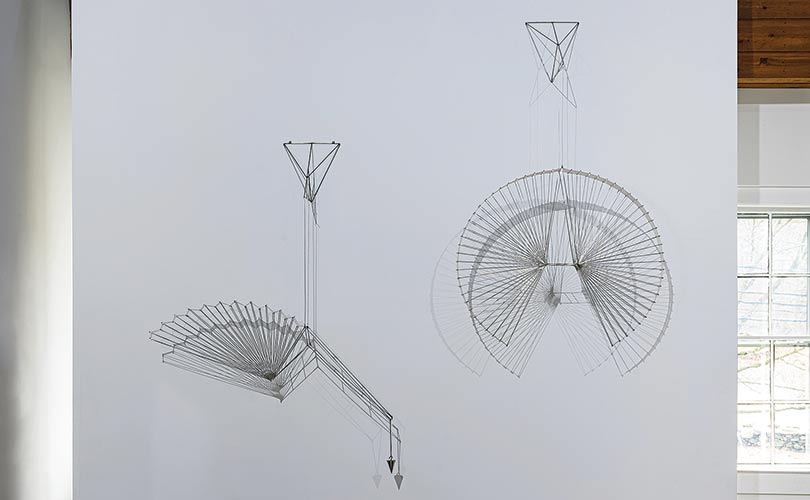
5was Small Double Ended, Warren Seelig, nylon, stainless steel, 63″ x 33″ x 16.375; 6was Small White Wheel, Warren Seelig, nylon, stainless steel 62″ x 40″ x 12″, 1996. Photo by Tom Grotta.

New for browngrotta arts are also Warren Seelig’s works of metal and stone. Seelig has family ties to fiber milling and the textile industry and was exposed to both textiles and the textile manufacturing machinery. He received a BS from Philadelphia College of Textiles and Science, where he created his first woven works, then an MFA from Cranbrook Academy of Art in 1974. Seelig moved from woven works to unique structural, fan-like works using mylar frames and an innovative double-weave technique. He then shifted to suspended spoke-and-axle pieces and wall-mounted shadow fields, like White Wheel and Small Double Endedand Stone Shadowfield which viewers will see in Acclaim! Seelig has been regularly commissioned to create installations for corporate offices and convention centers. Seelig teaches, curates, and writes on various subjects related to textile, fiber, and material studies. 

Gerhardt Knodel Jacquard weavings
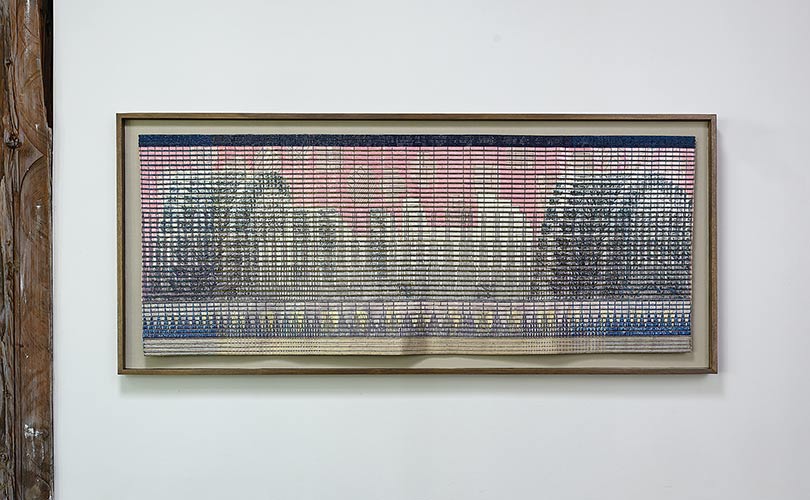
1gkn Santa Cruz, Gerhardt Knodel, cotton twill tape painted and printed before weaving, Mylar, metallic gimp, linen, lined with cotton fabric, 24.75” x 57” x 1.5”, 1981. Photo by Tom Grotta.

Gerhardt Knodel is another artist new for browngrotta arts. Knodel has contributed to the evolution and identity of contemporary work in the fiber medium for more than four decades. For 25 years he led the graduate program in Fiber at Cranbrook Academy of Art, and subsequently was appointed Director, being awarded Director Emeritus in 2006. Knodel’s work with fiber includes installations, theater, architectural commissions, and the pictorial potential of weaving. In Acclaim! there are three works by Knodel each of which involves intricate patterning and interesting use of metallic threads. Santa Cruz features an image of the boardwalk in California; Jacquard Suite 7 and Jacquard Suite 10 interesting patterning.

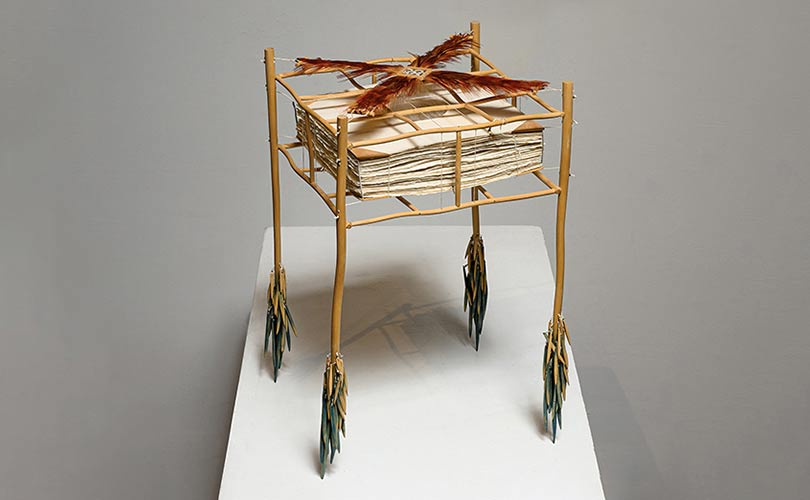
29ddm Mourning Station #4, Dominic Di Mare, hawthorn, handmade paper, silk, bone, bird’s egg, feathers, gold and wood beads, 13″ x 7″ x 7″, 1981. Photo by Tom Grotta.

The works by Dominic Di Mare that is included in Acclaim! is particularly intriguing. It includes, The Mourners, a group of woven hangings from the early 60s. It also includes a work from 20 years later, Mourning Station #4, that features the artist’s characteristic assemblage of feathers, handmade paper, beads and woven silk, one of what the Smithsonian calls his, “enigmatic sculptures from handmade papers, polished hawthorne twigs, and feathers.”

Hope you can join us at Acclaim!

Location:
browngrotta arts
276 Ridgefield Road Wilton, CT 06897

Artist Reception and Opening: 
April 29, from 11am to 6 pm

Remaining Days:
Sunday, April 30th: 11AM to 6 PM (40 visitors/ hour)
Monday, May 1st – Saturday, May 6th: 10AM to 5PM (40 visitors/ hour)
Sunday, May 7th: 11AM to 6PM [Final Day] (40 visitors/ hour)

Protocols: 
Eventbrite reservations strongly encouraged • No narrow heels please (barn floors)

Reserve a spot:
Eventbrite

8ddm The Mourners, Dominic Di Mare, waxed linen, wood, (Back row from left to right: 48.5″ x 24″; 46″ x 24″; 50.5″ x 24″; 47″ x 24″) Front row from left to right: 49.5″ x 24″ ; 46.5″ x 24″; 48.5″ x 24″) 1962-63. Photo by Tom Grotta.

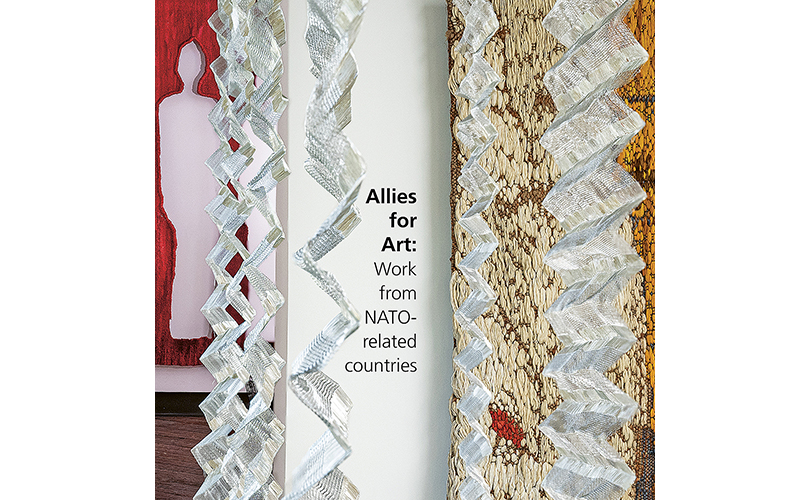
Allies for Art: Exclusively Online on Artsy through November 18, 2022

Did you miss the in-person version of Allies for Art: Work from NATO-related countries at browngrotta arts? Good news! You can see the art that made up the exhibition exclusively on Artsy through November 18th.

Three dimensional embroidered leaf shaped wall sculpture
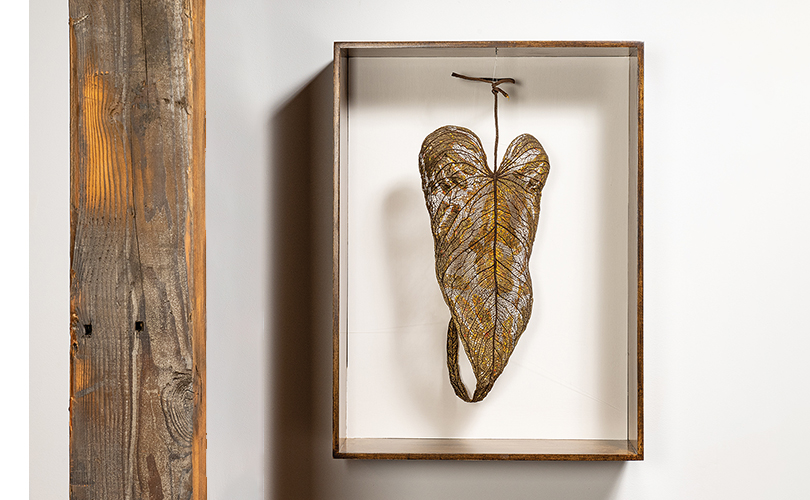
7ak Embraced by Nature II, Anda Klancic, embroidered viscose, flax, cotton, polyester, metal filament, PVA fabric 31” x 23” x 9.25”, 2004. Photo by Tom Grotta

The nearly 50 artists in Allies for Art are from 21 different countries — 18 NATO members and 3 NATO applicants. Their work reflects diverse perspectives and experiences. The exhibition includes art created under occupation, in the ‘60s through the 80s, art by those who left repressive governments in Hungary, Romania and Spain, and art by other artists who left Russia in later years. Allies for Art also includes current works created by European artists including Gudrun Pagter of Denmark, Åse Ljones of Norway, Włodmierz Cygan of Poland, Ceca Georgieva of Bulgaria and, artists new to browngrotta arts, including Esmé Hofman of the Netherlands, Aby Mackie of Spain and Baiba Osite of Latvia.

Abstract off the wall textile sculpture
20mb Giallo, Marian Bijlenga, cotton; horshair, 58″ x 53″, 1994. Photo by Tom Grotta.

You can also learn more about the exhibition in the Allies for Art full-color catalog, which includes lush images and details shots and an essay by Kate Bonansinga, Director, School of Art, College of Design, Architecture, Art, and Planning at the University of Cincinnati, Ohio available on our website.

VIEW EXHIBITION ONLINE: Artsy
VIEW EXHIBITION IN PRINT: Order an Allies for Art catalog


Portraits in Thread

The Textile Museum at George Washington University in DC has a portrait exhibition in the works. Learning about the Museum’s plans got us thinking about works created by browngrotta artists that feature human likenesses. We have a preference for abstract works and find them easier to exhibit as a group in the gallery. As a result, we don’t exhibit many works that are figurative, but we do find faces rendered in textiles consistently appealing. They record a person’s existence, but traditionally reflect much more — power, status, virtue, beauty, wealth, taste, learning or other qualities of the sitter. Portraiture can be popular with artists because of the freedom of composition it involves — lighting, angle of the head, hair, clothes, background, facial expression — almost endless options. Below is a gallery of some engaging portraits by artists who have worked with browngrotta arts.

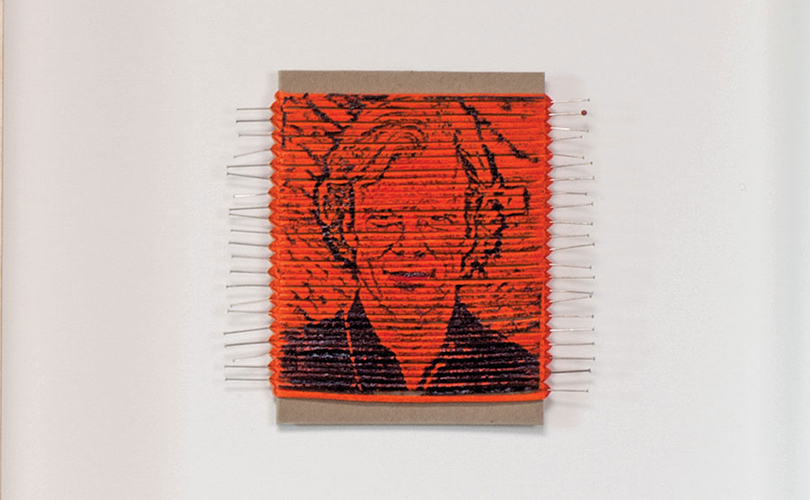
Process piece by ed Rossbach
Process Piece, Ed Rossbach, 15” x 15” x 2.5”, 1981. Photo by Tom Grotta

This deconstructed portrait by Ed Rossbach works on two levels — it appears to be a model of the way a likeness can be formed, and of course, it revels the likeness in black transferred onto fabric.

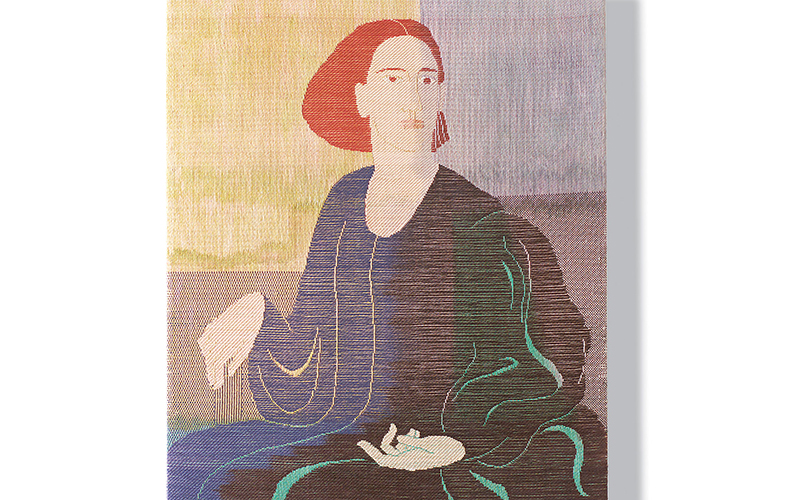
Ethel Stein portrait
Portrait, Ethel Stein mercerized cotton lampas (pre-dyed warp and weft) drawloom , controlled, 47” x 34.75” x 1” 1999. Photo by Tom Grotta

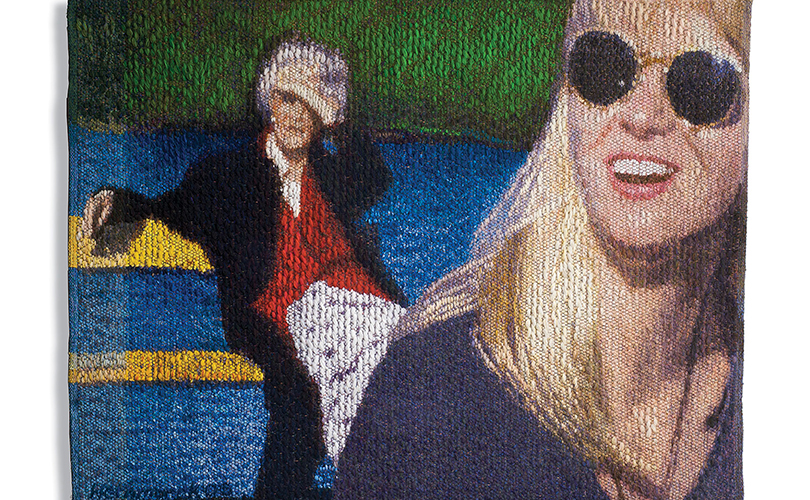
Portrait by Ethel Stein is an imagined depiction of a woman in contemplation while Helena Hernmarck’s On the Dock seems to capture an actual moment in time.

Helena Hernmarck tapestry
On the Dock, Helena Hernmarck, wool, 43″ x 57″, 2009. Photo by Tom Grotta

Marijike Arp portraits
DNA Unique, Marijike Arp, transparent foil, threads and paper, 66″ x 118″ x 1.5″, 2000. Photo by Tom Grotta

Marjike Arp made a statement about gender in DNA=Unique. The pair of subjects resemble one another and raise questions for the viewer: Are they related? Are they more similar than different? 

Iria Kolesnikova portraits
Photoatelier #11, Irina Kolesnikova, flax, silk, hand woven, 15.5” x 11.75”, 20” x 16” frame, 2004

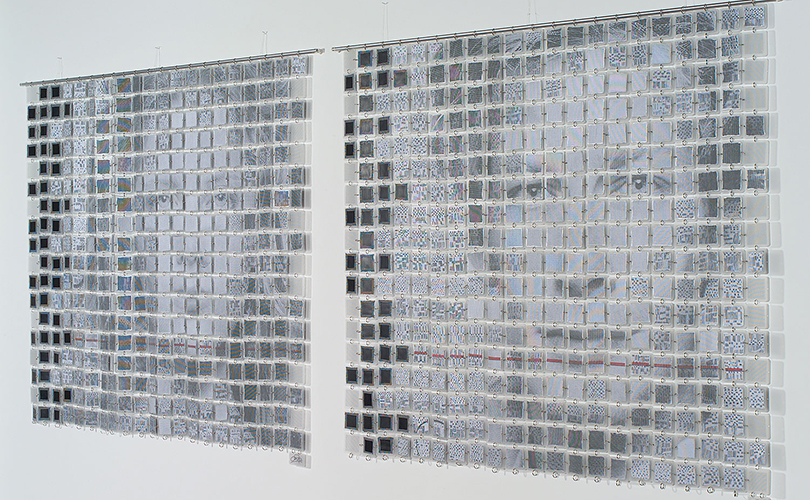
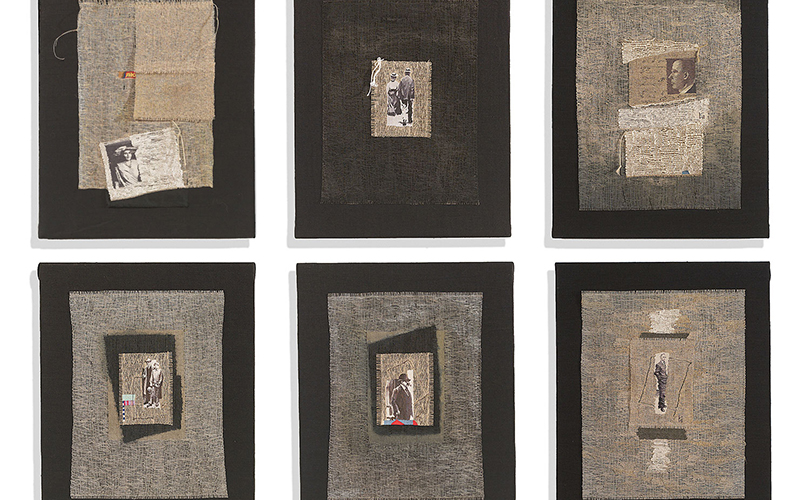
Other artists also work from photographic images. Irina Kolesnikova, for example, likes old black-and-white old photos. “I play with images of these pictures, using silhouettes, details of dress, signs of profession. I make collage and imitate collage in woven technique. You can not recognize an exact person in these pieces, because it is not important for me …. I like a paradoxical combination of contemporary art language and ancient handweaving technque.”

From the First Person  by Aleksandra Stoyanov
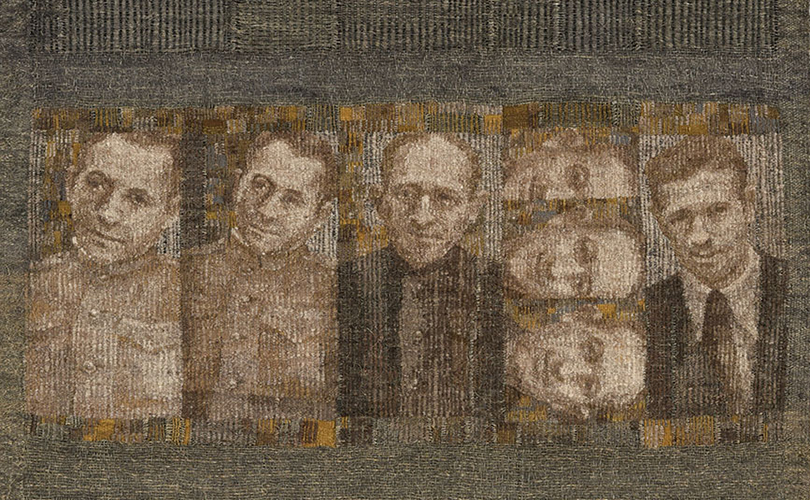
Aleksandra Stoyanov, From the First Person I, wool, sisal, silk, cotton threads 55.6” x 49.25”, 1999

Ukrainian-born artist Aleksandra Stoyanov began making tapestries in 1987, building on her background in graphic and set design. Some of these are based on photographs from her family album. The images evoke memories; the position of the subjects’ heads on their sides suggests the importance of one’s vantage point in interpreting events.

Lia Cook Su Series
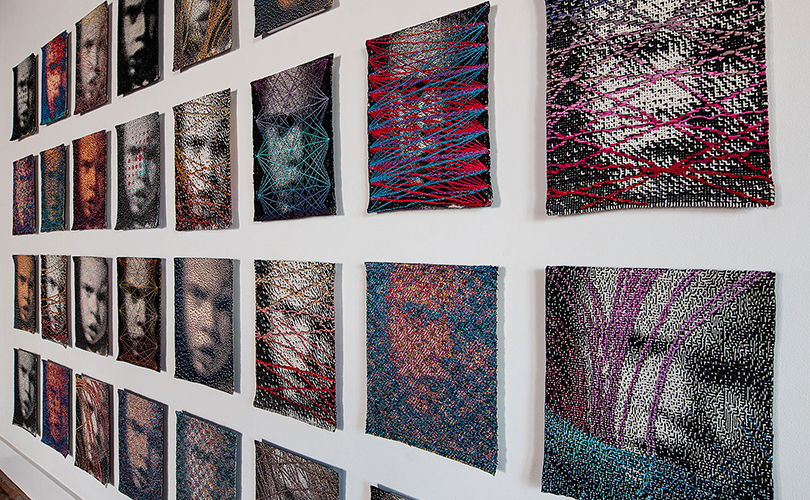
Su Series, Lia Cook cotton, rayon, woven 72” x 132”, 2010-2016. Photo by Tom Grotta

Lia Cook is a master of creating woven portraits from photographic images. Her Su Series Installation features 32 individual portraits. The exact same face, an image of Cook as a child, is used in each of the pieces but it is physically and materially translated differently each time through the weaving process. “The specific way each is translated creates a subtle and sometimes dramatic variation in emotional expression.” Cook says. “As one moves through the installation each iteration evokes a new response. The experience of the person viewing the piece is what is important to me. I am interested in the threshold at which the face dissolves first into pattern and then into a sensual tactile woven structure.  What does this discovery and the resulting intense desire to touch the work add to our already innate, almost automatic emotional response to seeing a face?… The viewer can experience sadness, happiness anger fear etc.  They don’t believe it is the same image”. It is fascinating to Cook — and to viewers of her work — that how an image is translated through the technical weaving process can change the emotional expression of the work.


Lives Well Lived: Ritzi Jacobi (1941 – 2022)

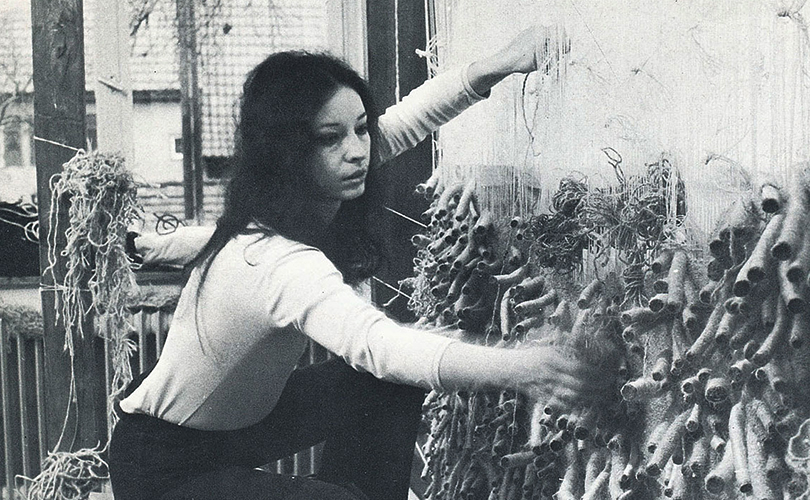
Ritzi Jacobi working on Exotica Series, Ritzi and Peter Jacobi, cotton, goat hair and sisal, 114″ x 60″ x 6″, 1975. Photo provided by the artist.

We write with sadness about the loss of prominent fiber sculptor, Ritzi Jacobi this past June. Along with artists such as Magdalena Abakanowicz and Jagoda Buic, Ritzi Jacobi was one of the European pioneers of textile art, who has established work with textile fibers in expansive, gestural, impulsive installations internationally since the 1960s. Jacobi was born in Bucharest, Romania in 1941, and studied at the arts academy there. The reliefs and objects she created together with her husband Peter Jacobi caused a sensation as early as the 1969  International Tapestry Biennal in Lausanne, Switzerland (the first of 11 in which she participated) and the 1970 Venice Biennial. The works were densely woven from vibrant fibers, and their “shaggy” mass and monumental size convey a rough physicality and are reminiscent of the mountains of their Transylvanian homeland. They represented nature and the archaic and at the same time dealt with conscious and unconscious elemental experiences.  Much of the freshness of the “new tapestry” movement resulted from this juxtaposition of layers, and focus on materials, Giselle Eberhard Cotton observed (“The Lausanne International Tapestry Biennials (1962-1995) The Pivotal Role of a Swiss City in the ‘New Tapestry’ Movement in Eastern Europe After World War II,” Giselle Eberhard Cotton, Textile Society of America, Symposium, September 2012).

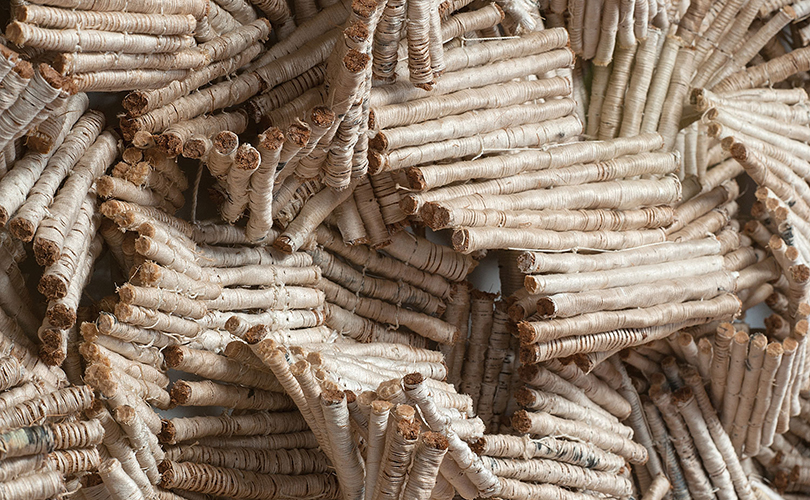
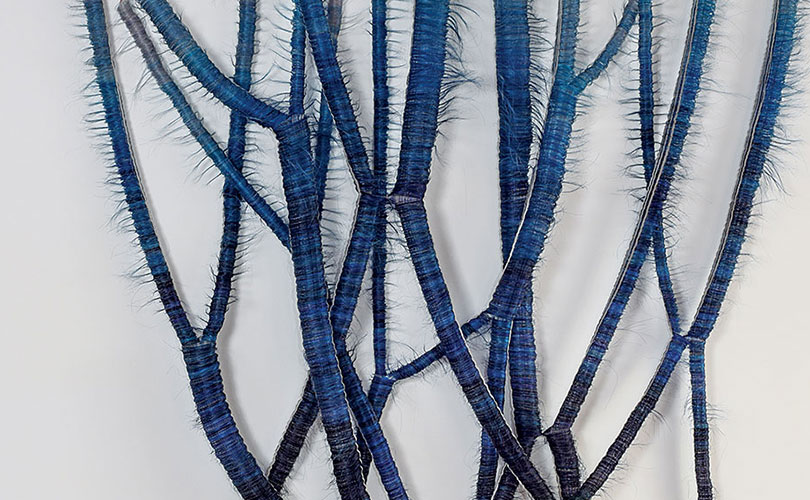
Detail of Breeze, Ritzi Jacobi coconut fiber, sisal, cotton 49” x 49” x 8”, 2000. Photo by Tom Grotta

After moving to Germany in 1970, Ritzi and Peter Jacobi initially continued their work together with the various textile fibers and layers of fragile paper and then turned to other fields of work separately. In her own work, Ritzi Jacobi continued to create large reliefs that underscored the sculptural possibilities of fiber, drawing in three dimensions, creating light and shadow with fiber cables and bundles of wrapped fibers. Ritzi Jacobi also worked with large, untreated cardboard elements, that conquered the surrounding space in a succinct and determined manner. Since the 1990s, she had been expanding her material repertoire to include metal and here, too, she showed abstract hatching and layers between surface and space, concentration and dissolution. Solo exhibitions and some together with Peter Jacobi, have taken place at the National Gallery of Victoria in Melbourne, the Musée d’Art Moderne in Paris and the Cleveland Institute of Arts in Ohio. Works by the artist can be found in major museums around the world. In recent years, Ritzi Jacobi has mainly worked on large-format tapestries, partly as commissioned works, and has been in demand internationally as an expert in juries and committees.  Her last solo exhibition took place at Galerie Diehl in Berlin in 2019. She died in Düsseldorf, where she has lived since 2000, after a long, serious illness. 

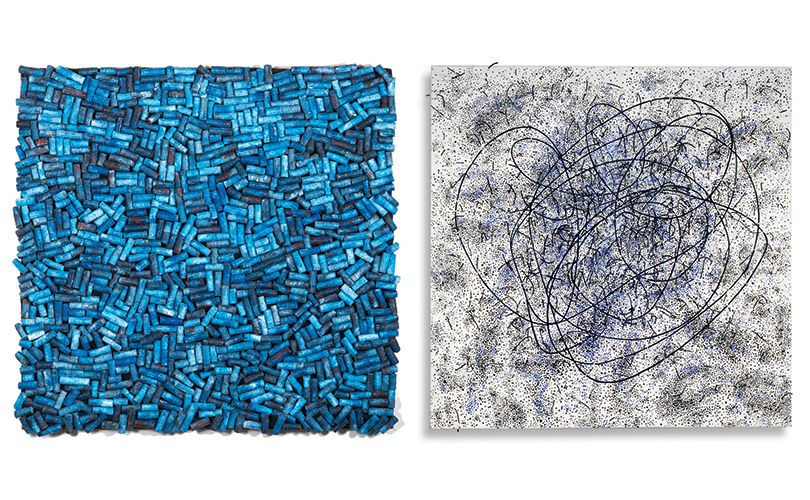
Ritzi Jacobi Blue Zone, coconut-fibre, acrylic paint, 57″ x 57″ x 3″, 2007; and Floating Matter, coconut fiber, cotton, acrylic paint, 53.5″ x 53.5″ x 6″, 2007. Photo by Tom Grotta

Adapted from an obituary by Thomas Hirsch.


Process Notes: James Bassler

Portrait of James Bassler, Photo by Mark Davidson

James Bassler describes himself as a problem solver. He loves nothing better than to pursue an idea and discover how the final execution differs from his initial “fuzzy” conception. An American Craft Council Gold Medalist, Bassler writes engagingly about his investigations into pre-Columbian and other weaving techniques, his experiments with different dyes and materials, and the influence of current events and modern life on his work. We share some excerpts of his writings below:

Origins
It didn’t hurt me to grow up in a family steeped in hard work and hand processes. My father was brought up in a Mennonite community in Pennsylvania. He was a major league baseball player, but interestingly enough, he had other talents including the hooking of rugs. I was introduced to the textile traditions at a very early age. I entered UCLA in the early 1950s. In 1953, I was drafted into the US Army with a tour of duty in Europe, followed by a civilian job in England. In 1960, I returned home via a cargo ship to China and Japan. It was on this journey that I witnessed the importance of world crafts, and their essential role in cultures. A spinning and weaving demonstration in Bombay, was of particular interest, as well as the dyeing processes of Indonesia and Japan. Returning to California, I re-entered UCLA as an art student and began to explore fabric patterning and later, weaving.

To Plait, James Bassler, Wedge weave construction; silk, linen, ramie, sisal, pineapple, nettles weft; indigo-dyed silk and linen warp, 47.25” x 44.25”, 2015. Photo by Tom Grotta.

On plaiting
To Plait is part of a series of weavings that propose to illustrate and demonstrate a variety of structures used throughout history and the world to create objects of fiber. Currently, with so much attention and interest directed toward electronics, I have found little curiosity directed toward how material objects are made. How did early people survive? To Plait can help answer that question. To Plait could help someone, some day, actually make something with their hands.

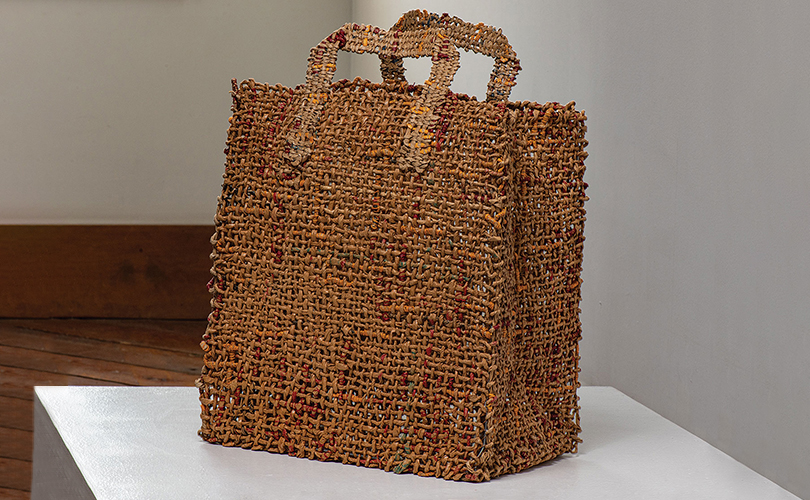
Shop, James Bassler made of brown paper Trader Joe’s shopping bags, cut and twisted and with yellow and red waxed linen thread, 16” X 10″, 2009.

On spinning
My intent to spin and weave Shop [made from “yarn” spun from Trader Joe’s bags] was not to create a handwoven shopping bag. I wove it to draw attention to the important role that vessels have played in ancient history, as they do today. I wove it to draw attention to the honesty and beauty of a simple, and readily available material. I wove it to draw attention to the adaptability of handweaving to create three-dimensional forms, but most of all, I wove it to celebrate the beauty of a handmade object.
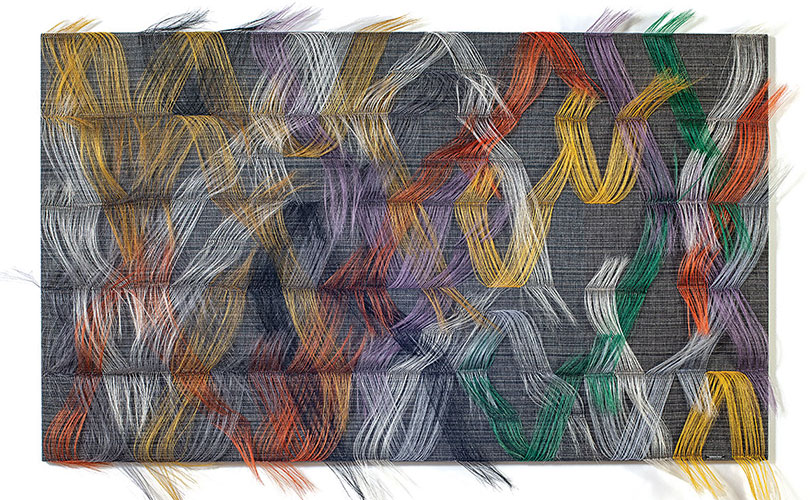
On Inca Time, James Bassler, four-selvage weaving, handspun alpaca, commercial wool, silk, linen, ramie, agave, cotton; natural dyes: lac, cochineal, gardenia jasminoides, sophora Japonica, huezache, walnut shells. 42” x 37” Photo by Tom Grotta.
On pre-Columbian textiles
For over 30 years I taught at UCLA. For 12 of those years I offered a course entitled “Textiles of the World: The Americas,” in the Fowler Museum there. With access to the Museum’s vast collection I became much more familiar with the challenges that the early indigenous people faced in order to create an identity to their particular cultures.  In terms of historical woven textiles created in the Americas, in particular areas, a weaving process was developed.  It is identified as scaffold weave, or four-selvaged and it is quite different from the weaving traditions of Europe.

In 1999, I challenged myself to learn scaffold weave, aided, I will confess, by some 20th century modifications, including foam core, straight pins, and large needles.  From that time on a good portion of what I have created uses this ancient technology.  I choose it because of the freedom it gives me.  However, the process does take longer.

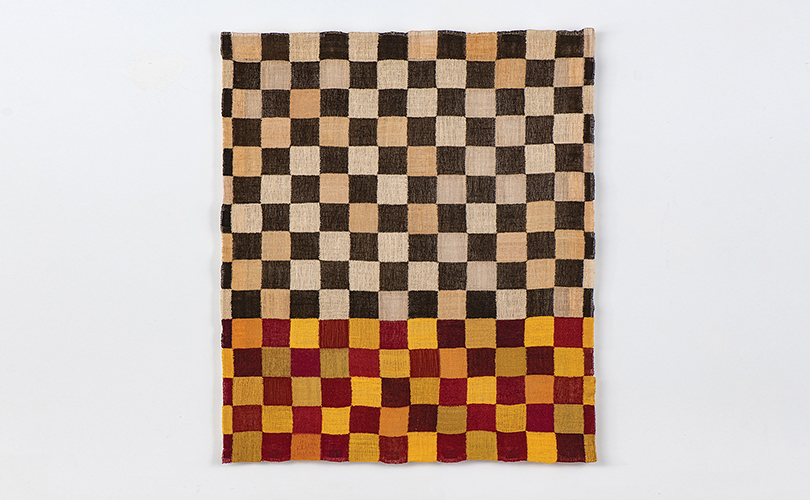
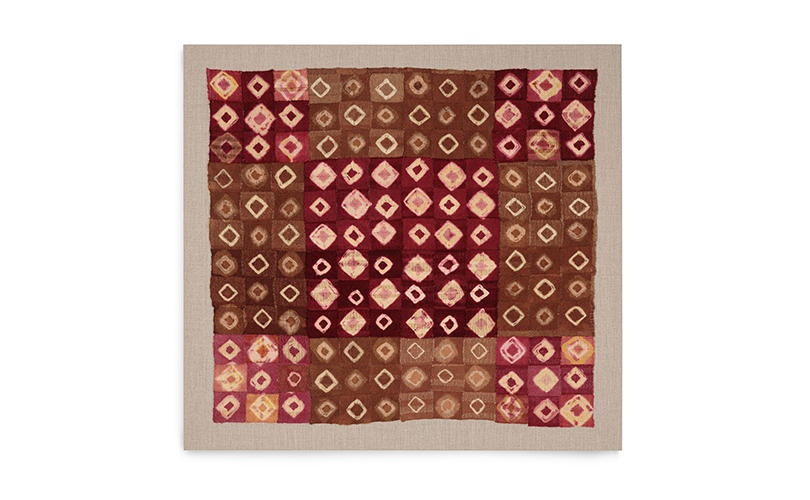
Regarding the woven textiles of the pre-Columbian Andean Cultures, one of the most recognizable patterns is the use of the checkerboard. One sees the checkerboard tunic often because it was the uniform of the Inca military, but it was used frequently in other ways.  I was inspired by images I had seen in a catalog of an exhibition at Yale University which Jack Lenor Larsen had sent me. A second inspiration came from beautiful images of pre-Columbian Andean shibori. Simultaneously, I began to explore these ideas, one a black and white checkerboard, scaffold weave, using a multitude of yarns I had been anxious to use.  On the other project, also scaffold weave and checkerboard, I chose to use a great variety of wool yarn since I planned to use natural dyes in the shibori process.

Mi Wari Boro, James Bassler, four-selvage weaving (scaffold weave) and shibori (tie-dye), handspun and commercial wool, natural dyes: lac, cochineal, gardenia jasminoides, sophora Japonica, huezache, walnut hulls, 32” x 35”, 2019. Photo by Mark Davidson.

In the piece Mi Wari Boro, the word “boro” comes from the Japanese tradition of repair and mending. I was faced with the need for numerous patches and mending in this piece due to the variety of wool yarns I introduced and their reaction to the numerous dye baths they were subjected to. Thus, the inspiration came from the pre-Columbian culture and the Japanese tradition of mending. 

I can say that a good amount of time was spent on each piece, including challenges that left fond memories regarding how certain problems were resolved, and what I learned. I really, truly am more comfortable in pre-Columbian time, thus “on Inca time.”

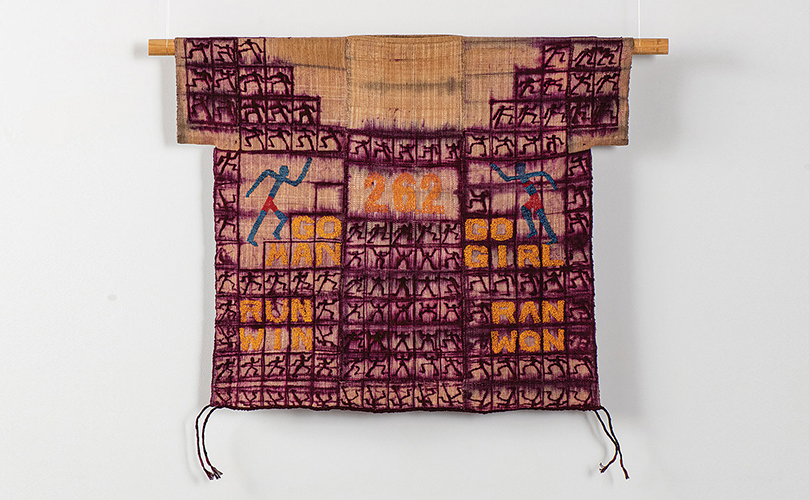
My Letterman Yantra, James Bassler, natural brown cotton, handspun silk, waxed linen – plain weave, brocade – dye immersion with off-set printing method (wicking); large figures, letters and numbers in raised embroidery, with smaller figures also embroidered in part or completely. 28.5” X 32.5”, 2012, Photo by Tom Grotta

On running: My Yantra Jacket
I was one of 11 artists invited to participate in the exhibit Sourcing the Museum at The Textile Museum in Washington D. C., curated by Jack Lenor Larsen. Regarding the process of selecting an object from the museum collection, I was dubious that I could be moved by an image on a computer screen, that I had never seen or touched. Nevertheless, after several searches I kept coming back to a Burmese shirt, with all the writings and mystical symbols covering the surface. After some research, I discovered that the drawings are called yantras, and that they are magical and sacred symbols to evoke protection, good luck, prosperity, support, love and compassion from the cosmic universe. At my age, I thought I could use all that positive energy.

Underlying this selection was the deeper desire to finally celebrate, with bravado, my achievements of competing in numerous marathon races. In order to complete these and other shorter runs, I had clothed my body in a variety of yantras, from puritan simplicity to blatantly annoying symbols of products I never used, love of God, city, state, or political alignment. This was the opportunity to create something regal, that captures the focused endurance of the individual marathon runner, along with the chants and ultimate tacky trophies and medals that await the victors. Yesterday’s yantras, today’s tattoos.

In remote mountain communities of the Sierra region of Oaxaca, women continue to collect and spin silk cocoons found on native oak trees. Bound by tradition, threads are dyed in a strong magenta dye and allowed to dry, unrinsed. These specific yarns are woven to create brocade images into a cotton ground. After being woven, the cloth is folded and bound, and submerged into a hot water bath, allowing the dye to bleed (wick), creating a pattern. Using this same silk, I created many brocade images of runners, leaving spaces for the images to print, or wick, during the dyeing process. Separately, the three panels of cloth that make up the piece were each carefully folded, clamped and submerged into the hot water, permitting the dozens of runner figures to emerge.


Scenes from an Exhibition: Crowdsourcing the Collective this Week

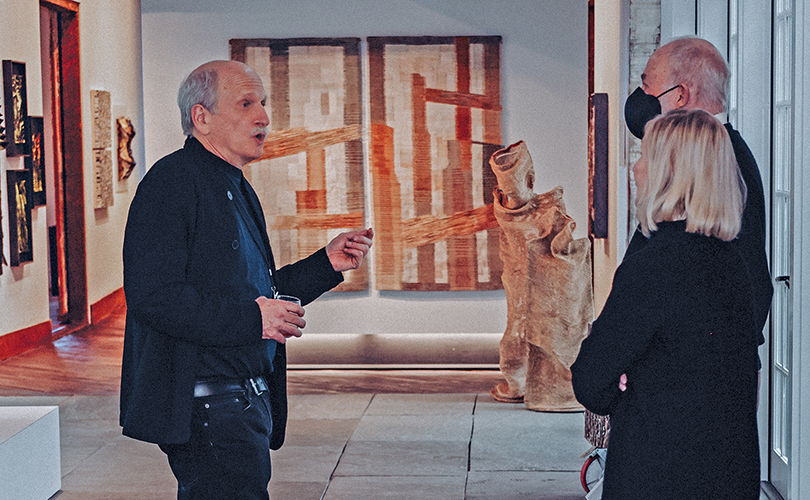
Photo by Juan Pabon/Ezco Production

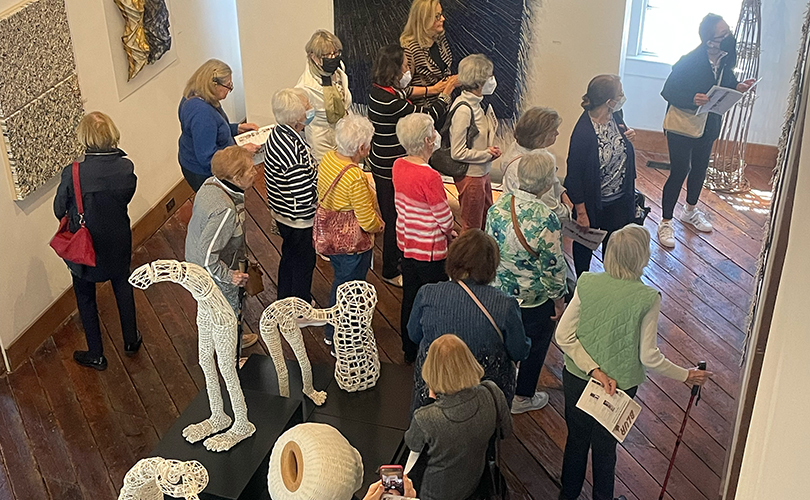
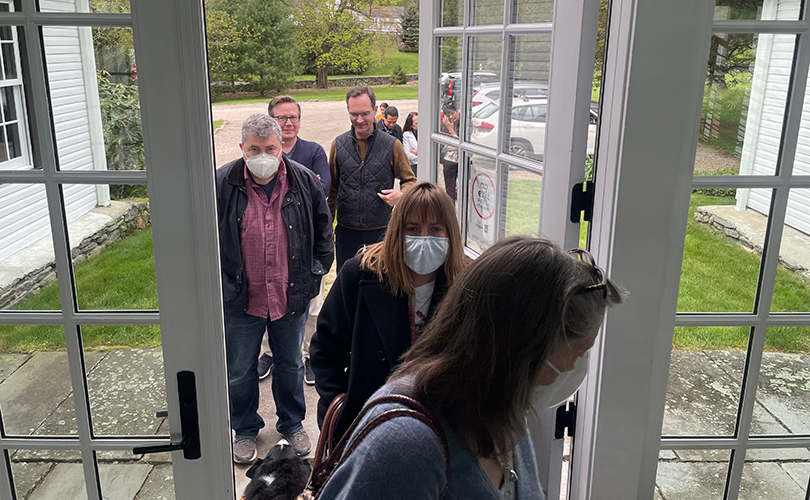
Despite some Covid cancellations, we’re enjoying good attendance to our Spring Art in the Barn exhibition, Crowdsourcing the Collective; a survey of textile and mixed media art this week. We had visitors in line on Sunday morning. We have had artists stop by, including Dawn MacNutt, Norma Minkowitz, Wendy Wahl, Nancy Koenigsberg, Jeannet Lennderste and Kari Lønning. We are hoping to see Blair Tate and Christine Joy later in the week.

We’ve had visits from groups from the Wilton Encore Club and Westport MoCA and a curator from the Flinn Gallery at the Greenwich Public Library. We are expecting more curators yet this week. 

The inspiration for the works in Crowdsourcing is of great interest to those attending. Lia Cook’s tapestries incorporate images of ferns from her California garden. Blair Tate experiments in visual layering based on frescoes interrupted by superimposed paintings and incised niches that she saw throughout Bologna. She rearranged separately woven strips to create windows on the wall — intentionally splintered, fragmented, unsettled as a reflection of our times. Dawn MacNutt’s works of seagrass and copper wire, The Last One Standing and Interconnected, are the last two works remaining from her earlier series, Kindred Spirits.

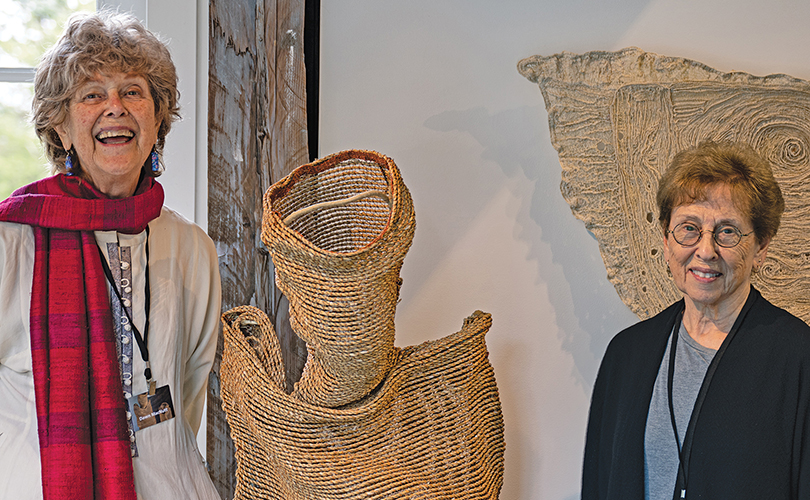
Dawn MacNutt and Norma Minkowitz
Dawn MacNutt and Norma Minkowitz. Photo by Tom Grotta

There are five days remaining — hope you can join us.

Remainder of the exhibition
Thru – Saturday, May 14th: 10AM to 5PM (40 visitors/hour)

Final Day
Sunday, May 15th: 11AM to 6PM (40 visitors/ hour)

Address
276 Ridgefield Road Wilton, CT 06897
(203)834-0623

Safety protocols
Eventbrite reservations strongly encouraged • We will follow current state and federal guidelines surrounding COVID-19 • As of March 1, 2022, masks are not required • We encourage you to wear a mask if your are not vaccinated or if you feel more comfortable doing so. • No narrow heels please (barn floors)

Art for a Cause: A portion of browngrotta arts’ profits for the months of May and June will benefit Sunflower of Peace, a non-profit group that provides medical and humanitarian aid for paramedics and doctors in areas that are affected by the violence in Ukraine. browngrotta arts will also match donations collected during the exhibition as part of browngrotta arts’ 2022 “Art for a Cause” initiative. A portion of the artists’ proceeds for certain works will also go to Sunflower of Peace: https://www.sunflowerofpeace.com/


Artist Focus: Marianne Kemp

Marianne Kemp weaving
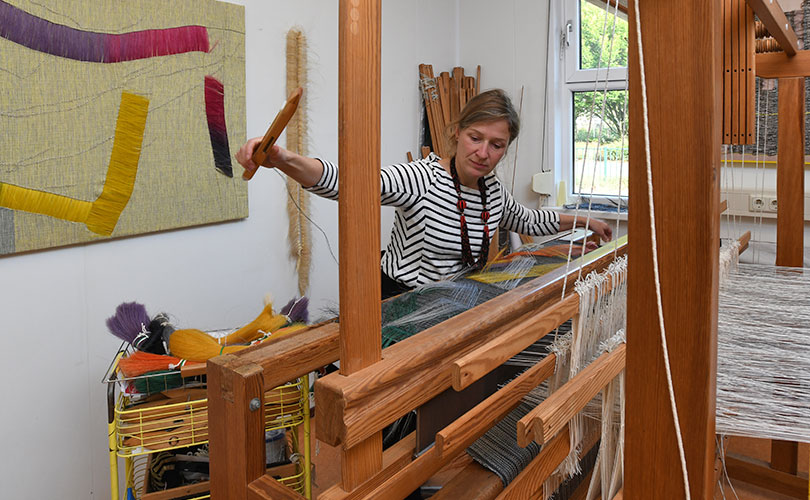
Marianne Kemp weaving her Vibrant Conversation tapestry, horsehair, cotton, linen in 2018. photo by Tom Grotta

Textile artist Marianne Kemp is a specialist in weaving with horsehair. She is passionate about exploring unconventional weaving techniques in her art. That passion, combined with her craftsmanship, is clearly visible in the work she creates. “I’m fascinated by the movement of the weavings, how the horsehair manifests in the net of the weaving technique,” she says. 

Tube Waves
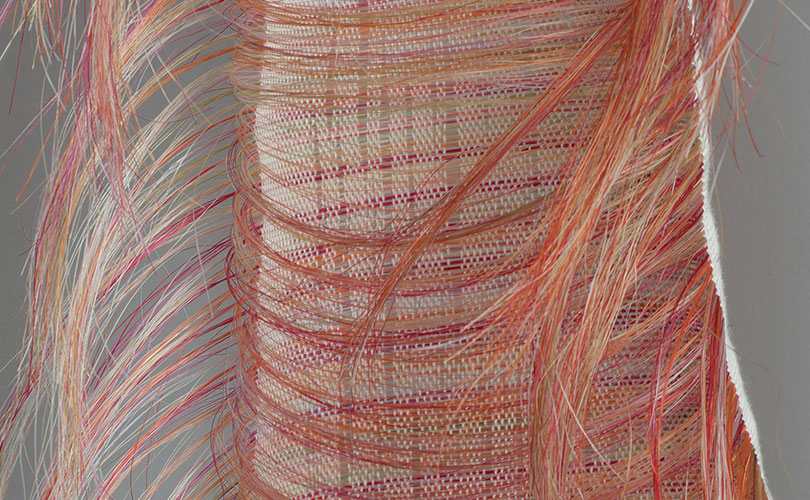
Detail of Tube Waves, Marianne Kemp, horsehair and cotton warp, 78” x 63”, 2015, Photo by Tom Grotta

Some creations, almost-mathematically precise, challenge viewers to become introverted and still. Other work is more extroverted and playful, displaying an exuberant cheerfulness. In either case, her work attracts the eye and stimulates an urge to touch For Tube Waves, for example, Kemp found her inspiration  in the rhythm of the waves. “The flowing colors, going from light silver to aqua, dark purple/blue to deep green, are rendered in the three-dimensional weaving technique I’ve created,” she explains. The ‘tubes’ flow in and over each other, which makes them appear to dance off the surface, depending on your position. From a distance, it’s a dynamic piece; upon closer inspection, there are many different details to discover.”

Vibrant Conversation
Vibrant Conversation, Marianne Kemp, horsehair, cotton, linen, 49” x 70” x 6 “, 2018, Photo by Tom Grotta

Kemp has combined an interest in an architectural weaving process with an appreciation for organic material, creating objects with elements that change space but are experienced as one. In Vibrant Conversation, the top and the bottom layer are embraced in a knot, showing an array of different perceptions in cultural traditions. The work endeavors to tie different generations together via storytelling, confronting collective knowledge with new experiences, prompting new insights.

Orchid
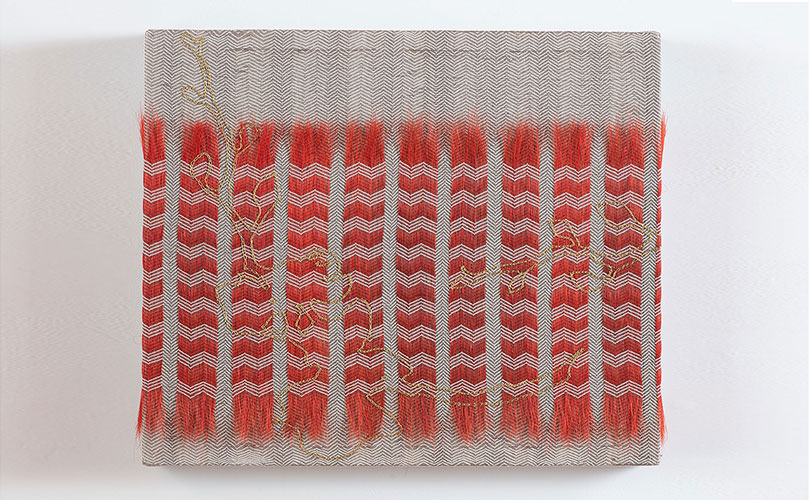
Orchid, horsehair, gold lures thread, wooden frame, 2018, Photo by Tom Grotta

In the stitched and woven Orchid, dyed red horsehair woven in between a delicate herringbone background highlights Kemp’s supreme eye for detail. For Kemp weaving is a form of meditation. “It is the only time of day that I do one thing at the time and think (solely) about one thing,” Kemp says. Weaving allows Kemp to give her brain a rest and explore her creative intuition — a good outcome for us. 

Detail Red Body
Red Fody, Marianne Kemp, cotton, horsehair, acrylic, 56” x 19” x 8”, 2013, Photo by Tom Grotta

Kemp’s work will be included in browngrotta arts’ 2022 Art in the Barn exhibition, May 7 – May 15, 2022.


Check Out Our One-of-a-Kind Gift Guide: No Supply Chain Issues Here

2021 browngrotta Gift Guide

This year we’ve gathered our art selections into a clickable lookbook format. Whether you are gifting yourself, a friend or family member, a work of art makes a truly unique choice. Our curated collection includes art for every location, including crowdpleasing centerpieces (Rocking the Table) and coveted items to set on a bookshelf (Boosting a Bookshelf) or counter top (Counter Balancing)

Narrow wall art pieces

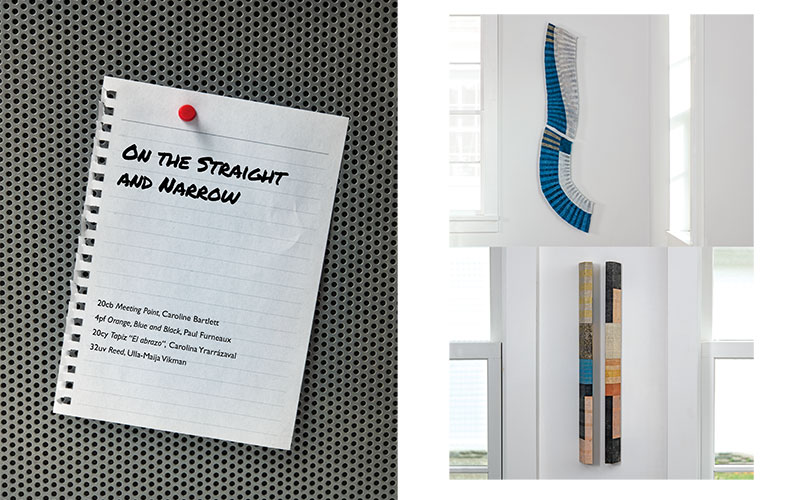
We’ve included art suggestions to fill special spots — including those often hard-to-fill narrow walls (On the Straight and Narrow). Our choices include a pleated fabric work by Caroline Bartlett of the UK and a hanging of hand-painted threads by Ulla-Maija Vikman, known as “Finland’s colorist.” Or have you got your eye on an empty space? The one that makes you think — “I wish I could find just the right piece of art for that spot.” We’ve got a batch of ideas for you there — from embellished photographs by Gyöngy Laky(US) to an intricate embroidery by Scott Rothstein(US) to a newsprint and lacquer collage by Toshio Sekiji of Japan.

Natural baskets

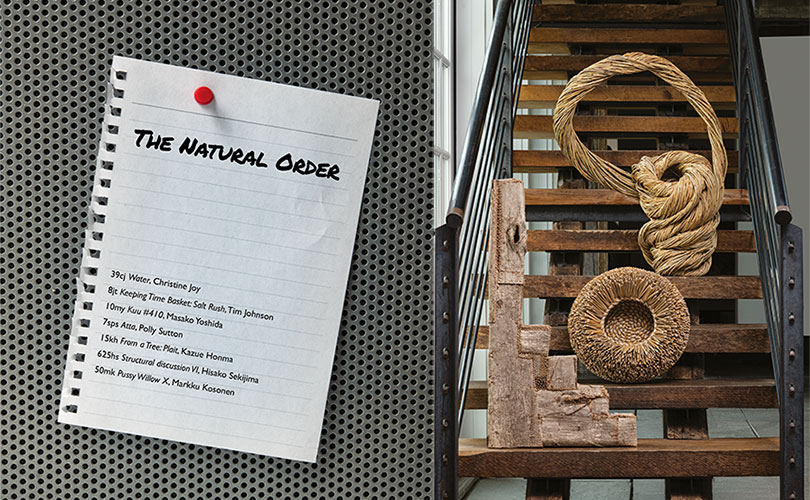
There are works at every price point, from the brightly colored abstract tapestry, Flow, by Jo Barker, a Cordis Prize winner from the UK to a basket sculpture of cottonwood by Christine Joy(US) to a new book about the innovative weaver Włodzimierz Cygan of Poland.

Take a look here: http://www.browngrotta.com/digitalfolios/HolidayFlipBook/Hoilday FlipBook 2021.html

The small print:

Order for the holidays by December 13th and we’ll ship by December 14th for domestic delivery by the holidays (though due to COVID and other delays, we can’t guaranteed the shippers’ schedule). If you’d like us to gift wrap your purchase, email us at art@browngrotta.com, as soon as you have placed your order. To ensure we know you want gift wrapping, don’t wait to contact us — we generally ship as soon as the orders are received. Quantities are limited.