Monthly archives: August, 2026

Summer Recap

Summertime and the living is easy … We’ve always loved that song by DuBose Heyward and George Gershwin. It’s not quite easier at browngrotta arts as we have lots of preparation to do for our upcoming fall exhibition and next year’s 40th anniversary celebration, but the pace is a little slower. We spend more time with family and friends and fishing in Maine with art projects in between.

Even if leisurely, life goes on, and we still have plenty of news to share.
Gjertrud Hals and Misako Nakahira
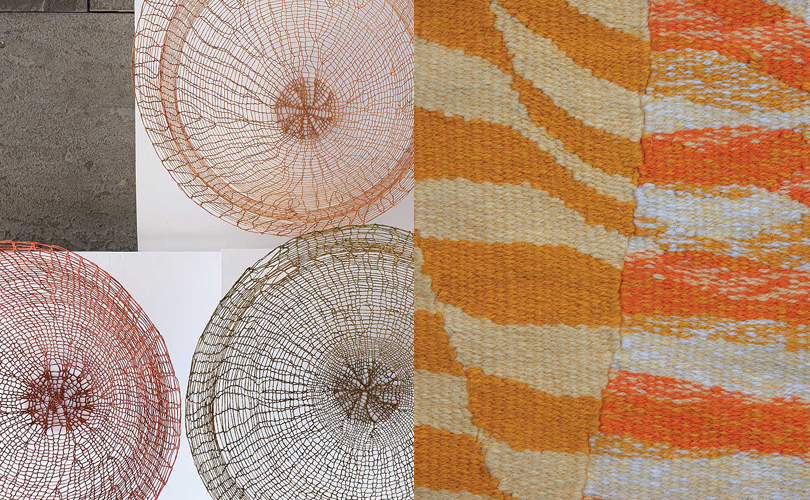
Works by Gjertrud Hals and Misako Nakahira. Photo by Tom Grotta.

The Loewe Craft Foundation Awards for 2026 were presented. Through its Craft Prize, the Loewe Foundation seeks to acknowledge and support international artisans over 18, of any gender who demonstrate an exceptional ability to create objects of superior aesthetic value. By identifying work that “reinterprets existing knowledge to make it relevant today while reflecting its maker’s personal language and distinct hand,” the Foundation aims to “highlight the continuing contribution of craft to the culture of our time.” Two of the artists that work with browngrotta arts were on the short list — Gjertrud Hals of Norway and Misako Nakahira of Japan. They join several other artists that browngrotta arts promotes who have made the shortlist in years past— Mercedes Vincente, Polly Adams Sutton, Yeonsoon Chang, Ferne Jacobs, and Simone Pheulpin, who was also awarded an honor prize. Separately, Loewe has worked with Jiro Yonezawa and Kay Sekimachi to create designs for products for the legendary leather goods retailer.
James Bassler, Dail Behennah, Lia Cook and Neha Puri Dhir
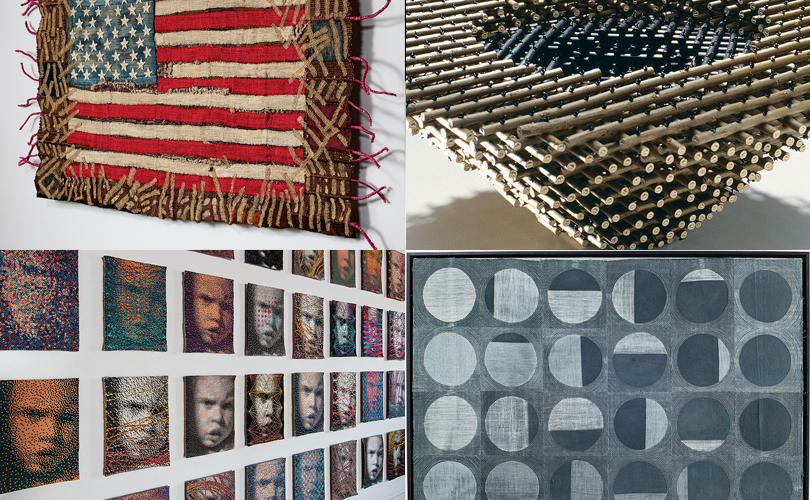
Works by James Bassler, Dail Behennah, Lia Cook and Neha Puri Dhir. Photo by Tom Grotta.

This summer saw Museum Acquisition actionThis Old House by James Bassler will join the permanent collection at Crystal Bridges Museum of American Art in Bentonville, Arkansas. This Old House was featured in the Museum’s recent exhibition,  America 250: Common Threads. The adoption of a second work of art by another artist is in progress at a separate major US museum. The last 12 months have seen more acquisition activity. Last August,  Bowl with Black Centre, by Dail Behennah was acquired by the Fuller Craft Museum in Brockton, Massachusetts. In November, Lia Cook’s Su Series was acquired by the Crystal Bridges Museum of American Art and Neha Puri Dhir’s work Transition, was acquired by the John and Mable Ringling Museum in Sarasota, Florida. In January, four works of wearable art by Norma Minkowitz joined the collection of the Los Angeles County Museum of Art in California. 
Jane Balsgaard
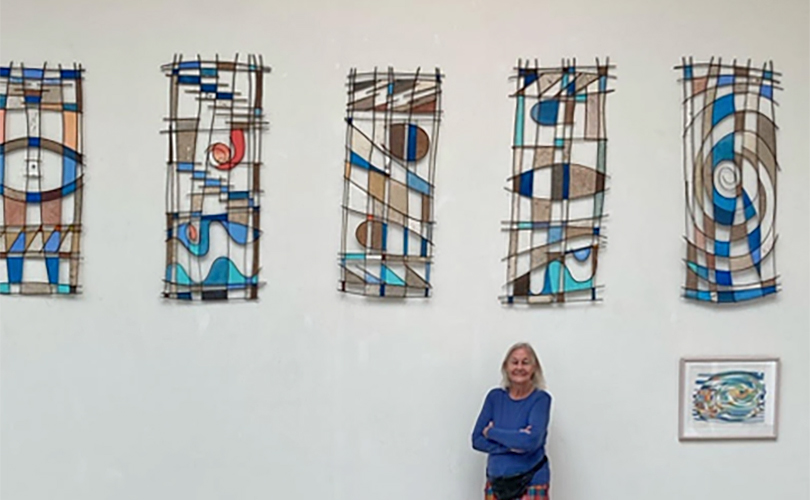
Jane Balsgaard. Photo courtesy of Jane Balsgaard.

Artists who work with browngrotta arts are featured in a number of Exhibitions in Canada, China, Europe, and the US. Jane Balsgaard’s work is on exhibit at the Vrå Exhibition in the  Art Building-Engelund Museum in Vrå, Denmark (through August 30th). Jeannet Leendertse is part of Water Proof: Maine Artists Reflect on their  Environment, at the  Wendell Gilley Museum in Southwest Harbor, Maine (through August 22nd). In Montreal, Canada, Mariette-Rousseau Vermette’s, Micheline Beauchemin’s, and Young-Ok Shin’s works are featured in Plot at the Baie-Saint-Paul Museum of Contemporary Art (through September 6th). The work of Eduardo Portillo and María Dávila is included in See You Tomorrow Under Other Skies at the  Andrew Kreps Gallery in New York City (through September 12th, with a summer break in August. Check hours). Gjertrud Hals’s work is part of the 
Personal Structures exhibition at the Palazzo Mora in Venice, Italy (through November 22nd).  Simone Pheulpin’s work is in Intertwined Breath: Contemporary Fiber Narratives at the  Taoxichuan Gallery in Jingdexhen, China (through November 25th). And, opening on August 25th, is a retrospective of Mary Merkel-Hess’s work at the  Brunnier Art Museum, Ames, Iowa (through January 31, 2027).
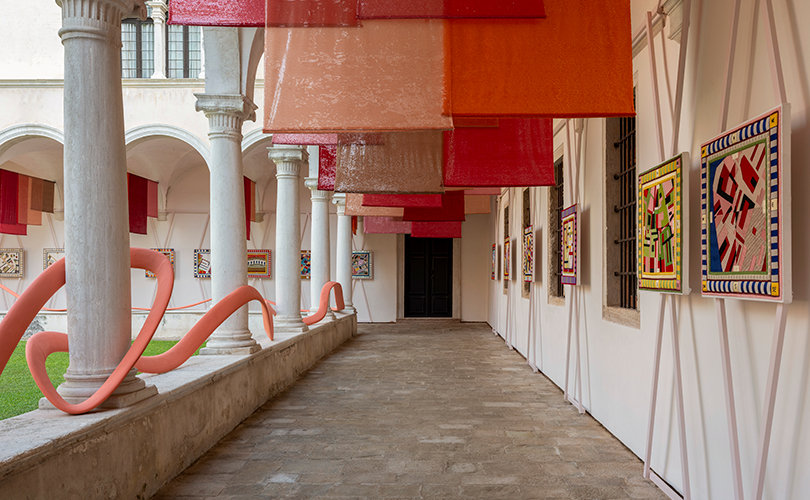
Birth-Giulio-Ghirardi
Birth-Giulio-Ghirardi©Michelangelo-Foundation

The fourth edition of the Homo Faber Biennial is titled An Island of Light and runs from September 1 – 30, 2026 at the Fondazione Giorgio Cini on San Giorgio Maggiore Island in Venice, Italy. Curated by the Michelangelo Foundation with artistic direction by Es Devlin, the event explores the relationship between light, materials, and the human hand. A number of artists who work with browngrotta arts will be part of the Biennial including Jiro Yonezawa, Christine Joy, Jennifer Zurick, Nancy Moore Bess, Simone Pheulpin, Polly Adams Sutton, and Gyöngy Laky. Homo Faber also maintains an online platform 
dedicated to craftsmanship that provides profiles of artisans worldwide.
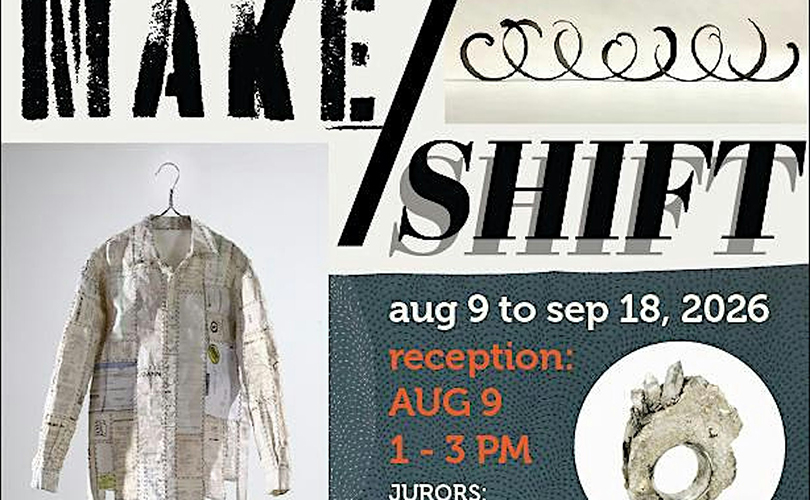
Make/Shift
Make/Shift exhibition, through September 19th.

In June, we served as Jurors for Make/Shift, an exhibition at the  Crown Gallery, Metro Art Studios in Bridgeport, Connecticut.  Artists were asked to submit work that “explores the space where material, process, and intention converge — grounded in techniques and materials traditionally associated with functional craft—ceramics, fiber, glass, wood, basketry, and other hand-based practices—reimagined through a fine art lens.” We reviewed more than 150 entries and selected over two dozen intriguing works — of glass, ceramics, jewelry, metal — but a preponderance of the entries were works of fiber. The exhibition will run from August 9th to September 19th.
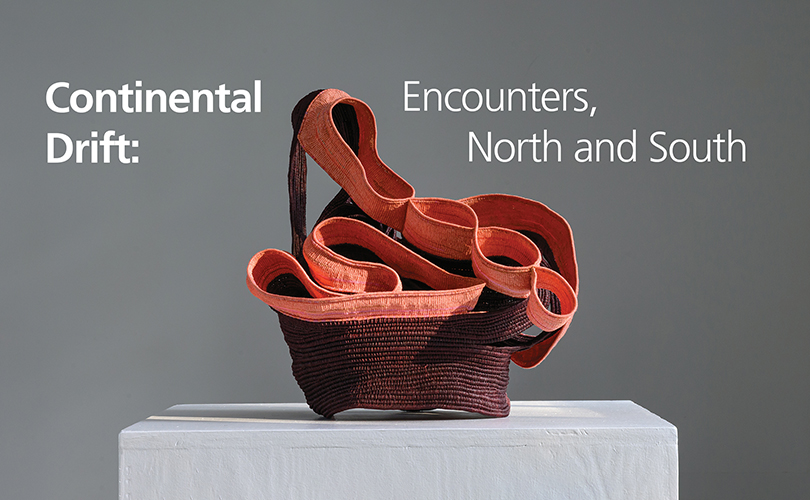
Ferne Jacobs
Work by Ferne Jacobs. Photo by Tom Grotta

Much of our summer has been spent on October Exhibition Planning. In Continental Drift: Encounters, North and South (October 17 – 25), we will explore art from North and South America from two different vantage points. First, we are gathering works by significant artists from the US, Canada, Chile, Venezuela, and Colombia, including Sheila Hicks, Lenore Tawney, and Carolina Yrarrázaval) many of whom are not just representative of their own countries but have a connection to other regions as well. Second, we will include work by artists from in and outside North and South America who cite art, artists, or experiences from these continents as an influence. We’ve been receiving deliveries from new artists from Argentina and Mexico, and viewed compelling works that artists created after a pilgrimage to another country or a study of an artist from elsewhere. And we’ve been in correspondence with Sarah Parrish, Associate Professor of Art History at Plymouth University, who’ll be writing the catalog essay for Continental Drift.

Hope you, too, are having a great summer!

Color Stories

584mr Carter’s Color Lesson, Mariette Rousseau-Vermette, wool and silk, 7′ x 2′ and 7′ x 4′ x 3″, 1993. Photo by Tom Grotta

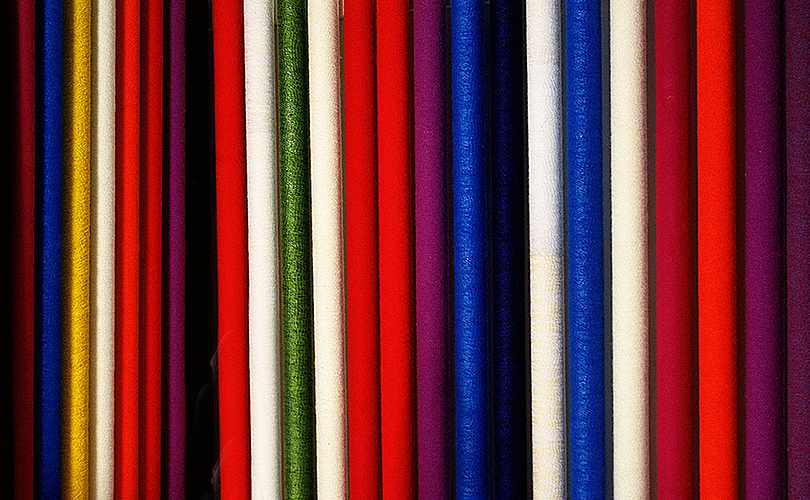
Color is a constant in art, while its potential for new and unique applications is limitless. Artists at browngrotta arts have taken the challenge to heart — finding inspiration in the teachings of Josef Albers, the art of Color Fields painter Mark Rothko, and systems of their own design.

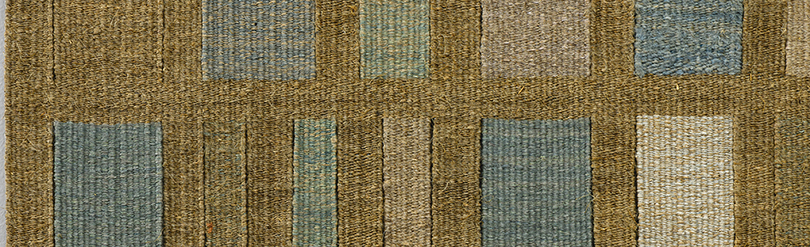
Detail: 37sl Dictionary – Light Indigo, Sue Lawty indigo-dyed, natural hemp, linen, 21.5 x 13, 2026. Photo by Tom Grotta
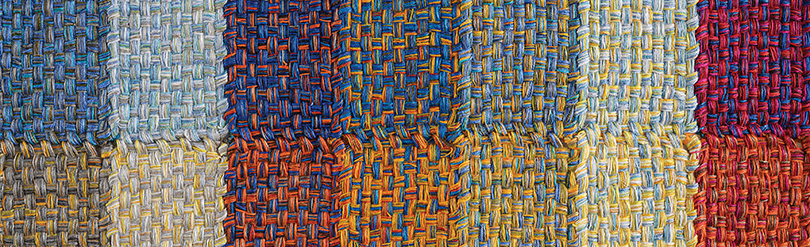
Detail: 1mkes Rhythm of Colors, Merja Keskinen, 80% linen, 20% cotton, 56″ x 62″, 2022. Photo by Tom Grotta
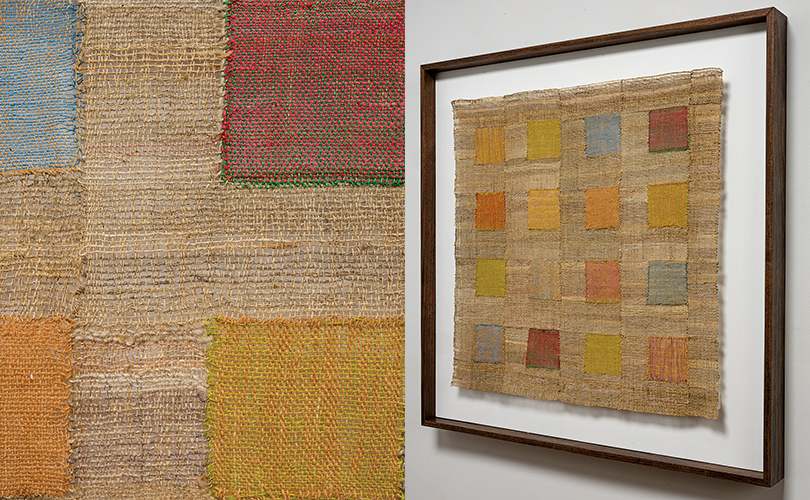
Detail: 22jbas The Yarns I Have Carried # 2, James Bassler, four selvaged weaving: left over warp and weft yarns from the past 65 years, including handspun and manufactured material, natural and synthetic dyed wool, silk, linen, cotton and ramie, 30″ x 31″ x 2.5″, 2025. Photo by Tom Grotta

In Bauhaus artist and teacher Josef Albers’s universe, color seduced and beguiled (The Josef and Anni Albers Foundation: https://www.albersfoundation.org/alberses/teaching/interaction-of-color). “These characteristics made color the most fascinating of art’s formal elements. Albers’s passion for color prompted his decision to launch what was possibly the first full-blown course in color ever given anywhere, and certainly the first based exclusively on direct observation of color’s behavior. . . . Color behaved. Color was magic.”

At Black Mountain College in the 1930s he introduced a color course unique at the time, followed by courses at Yale University and the publication of Albers’s landmark Interaction of Color in 1963, which crowned 30 years of effort.  His exercises focused on color in specific contexts, showing that if you put color A next to color B, or these colors next to those, you could anticipate certain results. Moving from simple to complex, with many exercises exploring the ramifications of a previous one, the course awakened the students to the quirks and variables of color behavior. The course was not a fixed body of color wisdom, but rather an ongoing inquiry in which solutions were not conclusions, but steps on an endless path.

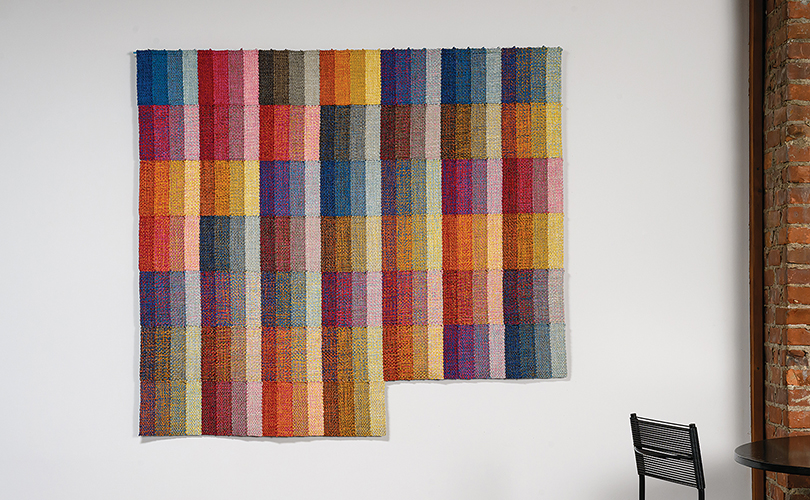
1mkes Rhythm of Colors, Merja Keskinen, 80% linen, 20% cotton, 56″ x 62″, 2022. Photo by Tom Grotta

Merja Keskinen engages in color experiments of her own navigating between following a system, as Albers did, and making room for discovery. Keskinen describes this generative uncertainty: “I work to see. The joy of discovery and the delight of experiencing colors are essential to me. The unpredictability and always-surprising color tones captivate me. I interpret life and the surrounding world with colors and explore the factors that influence color perception.” In works like, Rhythm of Colors, Keskinen works with a self-developed weaving technique, combining different-colored threads according to her preselected system, creating geometric square and rectangular shapes in various sizes whose surfaces produce a pixel-like optical blending — distinguishable as individual threads up close, but merging into wholly unexpected color combinations from a distance. Her work demonstrates that even the most rigorously systematic approach — mathematics applied to thread — contains inevitable surprise. The material collaborates, producing results the artist could not fully predict.

22jbas The Yarns I Have Carried # 2, James Bassler, four selvaged weaving: left over warp and weft yarns from the past 65 years, including handspun and manufactured material, natural and synthetic dyed wool, silk, linen, cotton and ramie, 30″ x 31″ x 2.5″, 2025. Photo by Tom Grotta

In his Threads I’ve Carried series James Bassler takes Albers’s Color Theory as a literal influence. The works reflect what the artist learned in his first “Color” class at UCLA in1953 once he realized that there was an “Art Department.” The head counselor at Santa Monica HighSchool had refused to allow him to take a Ceramics class because his GPA was too high. He pursued art, despite that first obstacle, and later Bassler would teach Josef Albers’s Color Theory at UCLA for some 25 years. This work is made of left-over warp and weft yarns from the past 65 years, including handspun and manufactured material, natural and synthetic dyed wool, silk, linen, cotton, and ramie. The result, is a four-selvaged weaving, a color study using complementary colors, In works from the series, Bassler explored a new bag of saved yarns, which presented new thoughts. “How bright or dark can I go before it upsets the whole idea,” he asks. “In this piece I pushed the subtle to almost disappear and the bright to almost overwhelm.”

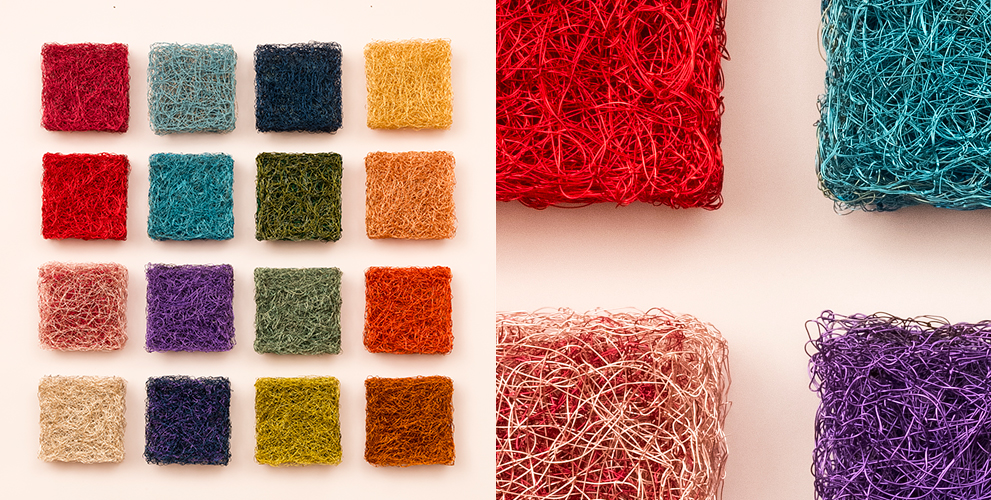
Chroma, Nancy Koenigsberg, coated copper wire 26 .5″ x 26.5″ x 2″, 2024. Photo courtesy of Nancy Koenigsberg

Nancy Koenigsberg’s Chroma is the artist’s version of a painter’s palette which took her more than six months. to complete. The sculptural artwork of coated, colored copper wire is comprised of four horizontal rows of small squares and four vertical rows, occupying an area 26 inches square. Each individual square is created by sewing and weaving coated copper wire and building layers of the color to a depth of 2.5 inches. The color combinations and contrasts challenge and engage the viewer both visually and conceptually.

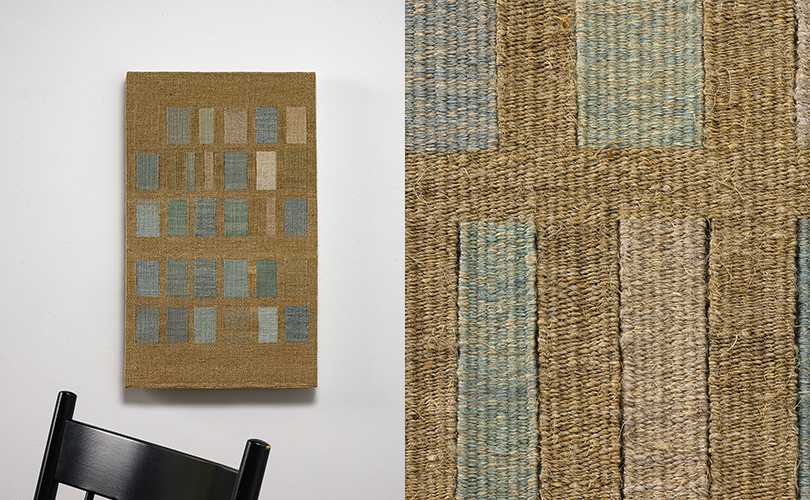
37sl Dictionary – Light Indigo, Sue Lawty indigo-dyed, natural hemp, linen, 21.5 x 13, 2026. Photo by Tom Grotta

In her Indigo Cloth series, Sue Lawty explores the innumerable variations of blue. In one series, Notes on Blue, Lawty commissioned a range of linen and hemp hreads to be hand dyed with indigo by Jeanette Orrell in Wales. Lawty purposely requested a range of unevenly dyed shades across the tonal spectrum and then worked intuitively,  reading the weaving line by line as it progressed. In Dictionary – Light Indigo Woven Tapestry, she explores more gradations of blue. Lawty pursues the inherent qualities of any material with which she works, seeking “an understated restraint, balance, tension, rhythm: an essential stillness.”  In Lawty’s practice, color feels less applied than absorbed — as though the fiber had always held it within. 

Mariette Rousseau Vermette wool tapestry
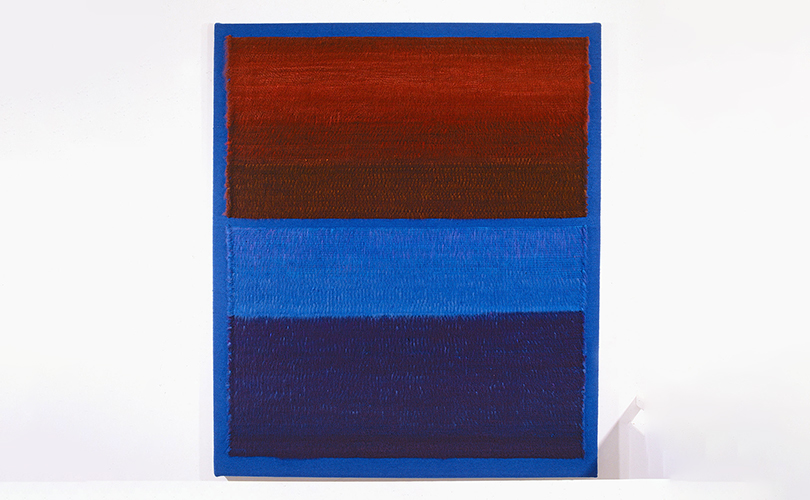
613mr Si Rothko Métait Conté, Mariette Rousseau-Vermette, wool, 94” x 80”, 1997. Photo by Tom Grotta

Experiments in color were the hallmark of members of the Color Fields movement of the 1950s and 60s.  Color Fields artists, among them Mark Rothko, created abstract paintings featuring large areas of solid color, flat surfaces, and a unified single-image field.  Rothko’s work with color was a potent influence for fiber artist Mariette Rousseau-Vermette. The Canadian artist saw an exhibition of the Rothko’s works in Italy in 1958. It was pivotal in inspiring her “to produce strictly artistic works in weaving,” Anne Newlands wrote in Weaving Modernist Art: The Life and Times of Mariette Rousseau-Vermette (Firefly Books, Richmond Hill, Ontario, 2023, p. 32). Throughout Rousseau-Vermette’s life, Newlands says, Rothko triggered “compositions with floating blocks of color, soft edges and her signature brushed wool technique to create a blending of colors and a sense of inner light.” Her interest in Rothko “marked her as a colorfield artist-weaver, fueling her ambition to create large-scale tapestries that would engulf the viewer and employ powerful chromatic contrasts of light and dark to evoke an emotional response.” 

Scott Rothstein stichöd weaving
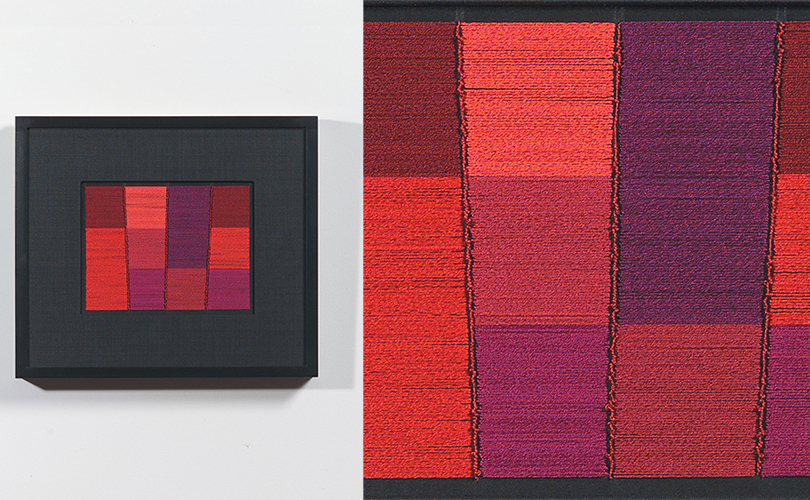
26sr Untitled Red #71, Scott Rothstein hand stitched silk thread on silk ground, black frame with denglass
12.75″ x 14.75″, 2002

Scott Rothstein also works in fields of color in vivid embroideries of silk like Untitled #71. “I have felt compelled to explore the subtleties of basic visual elements for 20 years,” he explains. “I find the simplest elements to be the most profound. A line, created by twisting threads, can have infinite possibilities. Two areas of color, in equal amounts, placed consecutively, might suggest harmony or contradiction.” 

However articulated, these explorations of color and its potential intrigue and engage the viewer just as they the artist.