
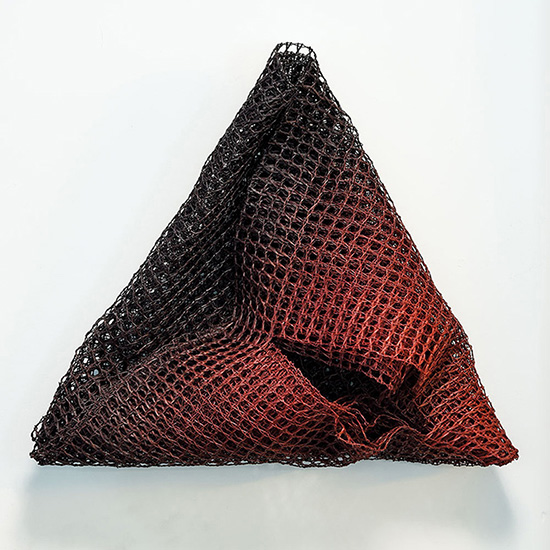
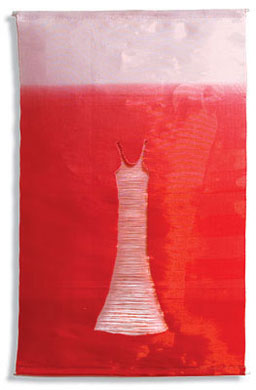
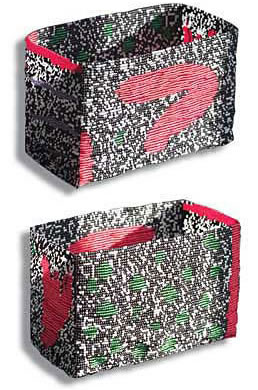
The Fall 2021 exhibition at browngrotta arts, Japandi: shared aesthetics and influences will celebrate affinities between Japan and the Nordic countries of Sweden, Finland, Norway and Denmark cultures through contemporary art. The show will feature 39 fiber and ceramic artists from Denmark, Finland, Japan, Norway, and Sweden. xJapandi is a hybrid union of Japanese and Scandinavian aesthetic approaches appreciated for its reverence for nature and natural, sustainable materials, exceptional craftsmanship, simplicity and minimalism, and the beauty of embracing imperfection. This union evokes a visual and physical sense of calm and tranquility. The exhibition will run from September 25 through October 3, 2021.
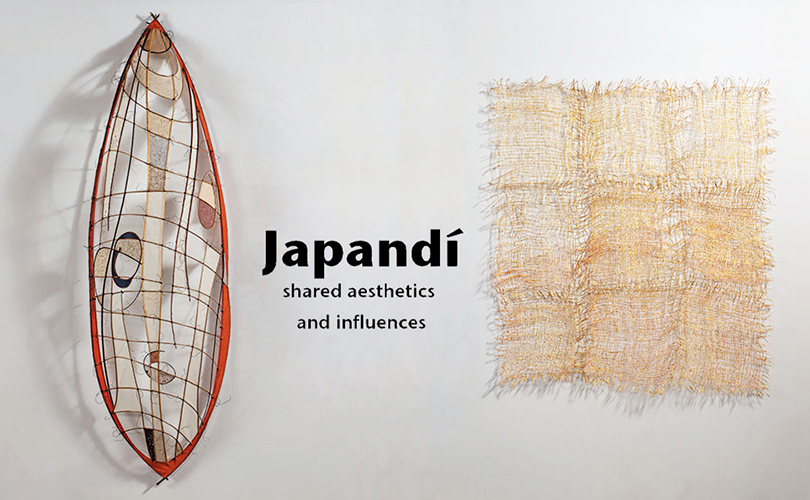
While attention on Japandi style may be currently popular, the interest in this merge of aesthetics is far from new. Artists and designers from the Nordic countries and Japan have been observing the parallels in their work and cultures for decades. Cultural and geographic elements made the Japanese work particularly appealing to Scandinavian artisans when it was first introduced to artists in the region in the 1800s. Both Japan and Northern European countries are deeply wooded and both have developed acclaimed woodworking traditions — in Scandinavia, techniques used by the Vikings and to protect against brutal winters, writes Danielle Johnson (Japonisme and the Origin of Modern Scandinavian Design,” OOKKUU, November 04, 2016.) The Japanese introduced new techniques, simplified forms, and most importantly, an approach towards woodworking that the Scandinavians deeply appreciated. The Scandinavians witnessed the fine craftsmanship and the sense of the natural materials that Japanese artisans brought to their work — particularly the manner in which the Japanese explored the wood’s essence, using minimal, refined designs so as not to detract from the experience from the viewer’s engagment with the materials.
“[B]oth cultures have developed in harsh natural environments that humans cannot control. I feel a common point for us is how to live comfortably with nature.” Kato Saeko, curator of The Shop at the cultural centre Japan House, London. (“The rise of ‘Japandi’ style,” Clare Dowdy, BBC Online, October 2019.) Finland’s Ambassador to Japan, Pekka Orpana, also acknowledged the respect for nature shared by the regions. “We come from different cultures and are very far apart, but it’s actually quite surprising how similarly [the Finnish and Japanese] visualize and see our way of life …. We have a lot of similarities that unite us … for instance, how we appreciate nature and design.”
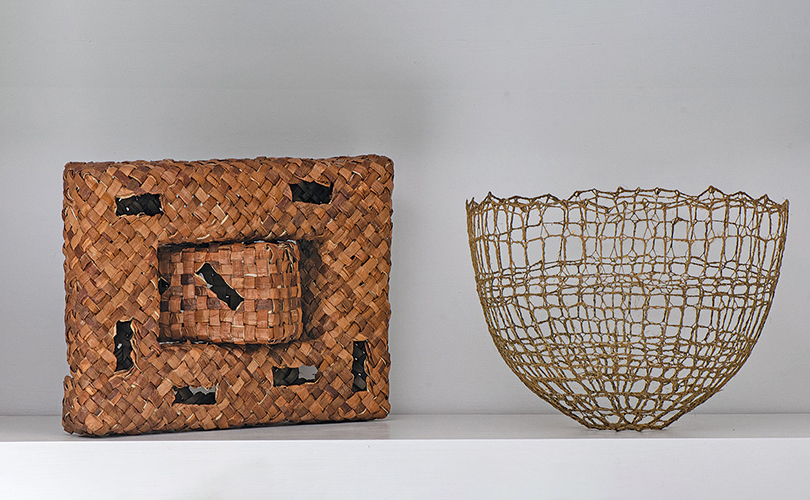
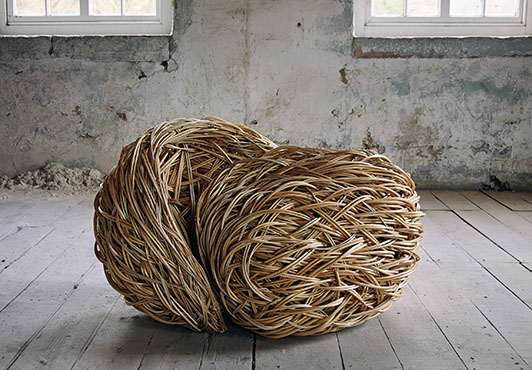
Hisako Sekijima, one of the artists in Japandi, has recognized, and embraced, the influences the cultures share. She sees a greater kinship in her approach to that taken by Nordic artisans than to the traditional aesthetics of her native Japan which are often ascribed to Zen spirit or a stylized empathy to nature in terms ofka-cho-fu-getsu (natural imageries of flower, bird, wind and the moon). Her explorations into the elegant or logical interplay between natural materials and structural methods have more to do with elemental processing of materials than emotional expressions. “When I use a branch of tree to make a basket, it becomes a kind of abstract component — a linear element with a certain role. For example, when a branch becomes a tool used to reach fruits on a high branch.” She sees a similar similar shifting of the materials’ nature in the Scandinavian object making. “Their manner is straightforward and elemental as well as universal.”
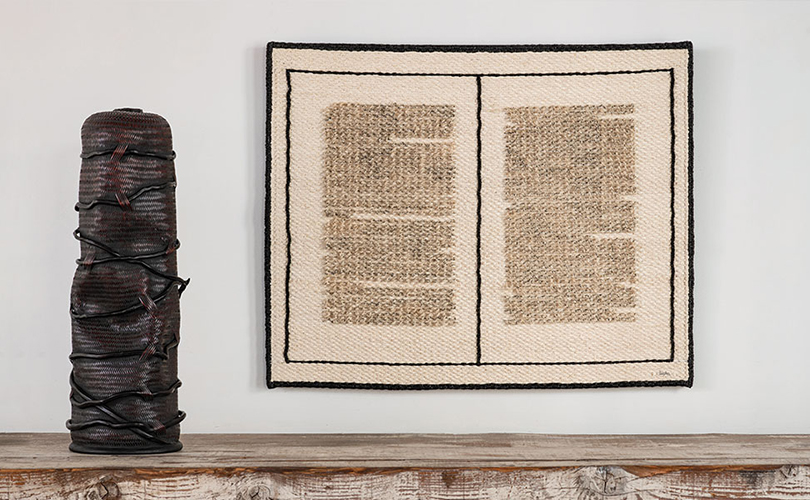
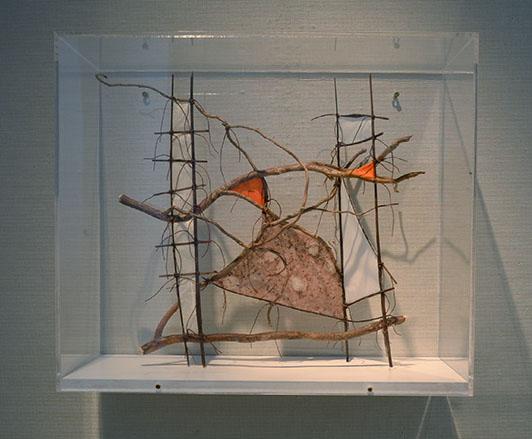
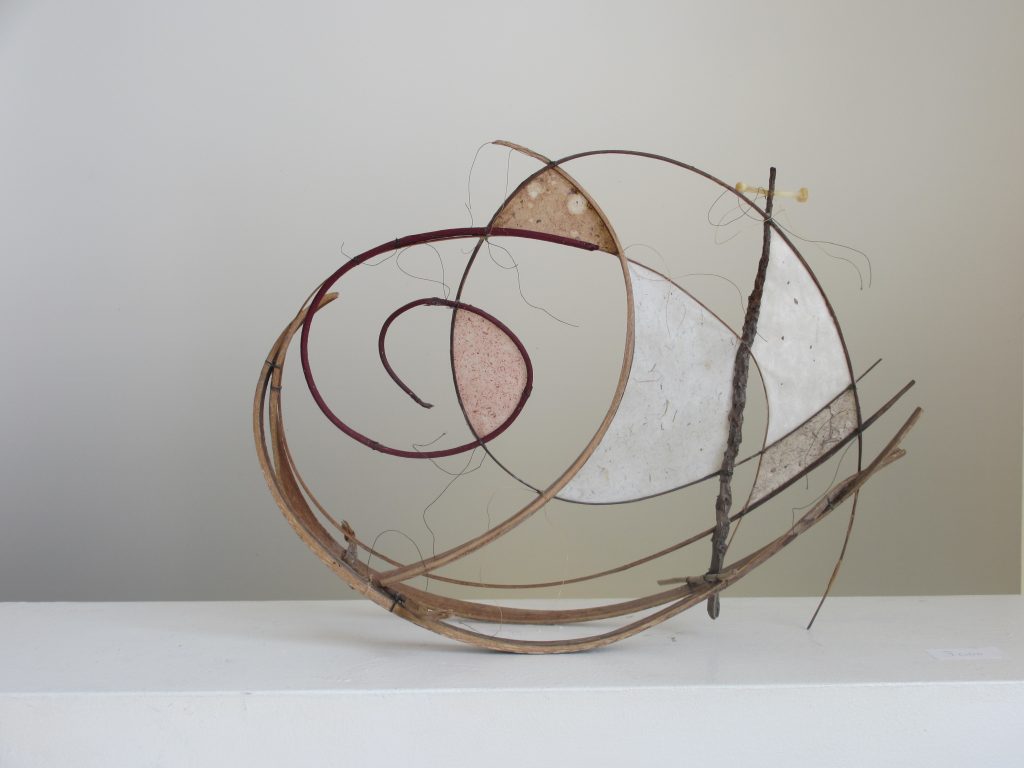
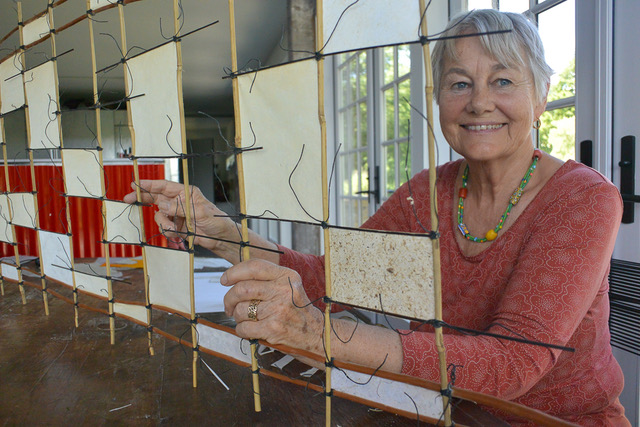
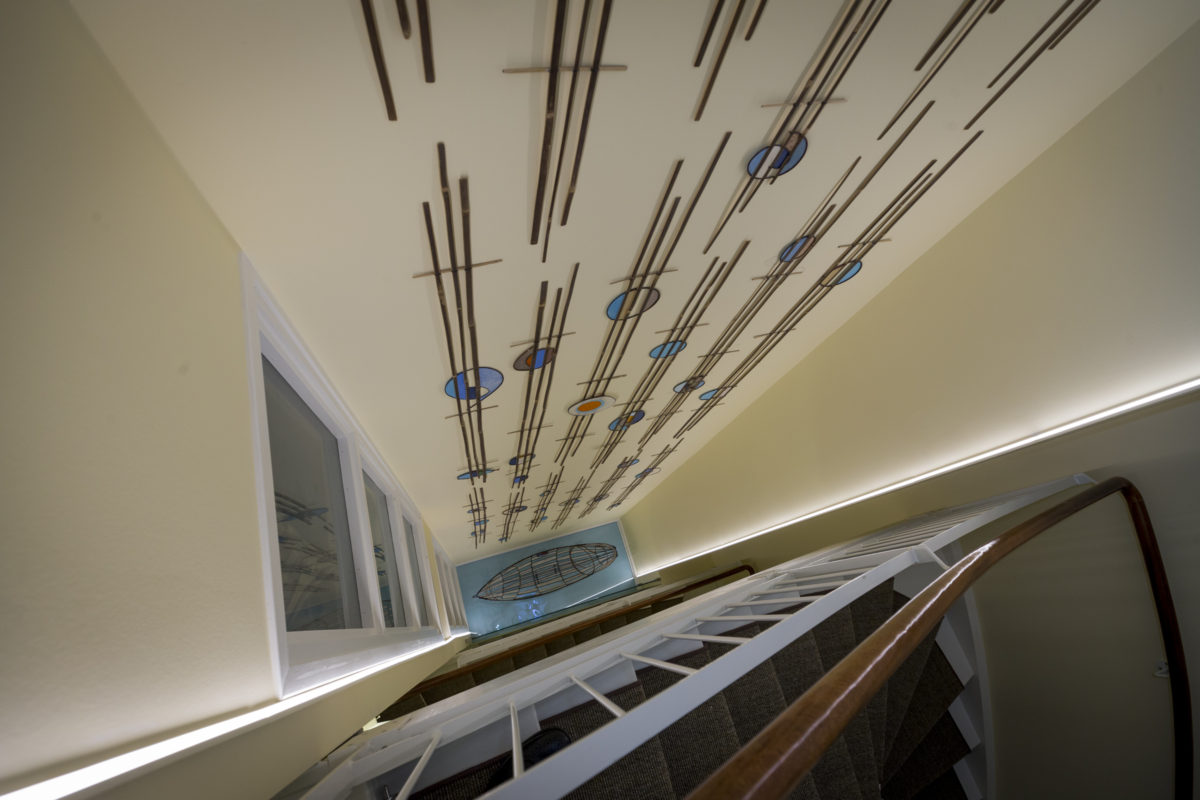
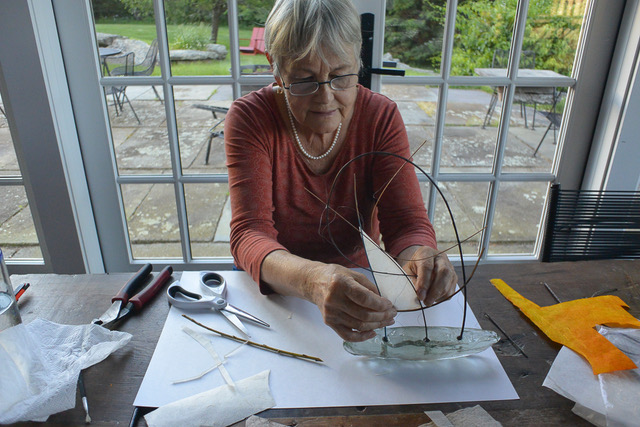
Paper is another natural material that Japanese and Nordic artists highlight in their work. “Simplicity, purity and a respect for materials is intrinsic to Japanese craft and their work links East and West by celebrating the inherent properties of paper (some areas are softly translucent, and overlaid areas exploit varying opacities) and accurately balancing material, technique and form, ” writes Sarah E. Braddock, textile lecturer, writer & curator (Project Papermoon catalog, Denmark, 2000) It was in Japan where Swedish artist Eva Vargö first experience how Japanese washi paper, especially when produced in the traditional way, exhibits a unique quality. The most interesting, in her view, was to experience how light filters through papers from lamps, paper shoji screen doors and windows. Danish artist Jane Balsgaard spent time in Japan in 1993 and 1998, preparing for exhibits there. Works of paper and twigs were the result. In her work, white paper often contrasts the dark color of the willow twigs. “Another element in her works that has connection to Japan,” writes Mirjam Golfer-Jørgensen, “is the skeleton, that partly frames the paper, partly combines with the hollows in the constuction, and gives another character to the paper that with a lightness that creates a contrast towards to the hollows.” (Influences from Japan in Dansh Art and Design 1870 – 2010, Mirjam Golfer-Jørgensen, Danish Architectural Press, 2013.)
Join us at Japandi: shared aesthetics and influences to see more ways in which these influences are exhanged and expressed. The hours of exhibtion are: Opening and Artist Reception: Saturday, September 25th: 11 to 6; Sunday, September 26th: 11 to 6; Monday, September 27th through Saturday October 2nd: 10 to 5; Sunday, October 3rd: 11 to 6; Advanced time reservations are mandatory; Appropriate Covid protocols will be followed. There will be a full-color catalog prepared for the exhibition available at browngrotta.com on September 24th.


Books Make Great Gifts 2016
Another year of widely divergent books. Art, biology, history and biography are all represented in the answers we received to the questions we asked of artists that work with browngrotta arts: What books cheered you? Inspired you? Provided an escape?
Dona Anderson, wrote that she is reading Herbert Hoover: A Life by Glen Jeansonne (NAL, New York, 2016) who calls Hoover the most resourceful American since Benjamin Franklin. “I recently had a birthday and remember that my mother went to vote on the day I was born, November 6th, and she voted for Herbert Hoover. Consequently, I started to think about what the political atmosphere was like then — as ours was so crazy and even more so now. When I went to the library in October, the Hoover book was brand new and it appealed to me.”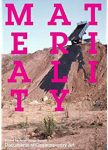 Rachel Max is reading Materiality, edited by Petra Lange-Berndt (MIT Press, Cambridge, 2015), one of the latest additons to the Whitechapel Documents of Contemporary Art series. It’s a fantastic series. Each volume in the series focuses on a specific theme and contains many thought-provoking essays from theorists and artists. Materiality not only addresses key geographical, social and philosophical issues, but it also examines how artists process and use materials in order to expand notions of time, space and participation. As the publisher notes, “this anthology focuses on the moments when materials become willful actors and agents within artistic processes.” Max has also been dipping into the diaries of Eva Hesse. “They are extremely private and were never meant for publication. But, as a huge fan of her work it is interesting to read her thoughts,” Max writes.
Nimura’s skillful crafting of a can’t-put-it-down narrative of their experiences on two sides of the Pacific is a vividly rich visual, as well as historical, account. She produced for the reader, through captivating descriptions illuminating the startling differences between these two very different cultures, the contrasting worlds we could easily visualize.
Stacy Shiff, Pulitzer Prise-winning author of Cleopatra wrote: “Nimura reconstructs their Alice-in-Wonderland adventure: the girls are so exotic as to qualify as ‘princesses’ on their American arrival. One feels “enormous” on her return to Japan.” It is just this Alice-in-Wonderland aspect of their story that caught my imagination. As in Louis Carroll’s Alice’s Adventures in Wonderland, it is the environment and the material culture that sets the stage for remarkable events. The tangible aspects of two vastly contrasting cultures – intellectually, technically, behaviorally and in terms of the accoutrements of every day life, express well the often conflicting, peculiar and unexpected events in the girls’ lives. The girls move from Japanese clothing, furniture and customs to western style and then back again feeling more comfortable in western settings than in their birth homes kneeling on the floor and lavishly swathed in yards and yards of embroidered silks.
In the late 19th century the US was bursting with inventions and change. Planning begun in the 1850s for the Chicago World’s Fair was well under way, ushering in the Gilded Age of rapid industrial growth, design innovation and expansion of popular culture. A startlingly appropriate time for the girls’ cultural experiment to take place. Nimura, who moved to Japan for three years with her Japanese/American nesei husband, was adept at utilizing her keen sense of design and broad knowledge of the two disparate material cultures. She skillfully brought to life the vast differences between the two civilizations through masterful and insightful descriptions of clothing, hairstyles, furniture, interiors, architecture as well as the cities in which they existed. This, combined with her extensive research, presents the reader with many insights into the relations between the two countries and their intertwined histories through the lives of these exceptional girls and their extraordinary adventures.
As Miriam Kingsberg of the Los Angeles Review of Books wrote, “Daughters… is, perhaps, less a story of Japanese out of place in their country, than of women ahead of their time.” Laky adds that while she was a professor of art and design at the University of California, Davis, she encouraged her students to study abroad. “This book illustrates how education and experience in a foreign country enhances understanding of other cultures and peoples – perhaps more important today than in the 1870s and 80s. I believe travel also greatly inspires creativity.”
It is a sad and exciting story about a typical lonely man in today’s Denmark, she wrote. “Written in a wonderful language – so one can just imagine him, by reading it and it is just as sad as Stoner.
As always, enjoy!