I’m no knitter, but I can online shop with the best of them. Whether you’re better at clicking knitting needles or computer keys, you can help Warming Families, a charity that knits clothing for the homeless. For every Lands’ End FeelGood Sweater purchased this Fall, the company will donate FeelGood yarn to Warming Families. Lands’ End expects to donate thousands of pounds of yarn — enough for volunteers to knit as many as 25,000 men’s, women’s and children’s hats. Vickie Howell, the host of DIY Network’s Knitty Gritty, as designed two hat patterns for Land’s End that you can download at http://www.landsend.com/lp/feelgood/feelgoodbeanie.pdf, if you want to join the Warming Families knitting volunteers. There’s also an instructional video with Vicki Howell that you can watch at the Lands’ End/Feel Good website.Buy a Sweater; Help the Homeless
I’m no knitter, but I can online shop with the best of them. Whether you’re better at clicking knitting needles or computer keys, you can help Warming Families, a charity that knits clothing for the homeless. For every Lands’ End FeelGood Sweater purchased this Fall, the company will donate FeelGood yarn to Warming Families. Lands’ End expects to donate thousands of pounds of yarn — enough for volunteers to knit as many as 25,000 men’s, women’s and children’s hats. Vickie Howell, the host of DIY Network’s Knitty Gritty, as designed two hat patterns for Land’s End that you can download at http://www.landsend.com/lp/feelgood/feelgoodbeanie.pdf, if you want to join the Warming Families knitting volunteers. There’s also an instructional video with Vicki Howell that you can watch at the Lands’ End/Feel Good website.Check It Out: All in the Family
The fashion line, Vena Cava boasts fans from Maggie Gyllenhaal to Rita Wilson to the Gossip Girls set. Started in 2003 by a two graduates of Parsons School of Design, who had been friends since high school, the line received back-to-back nominations for the Vogue/CFDA Fashion Fund Award in 2007 and 2008 and has garnered well-deserved acclaim for its “fresh spin on vintage mixed with an arty palette and hand-drawn prints.” Vena Cava collections have been inspired by Japan, Egyptian history and this year, wall murals of South Africa’s Ndebele tribe.
Admittedly, we are not so fashion forward around here. But we do love the Vena Cave blog, Viva Vena Cava at blogspot. http://www.vivavenacava.blogspot.com/ There are interesting textile finds — a Navajo rug, a beaded wall hanging. And lots of other posts of interest, from a Safety Pin Vest (a DIY version of the Safety Pin Camisole from the designers’ Spring 2010 line ) to photos of elaborately carved Sculptures of Cheese. But why did we check it out in the first place? Because Sophie Buhai, one of the firm’s principals (the other is Lisa Maycock) is Tom’s second cousin. And we’re proud. Check it out.
News Feed: Swimming Set to Decide “What is a Textile?”
FINA, the international governing body of swimming, has banned performance-enhancing “non-textile” swimsuits as of January 1, 2010, but has tabled the determination of “what is a textile?” until later this Fall.
High-tech suits made of 50% polyurethane were first worn in world competition in 2008. A second generation of the suits, made of 100% polyurethane, appeared after the summer Olympics. The material is thought to compress muscle, add extra buoyancy and provide more forward propulsion. More than 130 short- and long-course world records have been broken since swimmers started sporting the super suits. In fact, only two of the current world records were set before their introduction. Record-breaking is likely to slow once the ban is in place. Accordingly, some in the swimming community support a proposal to place an asterisk next to the world records set in polyurethane suits to distinguish records set before and after the suits were prohibited.FINA has some fine-tuning ahead. Its ruling says that only “allowable textiles” will be permitted, but that term has not been defined. In the art world, the definition of “textile” is quite expansive. Polyurethane would certainly be included if it was braided or plaited or woven or the like. According to WiseGEEK, “polyurethane is an incredibly resilient, flexible, and durable manufactured material that can take the place of paint, cotton, rubber, metal, and wood in thousands of applications across all fields.” Like tyvek®, mylar, fiber optic and stainless steel threads, it sounds like a promising material for artistic exploration — if not for athletic competition.
What Do You Think??
So, what should FINA consider when it takes up the question at its next bureau meeting this month or next? As SwimNews.com opined: “Definition of textile is important, profile specification is important, having no zipper is important. Work to be done.”
Here’s your chance: Do you have any advice for FINA on crafting its definition of “allowable textiles”? Let us know.
Guest Post Alert: Nancy Moore Bess
In less than a week, on Sunday, September 20, 2009, we’ll inaugurate our first Guest Post. Our first guest blogger will be artist, author, curator, teacher and art tour guide Nancy Moore Bess. Nancy’s work has been exhibited or acquired by the Museum of Arts and Design, New York; Barbican Centre, London; Szombathely Art Museum, Hungary; the Hunterdon Art Museum, New Jersey; the Contemporary Jewish Museum, San Francisco; Racine Art Museum, Wisconsin; and the Society for Arts and Crafts in Boston. Nancy is an insightful observer of the fiber art field and an acclaimed writer. Nancy lived and researched bamboo in Hawaii and Japan, then authored Bamboo in Japan, now in its second printing. The Japan Times called Bamboo in Japan, “a compendium of information that is not likely to be soon duplicated” and “one of the best-designed books of the year.”Art Insurance Intel
Do you remember back in the 80s, when shelter magazines featured shots of art work leaned against the wall rather than hung? Two of our clients suffered art damage following this pet- and vacuum-level installation trend. Maybe art insurance would have softened the blow.
Anyway, if you’ve ever wondered if you should insure your art collection the September 2009 issue of Art + Auction features a helpful guide. The article includes a graphic quiz to help you decide if you need specialized insurance or if a renter’s or homeowner’s policy will do.
And speaking of Art + Auction, look for our ad for the 10th Wave III: In Person exhibit in the October issue.
News Feed: Fabric at the Forefront in the H1N1 Flu Fight
Can textiles save lives? According to health experts, fabric can play a major role. All you need do is sneeze or cough into your sleeve. When you do, mucus droplets laden with disease-causing organisms are released into fabric where they soon dry and any microorganisms die or become inert. Reportedly, the flu virus can last up to 48 hours on impenetrable surfaces like plastic but survives a shorter time on porous surfaces like paper or cloth. In addition, when you practice what’s now known as “the Dracula sneeze,” microorganisms don’t wind up on your hands, and so aren’t transferred on to telephones, doorknobs, eyes, nose, or mouths.
Everyone’s pushing the “spread the word, not the germs” message. Elmo from Sesame Street will help Health and Human Services in public service ads this month. Schools and health departments in the U.S. and Canada are showing the amusing video, Why Don’t We Do It in Our Sleeves?, created by Ben Lounsbury, M.D., an otorhinolaryngologist (ENT physician). The purpose of the video, says the website, “is to make coughing into one’s sleeve fashionable, even patriotic.”
Speaking of fashion, you’ll find ideas for coping with the H1N1 outbreak wth style online, at flufashion.net which offers N95 respirator facemasks in bandana-style or animal prints. There are also shots on the internet of those who’ve chosen to style their own surgical masks. The CDC says facemasks and respirators are generally not recommended in community and home settings, except possibly for persons at increased risk of severe illness from flu or who are in crowded community settings where the flu has been diagnosed. If you fall into one of those groups, though, you’ve now got fashion options.
In Process: Randy Walker
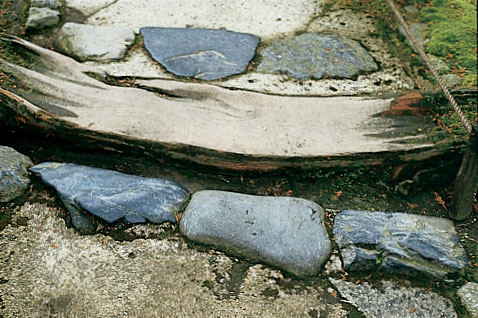
To accommodate the tensile nature of fiber, Randy Walker seeks out frameworks that can act as looms, or creates his own, like this corncrib in Kalamazoo. “I scour my environment for suitable materials, like a spider trying to locate a site to build its web,” he explains. “These frameworks can be found objects like saw blades or window screens, or they can be architectural spaces, but they must be satisfactory structurally and sculpturally. I am, therefore, intensely engaged with the materials I use, studying them for cues as to how I might handle them. These armatures eventually define a working method for a particular piece.”
This installation, Woven Corncrib, is part of the Western Michigan University (Kalamazoo) Sculpture Tour. National and international artists are commissioned to create and install work on the campus for two years. It was originally installed in Falcon Heights, Minnesota from 2004-9, using remnants of marine rope of various types. At WMU it was completely rewoven with a flat braid of 100% solution-dyed acrylic. The weaving process took two weeks of solid work. Although the installation will be up for two years, the braid material is expected to last much longer in terms of both color-fastness and material degradation.“For quite some time I have been interested in how fiber might be used in public artwork on large scales in a world where public art is predominantly seen by commissioning agencies as ‘permanent,’ ‘no-maintenance,’ etc. In other words: concrete, stone, steel,” Randy says. “While these more traditional materials are more permanent, even they need maintenance. Because there is often no funding or planning associated with maintenance of these “permanent” pieces, there are many around the country in states of decay. With the technological advances being made in fiber, and a fundamental shift in thought of what a work of public art could, I believe that it is possible to create art that has a planned maintenance, or regenerative potential. The Woven Corncrib is an example. It is re-woven, and a new piece is born from the old.”
Woven Corncrib, Western Michigan University, Kalamazoo, Michigan, photos courtesy of Randy Walker.
Check It Out: Helena Hernmarck and Norma Minkowitz at MAD
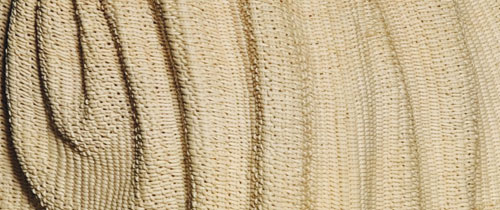
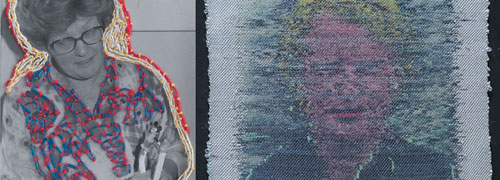
The Museum of Arts and Design in New York has rotated new works into Permanently MAD: Revealing the Collection, which traces the phenomenal rise of the studio craft tradition in America following World War II. The new additions include Floater IV, by Norma Minkowitz and Front Pages by Helena Hernmarck. Go see the new work. Here are images other works by Norma and Helena to whet your appetite.
Newsfeed: Innovation’s Downside
KUALA LUMPUR, Aug 28 (From Bernama) – International cocaine trafficking syndicates have found a clever way to venture into textiles. Police nabbed a 42-year-old woman flying from Peru to Kuala Lumpur airport last week, carrying two bags. A check on the suspect’s luggage revealed 23 shirts of similar colour and design. Police grew suspicious when they noticed the shirts were heavy – weighing 10 kg – and rough to the touch. Apparently, she was one of a group of fashionable drug mules recruited to carry more than just a copious amount of clothes in their luggage when heading overseas. The dealers liquify the cocaine, then dip the clothes in the solution. Once dried it’s ready to smuggle into another country. Upon arrival at their destination, the clothes are soaked in water and wrung dry. The cocaine liquid that results is crystallised for sale to ready buyers.
Search
Subscribe2
Recent Posts
- January 21, 2026
- January 14, 2026
- January 7, 2026
Pages
blogroll
Archives
- January 2026
- December 2025
- November 2025
- October 2025
- September 2025
- August 2025
- July 2025
- June 2025
- May 2025
- April 2025
- March 2025
- February 2025
- January 2025
- December 2024
- November 2024
- October 2024
- September 2024
- August 2024
- July 2024
- June 2024
- May 2024
- April 2024
- March 2024
- February 2024
- January 2024
- December 2023
- November 2023
- October 2023
- September 2023
- August 2023
- July 2023
- June 2023
- May 2023
- April 2023
- March 2023
- February 2023
- January 2023
- December 2022
- November 2022
- October 2022
- September 2022
- August 2022
- July 2022
- June 2022
- May 2022
- April 2022
- March 2022
- February 2022
- January 2022
- December 2021
- November 2021
- October 2021
- September 2021
- August 2021
- July 2021
- June 2021
- May 2021
- April 2021
- March 2021
- February 2021
- January 2021
- December 2020
- November 2020
- October 2020
- September 2020
- August 2020
- July 2020
- June 2020
- May 2020
- April 2020
- March 2020
- February 2020
- January 2020
- December 2019
- November 2019
- October 2019
- September 2019
- August 2019
- July 2019
- June 2019
- May 2019
- April 2019
- March 2019
- February 2019
- January 2019
- December 2018
- November 2018
- October 2018
- September 2018
- August 2018
- July 2018
- June 2018
- May 2018
- April 2018
- March 2018
- February 2018
- January 2018
- December 2017
- November 2017
- October 2017
- September 2017
- August 2017
- July 2017
- June 2017
- May 2017
- April 2017
- March 2017
- February 2017
- January 2017
- December 2016
- November 2016
- October 2016
- September 2016
- August 2016
- June 2016
- April 2016
- March 2016
- February 2016
- December 2015
- October 2015
- September 2015
- August 2015
- June 2015
- May 2015
- April 2015
- March 2015
- February 2015
- January 2015
- December 2014
- November 2014
- October 2014
- September 2014
- August 2014
- July 2014
- June 2014
- May 2014
- April 2014
- March 2014
- February 2014
- January 2014
- December 2013
- October 2013
- September 2013
- July 2013
- June 2013
- May 2013
- April 2013
- March 2013
- January 2013
- December 2012
- November 2012
- October 2012
- September 2012
- August 2012
- July 2012
- June 2012
- May 2012
- April 2012
- March 2012
- February 2012
- January 2012
- December 2011
- November 2011
- October 2011
- September 2011
- August 2011
- July 2011
- June 2011
- May 2011
- April 2011
- March 2011
- February 2011
- January 2011
- December 2010
- November 2010
- October 2010
- September 2010
- August 2010
- July 2010
- June 2010
- May 2010
- April 2010
- March 2010
- February 2010
- January 2010
- December 2009
- November 2009
- October 2009
- September 2009
- August 2009
Categories
- Acquisitions
- Aldrich Museum of Contemporary Art
- Allies for Art
- An Unexpected Approach
- Anniversary
- Architecture
- Art
- art + identity
- Art Assembled
- Art Materials
- art money
- Art Preview
- Art Textiles
- artist
- Artsy
- Awards
- bamboo
- Basketmakers
- Basketry
- Behind the Scenes
- Blue/Green
- Book Recommendations
- Books
- Catalogs
- Ceramics
- Charity
- Classes
- Collage
- Collectors
- Commentary
- Commission
- Commissions
- Danish Tapestry
- DIY
- Eco-Art
- Exhibitions
- Fashion
- Fiber Future
- Fiber Sculpture
- Film
- Galleries
- Gifts
- Guest Post
- History
- In the News
- Installations
- Japandi
- Japanese Art
- Japanese Ceramics
- Lectures
- Mixed Media
- Museums
- New This Week
- New York
- Obituary
- Obiturary
- Outdoors
- Paper
- Philadephia Museum of Art
- Photography
- Politics
- Pop-Up Exhibition
- Press
- Process Notes
- Sculpture
- SOFA
- Sweepstakes
- Tapestry
- tate modern
- Technology
- Text Art
- Travel
- Uncategorized
- Volume 50: Chronicling Fiber Art for Three Decades
- White
- White Art
- Who Said What
- Wood
- Workshops
Tags
Adela Akers art assembled Basketry browngrotta arts Carolina Yrarrázaval Dorothy Gill Barnes Ed Rossbach Gyöngy Laky Heidrun Schimmel Helena Hernmarck Hisako Sekijima James Bassler Jane Balsgaard Jennifer Falck Linssen Jin-Sook So Jiro Yonezawa John McQueen Judy Mulford Karyl Sisson Kay Sekimachi Kiyomi Iwata Kyoko KumaI Lawrence LaBianca Lenore Tawney Lewis Knauss Lia Cook Magdalena Abakanowicz Marian Bijlenga Mariette Rousseau-Vermette Mary Giles Mary Merkel-Hess Nancy Koenigsberg Nancy Moore Bess Naoko Serino Naomi Kobayashi Norma Minkowitz Rachel Max Randy Walker Sheila Hicks Sheila hicks Stéphanie Jacques Sue Lawty Tapestry Wendy Wahl Yasuhisa KohyamaAbout browngrotta.com
blogroll
reboot
site-ings
who's showing where
Subscribe
Pages
Archives
Calendar


Guest Post Alert: Nancy Moore Bess
Haystack–Renewal–Magic!
by Nancy Moore Bess
Click Guest Posts tab to read Nancy’s Haystack Reverie