THE VOCABULARY FOR DEFINING BEAUTY
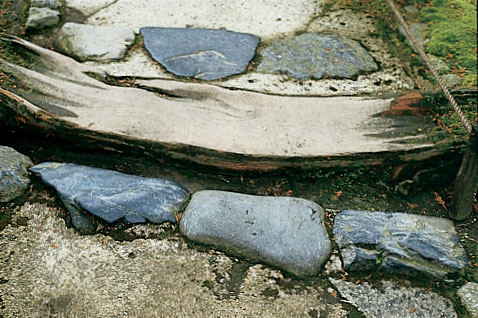
photo Nancy Moore Bess
Nancy Moore Bess has penned her fifth and last Guest Post this year, The Vocabulary for Defining Beauty. To read it, with our thanks, click Guest Posts above.

THE VOCABULARY FOR DEFINING BEAUTY
photo Nancy Moore Bess
Nancy Moore Bess has penned her fifth and last Guest Post this year, The Vocabulary for Defining Beauty. To read it, with our thanks, click Guest Posts above.

Nancy Moore Bess writes on Japan and its influence on her work.
Click “Guest Posts” to read the entire post.
 The opening of the 10th Wave III at Artifact Design Group, 2 Hollyhock Lane, Wilton Connecticut is from 3:30 to 7:30 this Friday the 9th of October. The exhibition features work from more than 40 artists from Europe, Asia, Canada, the US and the UK. Also featured in the exhibition are new furniture designs by Gregory Clark. The show will run through November 28, 2009. Hope you’ll get a chance to stop by!
For more information check the Events and Calendar Pages on our website: www.browngrotta.com.
October 4, 2009
Carving Foam For Fiber Sculpture
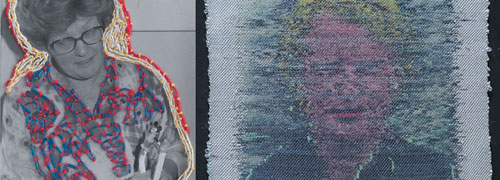
postcard and weaving of Katherine Westphal by Ed Rossbach
The American Craft Council has announced that Katherine Westphal has been selected to receive the 2009 Gold Medal, for consummate craftsmanship. Thirty-nine other artists have been awarded a Gold medal, including artists Sheila Hicks, Lenore Tawney, Dale Chihuly, Jack Lenor Larsen and Ruth Duckworth. Artists selected must have demonstrated extraordinary artistic ability and must have worked 25 years or more in the discipline or career in which they are being recognized.
Katherine was born in 1919. She studied painting, intending to be a commercial artist. In 1946, she was hired to teach design at the University of Washington in Seattle. It was there she met and married fellow faculty member, and later ACC Gold Medalist, Ed Rossbach. In 1950, the couple moved to Berkeley and Westphal began working with textiles. For eight years she designed commercial fabrics. In the mid-60s she accepted what she thought was a short-time assignment teaching industrial design at the University of California, Davis. She stayed 13 years, retiring as Professor Emeritus in 1979. From 1997 to 2001, the couple’s work was featured in museums across the US in a traveling exhibition, The Ties That Bind, Fiber Art by Ed Rossbach and Katherine Westphal from the Daphne Farago Collection.
Westphal has concentrated on surface, pattern and decoration in textiles, quilts and clothing, as well as baskets. The use of fractured and random images became a signature of her work. Her collages combined bold images and bright colors. In the catalog for the OBJECTS USA exhibition in 1970, she wrote, “I was trained as a painter. I see things from that viewpoint. I build up; I destroy. I let the textile grow, never knowing where it is going or when it will be finished. It is cut up, sewn together, embroidered, quilted, embellished with tapestry or fringes, until my intuitive and visual senses tell me it is finished and the message complete.”

UNTITLED KIMONO
Shortly after the color copier was introduced, while others were still concentrating on standard office applications, Westphal recognized the technology’s creative potential. She used heat transfer paper to imprint images onto paper and cloth, combining photographs that she had taken herself with found images, altering them, then tearing, cutting, rearranging and stitching them back together. Jo Ann Staab described the process in Surface Design in 1999, “She would also deliberately move an image while the copier was running, so that the print was blurred, or the movement was traced into a new image. It was magic. She took these images and incorporated them into her textile designs, her handmade books, and even her woven designs. One day I saw her working with an image of boisterous tennis star John McEnroe with his signature mop of red curls wrapped in a headband. She had abstracted and silhouetted an action pose and was setting up a diagonal repeat on sheets of copy paper taped together. I said, ‘Oh, that’s John McEnroe, I can tell because of his hair.’ She responded, ‘Oh, I don’t know who it is, I just liked the movement in this image – it’s from one of those sports magazines.’ Later the image emerged in a highly technical Jacquard weave repeat that Katherine produced as part of the Jacquard Project sponsored by the Rhode Island School of Design; row upon row of McEnroe figures pushed to a completely different level of abstract design meticulously rendered in multi-harness brocade.”
Westphal’s inventive approach has influenced myriad artists. As Ken Johnson, wrote of her and her husband, in the New York Times in 1998, “The permissions extended by Mr. Rossbach and Ms. Westphal have inspired generations of craftsmen. For each, weaving is a conservative discipline against which to react by using improbable materials, techniques or, occasionally, images. You don’t think about how beautifully or skillfully their works are made, but rather how inventively they play off conventional expectations.”
A SINGULAR VOICE – LESLEY DILL
by Nancy Moore Bess

Click Guest Posts tab to read about Nancy’s visit to Lesley Dill’s traveling exhibition.
Lesley Dill (b. 1950)
Dress of Inwardness
2006
white painted bronze, unique
Collection of Karen and Robert Duncan, Lincoln, NE
 I’m no knitter, but I can online shop with the best of them. Whether you’re better at clicking knitting needles or computer keys, you can help Warming Families, a charity that knits clothing for the homeless. For every Lands’ End FeelGood Sweater purchased this Fall, the company will donate FeelGood yarn to Warming Families. Lands’ End expects to donate thousands of pounds of yarn — enough for volunteers to knit as many as 25,000 men’s, women’s and children’s hats. Vickie Howell, the host of DIY Network’s Knitty Gritty, as designed two hat patterns for Land’s End that you can download at http://www.landsend.com/lp/feelgood/feelgoodbeanie.pdf, if you want to join the Warming Families knitting volunteers. There’s also an instructional video with Vicki Howell that you can watch at the Lands’ End/Feel Good website.
The fashion line, Vena Cava boasts fans from Maggie Gyllenhaal to Rita Wilson to the Gossip Girls set. Started in 2003 by a two graduates of Parsons School of Design, who had been friends since high school, the line received back-to-back nominations for the Vogue/CFDA Fashion Fund Award in 2007 and 2008 and has garnered well-deserved acclaim for its “fresh spin on vintage mixed with an arty palette and hand-drawn prints.” Vena Cava collections have been inspired by Japan, Egyptian history and this year, wall murals of South Africa’s Ndebele tribe.
 Admittedly, we are not so fashion forward around here. But we do love the Vena Cave blog, Viva Vena Cava at blogspot. http://www.vivavenacava.blogspot.com/ There are interesting textile finds — a Navajo rug, a beaded wall hanging. And lots of other posts of interest, from a Safety Pin Vest (a DIY version of the Safety Pin Camisole from the designers’ Spring 2010 line ) to photos of elaborately carved Sculptures of Cheese. But why did we check it out in the first place? Because Sophie Buhai, one of the firm’s principals (the other is Lisa Maycock) is Tom’s second cousin. And we’re proud. Check it out.

Check Out: “Has Conceptual Art Jumped the Shark Tank?” in the NYT
Don’t miss this week’s New York Times Op Ed by Denis Dutton: “Has Conceptual Art Jumped the Shark Tank?” http://www.nytimes.com/2009/10/16/opinion/16dutton.html?pagewanted=1&em.
Dutton is a professor of the philosophy of art at the University of Canterbury in New Zealand and the author of The Art Instinct: Beauty, Pleasure and Human Evolution, who takes a skeptical look at the long-term investment value of conceptual artwork.
In his editorial, Dutton questions whether conceptual art, i.e., work we admire not for skillful hands-on execution by the artist, but for the artist’s creative concept, has staying power. Human beings have a permanent, innate taste for virtuoso displays in the arts, observes Dutton, while the appreciation of contemporary conceptual art depends not on recognizable skill, but “on how the work is situated in today’s intellectual zeitgeist.” Dutton’s prediction: “Future generations, no longer engaged by our art ‘concepts’ and unable to divine any special skill or emotional expression in the work, may lose interest in it as a medium for financial speculation and relegate it to the realm of historical curiosity.” Not to worry. “There are plenty of prodigious artists at work in every medium, ready to wow us with surprising skills,” concludes Dutton. We agree.