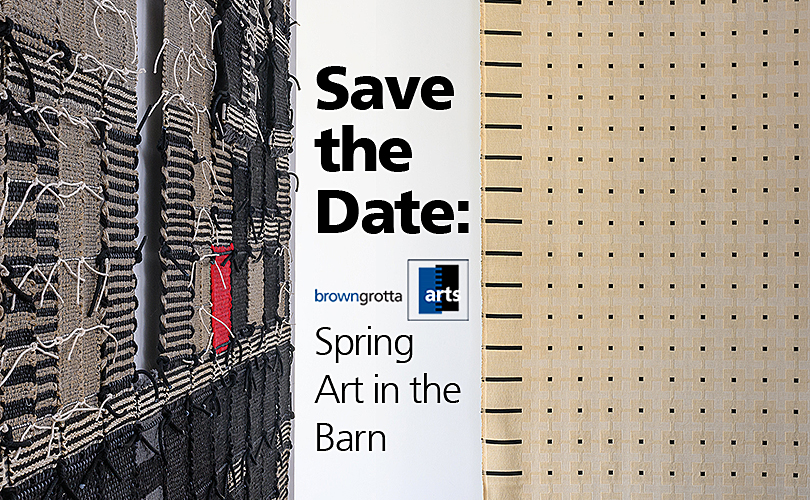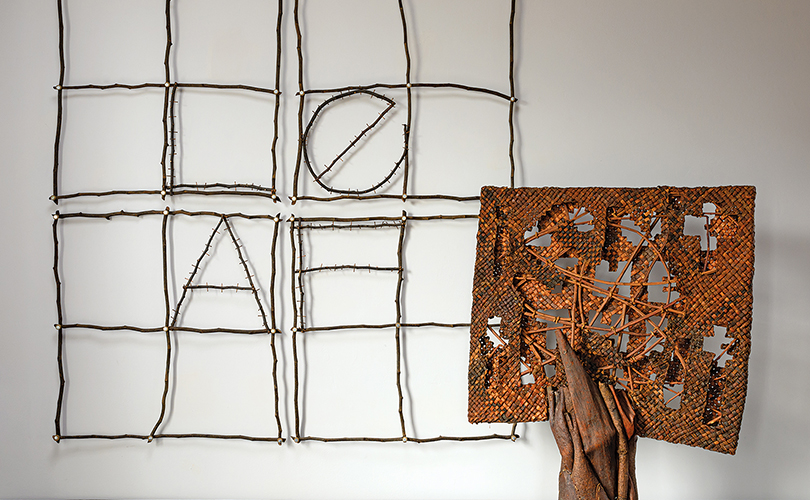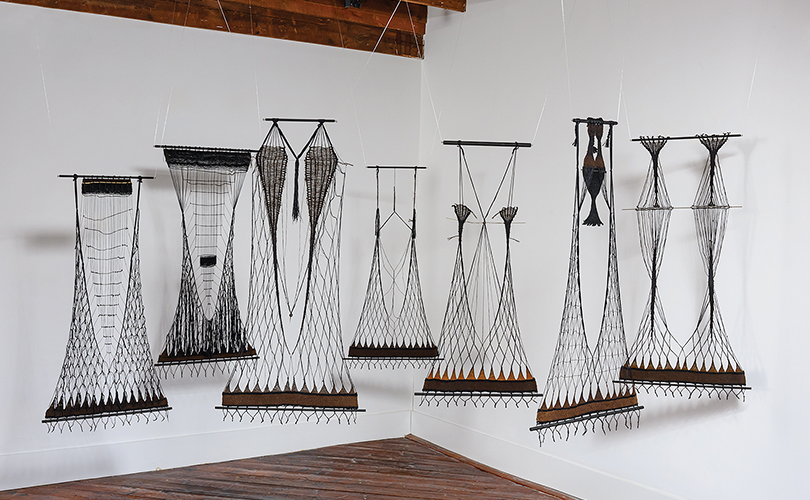
Tag: Aby Mackie

Art Assembled for March

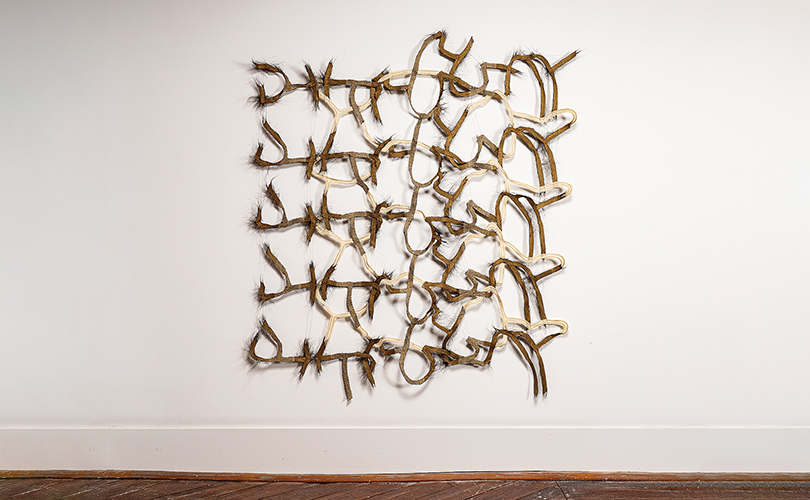
Our New this Week instagrams and browngrotta-created artlive videos in March were populated with works that evidence singular intention and mastery of a variety of materials. The featured artists reinvisioned everything from paper straws, to repurposed textiles, to willow branches with catkins intact. 
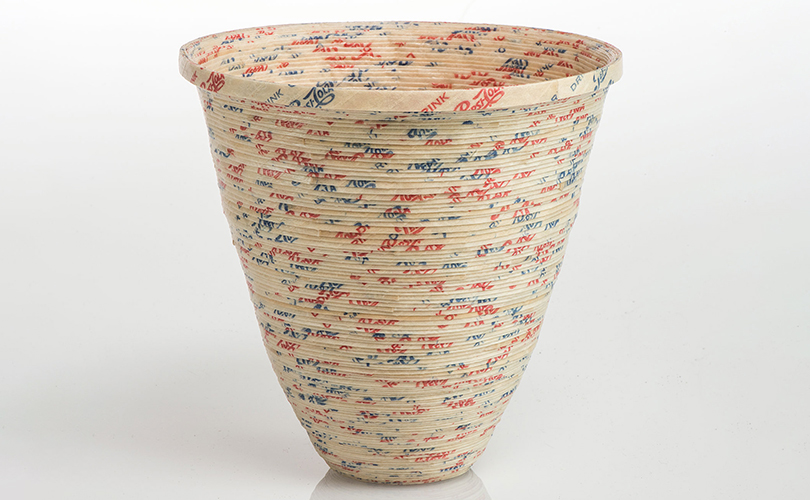
Pepsi Cola Faux Pot by Karyl Sisson
93ks Pepsi Cola Faux Pot, Karyl Sisson, vintage paper drinking straws and polymer, 5.75″ x 6″ x 6″, 2015. photo by Tom Grotta

The first work we highlighted was Karyl Sisson’s Pepsi Faux Pot. For years, Karyl Sisson has been collecting things like sewing notions — buttons and zippers, womenʼs vanity items — bobby pins, hair pins, and curlers, and paper drinking straws like the straws in Pepsi Cola Faux Pot. “I like the idea and practice of recycling and am drawn to undervalued and overlooked materials,” Sisson says. “These common, manufactured objects, reminiscent of my childhood, are the building blocks of my sculptures and wall art, while simple interlocking techniques found in basketry and needlework are usually the method of construction.”
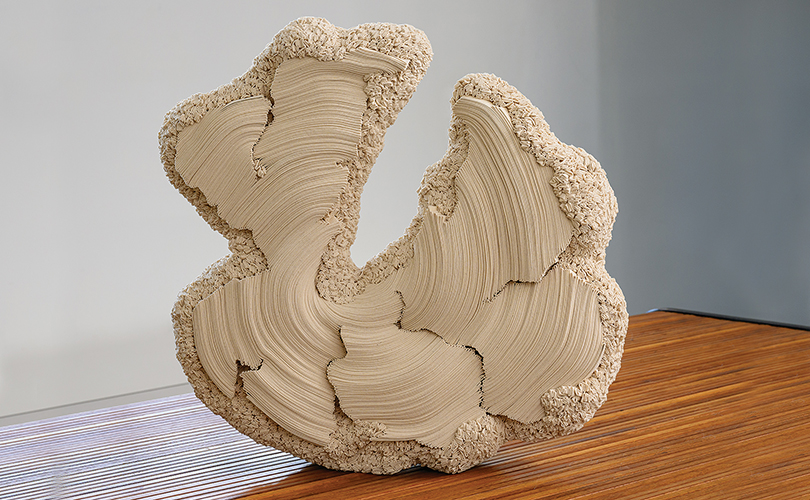
Simone Pheulpin cotton sculpture
42sp Tom, Simone Pheulpin, cotton, 17.75” x 14.5” x 11.25”, 2023. Photo by Tom Grotta

Our video of Simone Pheulpin’s Nova, part of the Eclipse series, gives viewers an opportunity to see up close the remarkable alchemy involved in this artist’s work. In Pheulpin’s hands humble strips of cotton become remarkable objects that evoke natural phenomena. She uses a method of her own devising, using neither glue or stitches. “I’m very, very interested in the roots, the layers, everything that is natural,” Pheulpin says. “The concretions, the accumulations, I love that, that’s the basic nature, the basis of my inspiration. I really like everything that is linear, everything that is repeated, piles of wood, walls. I love the walls, also by the sea, for example, the flowing water, the marks in the sand, the desert, the dunes, all that.” Pheulpin’s work will be part of a deep dive into materials in our upcoming exhibition, Transformations: dialogues in art and materials (May 9 – 17, 2026). 
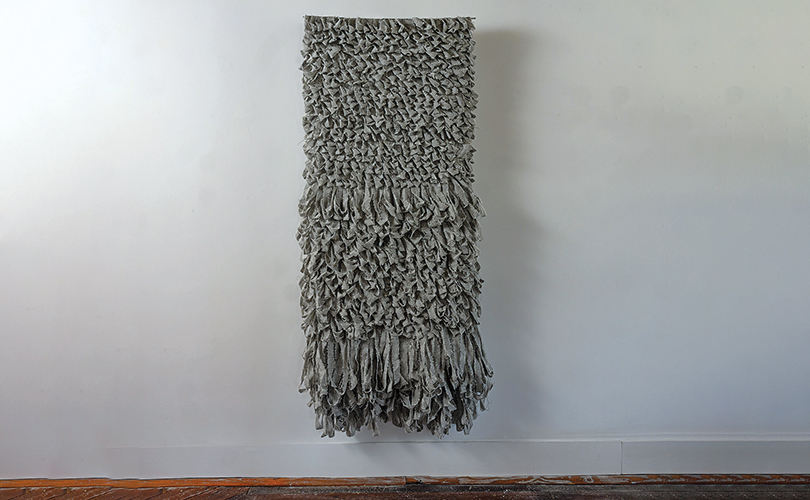
Aby Mackie textile
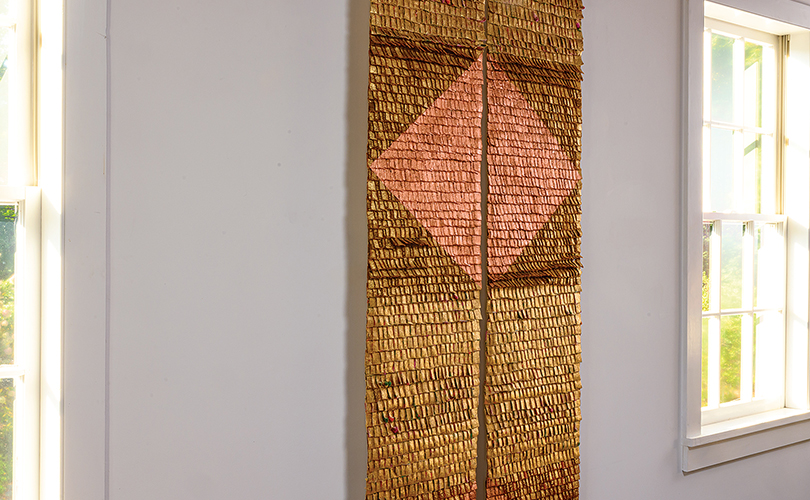
10am Between Order and Chaos, Aby Mackie, reconstructed domestic textiles 6, 83″ x 37″ x 6″, 2022. Photo by Tom Grotta

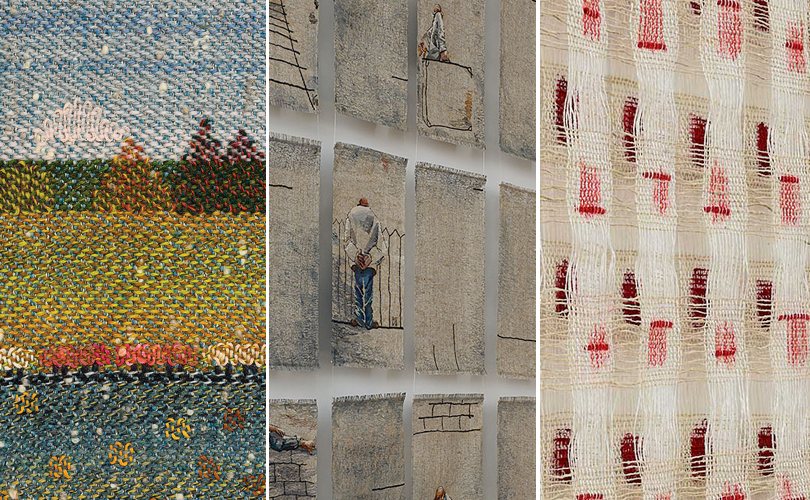
Barcelona-based artist Aby Mackie also approaches “humble” material in innovative ways — in her case, discarded textiles and household remnants are repurposed as fine art. Sourced from the streets of Barcelona, in works like Between Order and Chaos, she reimagines overlooked materials as powerful reflections on memory and value. In Barcelona, the contents of entire homes are often either thrown into the streets or auctioned off at Encants Vells market. The creation of Mackie’s work is driven by the selection and repurposing of objects and textiles from these sources in order to explore ongoing cultural themes, including materialism and consumerism. Mackie’s work will also be included in Transformations in May.
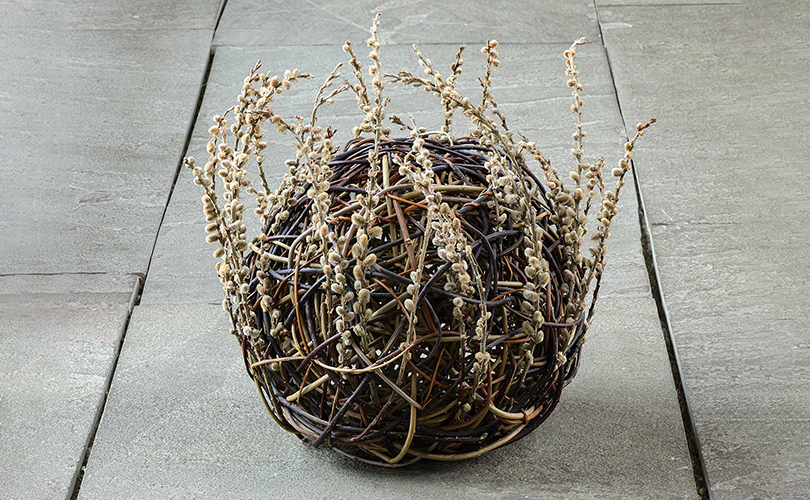
Lizzie Farey Willow basket
3lf.1 Willow Ball 2, Lizzie Farey, willow, 18” x 18” x 18”, 2000. Photo by Tom Grotta

The inspiration for Lizzie Farey’s work comes from the inherent qualities found in the natural materials around her Scotland location. Using willow, birch, heather, bog myrtle, and many other locally grown woods, her work ranges form traditional to organic sculptural forms — much of it pushing the boundaries of traditional technique.  In Willow Ball – 2 and Pussy Willow Bowl, willow seems to have been plucked unchanged from its natural surroundings, yet, with shape and color, the artist adds more. The works achieve Farey’s aim, to create baskets as reminders of the intense pleasure of nature – taking viewers to a place and a time that is universal.
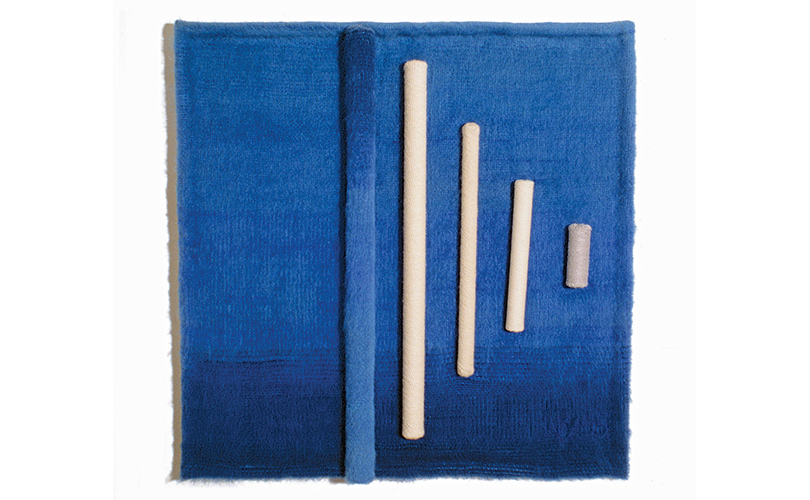
Mariette Rousseau-Vermette tapestry
600mr Verticles mdans le Bleu, Mariette Rousseau-Vermette, wool and aluminum , 38” x 38”, 1995. Photo by Tom Grotta

Mariette Rousseau-Vermette was a noted Quebec-based Canadian tapestry artist who pioneered innovations in fiber art during the 1960s, 70s and 80s. Rousseau-Vermette created weavings in which she experimented with scale, form, material, and color, which became known as tapestry-paintings. In Verticles dans le bleu the artist incorporates metal tubes wrapped in wool to create dimension and interest. Rousseau-Vermette’s work mixing optical fibers and wool will be included inTransformations in May.
John Garrett basket
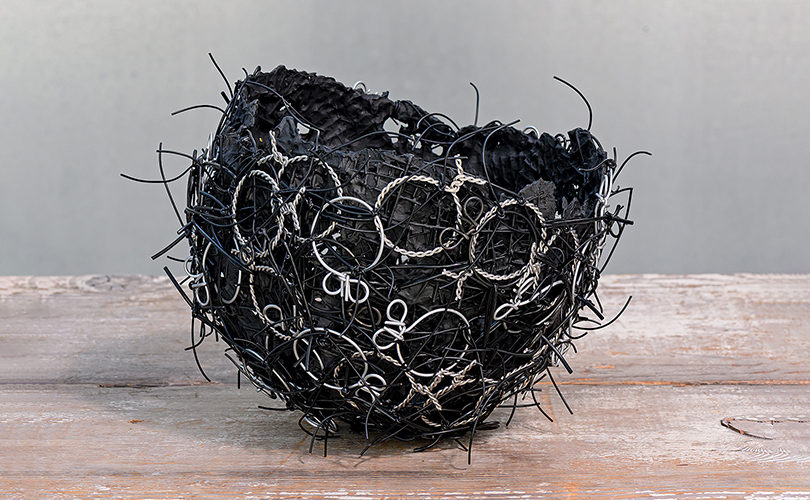
38jg Charred Black 2, John Garrett, Hardware cloth scrap, paper pulp, acrylic paint, rebar tie circles, aluminum rings, black rubber lacing, plastic covered electrical wire, 6.5″ x 8″ x 8″, 2025. Photo by Tom Grotta

In Charred Black 2, part of his Seven Baskets series, John Garrett fashions welded wire mesh into a vessel shaped by conflict and renewal. Inspired by images of war-torn landscapes, layers of paint, metal leaf, and bound wire evoke structures scarred and rebuilt, holding both destruction and resilience within their forms. “I had seen many pictures of the destruction of wars in Sudan, Ukraine, Israel, and Gaza,… Piles of debris littered landscapes,” Garrett says. “My painted paper baskets looked to me like structures distressed and damaged and covered in dust.”  Forms were painted and repainted and became new again while speaking of horrors between the layers. Shiny metal leaf covered the interiors and exteriors of others. Charred Black 2 was wrapped with rings of plied wire and tied down with more wire or fabric, bringing to mind a structure awaiting more layers of concrete or plaster. 
Dorothy Gill Barneslooking glass sculpture
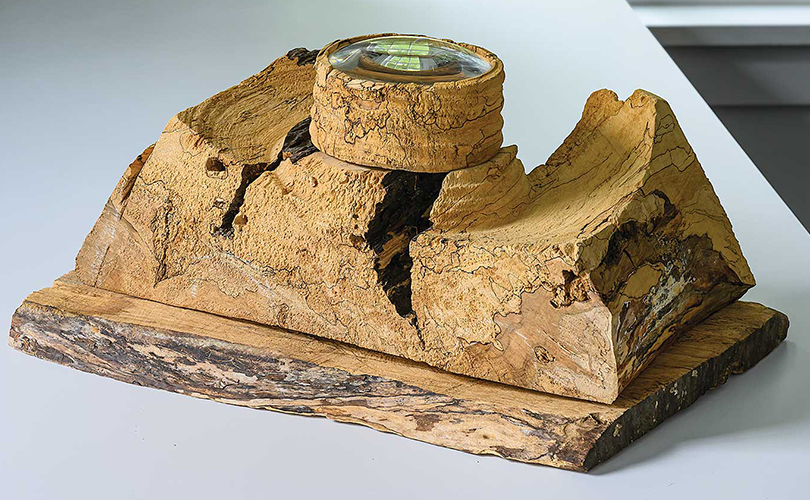
102dgb Spalted Maple Looking Glass, Dorothy Gill Barnes, spalted maple, glass lens, 9” x 18” x 14”, 2005-2013. Photo by Tom Grotta

In the 1970s, when she was in her 40s and early 50s, Dorothy Gill Barnes taught herself basketry through books, independent study, occasional classes, and connections with traditional makers, also drawing inspiration from contemporary artists and emerging developments in the field. Within a decade, her strikingly original works—crafted from natural materials—gained national and international recognition. Barnes delighted in revealing the ingenuity of nature, from animal-made forms to processes of growth and decay. Her work invites viewers to slow down and truly notice. In Spalted Maple Looking Glass, she has created an interactive experience: a glass lens, frames a small twig, magnifying both the object and its hollow. Through the lens, the tiny scene appears vast — refashioning something ordinary into a moment of wonder.
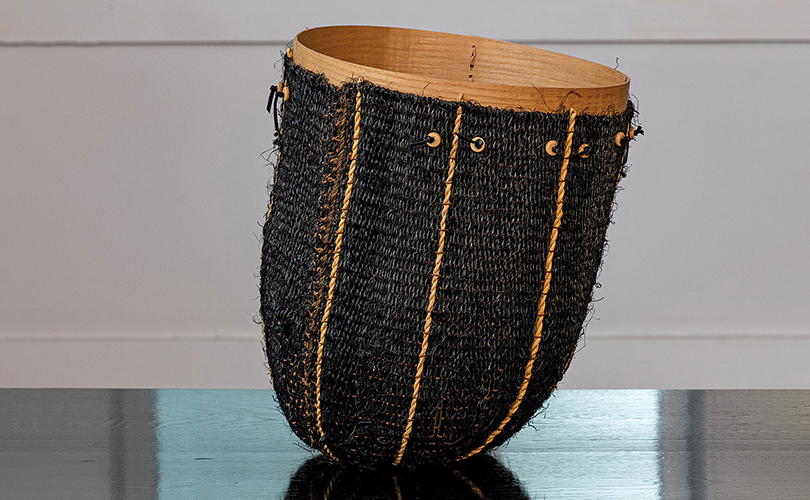
41mh #165r, Marion Hildebrandt, black sisal twine, brown waxed linen warp, hand twined rush, ash strip, wood rounds with leather ties, 9.5″ x 8″ x 8″, 2000. Photo by Tom Grotta

Marion Hildebrandt studied at the University of California, where she received degrees in the decorative arts and home economics. The artist lived and worked in Napa Valley, California, where she collected the plants — grasses, branches, pine needles, and bark — that she used to make her baskets. She employed the same materials that Native Americans used when they inhabited the area. Like them, Hildebrandt appreciated the natural materials that surrounded her, utilizing her artistic vision to create artistic art forms into structural objects like #r165.

Holiday Greetings!

Tim Johnson Baskets
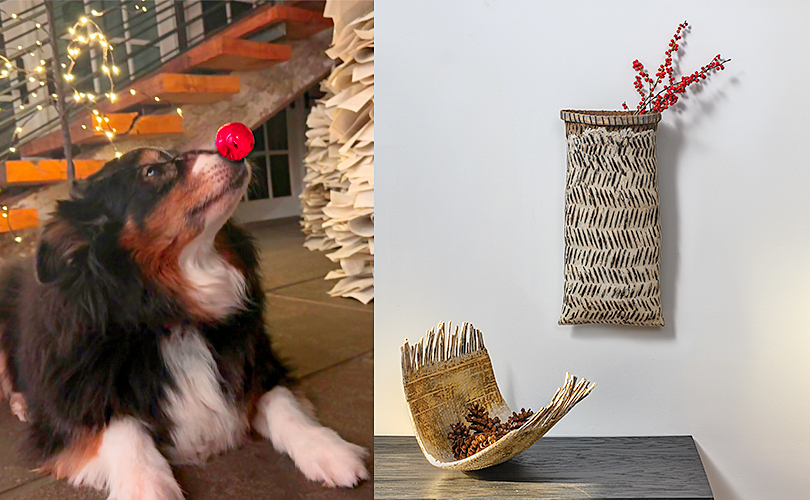
Tim Johnson, Curve VI , 2019 and Wall Pocket, 2023. Photos by Tom Grotta

We’re beginning our holiday revelry early this year!

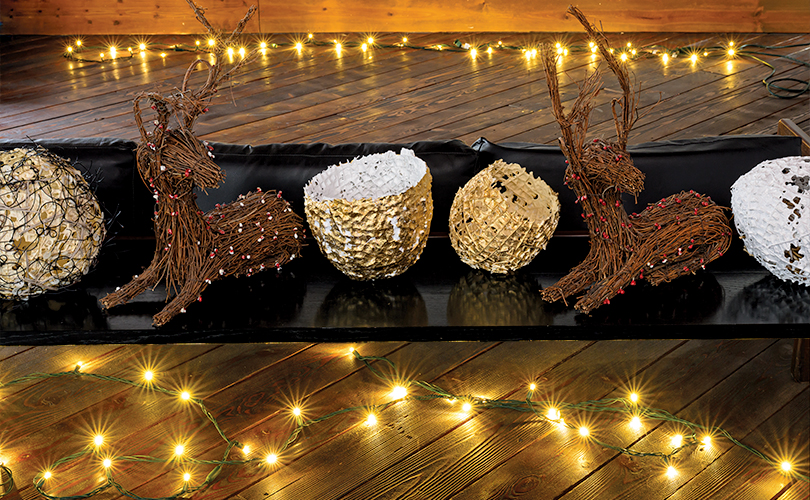
Here’s round up of Holiday images.

John Garrett Baskets
John Garrett Hardware Cloth Scrap Baskets, 2025. Photo by Tom Grotta
Cassidy Australian Shepherd
Cassidy. Photo by Tom Grotta
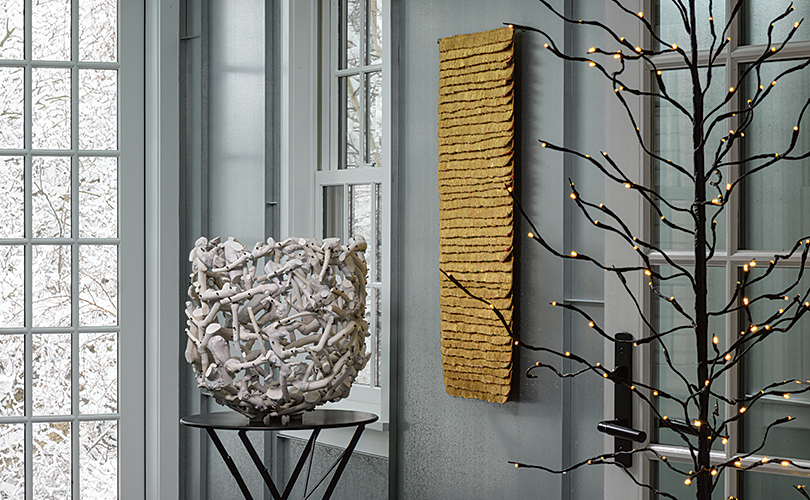
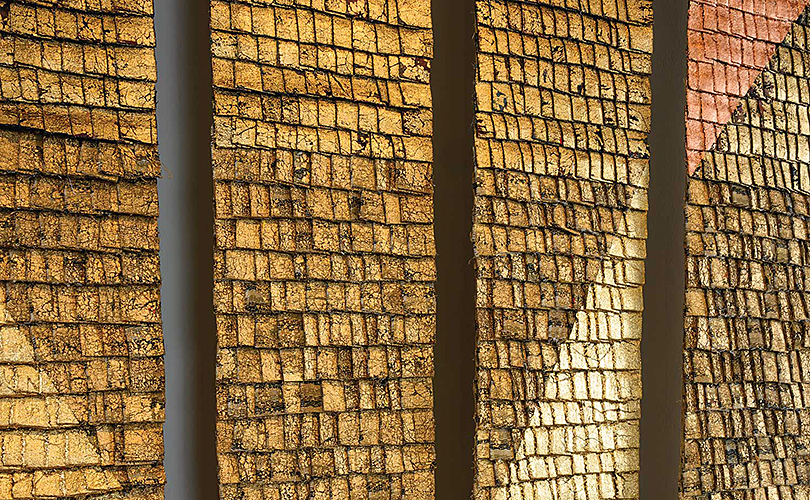
Gyöngy Laky Basket, Abby Mackie gold wall hanging
Traverser, Gyöngy Laky, 2016 and We Can All Be Saved 17, Aby Mackie, 2024. Photo by Tom Grotta
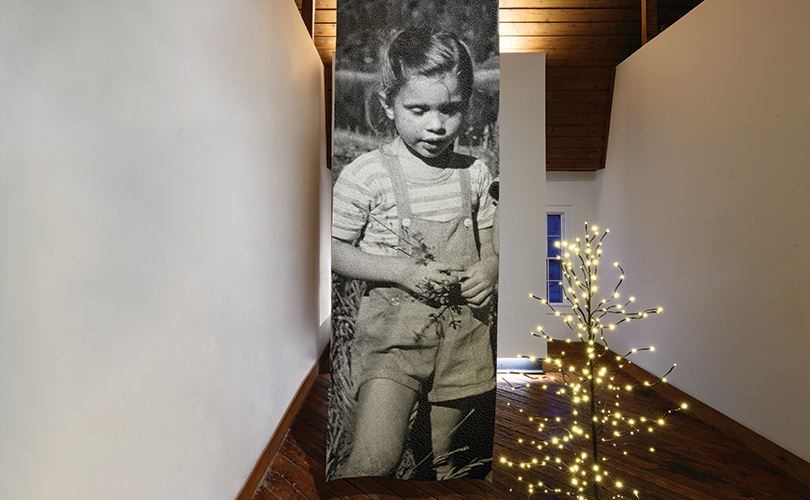
Lia Cook Tapestry
Big Susan, Lia Cook, 2005. Photo by Tom Grotta

Wishing you all a most enjoyable holiday season!


In Print: Beauty is Resistance

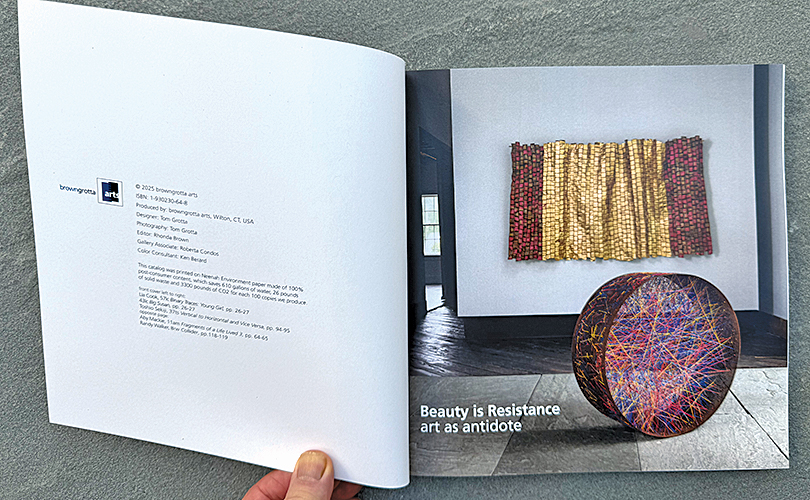
Title Page Beauty is Resistance Catalog
Works by Abby Mackie and Randy Walker. Photo by Tom Grotta

If an exhibition takes place but there is no catalog to document it, did anyone see it? Certainly not enough people have seen it, as far as browngrotta arts is concerned.  That’s why we produce a catalog for nearly every exhibition we host.

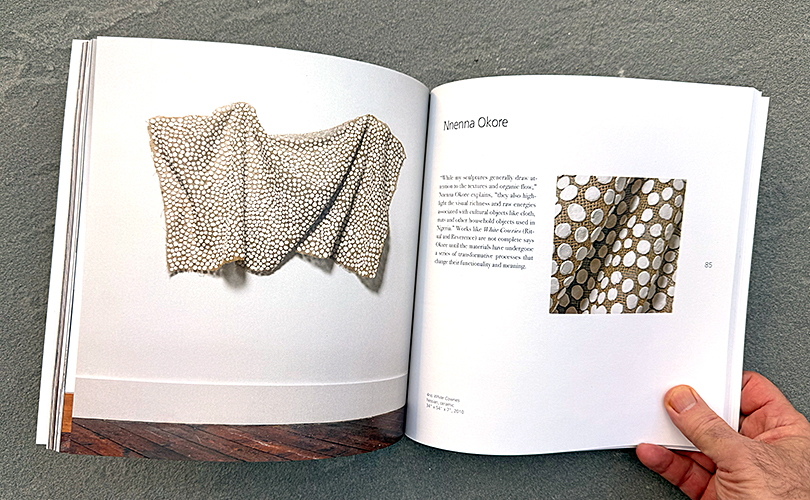
Nnenna Okore spread

We had hundreds of people visit our Fall 2025 exhibition,  Beauty is Resistance: art as antidote. But we also cowry to share the remarkable works in Beauty with even more people through our installation video and Zoom talkthrough, both on our YouTube channel, and through the print version of the show, a catalog (our 61st), available on our website.

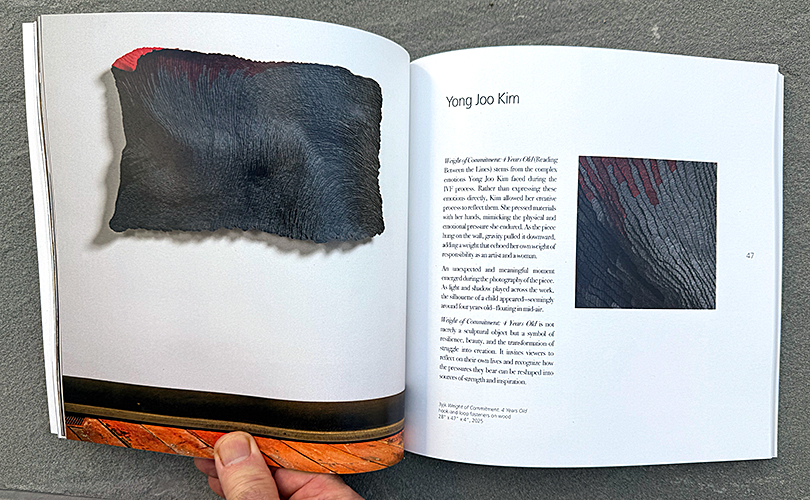
Yong Joo Kim Spread

The 132-page catalog contains 125 full-color images. There are full view and detail images of each of the featured works in the exhibition. There are statements about each work in the catalog. The works in the exhibition fell loosely into four subthemes: Reading Between the Lines, Threads of Memory, Radical Ornament, and Ritual and Reverence, and the catalog identifies the category that each work falls into.

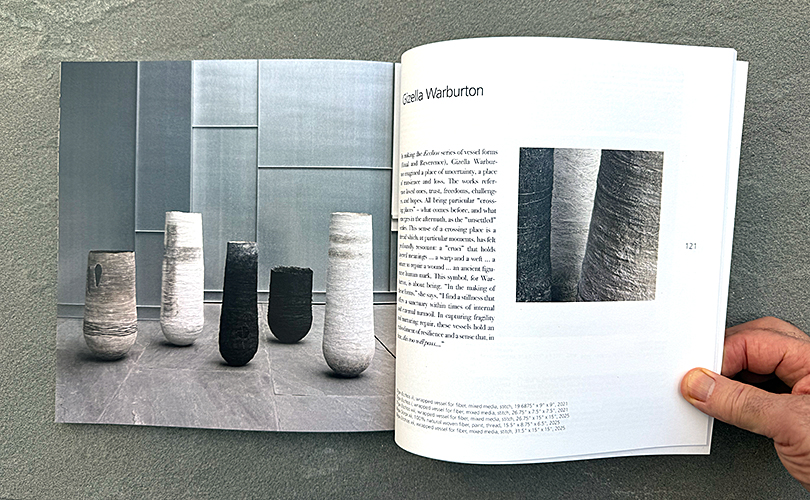
Gizella Warburton Spread

Elizabeth Essner, Windgate Associate Curator at the Museum of Art, Houston contributed an insightful essay to the catalog, “Looking at Beauty.” Essner writes about the role of nature in many of the artists’ work — for materials, lessons, and poetic inspiration. She examines varying historic conceptions of beauty, subjective, objective, and embodied, and discusses the significance of prevailing cultural aesthetics. in summarizing beauty’s pivotal place in art, Essner quotes late art critic Peter Schjeldahl (1942 – 2022) who predicted that in the future, “beauty will be what it always has been and, despite everything, is now in furtive and inarticulate ways: an irrepressible, anarchic, healing human response without which life is a mistake.”

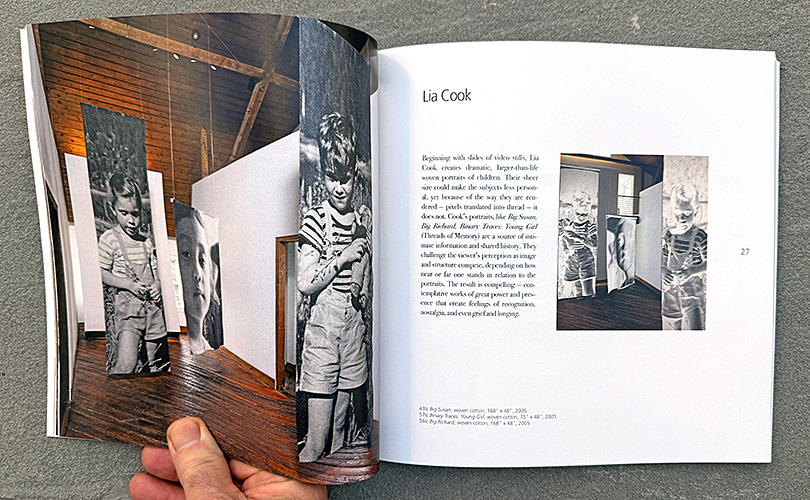
Lia Cook Spread

Order your copy on our website. If it’s a gift, let us know at art@browngrotta.com before December 15th and we will gift wrap your copy before we send it.

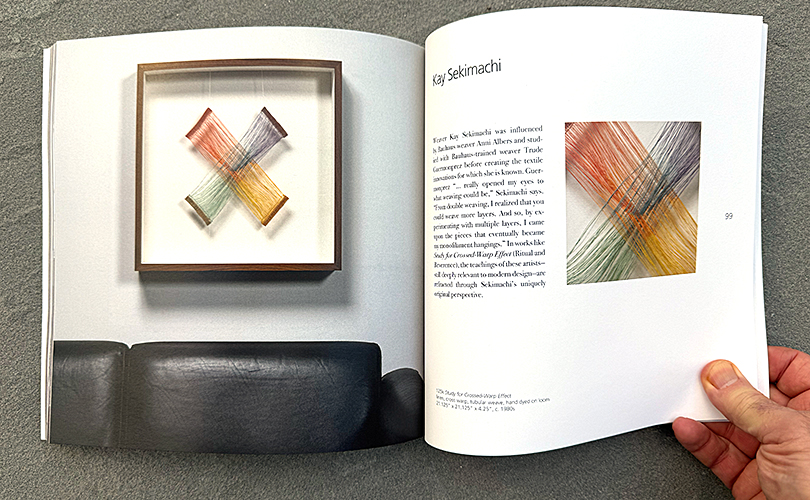
Kay Sekimachi Spread

Art Assembled: October

October was another month of intriguing artworks.; we featured four works from our recent exhibition, Beauty is Resistance: art as antidoteIn Beauty, we celebrated artists for whom aesthetic creation serves as a form of radical defiance, cultural preservation, and political voice. In the exhibition, international artists spanning generations and geographies, challenged the notion of beauty as mere indulgence and reframed it as a tool for protest, remembrance, and imagination. 

Aby Mackie Gold wall hanging
Aby Mackie, We Can All Be Saved 19, repurposed textile, gold and copper leaf, shellac
79″ x 35″, 2024. Photo by Tom Grotta

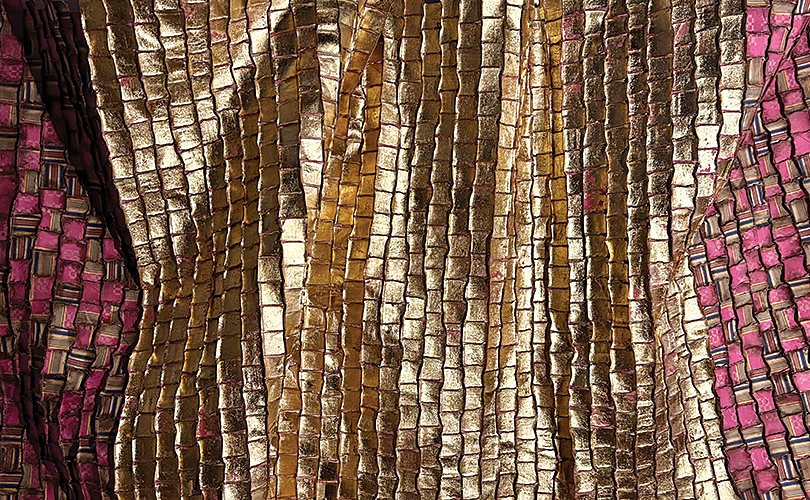
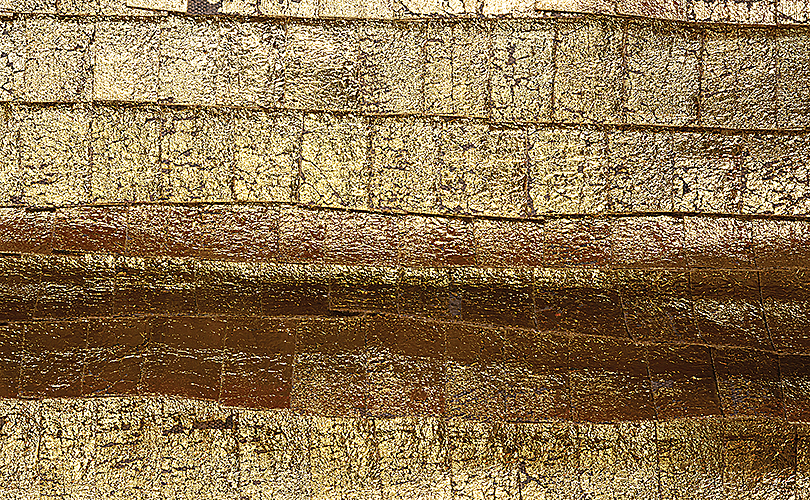
First up was Aby Mackie’s Fragments of a Life Lived 3  made in 2025. Mackie’s textile-based artwork engages with themes of ecology, history, and resistance through a process of reclamation and transformation. Working with discarded historic textiles, she deconstructs and reconfigures them—disrupting their original function to create new meaning. In Fragments of a Life Lived 3 she used antique-ticking fabric as both material and metaphor. Once utilitarian, worn by time and use, the fabric is reconstructed through stitching and further manipulated with paint and gold leaf. These interventions reimagine its surface to form layered, disrupted visual narratives—echoing stories of erosion, endurance, and renewal. The use of gold leaf requires viewers to stop and consider what should be valued and what should be discarded.

Blue/Green Cooper Nancy Koenigsberg Wall sculpture
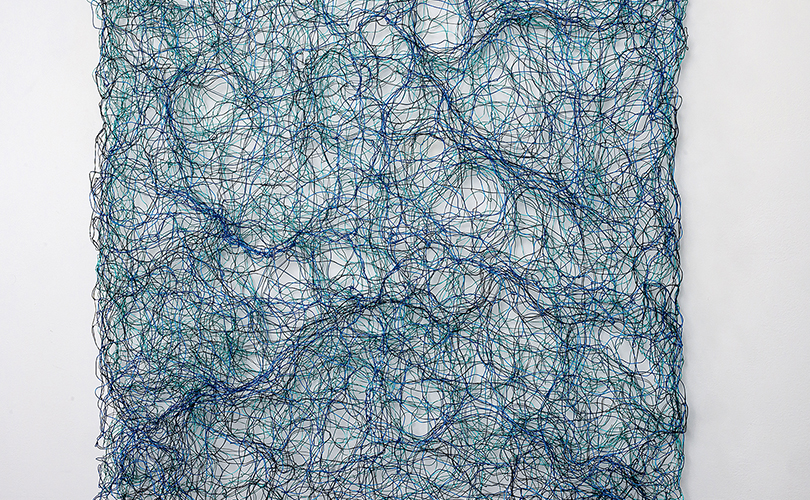
Nancy Koenigsberg, Ocean, coated copper wire, 32″ x 32″ x 3″, 2025, Photo by Tom Grotta

Next we focused on Ocean by Nancy Koenigsberg. The work is a meditation on movement and endurance, rendered in wire—an industrial material shaped into an evocation of tides, currents, and undertow. The piece positions material practice as a form of quiet defiance—an insistence on remembering, marking, and enduring. “The work is concerned with ecology,” Koenigsberg says, “as I’ve been very perturbed by the recent flooding and storms across the country.”

Mary Giles Waxed linen figurative sculpture
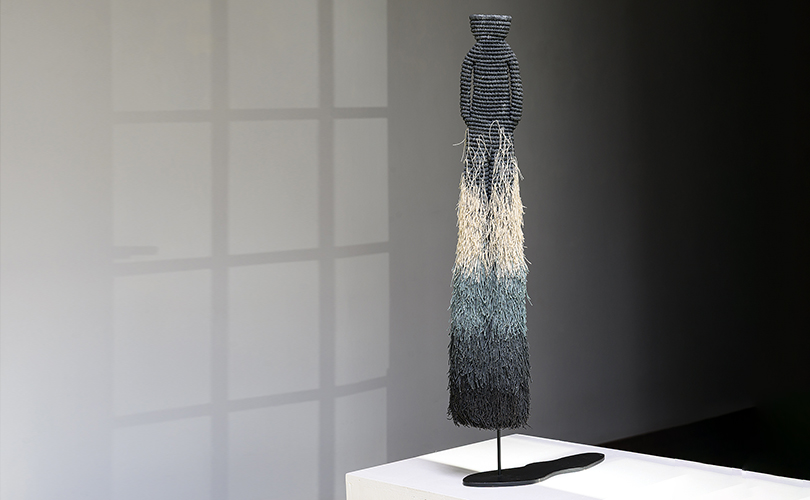
Mary Giles, 25mg Grey Shadow, waxed linen with iron base, 24.75” x 10.625” x 5”, 2001. Photo by Tom Grotta

In Grey Shadow, by Mary Giles, the human figure is used both as a formal reference and as an element of commentary. Throughout her career, Giles investigated various media including waxed linen, porcupine quills, and a number of metals like copper and iron. Giles often used coiling—a process associated with Native American basket traditions—to move between two and three dimensions in her sculpture. Giles said of her work, “I interpret and express explored communication and intimacy in relationships. The results are reflected in my figural work. I admire the directness and honesty I see in tribal art and I try to incorporate those qualities in my own.”

Neha Puri Dhir silk textile
Neha Puri Dhir, 11npd Luster of Time, pleating and stitch-resist dyeing on handwoven silk, 18.75″ x 18.25″ x 2.5″, 2023. Photo by Tom Grotta

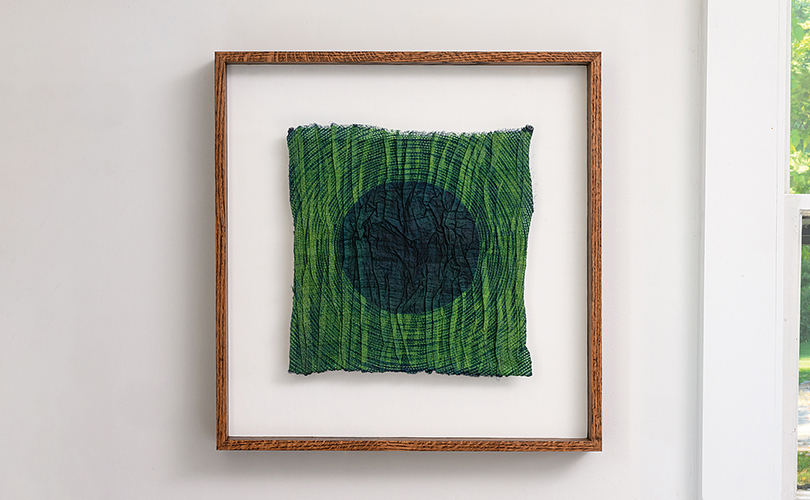
The last work we looked at in October was Luster of Time, by Neha Puri Dhir. Dhir‘s textile study has been broad based, including time at the National Institute of Design, Ahmedabad, India, studies in Italy, Latvia, the UK, and a workshop with Americans Yoshiko Wada and Jack Larsen. Dhir has intentionally explored a variety of textile techniques, developing a particular appreciation for shibori and stitch resist. The delicate lines and textures in Luster of Time, evoke the beauty of aging and the stories embedded in the passage of time. The deep circular form at the center suggests a meditative stillness, grounding the viewer amidst the rhythmic folds. This piece celebrates time as a collaborator, turning fabric into a canvas where aging itself becomes a mark of grace and resilience.

If you’d like to learn more about the works in Beauty in Resistance you can purchase a catalog on our website or join us at a talkthrough of images from the exhibition on Zoom, Art on the Rocks: an art talkthrough with spirits, on November 11, 7 pm EST. 


Save the Date: Beauty is Resistance Opens at browngrotta arts on October 11th

We’ll be exploring Beauty as Resistance: art as antidote in our 2025 Fall “Art in the Barn” exhibition at browngrotta arts in Wilton, Connecticut. The exhibition will explore how aesthetic creation—particularly within textile, fiber, and material-based practices—serves as a form of defiance, cultural preservation, and political voice. In an age of political polarization, ecological crisis, and rampant commodification, beauty might seem like a luxury—or a distraction. But the artists in this exhibition harness the power of beauty not as escape but as agency: to mourn, to protest, to remember, to heal, and to imagine

Beauty is Resistance by Norma Minkowitz
Frozen in Time by Norma Minkowitz. Photo by Tom Grotta

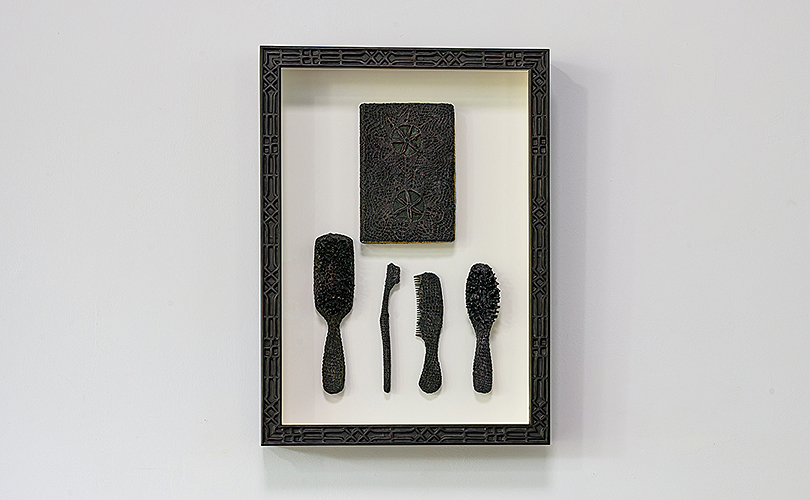
Beauty is Resistance will bring together more than two dozen artists, spanning generations, mediums, and geographies. The works fall loosely into four subthemes. Norma Minkowitz’s Frozen in Time reflects Threads of Memory, artworks in which fiber as a tool to archive personal, cultural, and collective memory and experience. Minkowitz’s work is about once-used personal items, perhaps ancient relics, in ominous black, showing every detail in time. A diary, combined with combs, various brushes, documenting a persons lived life, hidden messages inside a book that can’t be opened, are all frozen in time. These tell a story or trigger a question for the viewer.  

Reading Between the Lines
Fragments Of A Life Lived 3 by Aby Mackie. Photo courtesy of Aby Mackie

Reading Between the Lines includes works that subtly or explicitly engage with, politics, ecology, and resistance. Aby Mackie, an artist located in Spain, works with discarded historic textiles, deconstructing and reconfiguring them. “In reworking with what was cast aside,” Mackie says, “my practice becomes a form of quiet resistance—honoring forgotten stories and reasserting the enduring significance of craft in the face of environmental and cultural neglect.” In the 80s, Ed Rossbach created aseries of assemblages, titled El Salvador. In the series, Rossbach used camouflage cloth and sticks to protest US covert activity in that South American country. More personal is Yong Joo Kim’s Weight of Commitment: 4 Years Old. For Kim, making art is less a means of expression and more a residue of her efforts to sustain her life under pressure and weight. She creates art works she hopes are seen as symbols of resilience, beauty, and the transformation of struggle into creation. Weight of Commitment illustrates that approach. “As light and shadow played across the work,” Kim says, “the silhouette of a child appeared—seemingly around four years old—floating in mid-air. This moment was meaningful, because it was completely unintended, and I made it while I was going through IVF.”

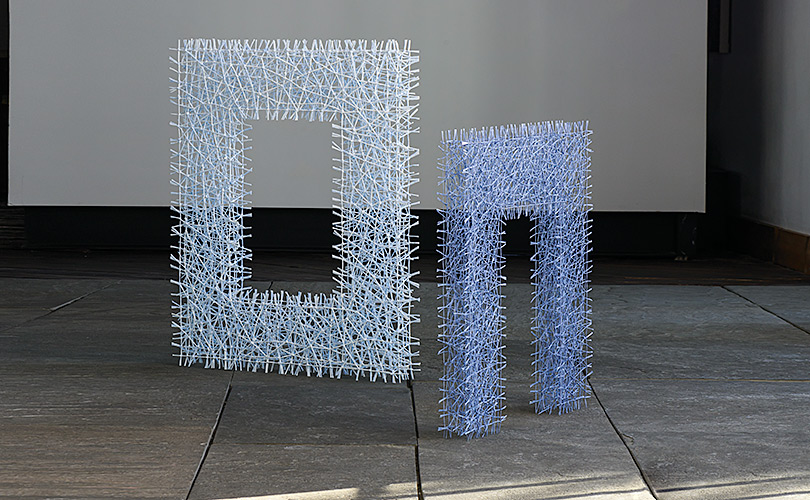
Collider by Randy Walker
Collider by Randy Walker. Photo by Tom Grotta

Randy Walker’s Collider reflects another of Beauty’s subthemes, Radical Ornament, in which art reclaims ornamentation, surface and structure as valid forms of protest and joy. Trained as an architect, Walker’s work straddles several boundaries of craft, sculpture, and installation.His works create dialogues — solidity and transparency; structural stability and collapse; visibility and invisibility.

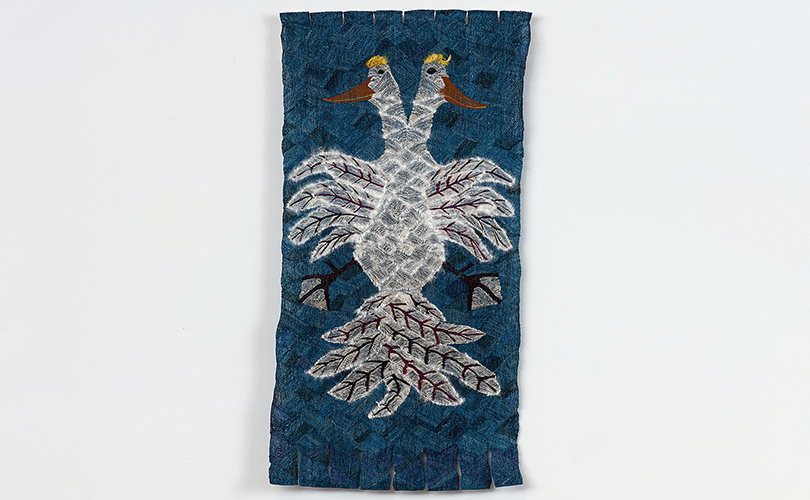
Donald and his Habsburg Empire by James Bassler
Donald and his Habsburg Empire by James Bassler. Photo by Tom Grotta

Finally, for Ritual and Reverence, the fourth subtheme, we’ll exhibit work grounded in indigenous craft and sacred traditions reimagined. James Bassler’s Donald and his Habsburg Empire, is a comment on both the historical and the contemporary attitude of arrogance and entitlement that has existed throughout history. Bassler references the Habsburgs, the ruling family of Austria, 1276-1918 and of Spain,1516-1700, that gave the world elitism through birthright, with no regard to proven achievement, noting that today in the US, the Kardashian and the Donald Trump model has made the acquisition of vast sums of money and profit an alarming societal objective, an elitism that values profits over people. In 2016, Bassler was invited to an exhibition at the Museo Textile de Oaxaca in Mexico that utilized feathered yarn, created of Canadian feathers, by spinners in Mexico who based the yarns on ones created in the 17th century. “After reviewing all of the material, I couldn’t help but notice that on many of the ancient textiles in which the feathers were used promoted the double-headed eagle of the Habsburg Empire, a reminder to those subjugated as to who was in charge,” Bassler says. “With that in mind and knowing that the feathers came from Canadian ducks, it was a logical step to create the double-headed ducks. The Donald Trump arrogance factor developed as the presidential debates materialized.”

Other artists whose work will be exhibited in Beauty is Resistance include: Kay Sekimachi (US), Neha Puri Dhir (IN), Karyl Sisson (US), Naoko Serino (JP), Laura Foster Nicholson (US), Jin-Sook So (KR), Irina Kolesnikova (DE), James Bassler (US), Gyöngy Laky (US), Lia Cook (US), and Eduardo Portillo and María Dávila (VE). 

Reserve a time to visit Beauty as Resistance: art as antidote : HERE

Beauty as Resistance: art as antidote
October 11 – 19, 2025

Location: 
browngrotta arts, 276 Ridgefield Road Wilton, CT 06897 

Times:
Saturday, October 11th: 11AM to 6PM [Opening & Artist Reception] 
Sunday,  October 12th: 11AM to 6PM
Monday, October 13th through  Saturday, October 18th: 10AM to 5PM
Sunday, October 19th: 11AM to 6PM [Final Day]

Safety Protocol:
No narrow heels please — barn floors.


Save the Date

Fiber art is having a moment. It’s “the new painting” according to Art in America and a trend that Artsy says will “take hold across the contemporary art world in 2025.”  Exhibitions of art textiles are on view across the US and Europe, including Woven Histories: Textiles and Modern Abstraction which will open at the Museum of Modern Art in New York in April. 

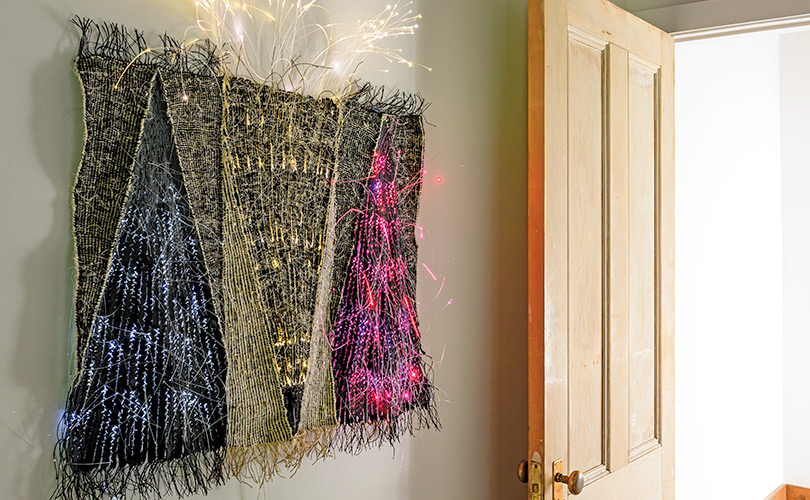
Wlodzimierz Cygan
20wc Totems, Wlodzimierz Cygan, linen, sisal, fiber optic, 37″ x 37″ x 7″, 2022. Photo by Tom Grotta

In Field Notes: an art survey (May 3rd -11th)browngrotta arts will provide a high-level view of the fiber medium, informed by the gallery’s 30+ years specializing in the promotion of art textiles and fiber sculpture. 

Sung Rim Park
1-2srp Beyond 220723, 180623, Sung Rim Park, Hanji, 46″ x 36″ x 4″; 36″ x 36″ x 4″, 2023. Photo by Tom Grotta

In art and science, field notes generally consist of a descriptive element, in which the observer creates a word picture of what they are seeing — the setting, actions, and conversations; combined with a reflective portion, in which one records thoughts, ideas, and concerns based on their observations. In Field Notes, viewers will be able to observe a varied group of art works, reflect on the creators’ thoughts about their art practice, and generate their own questions and conclusions.

More than two dozen accomplished international artists will share what’s on their minds, what’s on their looms, and what’s inspiring their art process, just as the art form’s popularity crests, including Sung Rim Park, and a few other artists whose work we have not shown before. Works by fiber art pioneers, Kay Sekimachi (US), Sheila Hicks (US), and Mariette Rousseau-Vermette (CA), will also be part of the exhibition, providing insights about the medium’s evolution.

Mariette Rousseau-Vermette
171mr Reflets de Montréal, Mariette Rousseau-Vermette, wool, 42″ x 82″ x 2.5″, 1968. Photo by Tom Grotta

“Textile art is strong in Norway today,” says Åse Ljones. “It has gained a higher status, and is often purchased for public decoration.” In her work, she is “looking for the shine, the light and the stillness in the movement that occurs in the composition of my pictures,” she says. “I embroider by hand on linen fabric.” The viscose thread she uses adds glow and shine in the composition. “With different light sources,” she says, “the image changes all the time. As a viewer, one must be in motion to see and experience the changes.” 

Aby Mackie, who works in Spain, combines existing materials with the tactile intimacy of textile techniques. “By blending these elements,” she says, “my work challenges perceptions of craft and sustainability, offering new ways to perceive the familiar and celebrating the beauty of reinvention.” Mackie agrees with Ljones about the evolving role of fiber. “The field of fiber art is currently experiencing a profound shift,” says Mackie, “gaining recognition as a respected medium within contemporary art.” 

Fiber is “a powerful medium for storytelling and innovation in the current art world,” Mackie concludes. Join us in May as we highlight those stories and celebrate fiber art’s resurgence!

Sheila Hicks
40sh.1 Family Evolution, Sheila Hicks, 9” x 25” x 9”, 1997. Photo by Tom Grotta

Exhibition Details:
Visit Field Notes: an art survey at browngrotta arts, 276 Ridgefield Road, Wilton, CT 06897 from May 3 – May 11, 2025. 

Gallery Dates/Hours:
276 Ridgefield Road Wilton, CT 06897

Opening & Artist Reception
Saturday, May 3rd: 11am to 6pm
Sunday, May 4th: 11am to 6pm
(40 visitors/ hour)
Monday, May 5th – Saturday, May 10th: 10am to 5pm
(40 visitors/ hour)
Sunday, May 11th: 11am to 6pm
[Final Day] (40 visitors/ hour)

Safety Protocols: 
• No narrow heels please (barn floors)


Five Days Remain to See Discourse at browngrotta arts in Wilton, CT

from left to right: works by Hiroko Sato-Pijanowski, Aby Mackie, Tim Johnson, Jane Balsgaard, Gyöngy Laky, Gizella Warburton, Margareta Ahlstedt-Willandt photographed through a basket by John McQueen. Photo by Tom Grotta

Join us this week, through Sunday May 12, at 6 pm to see our Spring Art in the Barn exhibition, Discourse: art across generations and continents. Traffic has been steady, including a guided tour for 15 people on Tuesday, but we still have slots available for gallery appointments and drop ins.

Viewers will enjoy 150+ works by more than 60 artists from 20 countries. Many people take two trips through the space to ensure they have not missed anything.

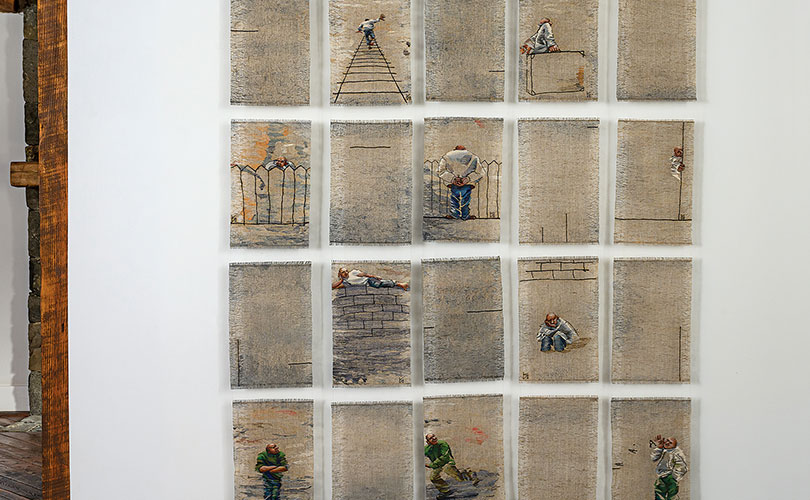
While here they learn more about works in the show including Irina Kolesnikova’s Spectator, a filmstrip- like group of woven portraits of her alter ego. She places him in discomfiting situations.  “Sometimes the events happening around him are frightening,” Kolesnikova says, “he wants to go away, to run far away. But curiosity makes him come back again, secretly observing, trying to memorize all impressions.”

Irina Kolesnikova Spectator weaving
28ik Spectator, Irina Kolesnikova, handwoven flax, silk, wood, 58.5″ x 43.25″ x 1″, 2013. Photo by Tom Grotta

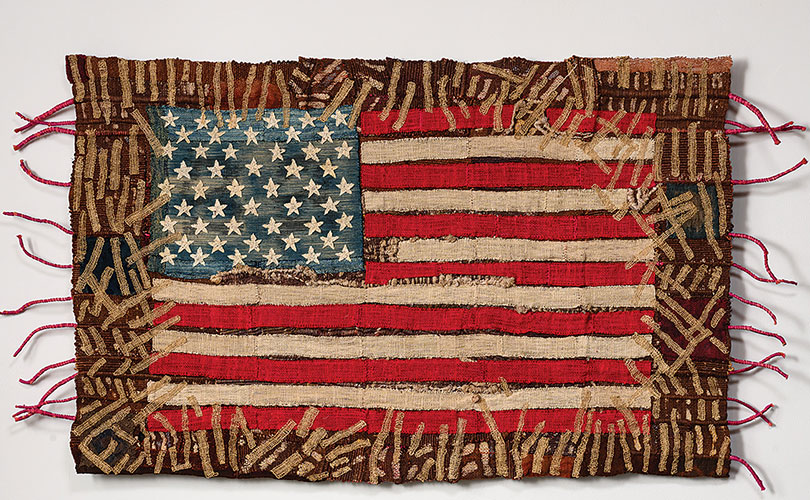
James Bassler’s This Old House, is another work that encourages viewers to take a closer work and consider its inspiration and origins. “Over a year ago, a friend gave me a book, Caste, by Isabel Wilkerson,” Bassler writes. “It  caused me to begin yet another weaving of a flag, which includes references to the textile traditions of Africa.  In my early days of learning how to weave, the late 60s and early 70s, I wove many samples, and after weaving, experimented with batik and dyeing.  After all these years, those woven samples — maybe eight or ten of them —  were sewn together to become the surface on which the flag would eventually, after about a year, emerge.”

James Bassler Flag weaving
20jbas This Old House, James Bassler, multiple cotton and silk warps, patched together, multiple sisal, silk, linen, agave, ramie wefts, synthetic and natural dyes. batik plain and wedge-weave construction
27” x 42”, 2024. Photo by Tom Grotta

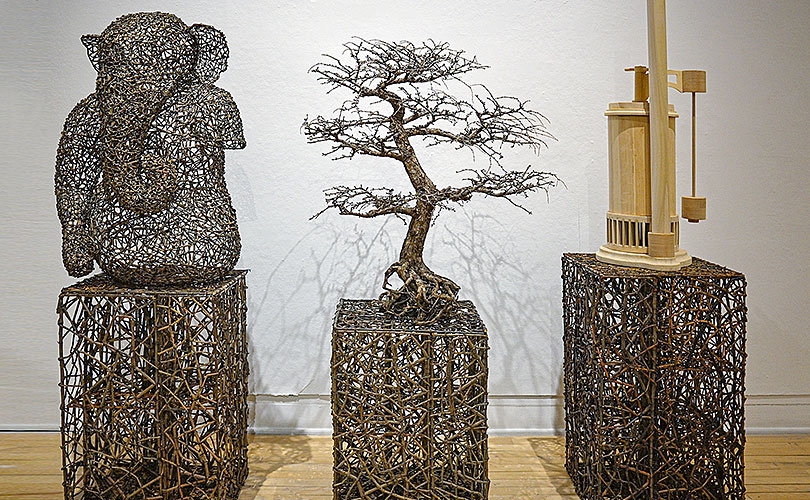
Same Difference by John McQueen draws appreciative comments (“That’s clever!” “I get it.”) when people learn its backstory. It’s comprised of three items on pedestals made of sticks tied with waxed linen — a wooden sump pump, the skeleton of a bonsai tree, and a representation of the elephant god Ganesh made of tied twigs. The items seem to have been chosen randomly, but they are not. Each draws water from the ground and uses it to slake thirsty crops and people, trees and animals.

John McQueen Same Difference three willow sculptures
21jm Same Difference, John McQueen, wood, sticks, bonsai, 54” x 60” x 24”, 2013, photo by Tom Grotta

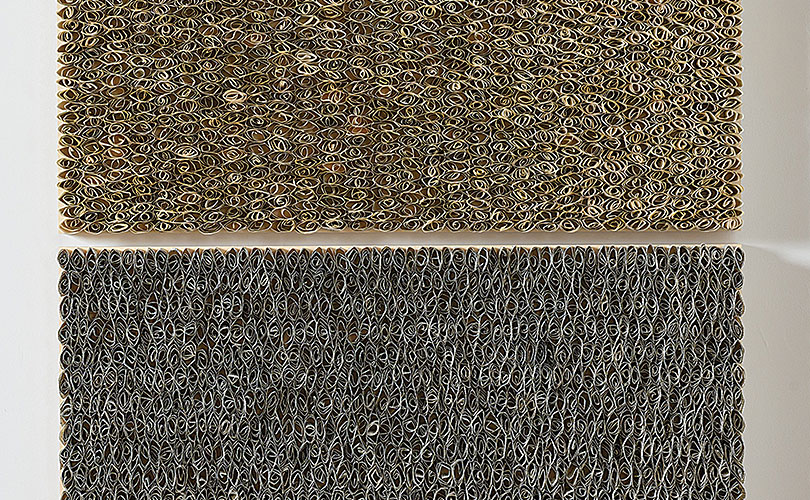
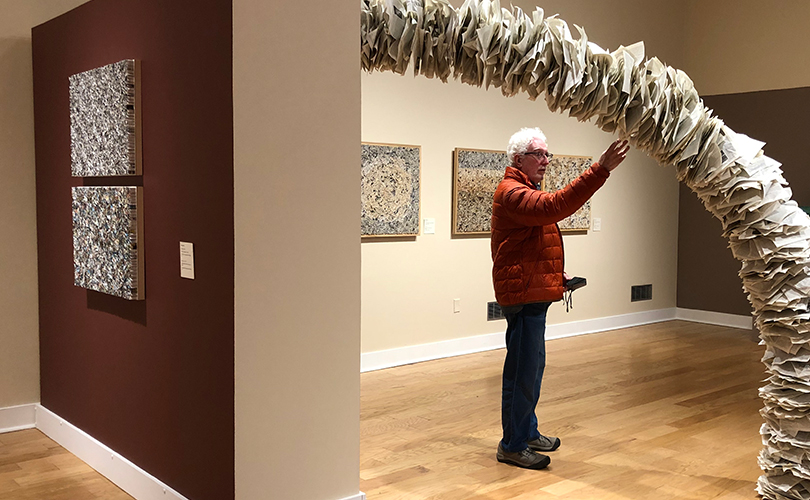
Wendy Wahl’s work in Discourse explores inversion  a reversal of position, order, form, or relationship — and requires people to take a closer look. Wahl writes that she reassembles encyclopedia pages because of their symbolism, conceptual reference, and unique paper quality.  “My interactions with these materials,” she writes, “are meditative. These pieces are created by deconstructing the books, rolling and pinching the individual parts, and, like a puzzle, fitting them to the panel. The interconnected spiral elements become the picture plane that explores dimension, direction, texture, color, and reflection.” 

44ww Inversion, 2023/24, Wendy Wahl, encyclopedia britannica pages, wood panel, 40″ x 30″, 2024. Photo by Tom Grotta

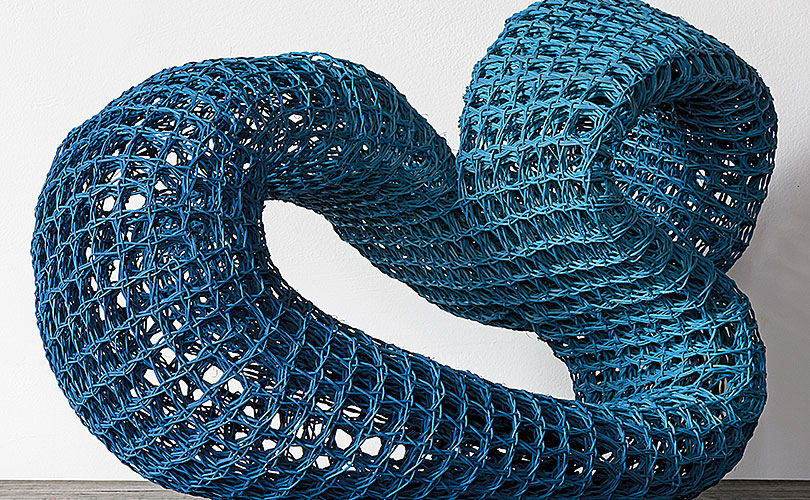
The evocative forms of Rachel Max’s work draw viewers in for inspection and introspection. Over the last few years, Max has been making forms that explore notions of infinity and time. The title for her piece in this exhibition, Caesura, came to her while she was making it. “I was thinking about the composition, working out where the weave should become less dense and where one section would end and another begin. I wanted to create a visual interruption, my equivalent to a break in music or a pause. In poetry, I discovered,  this is called Caesura.”

Sculptural blue basket form by Rachel Max
13rm Caesura, Rachel Max, woven cane sculpture, plaited and twined, dyed, 11” x 16.5” x 8”, 2023-24. Photo by Tom Grotta

There are dozens of works to discover at Discourse: art across generations and continents and five days remaining to join us. Hope we’ll see you!

Schedule a visit
Times to visit Discourse: art across generations and continents can be scheduled on POSH

Exhibition Details:
Discourse: art across generations and continents
Through May 12, 2024
browngrotta arts
276 Ridgefield Road, Wilton, CT 06897

Gallery Dates/Hours:
Wednesday May 8th through Saturday, May 11th: 10am to 5pm (40 visitors/ hour)
Sunday, May 12th: 11am to 6pm [Final Day] (40 visitors/ hour)
Schedule your visit at POSH.

Safety protocols: 
POSH reservations strongly encouraged • No narrow heels please 

Catalog:
A full-color catalog, browngrotta arts’ 59th, Discourse: art across generations and continents, with an essay by Erika Diamond, Artist | Curator | Associate Director of CVA Galleries | Chautauqua Institution, will be published by the browngrotta arts in May 2024 in conjunction with the exhibition.

Upcoming:
browngrotta arts will present a talkthrough of slides from Discourse on Zoom, Art on the Rocks: art art talkthrough with a twist, on Friday, June 11th at 7 pm EST.


Save the Date: browngrotta arts Spring Art in the Barn

We’ve spent the first weeks of 2024 summing up 2023 and looking at this year’s trends in art and design. Now we’ve got a more concrete prediction — our Spring Art in the Barn exhibition will run from Saturday, May 4 through Sunday, May 12, 2024. Discourse: art across generations and continents will explore the diversity in art textiles and fiber sculpture.

Blair Tate, Warren Seelig header
Details of tapestries by Blair Tate made in 2022 and Warren Seelig made more than 40 years earlier in 1976. Photo by Tom Grotta.

In Discourse, browngrotta arts will assemble a large and eclectic group of artworks that celebrate artists from different countries, who work with varied materials, and represent distinct artistic approaches. More than 50 artists from 20 countries will be featured.Included will be works from the art form’s origins 60 years ago, current mixed media works and sculpture, and pieces created in the decades between — enabling an intriguing look at intergenerational differences, material breakthroughs, and historical significance in fiber art.

Details: John McQueen, Norma Minkowitz, Norie Hatekayama
Details: John McQueen, Norma Minkowitz, Norie Hatekayama. Photo by Tom Grotta.

structural explorations
Despite their distinctiveness, the artists in Discourse share a common trait. Each possesses “material intelligence,” what author Glenn Adamson describes as “a deep understanding of the material world around us, an ability to read that material environment, and the know-how required to give it new form.” The works in Discourse reflect this mastery. Artists like John McQueen and Norma Minkowitz of the US and Norie Hatekayama and Naoko Serino of Japan engineer imaginative structures of unexpected materials — plaited paper tape, molded jute, crocheted linen, and pieced twigs and branches. 

Details: Gudrun Pagter, Warren Seelig, Blair Tate
Details: Gudrun Pagter, Warren Seelig, Blair Tate. Photos by Tom Grotta

fiber art … an evolution
Discourse also offers viewers a chance to make intergenerational and cross-continental comparisons. Included will be starkly graphic weavings by Warren Seelig (US) made in the 70s and 80s, and ones by Gudrun Pagter (DK), and Blair Tate (US) made 40+ years later. We have often observed a different sensibility among artists from Eastern Europe and those in Western Europe, Asia, and the US. Artists in Eastern Europe have a history, which began after World War II, of using items at hand to create works – sisal, rope, hemp, goat hair. A fierce energy is seen in these works; they are rugged and raw. By contrast, for artists who worked elsewhere in more traditional tapestry materials like wool, silk, linen – quietly refined works were often the result. Discourse will spotlight such regional contrasts. 

Details: Marian Bijlenga, Shoko Fukuda, Marianne Kemp
Details: Marian Bijlenga, Shoko Fukuda, Marianne Kemp. Photo by Tom Grotta.

material matters
Viewers to Discourse will also see a wide range of to material and technique approaches. Several artists make vastly different uses of paper — scrolling of encyclopedia pages by Wendy Wahl (US), knotted paper objects by Shoko Fukuda (JP), and sculptural works of rice paper by Pat Campbell (US). Three other artists, Adela Akers (US), Marianne Kemp (NL), and Marian Bijlenga (NL), use horsehair in vastly different ways. 

Details: Laura Foster Nicholson, Irina Kolesnikova, Anneke Klein
Details: Laura Foster Nicholson, Irina Kolesnikova, Anneke Klein. Photos by Tom Grotta.

the medium is the message
Some of the artists in Discourse, including Laura Foster Nicholson (US) Gyöngy Laky (US), and Irina Kolesnikova (RU/DE), use the medium of fiber art to make explicit statements about the modern world — about personal anxiety, communication, and humans’ impact on the environment. “I like to tease the brain – to promote or even provoke or cajole, a visual dialogue with the viewer,” says Gyöngy Laky (US). Her work, Anticipation, which spells out the word “Who?“ in applewood branches, presents a question. “Given the challenges, concerns, conflicts and other dangers we face today,” Laky says, “this question, underlies the search for a way forward to a better day.” Anneke Klein (NL) is interested in communication: In Dialogue — Her work is made up of two layers that hang, one in front of the other. When you change your position in front of Dialogue, the interaction between the two layers changes, as it does between two speakers.

Detail: Lia Cook
Detail: Lia Cook. Photo by Tom Grotta.

experiments in technique
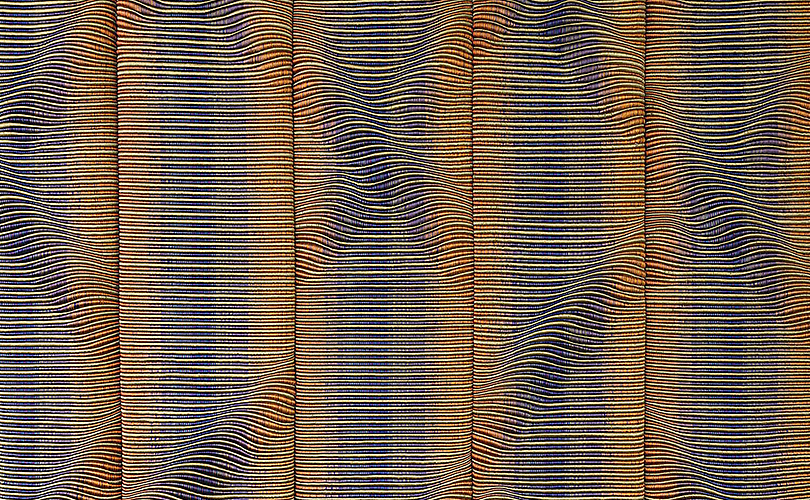
Contemporary fiber art is by definition experimental. It arose when a group of artists used tapestry techniques to create abstract sculptures that hung off the wall. A work of parallel optical lines from studies Lia Cook (US) did for her master’s thesis in the 1970s will be included along with works reflecting Neha Puri Dhir’s (IN) currrent experiments dying silk and baskets by Esmé Hofman (NL) of black willow and elm that also incorporate color.

Detail: Aby Mackie
Detail: Aby Mackie. Photo by Tom Grotta.

fiber art has emotional appeal
Fiber art — art textiles, tapestries, and three-dimensional sculpture — engages us on a deeply personal level. Our first memories are of cloth, fuzzy blankets, soft towels and they remain strong ones. Scientists have shown that different parts of the brain light up when we look at a woven image and a photographic image of the same item. Aby Mackie (SP) sources and recycles used fabrics from flea markets, fabrics laden with memory. She is captivated by these silent witnesses to a life lived; a worn bed sheet, a stained tablecloth, a moth-eaten gown. Such artifacts bear the marks and physicality of human nature, possessing a poetic power. She gilds this repurposed material in works like We Can All Be Saved, leaving viewers to consider what creates value.

We invite you to draw comparisons and gain new perspectives of your own. See you in May!

Exhibition Details:
Discourse: art across generations and continents
May 4 – May 12, 2024
browngrotta arts
276 Ridgefield Road, Wilton, CT 06897

Gallery Dates/Hours:
Saturday, May 4th: 11am to 6pm [Opening & Artist Reception]
Sunday, May 5th: 11am to 6pm (40 visitors/ hour)
Monday, May 6th through Saturday, May 11th: 10am to 5pm (40 visitors/ hour)
Sunday, May 12th: 11am to 6pm [Final Day] (40 visitors/ hour)
Schedule your visit at POSH

Safety protocols: 
POSH reservations strongly encouraged • No narrow heels please 

Catalog:
A full-color catalog, browngrotta arts’ 59th, Discourse: art across generations and continents, will be published by the gallery in conjunction with the exhibition.


Art Out and About: In the US and Abroad

So many exhibitions to visit this Spring from Sweden, Australia and the UK to California, Washington and New York — and two in Connecticut. Check them out.

Beauty and the Unexpected
Modern and Contemporary American Crafts
National Museum
Södra Blasieholmshamnen 2
Stockholm, Sweden
March 30, 2023 – January 21, 2024

Gyöngy Laky Incident
Incident, Gyöngy Laky, from Beauty and the Unexpected exhibition in Stockholm, Natural and commercial wood, paint,
bullets for building (screws), 50” x 50” x 4.5”, 2012. Photo by Tom Grotta

National Museum has invited Helen W. Drutt English, pioneering craft educator and gallerist of American Modern and Contemporary Crafts since the 1960s, to assemble a collection of objects drawn from the field of “American Crafts.” The selection of 81 works from the 1950s until today will in future enrich National Museum’s collections and will provide a possibility to look at American Crafts in the Nordic context.

International Textile Art Biennale 
(Fibre Arts Australia)
Emu Park Art Gallery
EMU Park
13 Hill Street
Queensland, Australia 
From April 15 – June 10, 2023

Neha Puri Dhir handwoven silk
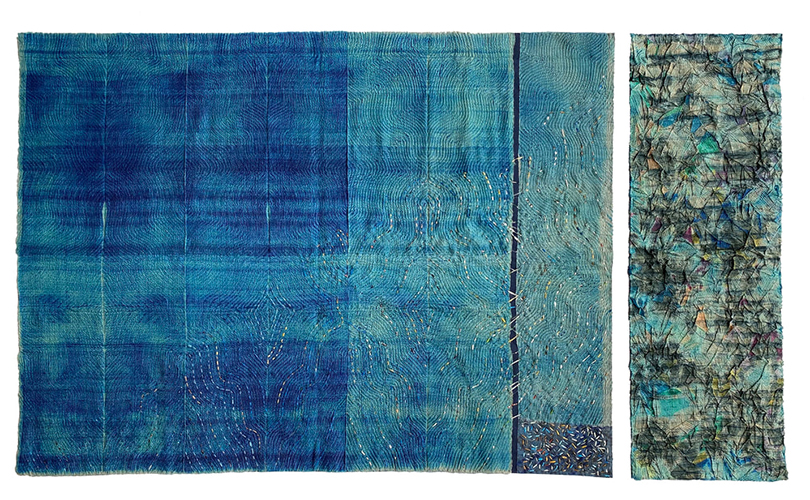
Overflow by Neha Puri Dhir, stitch-Resist Dyeing on Handwoven Silk (Diptych), 95 x 128cm 95 x 32cm, 2022. Photo by Neha Puri Dhir

Fibre Arts Australia is highlighting the contemporary practice within Art Textiles as an art form.

​The International Art Textile Biennale (IATB) seeks to exhibit the best of contemporary art textiles and invited submissions, from Australia and Internationally, that reflect a wide range of works related to the textile medium. Thirty-five artists were selected to participate, including Neha Puri Dhir. The works are exhibited at various locations throughout Australia.

Wendy Wahl Installation
Wendy Wahl Installation. Photo by Brooke Yung, assistant curator

Paper Town
Fitchburg Art Museum
185 Elm Street
Fitchburg, MA 01420
Through June 4, 2023

This exhibition takes paper out of the two-dimensional into a world that is fantastical, intricate, colorful, and personal. Inspired by the materiality of paper and the metamorphic quality of the papermaking process, Paper Town explores paper in pulp, cast, folded, and cut forms. The exhibition includes artwork by several artists located in New England:  May Babcock, Erik and Martin Demaine, Andrea Dezsö, Tory Fair, Hong Hong, Fred Liang, Michelle Samour, Heidi Whitman and browngrotta artist Wendy Wahl.

Polly Barton Irate
Works by Polly Barton, James Bassler and others in Ikat: A World of Compelling Cloth. Photo by Polly Barton.

Ikat: A World of Compelling Cloth
Seattle Art Museum
1300 First Avenue
Seattle, WA 98101
Through May 29, 2023

Visitors to Ikat: A World of Compelling Cloth, will enter the woven world of ikat, a complex textile pattern that knows no borders. Presenting over 100 textiles from the museum’s global collection with gifts and loans from a dedicated Seattle-area collector, Ikat: A World of Compelling Cloth is an introduction to the meticulous and time-honored processes of dyeing threads to create complicated hand-weaving. Contemporary work in the exhibition includes tapestries by Polly Barton and James Bassler, and an extraordinary installation by Rowland Ricketts.

Connective Threads
Palos Verde Cultural Center
Fiber Art from Southern California
Curated by Carrie Burckle and Jo Lauria
Through April 15, 2023

Carol Shaw-Sutton installation
Persephone’s Filters by Carol Shaw-Sutton. Photo by Carol Shaw-Sutton

Connective Threads provides a window into what is currently engaging fiber artists, even as this discipline continues to evolve and change. Emanating from artists’ studios in Southern California, the exhibition offers unique perspectives on the complicated identities of fiber art as a genre. Collectively they offer a penetrating examination of fiber’s possibilities. Exhibiting artists include Jim Bassler, Cameron Taylor-Brown, Ben Cuevas, Mary Little, Michael F. Rohde, and Carol Shaw-Sutton. 

Detail Magdalena Abakanowicz
Magdalena Abakanowicz’s Montana del Fuego detail by Tom Grotta

Magdalena Abakanowicz: Every Tangle of Thread and Rope
Tate Modern
Bankside
London SE1 9TG
Through May 21, 2023

In the ’60s and ’70s, the Polish artist Magdalena Abakanowicz created radical sculptures from woven fibers. They were soft, not hard; ambiguous and organic; towering works that hung from the ceiling and pioneered a new form of installation. They became known as the “Abakans.” Many of the most significant Abakans are brought together at the Tate Modern in a forest-like display in a 64-meter long gallery space.

The exhibition explores this transformative period of Abakanowicz’s practice when her woven forms came off the wall and into three-dimensional space. With these works she brought soft, fibrous forms into a new relationship with sculpture. A selection of early textile pieces and her little-known drawings are also on show.

And of course, there are the four “don’t miss” events browngrotta arts is involved in this Spring.

Norma Minkowitz installation
Norma Minkowitz: Body to Soul installation. Photo by Tom Grotta

Norma Minkowitz: Body to Soul
Fairfield University Art Gallery
Bellarmine Hall
Fairfield, CT
Through April 6, 2023

Gyöngy Laky and John McQueen
Out on a Limb by Gyöngy Laky and Billboard by John McQueen from the WordPlay exhibition.

Wordplay: Messages in Branches & Bark 
Flinn Gallery: Greenwich Library
101 West Putnam Avenue 
Greenwich, CT
March 30 – May 10, 2023

Aby Mackie detail
Detail: We Can All Be Saved 10 by Aby Mackie, gilded gold lead decontructed and reconfigured antique textiles, 2022. Photo by Tom Grotta

Making a Mark: The Art of Self Expression
Bay Street Theater
1 Bay Street
Sag Harbor, NY
Through May 7, 2023

And last, but not least, our Spring Art in the Barn at browngrotta arts:

Dominic Di Mare installation
The Mourners, Dominic Di Mare from the Acclaim! Works by Award-Winning Artists exhibition, waxed linen, wood, 46.5″-50.5″(h) x 24″each, 1962. Photo by Tom Grotta.

Acclaim! Work by Award-Winning International Artists
browngrotta arts
276 Ridgefield Road
Wilton, CT
April 29 – May 7, 2023


Allies for Art: Exclusively Online on Artsy through November 18, 2022

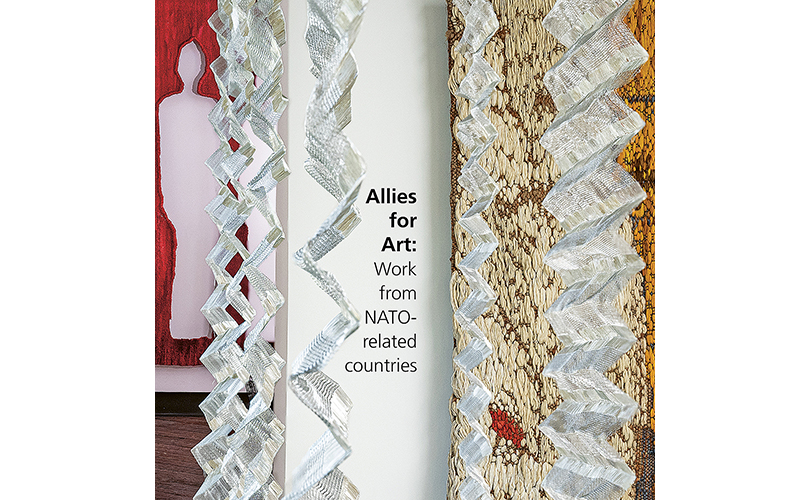
Did you miss the in-person version of Allies for Art: Work from NATO-related countries at browngrotta arts? Good news! You can see the art that made up the exhibition exclusively on Artsy through November 18th.

Three dimensional embroidered leaf shaped wall sculpture
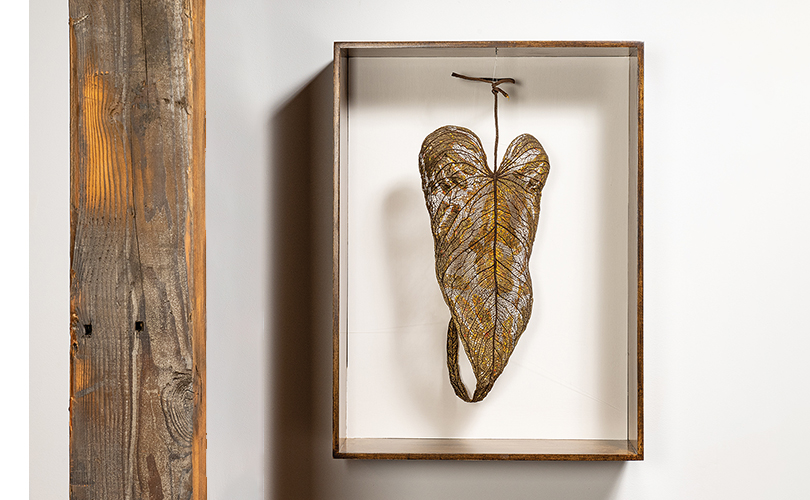
7ak Embraced by Nature II, Anda Klancic, embroidered viscose, flax, cotton, polyester, metal filament, PVA fabric 31” x 23” x 9.25”, 2004. Photo by Tom Grotta

The nearly 50 artists in Allies for Art are from 21 different countries — 18 NATO members and 3 NATO applicants. Their work reflects diverse perspectives and experiences. The exhibition includes art created under occupation, in the ‘60s through the 80s, art by those who left repressive governments in Hungary, Romania and Spain, and art by other artists who left Russia in later years. Allies for Art also includes current works created by European artists including Gudrun Pagter of Denmark, Åse Ljones of Norway, Włodmierz Cygan of Poland, Ceca Georgieva of Bulgaria and, artists new to browngrotta arts, including Esmé Hofman of the Netherlands, Aby Mackie of Spain and Baiba Osite of Latvia.

Abstract off the wall textile sculpture
20mb Giallo, Marian Bijlenga, cotton; horshair, 58″ x 53″, 1994. Photo by Tom Grotta.

You can also learn more about the exhibition in the Allies for Art full-color catalog, which includes lush images and details shots and an essay by Kate Bonansinga, Director, School of Art, College of Design, Architecture, Art, and Planning at the University of Cincinnati, Ohio available on our website.

VIEW EXHIBITION ONLINE: Artsy
VIEW EXHIBITION IN PRINT: Order an Allies for Art catalog