Tag: Yashusia Kohyama

Our 60-what? browngrotta arts’ latest publication

Catalog Cover: Transformations: dialogues in art and materials

Another exhibition, time for another catalog. The volume for this Spring’s exhibition, Transformations: dialogues in art and materials, is our 63rd (57 catalogs, 6 monographs). With work by 79 artists highlighted in Transformations, the catalog was bound to be a big one. In fact it weighs in at 164 full-color pages. The works in Transformations were installed to illustrate the varying ways artists used the same material — whether traditional, silk, cotton, sisal or more unusual, feathers, horsehair, and jute. The catalog essay explores additional themes.

Hisako Sekijima catalog spread
Two different types of Bambo Baskets by Hisako Sekijima. Photo by Tom Grotta

Making and Meaning
Some artists in Transformations take their materials beyond physical characteristics— asking viewers to feel, remember, or reconsider. Stéphanie Jacques describes this approach with characteristic directness: “[P]lant matter is not the subject of my work. It is a means among others… But this means is not trivial. It connects me to what man has always done, shaping what he needs with his hands from what he sees around him. What matters to me is to talk about what is alive.” Jacques constructs sculptural forms that are humanoid but less than literal, using volume to give life to an unfilled interior space — speaking of the movements of the body, desire, intuitions, something that pushes from the inside and overflows. For Hisako Sekijima the subject is not the material alone; it is the dynamic interplay between what the material will and will not do, and what the maker can discover within that negotiation. 

Willow title page
willow works by Dail Behennah, Stéphanie Jacques and Esmé Hofman. Photo by Tom Grotta

The Material as Its Own Message
For some artists, the material does not carry meaning so much as it is the meaning. Sue Lawty and Yasuhisa Kohyama work at opposite ends of the material world —one with fiber and stone, the other with clay and fire — but they share a conviction that the deepest outcomes come not from overriding what a material wants to do, but from creating conditions for it to reveal itself.

Yasuhisa Kohyama and Sue Lawty catalog pages
Ceramic by Yasuhisa Kohyama and Indigo weaving by Sue Lawty. Photo by Tom Grotta

Material as Cultural Memory
James Bassler and Eduardo Portillo and María Dávila ask us to attend to where materials have been — to the long human histories encoded in fiber, dye, and weave structure. For these artists, meaning is inseparable from origin; the biography of a material is part of what the finished work contains. Bassler has spent decades drawing from Navajo wedge-weave, pre-Columbian scaffold weave, and Andean shibori, accumulating a global inventory of material knowledge. Portillo and Dávila traveled extensively in China and India to study indigo dye-making, silk sericulture, and handweaving, learning that fiber is a vehicle for understanding other cultures. Their Azul Indigo series emerged from looking for blue in their Venezuelan mountain landscape. 

James Bassler and Eduardo Portillo and María Dávila catalog pages
Indigo weavings by James Bassler and Eduardo Portillo and María Dávila. Photo by Tom Grotta

Between System and Surprise
One theme recurring in Transformations is the tension between system and discovery. Merja Keskinen describes this generative uncertainty: “I work to see. The joy of discovery and the delight of experiencing colors are essential to me.” Norie Hatakeyama works with factory-made paper-packing tape, an experimental material that enables her to break free from traditional limitations. By submitting an industrial material to the ancient technique of plaiting, she transforms both: the tape becomes sculpture, and the sculpture raises questions about what we mean by “natural.”

Norie Hatakeyama and  Merja Keskinen cTALOG PAGES
Paper sculpture by Norie Hatakeyama and line weaving Merja Keskinen. By Tom Grotta

Drawing with Material, Drawing in Space
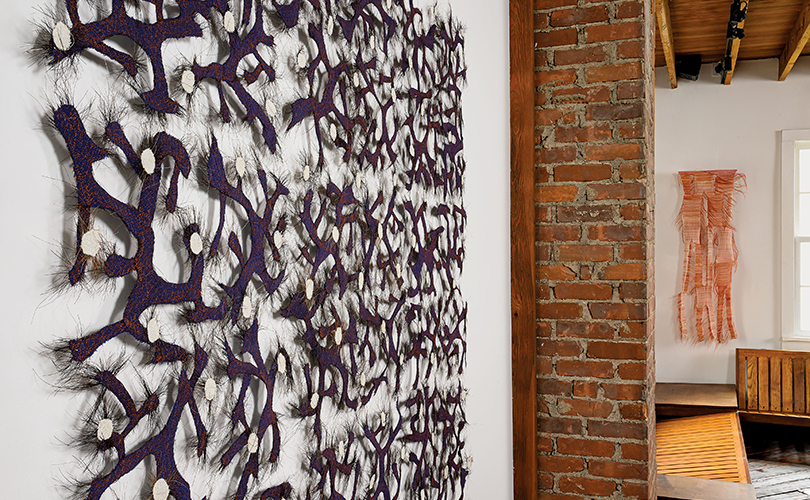
Several artists treat fiber not as the medium of weaving but as an instrument of drawing itself. “Instead of drawing on paper,” Marian Bijlenga says, “I draw in space by using textile as a material.”After rejecting weaving as too slow, she discovered horsehair as an element — stiff enough to stand on its own, allowing a new kind of freedom. Kyoko Kumai has spent decades achieving something similarly paradoxical with stainless steel. She has written of her chosen material with wonder: “Thin pieces of stainless steel wire create a richly expressive fabric that does not stand solidly, cleaving the air. It has its own language fluttering above the floor; breathing and melting into the air.” 

Kyoko Kumai Catalog spread
steel filament textiles by Kyoko Kumai. Photo by Tom Grotta

The works in Transformations demonstrate how material intelligence, at its highest level, transcends the categories of craft and fine art altogether.
Materials in Conversation: Transformations Opens this Week

In the right hands, a strip of bark becomes a narrative. Linen becomes landscape. Seaweed becomes an accent, steel mesh becomes a tapestry, and a cloth measuring tape — repurposed, reimagined — becomes art. 

Simone Pheulpin, Mercedes Vicente, Norma Minkowitz
Cotton works by Simone Pheulpin, Mercedes Vicente, Norma Minkowitz. Photo by Tom Grotta

This is the animating premise of Transformations: dialogues in art and material which opens this Saturday, May 9th at browngrotta arts. The exhibition that asks a deceptively simple question: what happens when artists stop treating materials as additives and start treating them as collaborators? The answer, it turns out, is profound.

Material Is Not Neutral
We tend to think of materials as passive — the stuff through which ideas pass on their way to becoming art. The artists in Transformations challenge that assumption at every turn. In the contemporary art context, materiality isn’t just about physical substance. It encompasses everything a material carries with it: weight, surface, history, cultural memory, expressive charge. A piece of linen isn’t just woven thread. It’s centuries of labor, landscape, and touch.

linen works work by
Linen works by Jane Sauer, Carol Shaw-Sutton, Mary Giles. Photo by Tom Grotta

System and Surprise
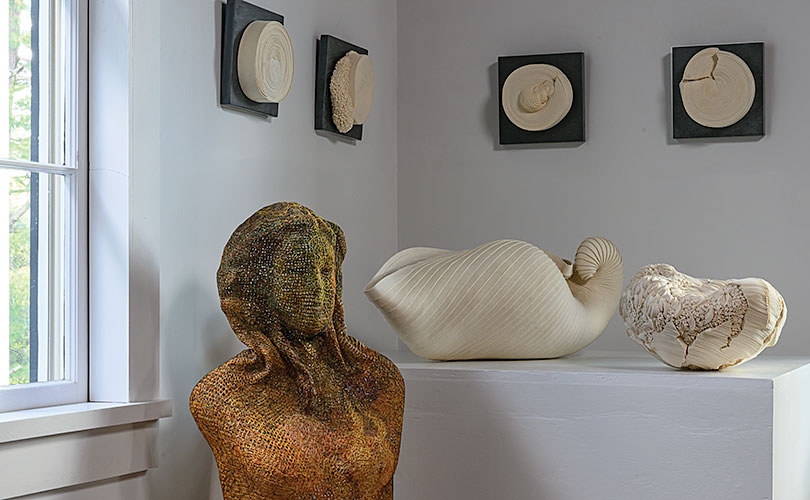
Transformations proves that the range of works that a simple material can inspire is nearly endless. Carol Shaw-Sutton, Chiyoko Tanaka, Sara Brennan, Mary Giles, Merja Keskinen, and Jane Sauer all work with Linen. In Shaw-Sutton’s hands the material becomes a molded vessel. Under Chiyoko Tanaka’s ministrations, woven linen fabric is returned to its essential threads, transformed into an artifact. For Sara Brennan, woven linen serves as a canvas. From a distance, her works appear to be abstract paintings. A close up view reveals a textured weaving using dozens of shades. For Jane Sauer and Mary Giles, linen is a sculptural medium.

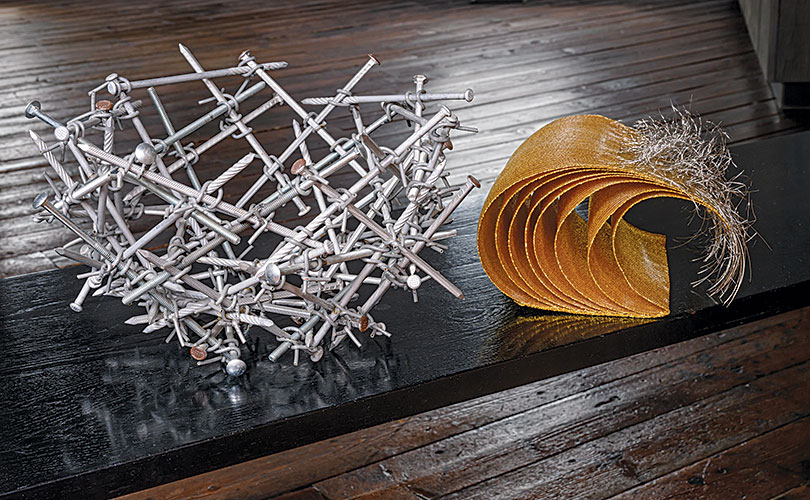
Gyöngy Laky, Kyoko Kumai
Metal works by Gyöngy Laky, Kyoko Kumai. Photo by Tom Grotta

Material as More
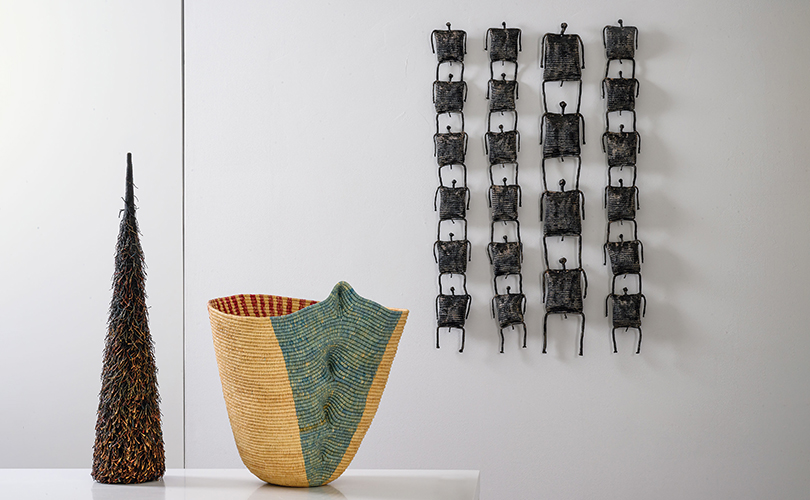
Metal is a canopied category in Transformations. Artists consider it as thread— from gold filaments, to lead extrusions, to bent wire of copper and brass. Kyoko Kumai’s spun steel threads float. Gyöngy Laky turns nails and wire into an artful assemblage. Sue Lawty weaves with bast fibers — raffia, hemp, nettle, linen — and elemental lead, and assembles carefully ordered stones drawn from beaches and riverbeds. She pursues qualities inherently given by the chosen substance, seeking “an understated restraint, balance, tension, rhythm: an essential stillness.”

Yasuhisa Kohyama and Toshiko Takaezu
Clay works by Yasuhisa Kohyama, Toshiko Takaezu. Photo by Tom Grotta

Same Input, Different Outcome
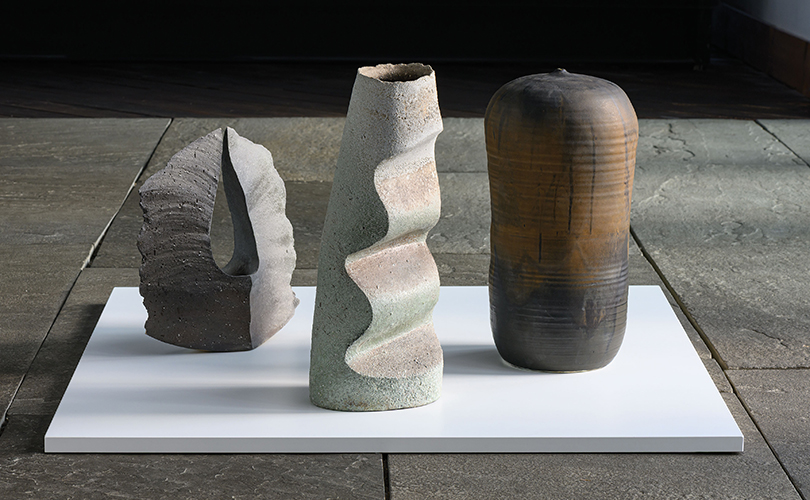
Toshiko Takaezu and Yasuhisa Kohyama both devoted their lives to clay, but their practices reveal just how vast the distance can be within a single medium. Takaezu’s closed ceramic forms — rounded, glazed, often containing a small stone or rattle sealed inside — are intimate and quietly mysterious, their surfaces richly colored and their shapes suggesting the human body. There is a sense of the maker’s hand coaxing something from the earth. Kohyama, by contrast, surrenders control to the fire itself. He builds by hand and fires with wood, never applying glaze; color and surface are entirely the product of ash movement and the object’s position within the kiln. Where Takaezu brings clay close — shaping it into vessels that hold secrets — Kohyama sends it into an elemental process and receives back something ancient and unpredictable.

Marian Bijlenga, Marianne Kemp
Horsehair works by Marian Bijlenga, Marianne Kemp. Tom Grotta

What These Works Carry
What unites the artists in Transformations isn’t a shared aesthetic or a shared geography. It’s a shared conviction: that choosing a material is a serious act, that working with it is as meaningful as the finished object, and that what results carries something more than form.

It carries thought. History. Culture. The trace of a hand that knew exactly what it was doing — and trusted the material to meet it halfway.

Join us at Transformations: dialogues in art and material (May 9-17) at browngrotta arts in Wilton, CT. Or order the 164-page catalog from browngrotta.com.