Tag: Merja Keskinen

Color Stories

584mr Carter’s Color Lesson, Mariette Rousseau-Vermette, wool and silk, 7′ x 2′ and 7′ x 4′ x 3″, 1993. Photo by Tom Grotta

Color is a constant in art, while its potential for new and unique applications is limitless. Artists at browngrotta arts have taken the challenge to heart — finding inspiration in the teachings of Josef Albers, the art of Color Fields painter Mark Rothko, and systems of their own design.

Detail: 37sl Dictionary – Light Indigo, Sue Lawty indigo-dyed, natural hemp, linen, 21.5 x 13, 2026. Photo by Tom Grotta
Detail: 1mkes Rhythm of Colors, Merja Keskinen, 80% linen, 20% cotton, 56″ x 62″, 2022. Photo by Tom Grotta
Detail: 22jbas The Yarns I Have Carried # 2, James Bassler, four selvaged weaving: left over warp and weft yarns from the past 65 years, including handspun and manufactured material, natural and synthetic dyed wool, silk, linen, cotton and ramie, 30″ x 31″ x 2.5″, 2025. Photo by Tom Grotta

In Bauhaus artist and teacher Josef Albers’s universe, color seduced and beguiled (The Josef and Anni Albers Foundation: https://www.albersfoundation.org/alberses/teaching/interaction-of-color). “These characteristics made color the most fascinating of art’s formal elements. Albers’s passion for color prompted his decision to launch what was possibly the first full-blown course in color ever given anywhere, and certainly the first based exclusively on direct observation of color’s behavior. . . . Color behaved. Color was magic.”

At Black Mountain College in the 1930s he introduced a color course unique at the time, followed by courses at Yale University and the publication of Albers’s landmark Interaction of Color in 1963, which crowned 30 years of effort.  His exercises focused on color in specific contexts, showing that if you put color A next to color B, or these colors next to those, you could anticipate certain results. Moving from simple to complex, with many exercises exploring the ramifications of a previous one, the course awakened the students to the quirks and variables of color behavior. The course was not a fixed body of color wisdom, but rather an ongoing inquiry in which solutions were not conclusions, but steps on an endless path.

1mkes Rhythm of Colors, Merja Keskinen, 80% linen, 20% cotton, 56″ x 62″, 2022. Photo by Tom Grotta

Merja Keskinen engages in color experiments of her own navigating between following a system, as Albers did, and making room for discovery. Keskinen describes this generative uncertainty: “I work to see. The joy of discovery and the delight of experiencing colors are essential to me. The unpredictability and always-surprising color tones captivate me. I interpret life and the surrounding world with colors and explore the factors that influence color perception.” In works like, Rhythm of Colors, Keskinen works with a self-developed weaving technique, combining different-colored threads according to her preselected system, creating geometric square and rectangular shapes in various sizes whose surfaces produce a pixel-like optical blending — distinguishable as individual threads up close, but merging into wholly unexpected color combinations from a distance. Her work demonstrates that even the most rigorously systematic approach — mathematics applied to thread — contains inevitable surprise. The material collaborates, producing results the artist could not fully predict.

22jbas The Yarns I Have Carried # 2, James Bassler, four selvaged weaving: left over warp and weft yarns from the past 65 years, including handspun and manufactured material, natural and synthetic dyed wool, silk, linen, cotton and ramie, 30″ x 31″ x 2.5″, 2025. Photo by Tom Grotta

In his Threads I’ve Carried series James Bassler takes Albers’s Color Theory as a literal influence. The works reflect what the artist learned in his first “Color” class at UCLA in1953 once he realized that there was an “Art Department.” The head counselor at Santa Monica HighSchool had refused to allow him to take a Ceramics class because his GPA was too high. He pursued art, despite that first obstacle, and later Bassler would teach Josef Albers’s Color Theory at UCLA for some 25 years. This work is made of left-over warp and weft yarns from the past 65 years, including handspun and manufactured material, natural and synthetic dyed wool, silk, linen, cotton, and ramie. The result, is a four-selvaged weaving, a color study using complementary colors, In works from the series, Bassler explored a new bag of saved yarns, which presented new thoughts. “How bright or dark can I go before it upsets the whole idea,” he asks. “In this piece I pushed the subtle to almost disappear and the bright to almost overwhelm.”

Chroma, Nancy Koenigsberg, coated copper wire 26 .5″ x 26.5″ x 2″, 2024. Photo courtesy of Nancy Koenigsberg

Nancy Koenigsberg’s Chroma is the artist’s version of a painter’s palette which took her more than six months. to complete. The sculptural artwork of coated, colored copper wire is comprised of four horizontal rows of small squares and four vertical rows, occupying an area 26 inches square. Each individual square is created by sewing and weaving coated copper wire and building layers of the color to a depth of 2.5 inches. The color combinations and contrasts challenge and engage the viewer both visually and conceptually.

37sl Dictionary – Light Indigo, Sue Lawty indigo-dyed, natural hemp, linen, 21.5 x 13, 2026. Photo by Tom Grotta

In her Indigo Cloth series, Sue Lawty explores the innumerable variations of blue. In one series, Notes on Blue, Lawty commissioned a range of linen and hemp hreads to be hand dyed with indigo by Jeanette Orrell in Wales. Lawty purposely requested a range of unevenly dyed shades across the tonal spectrum and then worked intuitively,  reading the weaving line by line as it progressed. In Dictionary – Light Indigo Woven Tapestry, she explores more gradations of blue. Lawty pursues the inherent qualities of any material with which she works, seeking “an understated restraint, balance, tension, rhythm: an essential stillness.”  In Lawty’s practice, color feels less applied than absorbed — as though the fiber had always held it within. 

Mariette Rousseau Vermette wool tapestry
613mr Si Rothko Métait Conté, Mariette Rousseau-Vermette, wool, 94” x 80”, 1997. Photo by Tom Grotta

Experiments in color were the hallmark of members of the Color Fields movement of the 1950s and 60s.  Color Fields artists, among them Mark Rothko, created abstract paintings featuring large areas of solid color, flat surfaces, and a unified single-image field.  Rothko’s work with color was a potent influence for fiber artist Mariette Rousseau-Vermette. The Canadian artist saw an exhibition of the Rothko’s works in Italy in 1958. It was pivotal in inspiring her “to produce strictly artistic works in weaving,” Anne Newlands wrote in Weaving Modernist Art: The Life and Times of Mariette Rousseau-Vermette (Firefly Books, Richmond Hill, Ontario, 2023, p. 32). Throughout Rousseau-Vermette’s life, Newlands says, Rothko triggered “compositions with floating blocks of color, soft edges and her signature brushed wool technique to create a blending of colors and a sense of inner light.” Her interest in Rothko “marked her as a colorfield artist-weaver, fueling her ambition to create large-scale tapestries that would engulf the viewer and employ powerful chromatic contrasts of light and dark to evoke an emotional response.” 

Scott Rothstein stichöd weaving
26sr Untitled Red #71, Scott Rothstein hand stitched silk thread on silk ground, black frame with denglass
12.75″ x 14.75″, 2002

Scott Rothstein also works in fields of color in vivid embroideries of silk like Untitled #71. “I have felt compelled to explore the subtleties of basic visual elements for 20 years,” he explains. “I find the simplest elements to be the most profound. A line, created by twisting threads, can have infinite possibilities. Two areas of color, in equal amounts, placed consecutively, might suggest harmony or contradiction.” 

However articulated, these explorations of color and its potential intrigue and engage the viewer just as they the artist.


Art Assembled in June

Even though June is a short month, this year it offered five Mondays and five New this Weeks. Throughout the month, we highlighted a diverse group of tapestries and sculpture from France, Canada, Finland, and the US.

Mary Giles wall totems
71mg Anointed Procession, Mary Giles, waxed linen, wire, 31″ x 19″, 1995. Photos by Tom Grotta

Recognized as a Master of the Medium Award by the James Renwick Alliance, US artists Mary Giles’ unique ability to manipulate materials such as waxed linen, porcupine quills, metal, paper, silk, and copper wire allowed her to craft intricate sculptures and vessels that blur the lines between the natural and the imagined. This juxtaposition exudes messages of both strength and fragility, inviting viewers to contemplate the symbiosis of these elements. In accepting the award, Giles said of her work: “I interpret and express explored communication and intimacy in relationships. The results are reflected in my figural work. I admire the directness and honesty I see in tribal art and I try to incorporate those qualities in my own.” In Anointed Procession, human-like figures of different sizes are linked, raising questions of hierarchy and human interaction.

Merja Kekinen colorful small weaving
2mkes Horizontal Colors IMerja Keskinen, multi-colored linen textile, 30.75″ x 19″, 2024. Photos by Tom Grotta

One theme recurring in our recent exhibition,Transformations : dialogues in art and materials, is the tension between system and discovery. Merja Keskinen describes this generative uncertainty: “I work to see. The joy of discovery and the delight of experiencing colors are essential to me.” In works like Horizontal Colors I, Keskinen combines different-colored threads according to a preselected system, creating geometric shapes whose surfaces produce a pixel-like optical blending — distinguishable as individual threads up close, but merging into unexpected color combinations from a distance. The works are based on consideration of color theories and an examination of the factors that influence the artist’s experience of color, The design approach, Keskinen says, is an implementation of a self-developed weaving technique, which combines various sized pieces and formations of diversely colored elements.

Last Card Weaving by Kay Sekimachi
133K Last Card Weaving Kay Sekimachi, polished cotton, cardwoven, seamless tube, c. 2021, 29.125 x 13.125 x 2.5, 2021. Photos Tom Grotta

In creating The Last Card Weaving, renowned US weaver, Kay Sekimachi, created a necklace-like object of black, polished cotton. Sekimachi used card weaving — which dates back to the Vikings. “Essentially, you need a deck of cards with holes at each corner,” explains Sekimachi, who turns 99 this year. “The warp threads get threaded through the holes, and the cards are turned to make a shed. To weave a tube, the weft enters the shed from the same side, after the weaving is done it gets pulled into a tube.” 

Simone Pheulpin folded cotton sculpture
44sp Bruxelles – Série Éclosion, Simone Pheulpin, cotton, pins, 9” x 12 .25” x 12.25”, 2026. Photos by Tom Grotta

BruxellesSérie Éclosion is a quintessential work by French textile sculptor, Simone Pheulpin. Pheulpin’s self-developed technique is based on the meticulous, repetitive folding of strips of unbleached, cotton canvas. Pins, hidden in the heart of each work, hold her works together. In the crags and crevices Pheulpin creates, a universe unfolds, sometimes mineral, sometimes vegetable, reflecting the natural world.

Mariette Rousseau-Vermette Large wool tapestry
489mr Mauve Noir Rouge, Mariette Rousseau-Vermette, wool, 8’ x 12’, 1979. Photo by Tom Grotta

Mariette Rousseau-Vermette was a pioneer of modernist tapestry and one of Canada’s most prolific and influential artist-weavers. Rousseau-Vermette wove hundreds of radiant large-scale tapestries that complemented the cool interiors of modern architecture. Like Mauve-Noir-Rouge her works combined luminous colors with soft wool that she specially sourced for its sumptuousness. She exhibited across Canada and internationally and attracted prestigious commissions from the private and public sectors, including commissions for theater curtains at the National Arts Centre, Ottawa and the Kennedy Center in Washington, DC.


Our 60-what? browngrotta arts’ latest publication

Catalog Cover: Transformations: dialogues in art and materials

Another exhibition, time for another catalog. The volume for this Spring’s exhibition, Transformations: dialogues in art and materials, is our 63rd (57 catalogs, 6 monographs). With work by 79 artists highlighted in Transformations, the catalog was bound to be a big one. In fact it weighs in at 164 full-color pages. The works in Transformations were installed to illustrate the varying ways artists used the same material — whether traditional, silk, cotton, sisal or more unusual, feathers, horsehair, and jute. The catalog essay explores additional themes.

Hisako Sekijima catalog spread
Two different types of Bambo Baskets by Hisako Sekijima. Photo by Tom Grotta

Making and Meaning
Some artists in Transformations take their materials beyond physical characteristics— asking viewers to feel, remember, or reconsider. Stéphanie Jacques describes this approach with characteristic directness: “[P]lant matter is not the subject of my work. It is a means among others… But this means is not trivial. It connects me to what man has always done, shaping what he needs with his hands from what he sees around him. What matters to me is to talk about what is alive.” Jacques constructs sculptural forms that are humanoid but less than literal, using volume to give life to an unfilled interior space — speaking of the movements of the body, desire, intuitions, something that pushes from the inside and overflows. For Hisako Sekijima the subject is not the material alone; it is the dynamic interplay between what the material will and will not do, and what the maker can discover within that negotiation. 

Willow title page
willow works by Dail Behennah, Stéphanie Jacques and Esmé Hofman. Photo by Tom Grotta

The Material as Its Own Message
For some artists, the material does not carry meaning so much as it is the meaning. Sue Lawty and Yasuhisa Kohyama work at opposite ends of the material world —one with fiber and stone, the other with clay and fire — but they share a conviction that the deepest outcomes come not from overriding what a material wants to do, but from creating conditions for it to reveal itself.

Yasuhisa Kohyama and Sue Lawty catalog pages
Ceramic by Yasuhisa Kohyama and Indigo weaving by Sue Lawty. Photo by Tom Grotta

Material as Cultural Memory
James Bassler and Eduardo Portillo and María Dávila ask us to attend to where materials have been — to the long human histories encoded in fiber, dye, and weave structure. For these artists, meaning is inseparable from origin; the biography of a material is part of what the finished work contains. Bassler has spent decades drawing from Navajo wedge-weave, pre-Columbian scaffold weave, and Andean shibori, accumulating a global inventory of material knowledge. Portillo and Dávila traveled extensively in China and India to study indigo dye-making, silk sericulture, and handweaving, learning that fiber is a vehicle for understanding other cultures. Their Azul Indigo series emerged from looking for blue in their Venezuelan mountain landscape. 

James Bassler and Eduardo Portillo and María Dávila catalog pages
Indigo weavings by James Bassler and Eduardo Portillo and María Dávila. Photo by Tom Grotta

Between System and Surprise
One theme recurring in Transformations is the tension between system and discovery. Merja Keskinen describes this generative uncertainty: “I work to see. The joy of discovery and the delight of experiencing colors are essential to me.” Norie Hatakeyama works with factory-made paper-packing tape, an experimental material that enables her to break free from traditional limitations. By submitting an industrial material to the ancient technique of plaiting, she transforms both: the tape becomes sculpture, and the sculpture raises questions about what we mean by “natural.”

Norie Hatakeyama and  Merja Keskinen cTALOG PAGES
Paper sculpture by Norie Hatakeyama and line weaving Merja Keskinen. By Tom Grotta

Drawing with Material, Drawing in Space
Several artists treat fiber not as the medium of weaving but as an instrument of drawing itself. “Instead of drawing on paper,” Marian Bijlenga says, “I draw in space by using textile as a material.”After rejecting weaving as too slow, she discovered horsehair as an element — stiff enough to stand on its own, allowing a new kind of freedom. Kyoko Kumai has spent decades achieving something similarly paradoxical with stainless steel. She has written of her chosen material with wonder: “Thin pieces of stainless steel wire create a richly expressive fabric that does not stand solidly, cleaving the air. It has its own language fluttering above the floor; breathing and melting into the air.” 

Kyoko Kumai Catalog spread
steel filament textiles by Kyoko Kumai. Photo by Tom Grotta

The works in Transformations demonstrate how material intelligence, at its highest level, transcends the categories of craft and fine art altogether.


Meet Merja Keskinen:  In Transformations this May

Merja Keskinen portrait
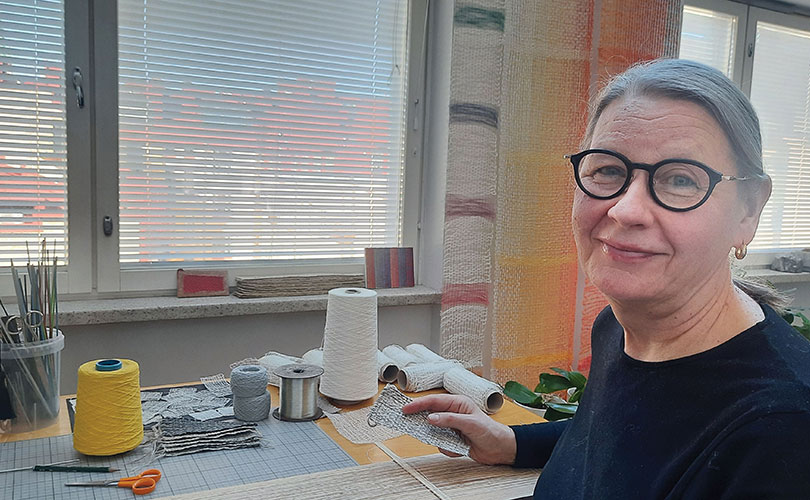
Merja Keskinen, photo by Juha Keskinen

This year’s Spring “Art in the Barn” exhibition at browngrotta arts is Transformations: dialogues in art and material. In Transformations, we’ll highlight the unique materials adopted by artists we represent, including lead, stones, feathers, seaweed, and coconut fiber. We’ll also explore the singular results achieved by different artists approaching the same material.
Linen textile installation
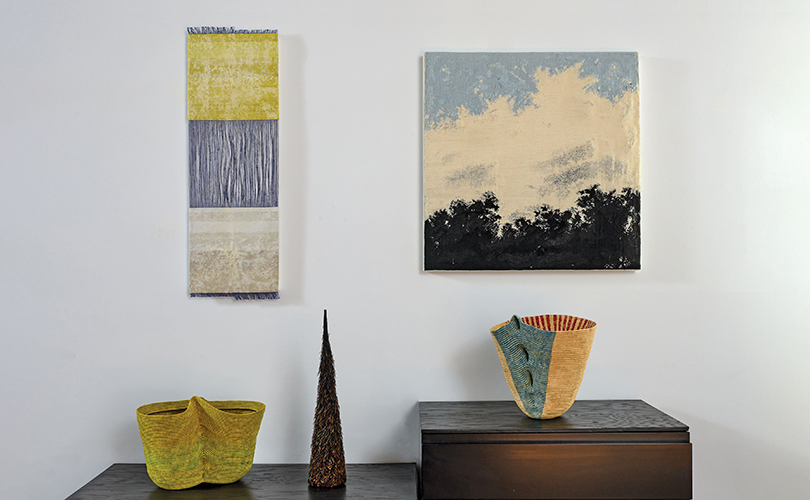
Linen works by Chiyoko Tanaka, Sara Brennan, Carol Shaw Sutton, Jane Sauer. Photo by Tom Grotta

One of the those materials is linen — we’ll exhibit “quivers” by Gary Trentham, figures by Mary Giles, vessels by Carol Shaw-Sutton, and wall works by Chiyoko Tanaka, Sara Brennan, and new to browngrotta audiences, Merja Keskinen.
Merja Keskinen tapestry detail
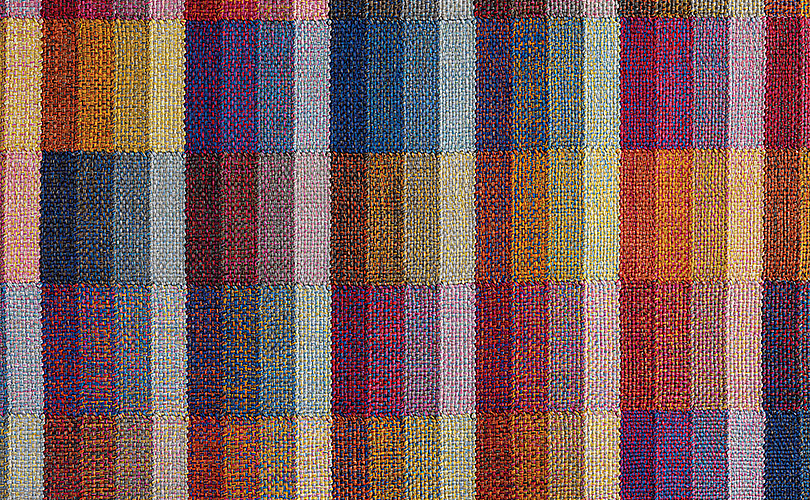
Detail: 1mkes Rhythm of Colors, Merja Keskinen, 80% linen, 20% cotton, 56″ x 62″, 2022. Photo by Tom Grotta

Merja Keskinen is a Finnish artist whose explorations of color and linen intrigued us. She is an illusionist, creating single surfaces that appear dimensional like that in Rhthym of Colors which gives the impression of a three-dimensional work. Her method provides additional surprises.”The texture and structure of the surface imitate woven fabric,” she says, “but I make the works without looms by braiding and sewing. I wind my yarn around frames of different sizes. Usually, the warp thread continues unbroken in the direction of the weft. I weave parts with a simple plait binding, threads of different colors cross each other vertically and horizontally, one over, one under.”
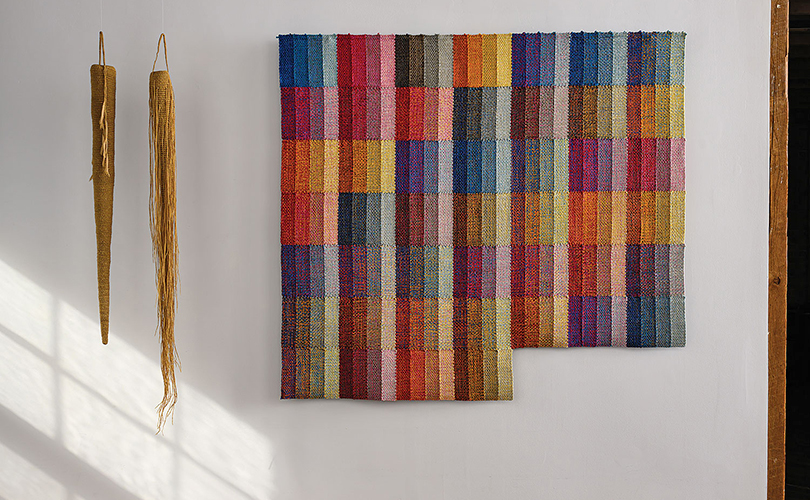
Gary Trentham, Merja Keskinen installation
Gary Trentham Hanging linen Baskets, 1mkes Rhythm of Colors, Merja Keskinen, 80% linen, 20% cotton, 56″ x 62″, 2022. Photo by Tom Grotta

Keskinen’s explorations of color are equally mesmerizing. “I combine colors and threads according to a preselected system. The impressions and changes created by the colors are based on mathematical considerations and systematics. In parts of the works, the thread colors change a few threads at a time according to the chosen system.”
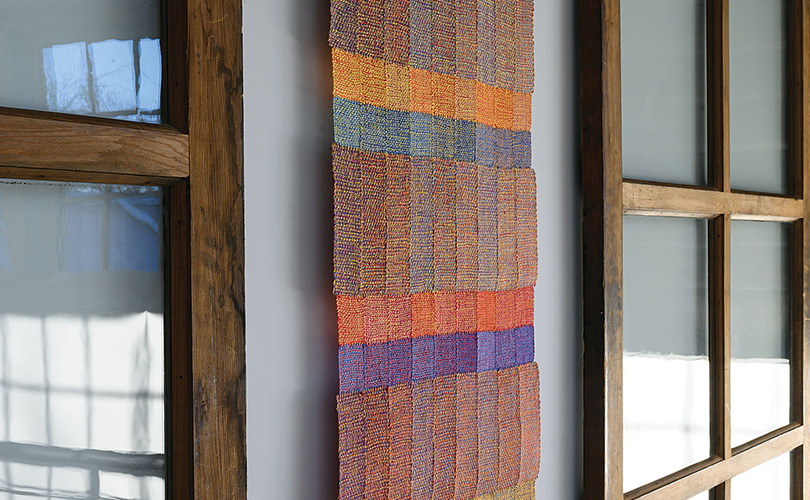
Merja Keskinen textile
2mkes Horizontal Colors I, Merja Keskinen, linen, 30.75″ x 19″, 2024

The colors blend optically; subtle shifts and delicate changes are optimized. In Horizontal Colors 1 and 2,  the starting point for each work is three colors — blue, red and yellow, and three different shades of the colors —  nine thin linen threads each. The combinations of three colors created different shades of brown. The combinations of two colors created different shades of violet, orange and green. The works consist of all 81 different color combinations according to Keskinen’s predefined system. Rhthym of Colors consists of 184 differently colored parts.

For viewers, the experience of Keskinen’s work is multifaceted. The different colored threads can be distinguished when viewed closely, when viewed from a distance, the color is formed by the combined effect of the shades. The third element that impacts the viewer’s experience is spatial. “The delicate works made of transparent, light structures take their final shape only when hung in the space…, “ Keskinen explains. “The colors live according to the space. The same work in different spaces can appear as different color experiences. Light plays an important role in shaping the works.”
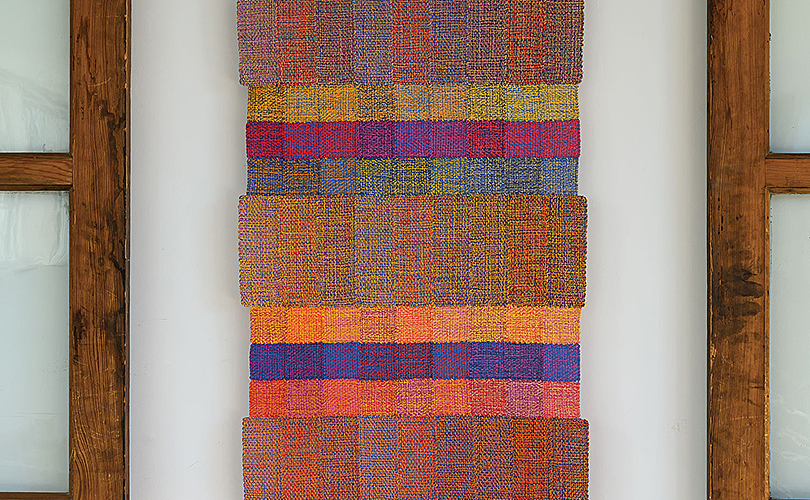
Merja Keskinen textile
3mkes Horizontal Colors II, Merja Keskinen, linen, 30.75″ x 19″, 2024. Photo by Tom Grotta

The artist, who graduated with a Master of Arts degree from the University of Art and Design (now Aalto University) in 1988, lives and works in Helsinki. Keskinen’s career initially focused on industrial textile design and expert positions on textile collections for public spaces, eventually becoming a full-time visual artist. She has held several solo exhibitions and participated in group exhibitions with her works at home and abroad. Her commissioned work for the Finnish Embassy in Paris was completed in 2012 and for the Finnish Pensions Agency in Helsinki in 2020. The Textile Artists Association TEXO awarded Keskinen with the Textile Artist of the Year award in 2019. The Arts Promotion Centre has granted Merja Keskinen a 5-year state artist professorship grant for 2022–26.

The artists in Transformation: dialogues in art and materialsincluding Merja Keskinen, all meet curator and historian Glenn Adamson’s definition of material intelligence, that is: “a deep understanding of the material world around us, an ability to read that material environment, and the know-how required to give it new form.” We hope you’ll come and see her work this May.