Tag: Eduardo Portillo & Mariá Eugenia Dávila

Artists on Anni Albers’ Enduring Influence

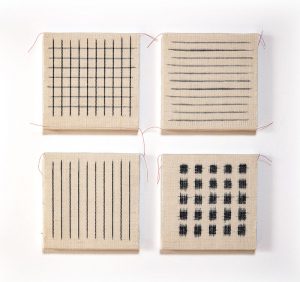
10 Lines 11 Lines 17 Lines 25 Squares, Kay Sekimachi, 6” x 6” each linen, polyester warp, permanent marker, 2017

As we noted in our last two blog posts, Anni Albers has been a profound influence for artists worldwide. Albers’ ability to combine the ancient craft of hand weaving with the language of modern art, finding within the two a multitude of ways to express modern life, led her to inspire numerous artists, from browngrotta arts, including Sue Lawty who wrote about her Albers’ influence on arttextstyle last week.

Fellow weaver and fiber artist Kay Sekimachi loved both Albers’ work and writings. When discussing Albers’ weaving method Sekimachi quoted Albers’ admonition, “You just have to listen to the threads,” adding, “that’s what keeps me going.” Sekimachi says that Albers’ book On Designing has served as her weaving “bible.”
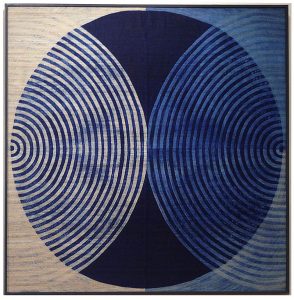
Neha Puri Dhir

Neha Puri Dhir, an India-based textile artist, whose captivating geometric-based work will be featured in our upcoming Art in the Barn exhibition, Art + Identity: an international view, has also been influenced by Albers. “I have always found Anni’s work as a modernist textile artist revolutionary. Her work has a visual language of simple and direct compositions which has deeply influenced my art practice.” Dhir believes the way in which she expresses interactions of colors and forms as simple compositions in her own work has been unconsciously inspired by Albers. Dhir has embodied Albers’ step-by-step approach to exploration, making that the underlying sensibility of her art practice.
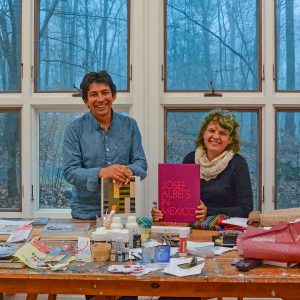
Eduardo Portillo & Mariá Eugenia Dávila at the Albers Foundation

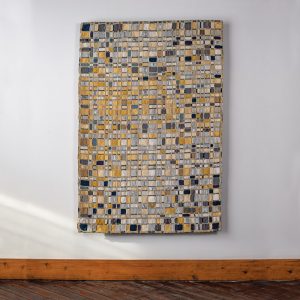
Mariá Dávila and Eduardo Portillo have approached Anni Albers’ legacy with intention. In late 2018, the couple spent a month at the Josef and Anni Albers’ Foundation in Bethany, Connecticut. The Foundation maintains two residential studios for visiting artists who exemplify the seriousness of purpose that characterized both Anni and Josef Albers. The residencies are designed to provide time, space, and solitude, with the benefit of access to the Foundation’s archives and library. The couple wrote to us a few times during their stay.Today we were at the Albers archive, we found the notes for the Annie’s book On Weaving and were very near to some of her works — a special day. Now our days are very intense, daytime for the Library, nighttime for the Studio. During these days we have been devoted almost completely to study Josef’s and Anni’s work and thoughts. It has been very helpful in understanding our own process. We are not working on the loom now, you will find us surrounded by books and  draft papers.”

When we visited them in Bethany in December, they told us:”The silence and the beauty here is a gift. Our lives at home are so busy and so intense that it is hard to focus and think about our work and its direction. Here, we are living an almost monastic life, studying and thinking nearly full-time spurred by the example of the Albers who were remarkably prolific.”

New Nebula, Eduardo Portillo & Mariá Eugenia Dávila , silk, alpaca, moriche palm fiber dyed with Indigo, rumex spp, onion, eucalyptus, acid dyes, copper and metallic yarns, 74” x 49.25”, 2017


“The Foundation has thousands of works, which they are cataloging. Anni’s loom is here, but we did not come here to
weave, but to think and study. We are very interested in her pictorial works — where she tried to embody something tangible, like the sun or a landscape, metaphorically, in a weaving.”

“This place is unique, educating, mutating, extraordinary — so many adjectives you could choose. Anni opened the door for people to think about textiles differently. Now, with the Tate exhibition, she will open doors again.”

And on reflection, when the residency was nearly over: “Just a sentence, a few of her words, has been enough to enlighten our path. Her clear vision on how a weave is created allows us to transit with confidence to experimentation through the threads and the interchange that exists between ideas and materials. Revisiting her work makes us witnesses to her legacy.”

Art Assembled: New This Week August

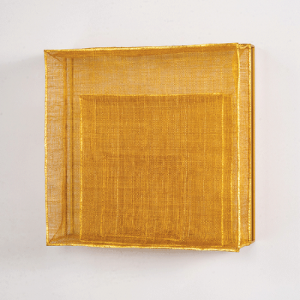
The Path which Leads to Center 18-05, Chang Yeonsoon, abaca fiber, barberry roots dye, 100% pure gold, 17” x 17” x 6.5”, 2017.

On tap in August were spectacular pieces by Chang Yeonsoon, Norma Minkowitz, Eduardo Portillo & Mariá Eugenia Dávila and Marian Bijlenga.


We kicked off August with Chang Yeonsoon’s The Path which Leads to Center 18-05. In much of her work, Yeonsoon dyes her fibers with indigo. However, in making The Path which Leads to Center 18-05 she used barberry root dye and 100% pure gold leaf. The process which Yeonsoon uses to apply the gold lead is a Korean technique called geumbak. Though geumbak is usually used with natural lacquer, Yeonsoon was able to create a new lacquer with gold leaf.

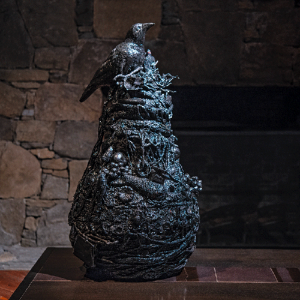
Trove, Norma Minkowitz, mixed media, 38” x 19” x 19”, 2018


On our trip to Norma Minkowitz’ studio this summer, which you can read about in our blog post HERE, we picked up
Trove. The sculpture is made using small trinkets Minkowitz has collected throughout her life, therefore the reason why she named it Trove. To take a closer look at Trove watch the video we made HERE

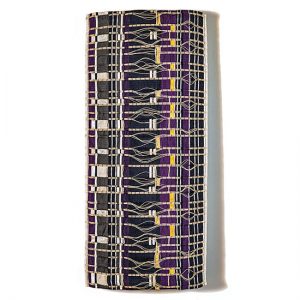
Transición, Eduardo Portillo & Mariá Eugenia Dávila, alpaca; metallic yarns and silver leaf; moriche palm fiber, silk, 56″ x 24.25”, 2018


Next up, we had Eduard Portillo and Mariá Eugenia Dávila’s wall-hanging Transición. The wall-hanging’s vibrant purple hue makes the woven “mosaic” impossible to go unnoticed. Portillo and Dávila source and create all of their own materials. The Venezuelan couple grows their own mulberry trees on slopes of the Andes (Mulberry trees are the sole food source for silkworms), rear their own silkworms, obtain the silkworm threads and color the threads with their own natural dyes to use in making textiles.

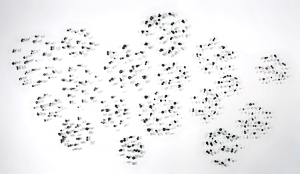
Fish Scale, Marian Bijlenga, dyed fish scales, 64 x 113 x 1 in, 2012


To wrap-up the month of August, we shared Marian Bijlenga’s
Fish Scale. Bijlenga is not afraid of challenging herself to work with new materials. In the past, she has worked with materials such as horse hair, viscose, paper and glass. Her piece Fish Scale is in fact made with extremely delicate fish scales. In making the piece, Bijlenga carefully connected a network of scales using very fine thread, giving the illusion that the scales are floating in mid-air. To see Fish Scale in detail, check out THIS video. 


browngrotta arts Returns to SOFA Chicago, November 5-8th

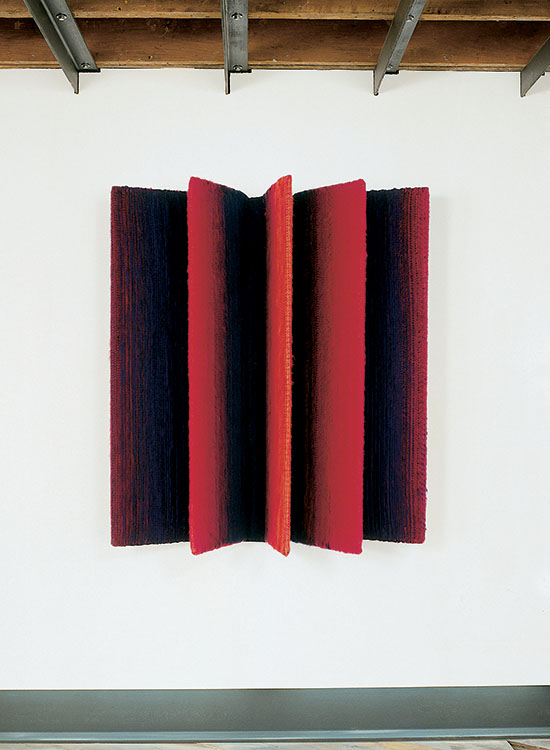
627mr PapelionIidae, Mariette Rousseau-Vermette wool, steel, 54” x 54” x 16”, 2000

627mr PapelionIidae, Mariette Rousseau-Vermette
wool, steel, 54” x 54” x 16”, 2000

After a few-year hiatus, browngrotta arts will return to the Sculpture, Objects, and Functional Art Exposition at the Navy Pier in Chicago next month. We’ll be reprising our most recent exhibition, Influence and Evolution: Fiber Sculpture…then and now, with different works for a number of artists, including Naoko Serino, Kay Sekimachi, Anda Klancic, Ritzi Jacobi, Randy Walker, Mariette Rousseau-Vermette, Carolina Yrarrázaval and Lenore Tawney. Other artists whose work will be featured in browngrotta arts’ exhibit are Magdalena Abakanowicz, Adela Akers, Lia Cook, Sheila Hicks, Masakazu Kobayashi, Naomi Kobayashi, Luba Krejci, Jolanta Owidzka, Ed Rossbach, Sherri Smith, Carole Fréve, Susie Gillespie, Stéphanie Jacques, Tim Johnson, Marianne Kemp, Federica Luzzi, Rachel Max, Eduardo Portillo & Mariá Eugenia Dávila, Michael Radyk and Gizella K Warburton. SOFA will publish a related essay, Fiber Art Pioneers: Pushing the Pliable Plane by Jo Ann C. Stabb,
on the origins of the contemporary fiber movement.

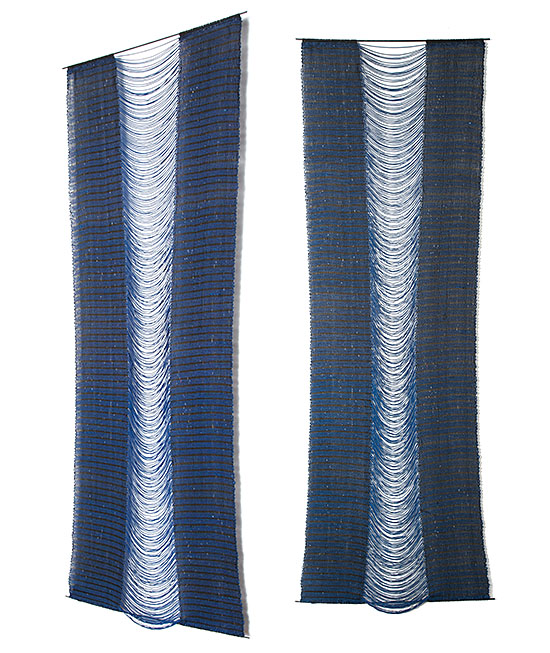
1cy AZUL Y NEGR Carolina Yrarrázaval rayon, cotton 116" x 40.5”, 2003

1cy AZUL Y NEGR
Carolina Yrarrázaval
rayon, cotton
116″ x 40.5”, 2003

Now in its 22nd year, SOFA CHICAGO is a must-attend art fair, attracting more than 36,000 collectors, museum groups, curators and art patrons to view museum-quality works of art from 70+ international galleries. After a nationwide competition, SOFA CHICAGO recently placed #7 in the USA Today Reader’s Choice 10 Best Art Events.New this year, SOFA CHICAGO will unveil a revamped floorplan created by Chicago architects Cheryl Noel and Ravi Ricker of Wrap Architecture. The re-envisioned design will create a more open and cohesive show layout, allowing visitors to explore the fair in a more engaging way. Changes include a new, centrally located main entrance where browngrotta arts’ booth, 921, will be located. Cheryl Noel of Wrap Architecture adds, “The most effective urban contexts contain distinct places within the larger space, corridors with visual interest and clear paths with fluid circulation. We believe this new floorplan will capture the spirit of the art and be an expression of the work itself, exploring form and materiality, with the same level of design rigor applied.”

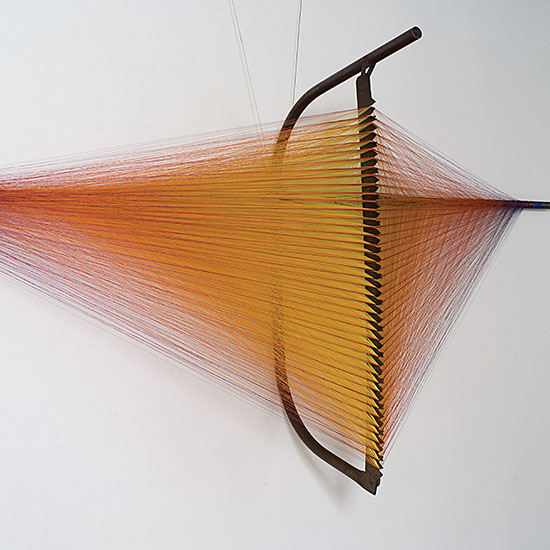
1rw SAW PIECE NO.4 (AUTUMN) Randy Walker, salvaged bucksaw, steel rod, nylon thread 42" x 96" x 26", 2006, Photo by Tom Grotta

1rw SAW PIECE NO.4 (AUTUMN)
Randy Walker, salvaged bucksaw, steel rod, nylon thread
42″ x 96″ x 26″, 2006, Photo by Tom Grotta

On Friday, November 6th, from 12:30 to 2:30, Michael Radyk will be at browngrotta arts’ booth to discuss his Swan Point series, Jacquard textiles created to be cut and manipulated after being taken off the loom, in which Radyk was trying “to bring the artist’s hand back into the industrial Jacquard weaving process.” SOFA opens with a VIP preview on Thursday, November 5th, from 5 pm to 9 pm. The hours for Friday and Saturday are 11 am – 7 pm; and 12 to 6 pm on Sunday the 8th. SOFA is in the Festival Hall, Navy Pier, 600 East Grand Avenue Chicago, IL 60611. Hope to see you there!