
Tag: Ed Rossbach

In Print: Weave Arrived, in how to spend it, the Financial Times

weave.arrived.jpg

Basketry has graduated from country-fair staple to sophisticated urban art form, Emma Crichton-Miller wrote in Weave Arrived, an article in the December 5, 2009 issue of the Financial TImes‘ glossy weekly magazine, how to spend it. Over the last 15 years, Crichton-Miller observes, “basket-making has experienced not just a revival but a reinvention.” The transformation to an expressive medium has been led in the UK by Mary Butcher, recently designer-in-residence at the Victoria and Albert Museum. Butcher learned traditional skills from artisan basketmaker, Alwyne Hawkins, but as a research fellow she began to use the materials to create work that “slipped its leash” — cones that hang from the ceiling, chains of bark rings and densely woven sculptural shapes. Crichton-Miller notes that outside the UK, art basketmaking has had a high profile for sometime as a result of artists like Markku Kosonen of Finland, and John McQueen and Ed Rossbach in the US.

With the vessel no longer the “first priority,” says Butcher, basketmakers are able to address other exploratory concerns. Lizzie Farey’s willow spheres and soaring wall pieces are animated by her attachment to the landscape of Scotland, where she lives and works. Dail Behennah, who studied geography, creates forms of steel, willow and other woods that are constructed, rather than woven. Her grids, scaffolds and spheres explore ideas about line and light and shadow. Joe Hogan rescues ancient wood from bogs and the sea that he incorporates into his woven forms. The result is often unexpected, highly individual and energetic. Artists like these have ended “basketry’s 20th-century obsession with the past,” Crichton-Miller concludes, and entered “a new world of pure function-free aesthetic pleasure.”
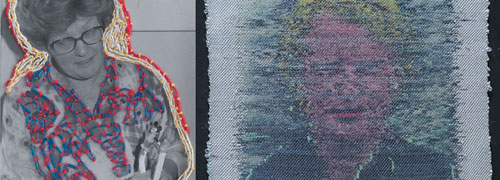

Gold Medal Winner: Katherine Westphal

portaits-of-Katherine-by-Ed-Rossbach.jpg

postcard and weaving of Katherine Westphal by Ed Rossbach

The American Craft Council has announced that Katherine Westphal has been selected to receive the 2009 Gold Medal, for consummate craftsmanship. Thirty-nine other artists have been awarded a Gold medal, including artists Sheila Hicks, Lenore Tawney, Dale Chihuly, Jack Lenor Larsen and Ruth Duckworth. Artists selected must have demonstrated extraordinary artistic ability and must have worked 25 years or more in the discipline or career in which they are being recognized.
Katherine was born in 1919. She studied painting, intending to be a commercial artist. In 1946, she was hired to teach design at the University of Washington in Seattle. It was there she met and married fellow faculty member, and later ACC Gold Medalist, Ed Rossbach. In 1950, the couple moved to Berkeley and Westphal began working with textiles. For eight years she designed commercial fabrics. In the mid-60s she accepted what she thought was a short-time assignment teaching industrial design at the University of California, Davis. She stayed 13 years, retiring as Professor Emeritus in 1979. From 1997 to 2001, the couple’s work was featured in museums across the US in a traveling exhibition, The Ties That Bind, Fiber Art by Ed Rossbach and Katherine Westphal from the Daphne Farago Collection.

Westphal has concentrated on surface, pattern and decoration in textiles, quilts and clothing, as well as baskets. The use of fractured and random images became a signature of her work. Her collages combined bold images and bright colors. In the catalog for the OBJECTS USA exhibition in 1970, she wrote, “I was trained as a painter. I see things from that viewpoint. I build up; I destroy. I let the textile grow, never knowing where it is going or when it will be finished. It is cut up, sewn together, embroidered, quilted, embellished with tapestry or fringes, until my intuitive and visual senses tell me it is finished and the message complete.”

UNTITLED KIMONO

UNTITLED KIMONO

Shortly after the color copier was introduced, while others were still concentrating on standard office applications, Westphal recognized the technology’s creative potential. She used heat transfer paper to imprint images onto paper and cloth, combining photographs that she had taken herself with found images, altering them, then tearing, cutting, rearranging and stitching them back together. Jo Ann Staab described the process in Surface Design in 1999, “She would also deliberately move an image while the copier was running, so that the print was blurred, or the movement was traced into a new image. It was magic. She took these images and incorporated them into her textile designs, her handmade books, and even her woven designs. One day I saw her working with an image of boisterous tennis star John McEnroe with his signature mop of red curls wrapped in a headband. She had abstracted and silhouetted an action pose and was setting up a diagonal repeat on sheets of copy paper taped together. I said, ‘Oh, that’s John McEnroe, I can tell because of his hair.’ She responded, ‘Oh, I don’t know who it is, I just liked the movement in this image – it’s from one of those sports magazines.’ Later the image emerged in a highly technical Jacquard weave repeat that Katherine produced as part of the Jacquard Project sponsored by the Rhode Island School of Design; row upon row of McEnroe figures pushed to a completely different level of abstract design meticulously rendered in multi-harness brocade.”

Westphal’s inventive approach has influenced myriad artists. As Ken Johnson, wrote of her and her husband, in the New York Times in 1998, “The permissions extended by Mr. Rossbach and Ms. Westphal have inspired generations of craftsmen. For each, weaving is a conservative discipline against which to react by using improbable materials, techniques or, occasionally, images. You don’t think about how beautifully or skillfully their works are made, but rather how inventively they play off conventional expectations.”