
Lenore Tawney collages, In Chaco and The Loftiest Word and sculpture, Boy with Duck, at AIFAF
From February 3rd to the 8th. browngrotta arts will join more than 80 international galleries exhibiting at the American International Fine Art Fair (AIFAF) in Palm Beach, Florida. AIFAF is recognized as the “crown jewel” of American art fairs and is the only American art and antiques fair rated 5 stars by The Art Newspaper. AIFAF is a fully vetted fair, featuring prestigious international dealers presenting a mix of paintings, sculpture, jewelry, antiques, contemporary design and decorative arts. In cooperation with the Baruch Foundation and the Lenore G. Tawney Foundation, browngrotta arts will feature the work of Magdalena Abakanowicz and Lenore Tawney at AIFAF, artists whose work redefined weaving and sculpture in the 20th Century.
Abakanowicz is the best-known Polish artist in the world. She initially gained acclaim for her “Abakans,” monumental woven works of sisal, ropes and other fibers that hung free in space. Next were headless human forms of burlap and later bronze. Large groupings of her sculptures are installed around the world, from Chicago’s Millennium Park to Olympic Park in Seoul to the Israel Museum in Jerusalem. In presenting her a Visionaries! award in 2000, the Museum of Arts and Design cited her for “her powerful explorations, dealing with the impact of social and political reality on individual identity, that have demonstrated the potential of fiber as an effective and expressive sculptural material.”

Weavings by Magdalena Abakanowicz at AIFAF. The weavings on the far right and far left were woven in the 1980s; the piece in the center is from the 1960s.
At AIFAF, browngrotta arts will exhibit three weavings by Abakanowicz, one from the 1960s and two, from the Anne and Jacques Baruch Collection, Ltd., created in the 1980s. The Baruchs opened a gallery in Chicago in the late 1960s, bringing work to the U. S. from Central Europe in order to give exposure to the Slavic art that Jacques, who died in 1986, once described as “the finest work of tomorrow…not what is known…the new blood.” Jacques was unable to travel after 1970, but Anne continued to travel to Central Europe to search for art. As the political situation in the area tightened, Anne, began smuggling art into the US, often at great risk. Government agents would seal her packages of approved art before she left; with the help of artists, she would often unseal the packages and reseal them in order to add unsanctioned works. She would travel with a bright red Hartman suitcase with a false bottom, filled with art supplies that the artists could not buy. On her return trip, artworks would be hidden inside. In this manner, Anne amassed a singular collection of contemporary textiles and historical and contemporary Czech photography. The Baruch Foundation was established in 2008, subsequent to Anne’s death in 2006 and is comprised of her personal art collection and the artwork inventory of The Anne and Jacques Baruch Collection, Ltd. The missions of the Foundation are to preserve and foster the growth of the visual arts of Eastern and Central Europe through donations of artwork to museums and schools, and to fund educational programs and scholarships by the sale of artwork.
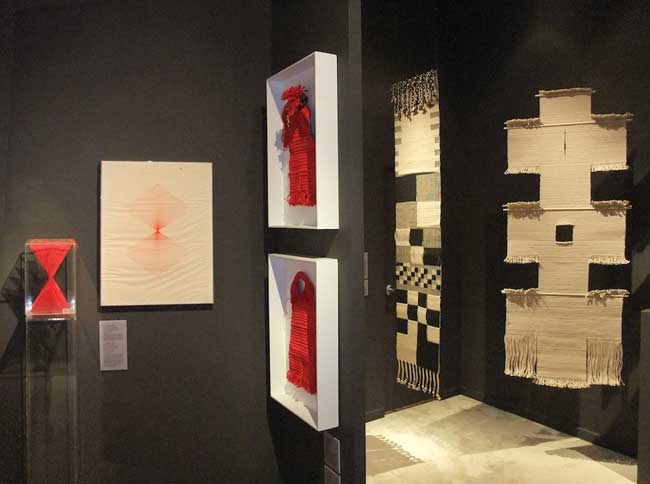
Works by Lenore Tawney on display in the browngrotta arts booth at AIFAF.
At AIFAF, browngrotta arts will also show weavings, drawings, collages and mixed media assemblages by Lenore Tawney, who died in 2007 at the age of 100. “Luminous is an apt word to describe the entire career of the American artist Lenore Tawney,” wrote Holland Cotter in the New York Times in 2004. In the 1950’s, he noted, “she created a series of monumental open-weave sculptures that were like nothing seen before or since. Astonishing.” About her collages Cotter has written, “Whether she sets cut-up bits of handwriting spinning around a reproduction of a Michelangelo sibyl or turns strips of antique German books into suspended grids, she touches on the roots of the collage medium in language and personal history with a reticent orginality.” The Lenore G Tawney Foundation was established in 1989 by Tawney for charitable and educational purposes. Its aim is to support other artists in their own artistic efforts and to support special projects at art museums and non-profit educational arts organizations; its highest priority is to nurture emerging artists and to provide them with learning opportunities through established educational programs.

 We’re leaving the ice and snow (sigh) for sunnier climes next week, where
 with Valeria Belletti and Sam Goldwyn Jr.) The result is the highly idiosyncratic list below. I am indebted to artist Sabrina Gschwandtner and Fiberarts editor Marci Rae McDade who compiled a list of feature-length fiber-related films in the April/May 2009 issue of Fiberarts (their selections are asterisked below). I have added the parantheticals and other nominees in developing my own compilation. For a much more extensive list (132!) of films that feature just knitting, see Knitting in the Movies; there’s another at



 by Raoul D’harcourt (Univ of Washington Press, 1974; Dover Publications, 2002). I discovered this book in the Public Library in Chicago around 1958. It was a reference book and only in French. Later it was translated in English, and a few years later it was reprinted. Wonderful examples, history and diagrams; there’s nothing like it. It was like my bible. Not sure if it still available. There are many other books on Philosophy and Architecture that I would recommend, but the D’harcourt book was the most influential.
 by Eric Broudy( Littlehampton Book Services Ltd., 1979; Published by the University Press of New England, 1993). This book is absolutely fascinating from a visual, historical, and technical point of view. The forms of looms have inspired me as sculptural elements in themselves. Understanding the evolution of their forms in a cultural context is invaluable. I have to imagine this book of interest to non-fiber people as well as serious fiber artists.
 , ed. Dieter Schwarz (Hatje Cantz Publishers; Bilingual edition 2005). Agnes talked about waiting for inspiration… and waiting…and waiting…and waiting. She also spoke of not having unnecessary distractions in your life such as pets and unnecessary friends. I put my husband and the two cats up for adoption but so far no takers.

 by Bernard Leach (Faber & Faber 1988).
 (and all of its variations)(recent reprint, Weatherhill, 2008) had a HUGE influence on my work. The Japanese have a wonderful way of using indigenous materials to wrap things…packaging, transporting, presenting. Even now, years later, the influence of these old techniques prevails. This book and its information, not basketry nor bamboo, drove me to Japan in the first place. Who knew it would have such a profound influence on my work? If you look at some of the earlier work I exhibited through browngrotta arts, you’ll see Japanese packaging everywhere. In New York, the recent reprint can be found in Kinokuniya Bookstore on 6th Avenue. Love that place!
 (University of California Press, 2004) is the absolute cornerstone of the project I have worked on for six years for the North Dakota Museum of Art. The book contains a series of papers and artist interviews that resulted from a year-long project all up and down the west coast (why not Portland???) in which Jacquelynn Bass and independent curator Mary Jane Jacobs looked at how curators shy away (to say the least) from work that has anything to do with spirituality. There were several retreats at a Zen Center in California, where papers on the topic were delivered. There’s more information about the project on the UC Press website. As to pursuing a career, I never really did that. I do what I do because I have to. It is what keeps me in the world.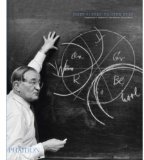
 by Frederick A. Horowitz and Brenda Danilowitz (Phaidon Press, 2009) It’s an account of Albers’ teaching at the Bauhaus, Black Mountain College and Yale. I took a summer course with him at Harvard when I lived in Cambridge and this book sums up some of the thing he had us do. It was very exciting.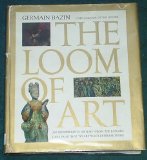
 by Germain Bazin, curator of the Louvre (Simon Schuster, NY, 1962) probably way out of print! The book is beautiful and I have it and love it still.
 (with Alexandra Quinn, Gibbs Smith, 2008). It is a wonderful book. He collects street trees and mills them and uses them in his work so he is dear to my heart.
 IF (Getty Publications; J. Paul Getty Museum; First Edition edition 1995) by another artist friend of mine, Sarah Perry.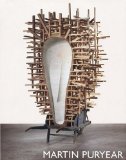
 (The Museum of Modern Art, New York 2007) by John Elderfield, Elizabeth Reede, Richard Powell, Michael Auping, Martin Puryear.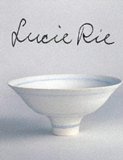
 by Tony Birks (Marston House 1994). I feel this book documents her work very well. I am always amazed at the “drawing” she could do with glaze.
 (Wesleyan 1971). It was my weaving “Bible”. In fact everything she wrote makes so much sense to me.
 by Mildred Constantine/Jack Larsen (Van Nostrand Reinhold 1972) it just turned my ideas and work upside down. I saw what was possible with the materials I was using and what else was out there. That book opened up a whole new world to me.
 by Soetsu Yanagi (Kodansha International, Revised edition, 1990). One of my first trips after arriving in Tokyo three weeks ago was to the Mingeikan, Yanagi’s museum and home. It was a delight, after so many years, to see some of the work pictured in the book. Yanagi’s theory that hard, repetitive practice resulted eventually in the disengagement of self and led to work of merit produced with ease was an inspiration to me. I was a young grad student when I first read the book and at the time every day was a struggle.
 by Claude Levi-Strauss (University Of Chicago Press, 1968). The introduction made me think about the role of an artist and about materials.

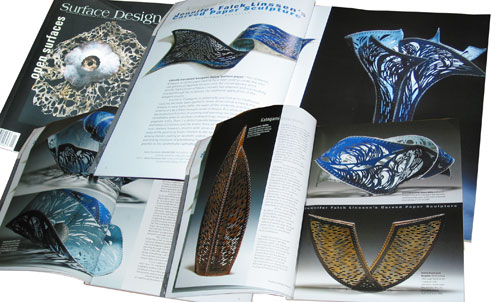


 Only a few weeks left to left observe the official International Year of Natural Fibres (yes, we’re sticking with the international spelling here). For browngrotta arts and many of the artists we represent, of course, promotion of natural fiber in art and otherwise is a lifelong pursuit. In 2009, however, we had the assistance of the Food and Agriculture Organization of the UN, which declared this year the International Year of Natural Fibres