
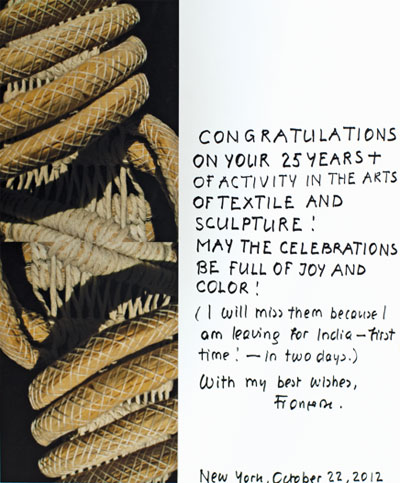
 Earlier this year, Françoise Grossen sent bga these congratulations on our 25th anniversary. Grossen’s remarkable contributions to the field predate ours. In 1972, her work was featured in, “Rope Art: A new form fit to be tied,” in Life Magazine in an article on the exhibition Deliberate Entanglements. “Françoise Grossen, a Swiss better at knotting than entomology, concocted a 20-foot Inch Worm” the magazine wrote. “Some viewers at New York’s Museum of Contemporary Crafts thought it moved.” (Life Magazine, December 1, 1972, pp.86-90). This year, Grosssen’s work, Ahnen Galerie, 10 braided bundles of dyed manila rope with appendages, 13 x 116 x 92 inches, was acquired by the Racine Art Museum. Ahnen Galerie is now on display in High Fiber: Recent Large-Scale Acquisitions in Fiber, http://www.ramart.org/content/high-fiber-recent-large-scale-acquisitions-fiber, at the Racine Museum of Art through January 20, 2013.
Looking Forward/Looking Back: Françoise Grossen
November 26th: Our Online Exhibition Opens With an Offer for CyberMonday
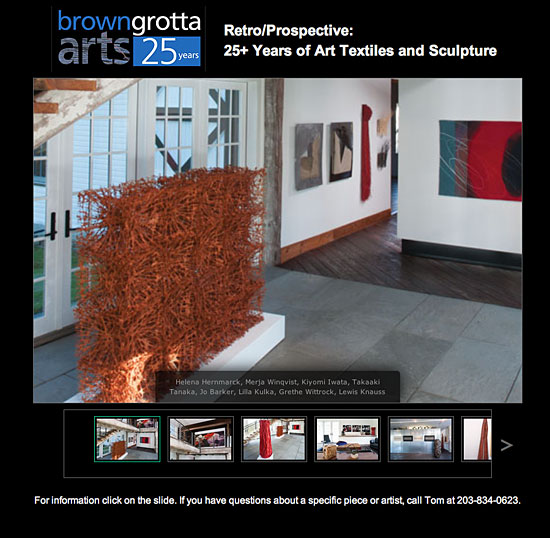 On Monday, November 26th, browngrotta arts will present an online version of our 25th anniversary exhibition,Retro/Prospective: 25+ Years of Art Textiles and Sculpture at browngrotta.com. The comprehensive exhibition highlights browngrotta arts’ 25 years promoting international contemporary art. Viewers can click on any image in the online exhibition to reach a page with more information about the artists and their work.
“Some works in Retro/Prospective: 25+ Years of Art Textiles and Sculpture reflect the early days of contemporary textile art and sculpture movement,” says Tom Grotta, founder and co-curator at browngrotta arts. “There are also current works by both established and emerging artists, which provide an indication of where the movement is now and where it may be headed.”
Since Monday the 26th is CyberMonday this year, sales of art, books, catalogs, videos or dvds placed online or by telephone that day will be discounted 10% (excluding tax and shipping). In addition, bga will make a donation to the International Child Art Foundation for each sale made from November 24th through December 31, 2012. Visit browngrotta.com. For more information call Tom at 203.834.0623 or email us at art@browngrotta.com.
Looking Forward/Looking Back: Randy Walker
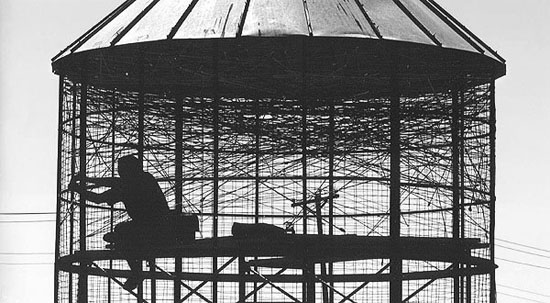
Woven Corncrib Copyright Randy Walker 2008
Ten years ago, I wound a spool of thread around a bent-up steel tomato cage for no reason at all. The idea of using thread to make art never entered my mind. I was just playing.
Trained as an architect, I thought in terms of solid things made from serious materials like concrete, glass, wood and steel. I had no affinity for textiles of any kind. Thread was soft, formless and barely visible. It also came in colors, which any sophisticated architect would be suspicious of. Furthermore, I found it difficult to handle, and I was surely not using it for what it was intended.
As I continued to wrap the deformed metal frame, a surface began to emerge. Not a solid surface, but an intricate, transparent one that allowed the entire volume of the cylindrical shape to be seen at once. As the lines of thread multiplied, their color intensified and light played off them. It was magical. I realized that textiles were none other than surfaces like the one I was making, only more solid. I became fascinated with the idea of an in-between surface, neither solid nor completely transparent.
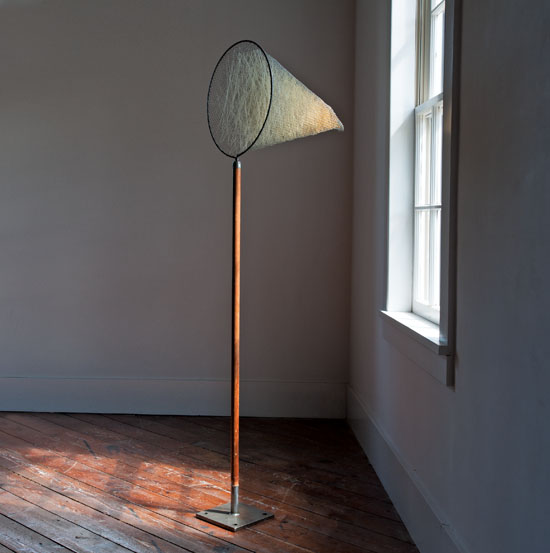
6rw Skimmer, Randy Walker, old cheese curd skimmer, nylon thread, steel base, 67.5″ x 21.5″ x 15.25″, 2008
Pleased with my three-dimensional creation, I went to the sewing store and bought an entire shelf of this thread. I searched for other things to wrap and found saw blades and kitchen sieves, a badminton racquet, scythes, and all manner of rusty implements to be ideal for my fibrous interventions. With each framework, I had to invent a way of adapting the fiber, and it was unknown and exciting territory.
I eventually discovered the work of Naomi and Masakazu Kobayashi, and from there browngrotta arts. I realized that browngrotta represented a small yet international community of artists that were pushing the traditional boundaries of textile arts. It was a place where art, craft, sculpture and architecture merged, unbounded by narrowly defined categories.
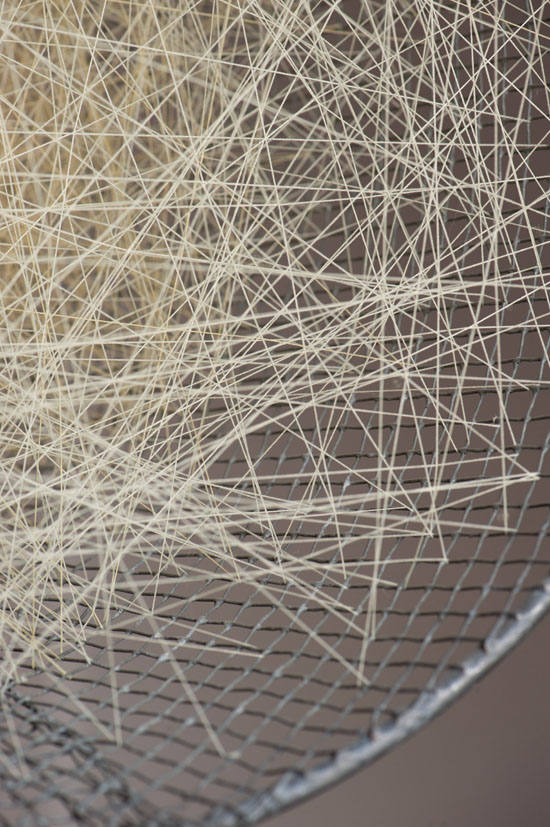
Randy Walker Skimmer detail
Over the years, I have continued to search for objects and spaces for my artistic investigations in thread. My explorations have led me to investigate the possibilities of fiber as a workable medium in architectural settings. At this large, public scale, I have used found objects and spaces that include an abandoned corncrib, concrete grain elevator, a historic wrought iron bridge and urban water fountains. Using fiber in the public realm challenges accepted notions of permanence and process traditionally associated with public art. I find that I must invest time not only in my art making, but in the research and development of fiber technology. On a more philosophical level, fiber has caused me to reflect deeply on what I am trying to do as an artist, and where my work is taking me.
Most of the time I am up to these challenges, but I have set out on a lonely and meandering artistic path. browngrotta is for me a beacon. I have only to look through these artists’ work to remind me of the unlimited and largely unexplored potential of this medium.
Randy Walker
November 2012
Looking Forward/Looking Back: Tamiko Kawata
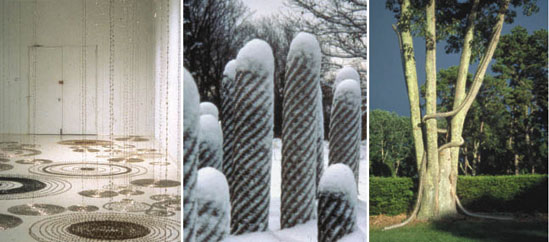
Tamiko Kawata installations
Safety pin has been my primary medium for some time. It functions variously as thread, yarn, clay or truss in my work process. Safety pins entered my life soon after I arrived from Japan, out of the necessity to shorten the all-too long American clothing.
In the beginning, I made simple flat pieces, finding ways to interlock the pins as if weaving. Each piece was an experiment and each piece took me to another unexpected stage. Slowly and naturally I found constructing systems as I went along, using only the inherent structural properties of the pins, and I can now create from anything from drawing-like works to three-dimensional self-standing works and jewelry forms.
In 1999, I was given the opportunity to install these works outdoors. It is a challenging and exciting practice, to expose this very domestic, usually hidden thing, to the open, rough environment of nature, where it must face all kinds of weather and is susceptible to damage and decay. Working outdoors gives me another angle to express my concept.
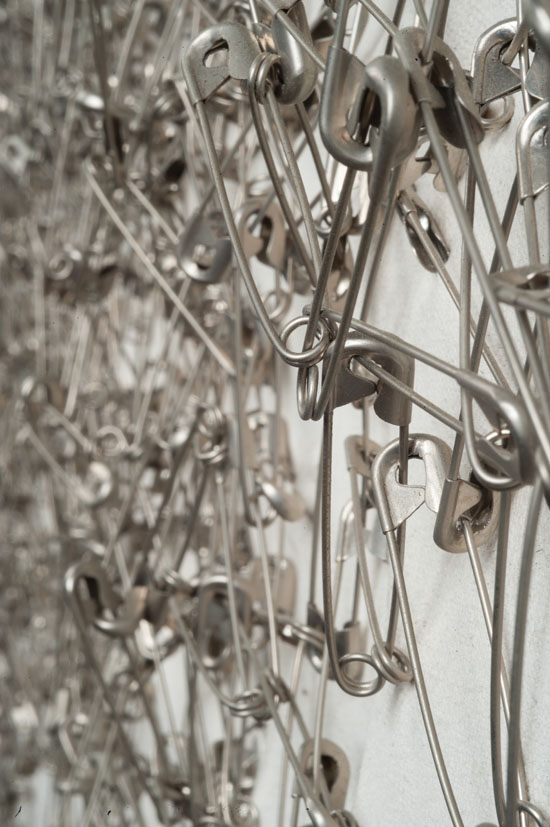
White City Detail by Tamiko Kawata, photo by Tom Grotta
I like to use materials suitable for expressing my belief in respect for common people and small lives, and things that reflect my feelings toward the American life that I have happily adopted. The impact of the differences between these two countries, in the lifestyles and the philosophies is so great that it still preoccupies my mind, even though I have lived longer here than I lived in Japan. Unconsciously, I continually connect two cultures.
I like to interweave these thoughts through my works… it is my diary in visual form.
September 2012
Hot off the Press: Our Largest Catalog Yet
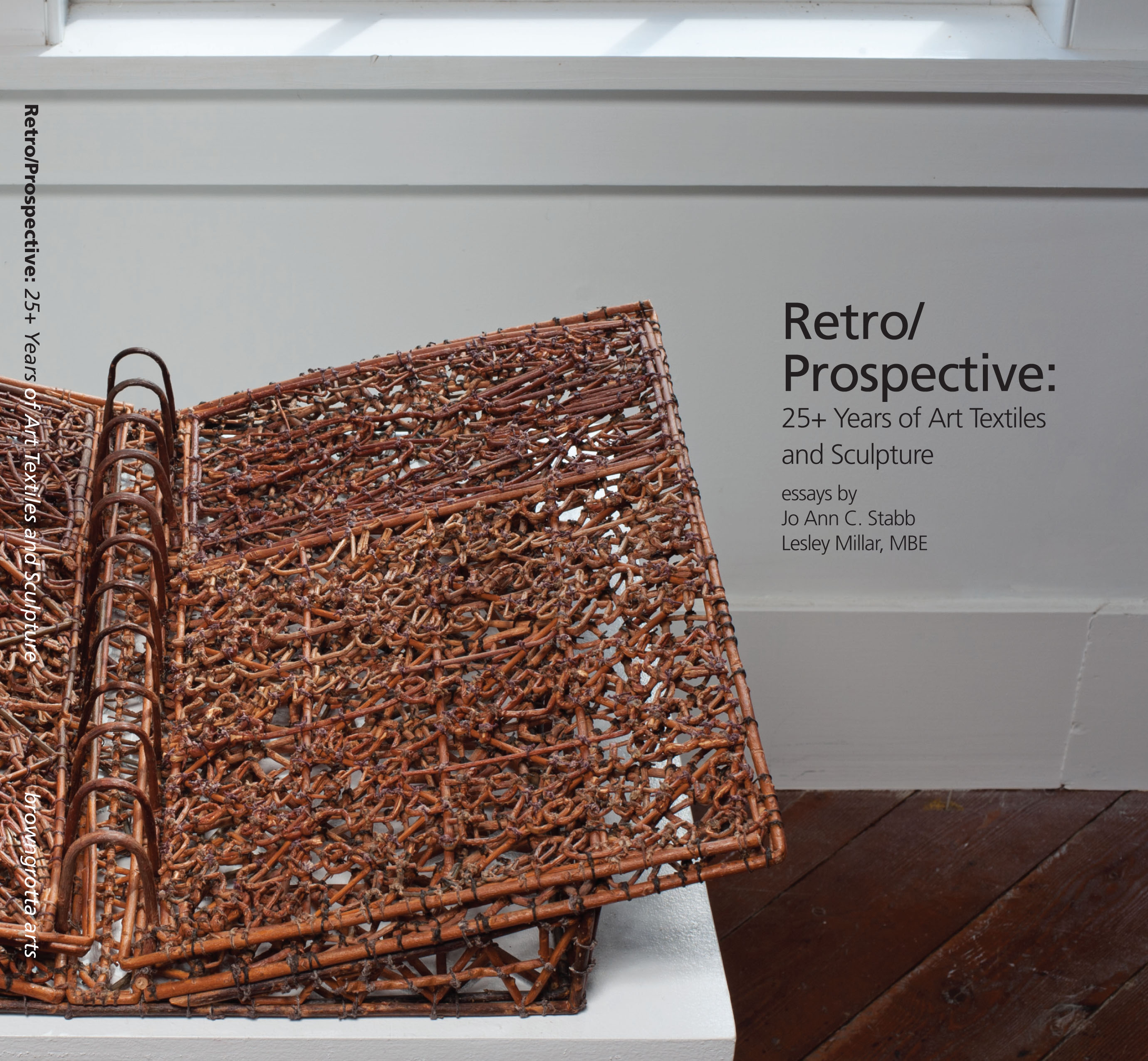 The catalog for Retro/Prospective: 25+ Years of Art Textiles and Sculpture is an ambitious venture for us. Currently weighing in at 182 pages, it features a timeline of art textile events from the 40s to the present, including the Lausanne Biennials (1962 to 1995), Fiber/Revolution in Milwaukee in 1986, Beyond Weaving in Greenwich, Connecticut in 2006, and key dates for fiber pioneers like Dorothy Liebes, Lenore Tawney, Magdalena Abakanowicz and Ed Rossbach. The catalog also includes two essays, one by designer Jo Ann Stabb, formerly on the design faculty at the University of California, Davis, on the emergence of contemporary textiles and fiber arts, the other by Lesley Millar, Professor of Textile Culture at the UK’s University of the Creative Arts, on recent developments in the field and what’s ahead. The catalog will be available in our online bookstore at http://browngrotta.com/Pages/c37.php for $55.00, plus shipping and sales tax where applicable.
Looking Forward/Looking Back: Simone Pheulpin
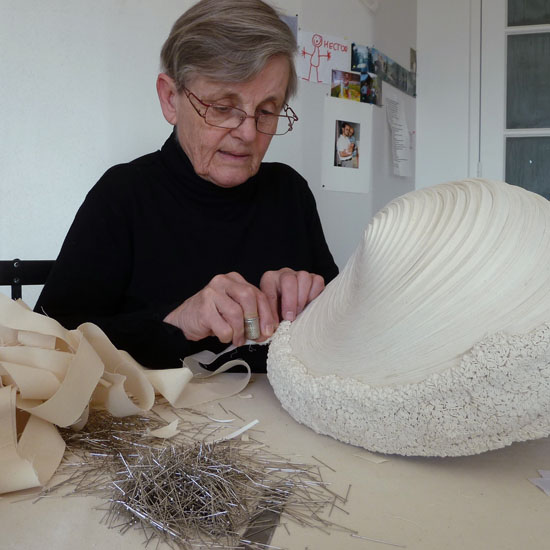
Simone Pheulpin at work, photo courtesy of Simone Pheulpin
The material I use for my artworks is very simple: raw cotton bands that I still find from the Vosges – my native region in eastern France. This material, I make unrecognizable, modifying its structure and nature by forming a dense and regular stacking of thin folds that retain their shape thanks to pins. My sculptures become organic material, vegetable or animal, and I could not imagine that they now have often travelled around the world!
In the last three years, my sculptures have been exhibited and traveled at an incredible pace, in amazing places full of history such Venetian palaces, mansions in Paris and Brussels, Swiss chalets, or European palaces (such as the Hotel Plaza Athénée in Paris, the Hotel de la Paix in Geneva, the Fairmont Monte Carlo, the Conrad Brussels) and also in unique museums as Villa Empain in Brussels and the Museum of Contemporary Tapestry in Angers, in addition to the United States and Asia, specifically, South Korea and Japan. These worldwide exhibitions have allowed my artworks to join Public and Private Collections for which I am very proud!
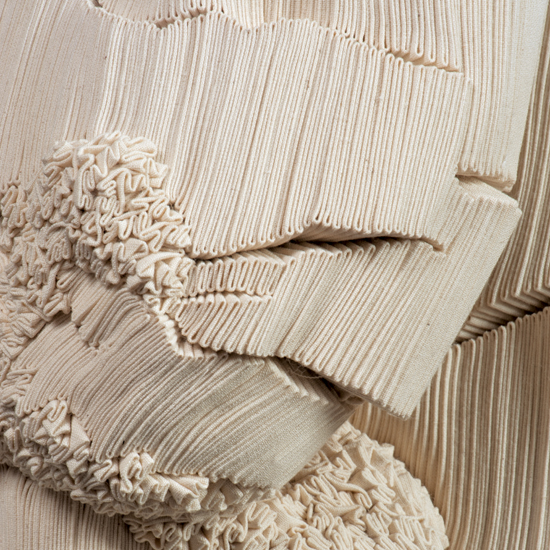
Falaise 4 detail by SImone Pheulpin, photo by Tom Grotta
I am also very proud of my intergenerational cooperation with a young and talented artist, Jeremy Gobé, a graduate of Decorative Arts in Paris and winner of the 2011 Bullukian Award. Launched in September 2011, the Bullukian Award assists young artists with contemporary creation. The Award, which includes a scholarship, a workshop opportunity and the production of a catalog, was a resounding success, with more than 160 applications. The jury, chaired by Véronique Ellena, rewarded Jeremy Gobé for his exhibition project monuments hands. The Bullukian Foundation will host an exhibition of the artist in November and December 2012, and Jeremy Gobé will honor me, Simone Pheulpin, in this exhibition!
From the Vosges in France, around the world, my travelling while artworks makes me happy!
Simone Pheulpin
September 2012
Make a Day of It! Visit Retro/Prospective and Other Art Events Near Wilton, CT
If you plan to come to Wilton, Connecticut between October 26th and November 4th for browngrotta arts anniversary exhibition, Retro/Prospective: 25+ Years of Art Textiles and Sculpture, consider adding a stop at one of the other cultural venues in our area on your trip. There are several exhibitions to choose from — all within 30 minutes of browngrotta arts:
Flinn Gallery
Greenwich Library
9 x 9 x 3: New Visions
101 West Putnam Avenue
Greenwich, CT 06830
203.622.7947
through November 28, 2012
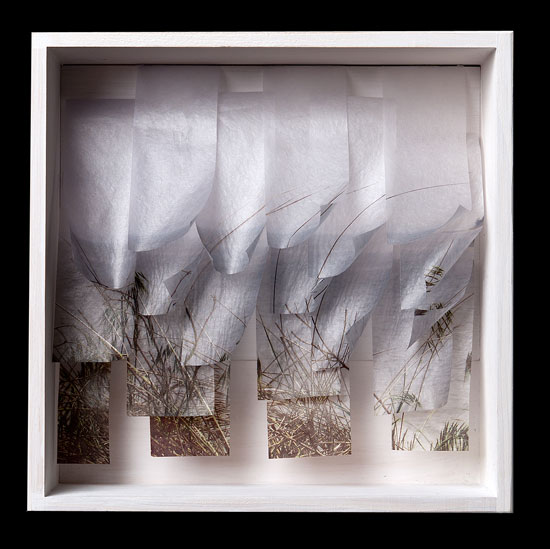
Katherine D. Crone, Blades of Grass, Wood, Usuyou Gampish, nylon monofilament Digitally altered photograph, inkjet printed, bookbinding stitched
9 x 9 x 3: New Visions is an exhibition of works created by members of the Textile Study Group of New York to fit inside wooden boxes with 9” x 9” x 3” exterior dimensions. Juror for the exhibition was Janet Koplos, who is a contributing editor of Art in America, where she was senior editor for 18 years. Among the artists included in the exhibition are: Katherine D. Crone, Margaret Cusack, Jeanne Heifetz, Nancy Koenigsberg, Carole P. Kunstadt, Yasuko Okumura, Gail Resen, Lois Russell, Barbara Schulman, Naomi Tarantal, Charlotte Thorp, K. Velis Turan, Saaraliisa Ylital and Erma Martin Yost. The Gallery hours are: Sunday 1:00 pm – 5:00 pm; Monday, Tuesday, Wednesday, Friday, Saturday 10:00 am – 5:00 pm and Thursday 10:00 am – 8:00 pm.
The Aldrich Contemporary Art Museum
Wendell Castle
Wandering Forms— Works from 1959–1979
258 Main Street
Ridgefield, CT 06877
203.438.4519
through February 20, 2013
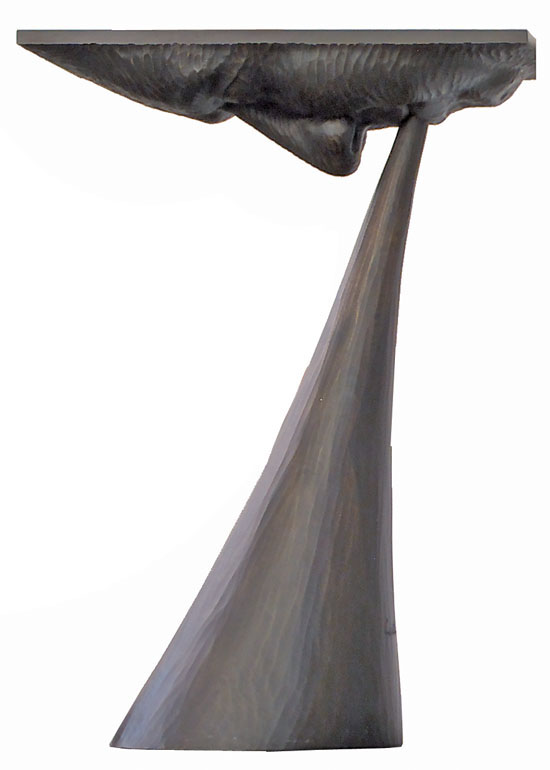
Wendell Castle birdsyeye Maple Veneer and Mahogany Table, private Collection
photo by Tom Grotta
Celebrated American designer/craftsman Wendell Castle (b. 1932) has been creating unique pieces of handmade sculpture and furniture for over five decades. Castle, who has consistently challenged the traditional boundaries of functional design since the outset of his career, was instrumental in helping to shape the American studio furniture movement throughout the 1960s and 1970s. He remains one of the most important American furniture makers working today.”To be inventive and playful and produce furniture which is a complement to nature, rather than in contrast to it is my philosophy,” Castle wrote in the catalog for the exhibition, Fantasy Furniture, held at the Museum of Contemporary Crafts, New York, New York in 1966.”My idea is not to reconstruct or stylize natural forms, but to produce a synthesis or metamorphosis of natural forms.” The Aldrich Museum hours are: Tuesday to Sunday, 12 noon to 5 pm.
The Aldrich Contemporary Art Museum
united states
Artist’s Projects
through February 24, 2013
united states is a semester of solo exhibitions and artist’s projects that approach both the nature of the United States as a country and “united states” as the notion of uniting separate forms, entities, or conditions of being. Timed to coincide with the 2012 American election season, united states is presented at a time when political and social divisions in this country are readily apparent, and polarization on many major issues is at an historical high. The Aldrich Museum hours are: Tuesday to Sunday, 12 noon to 5 pm.
The Wilton Historical Society
Building a Future From the Past: Architecture
224 Danbury Road
Wilton, CT 06897
203.762.7257
through October 31, 2012
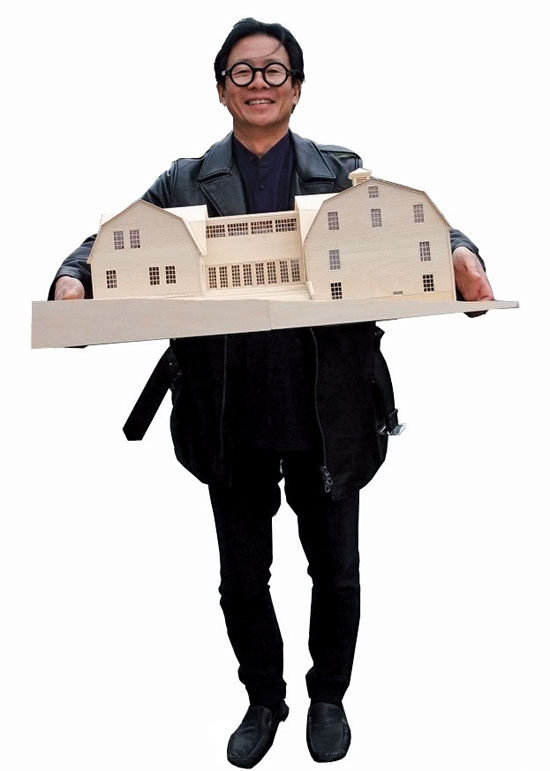
Architect David Ling holding, model of the browngrotta barn from the building a Future From the Past: Architecture exhibit ion. Photo by TomGrotta
This exhibition explores architects’ work to preserve antique homes while bringing them into the 21st Century. Among the homes included is browngrotta arts‘ home/office, designed by David Ling Architect, New York, New York. The Society’s hours are: Tuesday through Friday: 10 am to 4 pm; Saturday: 1 to 4 pm; 2nd & 4th Sundays of the month 1 to 4 pm.
browngrotta arts
Retro/Prospective: 25+ Years of Art Textiles and Sculpture
276 Ridgefield Road
Wilton, CT 06897
203.834.0623
October 26 through November 4, 2012
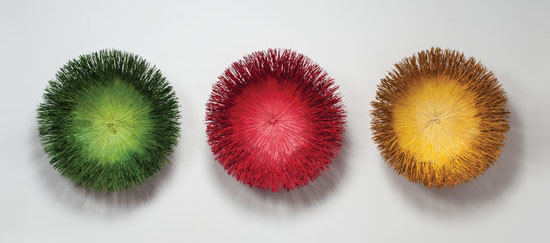
Ray Series, Mary Merkel-Hess, paper, reed, 24″ x 24″ x 6″ each, 2012, photo by Tom Grotta
This exhibition features work by more than 70 artists, some are pioneers, some mid career and some new to the field of art textiles, while others work in wood and metal, porcelain, glass and clay. Artists’ reception and Opening: October 27th, 1 to 5 pm; http://browngrotta.com’ hours October 26th and October 28th- November 4th: 10 am to 5 pm.
Looking Forward/Looking Back: Anda Klancic on the 2011 Miniartextil
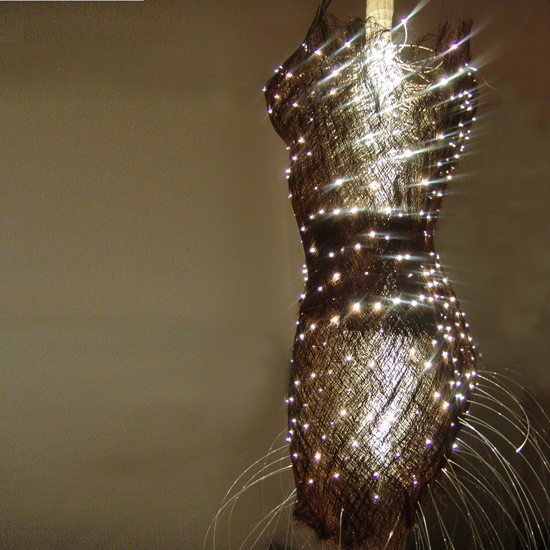
Aura, 2006 artwork and photo by Anda Klancic
In 2011, Artist Anda Klancic participated in the exhibition Energheia Miniartextil presenting the work Aura F & M in the former church of San Francesco in Como, Italy. The exhibition traveled to Milan, Venice and Montrouge in the suburbs of Paris. The excerpt below is from an interview with Olga Damiani in Arte & Arte, May 2012, http://www.miniartextil.it/news_press.php, translated with the help of the artist, Google and browngrotta arts:
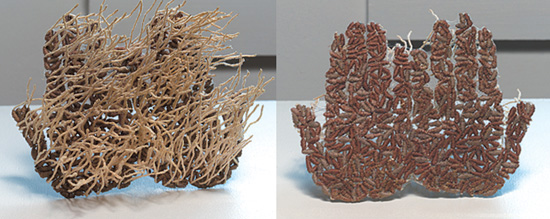
Growth, 2002 by Anda Klancic, photo by Tom Grotta
“It seems to me that in contemporary art, which rightly includes textile art, the value should be appreciated by the innovative content of the work, not by conformity with measures required and antiquated techniques. Miniartextil has the great merit of being able to pass these strict limits….I used optical fiber and fiber from the bark of palm for Aura F & M, but the research of artificial equipment and plant material, necessary for the work, was not my main thought. The choice of suitable materials was conditioned by the demands of expression. With Aura F & M I have chiefly tried to express in form of an objective construction the theme Energheia, that was proposed for this Miniartextil. I wanted to show the vital energy in the human species: the light, connected across from man to the earth and the universe, has the rhythm of breath, feeling of life. By creating this strong expressive content, communications that I consider important for humanity, I thought about various properties and the quality of the work submitted at different levels. At the first level, I inserted the shape and movement of light, as a pleasant, fresh element, one that may fail to attract the viewer’s eye in a social environment where people are bombarded at every turn by visual and audio advertising and information disequilibrium. In the second level, I tried to arouse in the viewer memories of distant experiences and thoughts of wisdom forgotten in quiet, and in doing so to create mnemonic associations in the present. The choice of materials can also be understood as a metaphor: the products are technological, they represent rationality combined with artistic intuition inherent in organic materials, again, used in order to induce subconscious associations. The diversity of rhythms lighting the two bodies, with the sources of halogen light obscured at various points, also contributes to a second level of meaning. It creates a metaphor for everyday life, that man and woman are rarely both in the light at the same moment, opening a window on the primordial difference between the sexes.”
Good Reads: Textiles, Tapestry and Ceramics
We’ve received three comprehensive and attractive books in the last few months, Textiles: The Whole Story, Uses, Meaning, Significance; Tapestry: A Woven Narrative; and Yasuhisa Kohyama: The Art of Ceramics, and we have enjoyed them all. (We know they are attractive and comprehensive, because they include artists whose work we represent and, in some cases, photographs by Tom.)
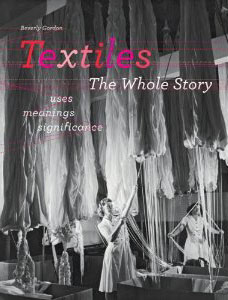 Beverly Gordon, author of Textiles: The Whole Story, Uses, Meaning, Significance from Thames & Hudson, has an ambitious aim. “My intention” she writes, “is to shine new light on the light on the taken-for-granted but fascinating subject of the roles and meanings that textiles hold in cultures throughout the world. I hope to make it undeniably evident that to be human is to be involved with cloth.” To do that, she takes readers on a dizzying trip across centuries and continents and beyond, from the linen strips that cover a mummy in Egypt circa 150-175 CE. to the fluropolymers protecting an astronaut as he walks in space in this century, with stops at Betsy Ross in colonial America, Mohandas Gandhi in colonial India, women glass spinners in Murano, Italy in 1905 and the Renaissance, where women worked on textiles in groups, along the way. In sections covering textiles and human consciousness, human survival, social meaning, money, status and control, meaning and beauty and the spiritual significance of cloth, Gordon provides insights and information for anyone with an interest in textiles and all they entail.
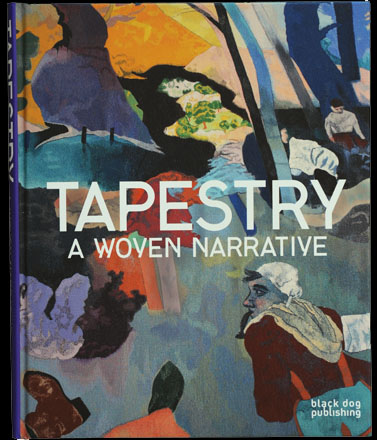 Tapestry: A Woven Narrative also takes the long view, providing a general introduction to the state of artisan tapestry weaving in the 21st century by way of contextual essays outlining developments from the Middle Ages to the modern age. In addition to the essays, the book also includes illustrated profiles of contemporary weavers, including Jo Barker, Sara Brennan and Sue Lawty — along with studio profiles of Dovecot and others. Tapestry: A Woven Narrative is available from browngrotta arts.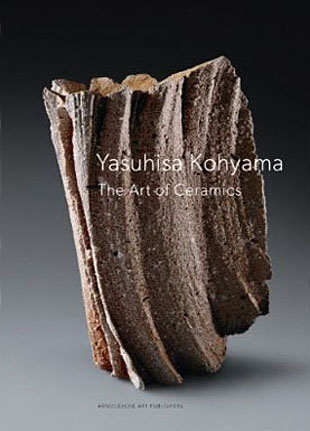
Also available from browngrotta arts is Yasuhisa Kohyama: The Art of Ceramics, which contains lush photos of dozens of Kohyama’s works as well as a foreword by Jack Lenor Larsen and essays by Susan Jefferies and others. What is important about Kohyama’s work, writes Jeffries, “is his embrace of contemporary life, and his bold and poetic use of line, mass and form; he is fully aware of the sculptural possibilities available to him. A love of nature and a life-long interest in sculpture and architecture have also inspired his work.”
Looking Forward/Looking Back: John Perreault
Anda Klancic, Lenore Tawney, Lewis Knauss
photos by Tom Grotta
“It is, in fact, the haptic, or touchable, nature of fiber art that throws off most art critics: they are only comfortable with the optic, granting tactile values a very low position on the aesthetic totem pole. In fiber art one cannot avoid the haptic and the haptic/optic conflict or, more graciously, the haptic/optic interplay. How fiber art looks is only part of the picture.
Dani Marti, Carolina Yrarrázaval, Sherrie Smith
Thus it is awkward, to say the least, that the English language and most particularly the critical language, is haptic-poor. Poetry can sometimes make amends, but is in itself an extremely specialized discourse, prone to enthusiasm at the expense of illumination. In the past the art critical language has been applied to some rather outrageous art: Earth Art, Anti-Form, Performance, Body Art, Conceptual Art, Patterning and Decoration. From this it may be gathered that any material criterion for art has been dislodged. Futurism and Dada insisted that art could be made of anything. If a pile of dirt, in certain cases, can be art, then why not a pile of fibers? If art can be made on a printing press, then why not on a loom? If art can be made by tossing molten lead against a wall, then why not by knotting threads? If art can quote the great “crafts” traditions, why cannot present day explorations of these materials and techniques be art too?”
Marian Bijlenga, Eva Vargo, Carolina Yeonsoon
photos by tom Grotta
John Perreault
then-Visual Arts Director, The Cultural Center
Staten Island, New York
From “Fiber Art: Gathering the Strands,” Fiber r/evolution, Milwaukee Art Museum, 1986