Category: Art Textiles

Sneak Peek: Catalog No. 37, Advocates for Art: Polish and Czech Fiber Artists from the Anne and Jacques Baruch Collection Catalog, Essay by Christa C. Mayer Thurman

catalog cover

Advocates for Art: Polish and Czech Fiber Artists from the Anne and Jacques Baruch Collection

The 37th catalog produced by browngrotta arts, Advocates for Art: Polish and Czech Fiber Artists from the Anne and Jacques Baruch Collection, will be available beginning November 10, 2010.

PALISADES (Detail), Anna Urbanowicz-Krowacka, wool and sisal, 55″ x 70″, 1992

Prominent art dealers Anne and Jacques Baruch first opened the Jacques Baruch Gallery in Chicago in 1967. The Baruch’s gallery focused on contemporary art and artists from Central and Eastern Europe, which Jacques once described as “the finest work of tomorrow…not what is known…the new blood.” Many of the works presented at the gallery were by artists who began their careers under Communist occupation. The gallery’s early years coincided with worsening political conditions behind the Iron Curtain. On August 20, 1968, the Baruchs left Prague just five hours before Soviet tanks rolled into the city and brutally ended a brief period of democratic reforms.

LUNE DE MIEL I (Detail), Magdalena Abakanowicz, sisal and linen, 55″x 78″ x 8″, 1986

Making trips behind the Iron Curtain during these years was a complex and, at times, dangerous, way of making a living. Despite these difficulties, the couple managed to find a significant entourage of artists to exhibit, among them a group of innovative textile artists, who had gathered acclaim at the Lausanne Biennials of International Tapestry and other European exhibitions, but who were not well known in the US. “We were captivated by their energy, experiments and bold compositions,” Anne would write of the Polish fiber artists she and Jacques met in 1970. “Though there were…shortages of studios, materials and most necessities for daily life, all their problems did not hamper their work. Rather, it stimulated their creativity, and their use of sisal, rope, metal, horsehair and fleece as well as the traditional wool, flax and silk, revealed new artistic thought with results which were dynamic, highly personal and original.”

LEATHER SKETCH (Detail), Jolanta Owidzka, high warp linen, sisal, leather 27″ x 45″ x 4″; 70 x 110cm, 1977

These artists included Magdalena Abakanowicz of Poland (whose tapestry Lune de Miel 2 is installed at Chicago’s McCormick Place and whose sculpture installation Agora,  a group of 106 iron cast figures, is in Chicago’s Grant Park), Jolanta Banaszkiewicz (Poland), Zofia Butrymowicz (Poland), Hanna Czajkowska (Poland), Jan Hladik (Czechoslovakia), Luba Krejci (Czechoslovakia), Lilla Kulka (Poland), Maria Laszkiewicz (Poland), Jolanta Owidzka (Poland), Agnieszka Ruszczynska-Szafranska (Poland), Wojciech Sadley (Poland), Anna Sledziewska (Poland), Anna Urbanowicz-Krowacka (Poland) and Krystyna Wojtyna-Drouet (Poland). It is work by this group of historically significant artists that is featured in this catalog.

CO-BOG ZLACZYL (WHAT GOD HAS JOINED), Lilla Kulkaa wool, silk 55″ X 48″, 1987

Christa C. Mayer Thurman has written an introductory essay about Jacques and Anne Baruch for the catalog. Thurman, who was the Chair and Curator of the Department of Textiles at the Art Institute of Chicago from 1967 through 2009, has also written brief essays about several of the 14 artists whose works are featured in the catalog. Thurman is the author and co-author of numerous books about textiles, including, Raiment for the Lord’s Service (1975); Claire Zeisler: a Retrospective (1979); Lissy Funk: A Retrospective (1989); and Textiles: The Art Institute of Chicago (1992). For European Tapestries in the Art Institute of Chicago (2008), Thurman was the general editor, contributed to the resulting volume as an author and oversaw the collection’s conservation. Thurman and her late husband, Lawrence S. Thurman were friends of the Baruchs for many years. During Thurman’s tenure at the Art Institute several textiles from behind the Iron Curtain entered the collection either as gifts, bequests or as purchases.

PODROZ (Journey) from the Kolodia series Agnieszka Ruszczynska-Szafranska linen, sisal, wool 60″ x 56″, 1986

The 76-page color catalog can be ordered from browngrotta arts beginning http://browngrotta.com/Pages/c35.php November 10, 2010.

Blurring the Line: Textile Art Takes Manhattan

This Fall, art involving weaving, embroidery and crochet is showing up in unexpected venues in New York, possibly answering the question, at last: Is craft art? One gallery disavows any connection: “Olek’s use of crochet has no relation to the world of craft, rather it is used as an alternative to other artistic mediums such as oil or acrylic on canvas.” the press materials assert. But we can’t help but wonder: Does the gallery protest too much??

In any event, Here’s a list of three intriguing exhibitions featuring artists who use cotton viscose, silk and recycled material, woven and crocheted, in their work as well as acrylic, ink, enamel and glass.


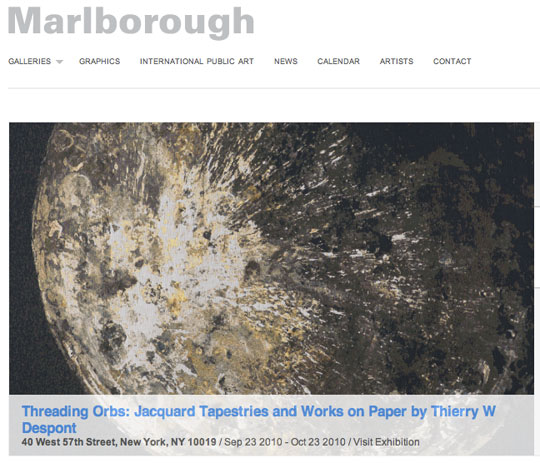
threading orbs
An Exhibition of Recent Tapestries and Works on Paper by Thierry W. Despont
Marlborough Gallery, Inc.
40 West 57th Street
New York, NY 10019
t. 212.541.4900 f. 212.541.4948
www.marlboroughgallery.com
September 23rd – October 23, 2010

The Marlborough Gallery mounts an exhibition of tapestries and works on paper by renowned artist, architect and designer Thierry W. Despont The show will mark the public debut of Despont’s work in tapestry. Eight monumental tapestries will be displayed. Despont is recognized for his paintings on wood panel or on copper mounted on wood panel that depict nebulas, celestial bodies and planets. These works are executed in mixed media with such materials as enamel, asphaltum, acrylic, ink, glue, epoxy resin, paper, alumichrom, and oil stick. By using contemporary Jacquard looms, Despont as translated these richly detailed, highly expressive paintings into woven tapestries that seem to glow with light.

Despont comments on this new body of work: “… I like to think of my orbs as floating in space, and tapestry, with its three-dimensional aspects, is a fantastic medium for them…. I am fascinated by our universe filled with billions of galaxies, of stars and planets, by the idea of being drawn into space and floating away. The tapestries display this poetic notion of floating with these orbs, as the light bounces off softly. … People are drawn to them…. It is an emotional force; they exert their own kind of gravity.”

In addition to his familiarity with tapestries as a child in France, Despont became engaged with the medium of tapestry — its beauty, artistic qualities and installation — through his restoration of Clayton, the Frick family mansion in Pittsburgh, and his design for the Decorative Arts Galleries of the J. Paul Getty Museum in Los Angeles, where numerous tapestries of the Seventeenth and Eighteenth Centuries are on view. He joins a number of contemporary artists who have used the new, technologically advanced Jacquard looms to create lasting work of power and intricate visual poetry.

An illustrated catalogue featuring an interview with the artist will be available at the time of the exhibition.


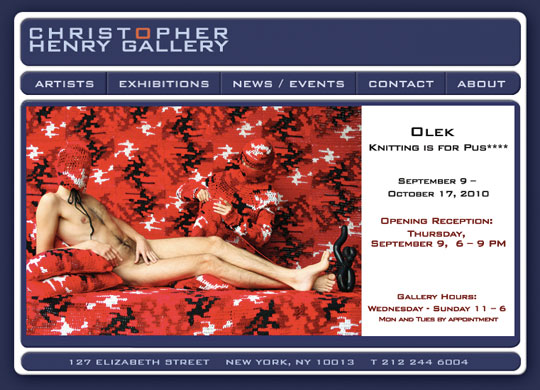
“OLEK: Knitting is for Pus****”
Christopher Henry Gallery
127 Elizabeth St., (Broome)
New York, NY
t.212.244.6004
www.christopherhenrygallery.com
Through October 17, 2010

Polish-born artist, Olek creates wild, and occasionally functional, structures from hundreds of miles of crocheted, woven, and often recycled materials, forms, and spaces. For this exhibition,the ChristopherHenry Gallery serves as the “home base” for Olek’s exhibit, a multi-media sculptural environment, featuring an entire room completely covered in crochet. Viewers may also follow her threads out of the gallery using a map to discover new objects she has crocheted and intertwined throughout the neighborhoods of NOLITA and L.E.S.

“Olek’s use of crochet has no relation to the world of craft,” reads the gallery’s press materials, “rather it is used as an alternative to other artistic mediums such as oil or acrylic on canvas. Its use can be interpreted as a metaphor for the complexity and interconnectedness of the body, its systems and psychology, and, in a broader sense, it can represent humanity itself. The connections are stronger as one fabric, as opposed to separate strands, but, if you cut one, the whole thing will fall apart. It also serves as a literal extension of the body, a second skin that can be stretched and reshaped. Olek’s use of crochet is not a feminist critique – her obsessive use of the medium, often denigrated as “women’s work”, combined with Olek’s recurring camouflage motif and the impressive scale of her projects, challenges traditional notions of gender, as she aggressively re-weaves the world as she sees fit. In a new series of text based works Olek contrasts the convenience and spontaneity of “txt msgs” to her time-consuming, laborious crochet, reevaluating the notions of privacy, communication, and technology while immortalizing the intense yet fleeting sentiments of modern relationships.”


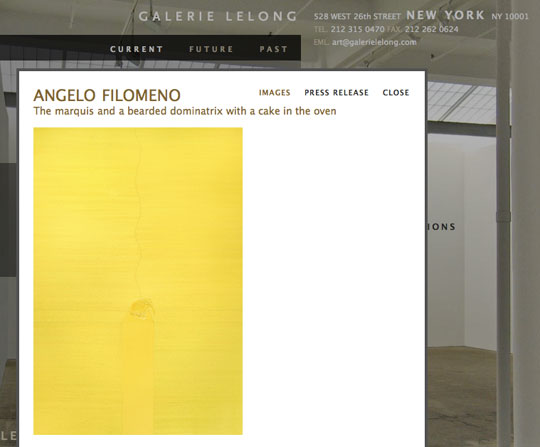
ANGELO FILOMENO:
The marquis and a bearded dominatrix with a cake in the oven

Galerie Lelong
528 W. 26th St.
New York, NY
t.212.315.0470
www.galerielelong.com
Through October 23, 2010.
In The marquis and a bearded dominatrix with a cake in the oven, Angelo Filomeno presents new embroidery paintings and sculpture that exemplify his signature technique and fascination with the macabre. Fantastical and allegorical in imagery, and intricate in technique, Filomeno’s works are deeply informed by his upbringing in Italy. Filomeno learned to embroider from his mother and began apprenticing for a tailor when he was 7; his father was a blacksmith. From a young age, Filomeno formed a keen awareness of texture, composition, detail, and craftsmanship. He also developed an interest in the darker facets of the human condition: mortality, isolation, compulsion, fragility. These stark themes have pervaded his work, juxtaposed with the use of alluring, sensuous materials such as silk, black glass, and crystals.

In his newest exhibition, Filomeno pares down the ornate approach for which he is best known and presents sparser, more concise works that evoke the artist’s common themes with minimal means. Included are two large-scale mandalas, embroidered mosaics of stitched silk and satin in varying shades of yellow. The concentric rings of geometric patterns and bright yellow hues beckon the viewer to gaze deeper and deeper in to the piece, only to be confronted by a sinister skull and hoards of cockroaches hidden in their centers. Also on view will be a triptych of detached, decomposing heads of men he deems ‘philosophers,’ a character that he has revisited throughout his career as a paradigm of the harsh aspects of mortality and reflection. “The irony,” Filomeno has said, “is that these portraits represent death, but they are still thinking about their own existence.”

Maybe we’ll see you there.


Artist News: Randy Walker

browngrotta arts is excited to present the work of sculptor Randy Walker at SOFA West 2010. Walker, who studied architecture, is known for his large-scale commissions using fiber and found objects to explore wrapped and woven three-dimensional space.

shimmer-frames.jpg

Shimmer Frames by Randy Walker

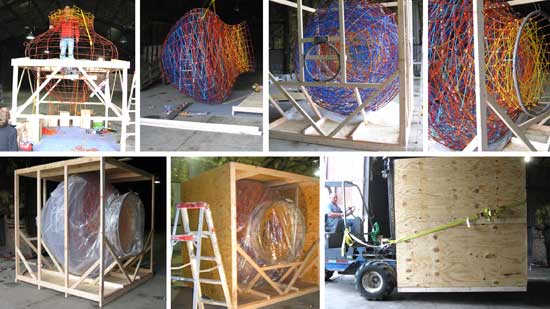
His most recent public artwork, Woven Olla, was unveiled in Santa Fe on June 26th. The City of Santa Fe Arts Commission, in collaboration with the Santa Fe Public Library and New Mexico Arts, a division of the New Mexico Department of Cultural Affairs, commissioned Walker in 2008 to create the three-dimensional, suspended steel and fiber artwork to hang under the main exterior entry canopy of the Southside Branch Library. The sculpture references a traditional Pueblo water jar, or olla, and reinterprets it on a scale appropriate to the community and the Library. Woven Olla marks the entry as a gathering place. The piece is an analogy for the Library as a container of knowledge, a resource no less precious than water.

Woven-Olla-shipping.jpg

Construction and shipping of Randy Walker’s “Woven Olla” to Santa Fe

Walker’s work is found in public and private collections around the country, including in Minneapolis, St. Louis and Connecticut. He was a recipient of a Pollock Krasner grant in 2008. In creating his work, the artist seeks out or constructs frameworks that act as looms. These frameworks can be found in objects like saw or they can be architectural spaces. In Saw Piece No. 4 (Autumn), which is featured on the cover of the Summer issue of The Journal of Wealth Management, a salvaged bucksaw creates the armature for a web of nylon thread.

“I am ceaselessly fascinated by the possibilities posed by a single strand of thread held in tension,” Walker explains. “My work straddles precariously on several boundaries: solidity and transparency, structural stability and collapse, visibility and invisibility. I strive to create work that primarily engages our sense of sight by contemplating how light can define structure, surface and color.”

Walker’s dramatic Shimmer Frames, a series of five pieces each 6 feet tall, will grace the entrance at SOFA West 2010.

Technorati Tags: Randy Walker, Santa Fe Public Art, Santa Fe Public Library, Public Art


Dispatch: American International Fine Art Fair, Palm Beach, February 3rd-8th

Tawney-Colles-at-AIFAF.jpg

Lenore Tawney collages, In Chaco and The Loftiest Word and sculpture, Boy with Duck, at AIFAF

From February 3rd to the 8th. browngrotta arts will join more than 80 international galleries exhibiting at the American International Fine Art Fair (AIFAF) in Palm Beach, Florida. AIFAF is recognized as the “crown jewel” of American art fairs and is the only American art and antiques fair rated 5 stars by The Art Newspaper. AIFAF is a fully vetted fair, featuring prestigious international dealers presenting a mix of paintings, sculpture, jewelry, antiques, contemporary design and decorative arts. In cooperation with the Baruch Foundation and the Lenore G. Tawney Foundation, browngrotta arts will feature the work of Magdalena Abakanowicz and Lenore Tawney at AIFAF, artists whose work redefined weaving and sculpture in the 20th Century.

Abakanowicz is the best-known Polish artist in the world. She initially gained acclaim for her “Abakans,” monumental woven works of sisal, ropes and other fibers that hung free in space. Next were headless human forms of burlap and later bronze. Large groupings of her sculptures are installed around the world, from Chicago’s Millennium Park to Olympic Park in Seoul to the Israel Museum in Jerusalem. In presenting her a Visionaries! award in 2000, the Museum of Arts and Design cited her for “her powerful explorations, dealing with the impact of social and political reality on individual identity, that have demonstrated the potential of fiber as an effective and expressive sculptural material.”

Abakans-at-AIFAF.jpg

Weavings by Magdalena Abakanowicz at AIFAF. The weavings on the far right and far left were woven in the 1980s; the piece in the center is from the 1960s.

At AIFAF, browngrotta arts will exhibit three weavings by Abakanowicz, one from the 1960s and two, from the Anne and Jacques Baruch Collection, Ltd., created in the 1980s. The Baruchs opened a gallery in Chicago in the late 1960s, bringing work to the U. S. from Central Europe in order to give exposure to the Slavic art that Jacques, who died in 1986, once described as “the finest work of tomorrow…not what is known…the new blood.” Jacques was unable to travel after 1970, but Anne continued to travel to Central Europe to search for art. As the political situation in the area tightened, Anne, began smuggling art into the US, often at great risk. Government agents would seal her packages of approved art before she left; with the help of artists, she would often unseal the packages and reseal them in order to add unsanctioned works. She would travel with a bright red Hartman suitcase with a false bottom, filled with art supplies that the artists could not buy. On her return trip, artworks would be hidden inside. In this manner, Anne amassed a singular collection of contemporary textiles and historical and contemporary Czech photography. The Baruch Foundation was established in 2008, subsequent to Anne’s death in 2006 and is comprised of her personal art collection and the artwork inventory of The Anne and Jacques Baruch Collection, Ltd. The missions of the Foundation are to preserve and foster the growth of the visual arts of Eastern and Central Europe through donations of artwork to museums and schools, and to fund educational programs and scholarships by the sale of artwork.

Tawney Weavings.jpg

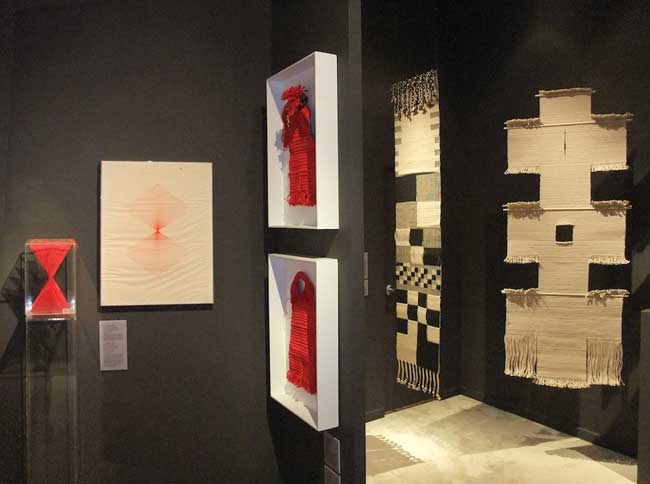
Works by Lenore Tawney on display in the browngrotta arts booth at AIFAF.

At AIFAF, browngrotta arts will also show weavings, drawings, collages and mixed media assemblages by Lenore Tawney, who died in 2007 at the age of 100. “Luminous is an apt word to describe the entire career of the American artist Lenore Tawney,” wrote Holland Cotter in the New York Times in 2004. In the 1950’s, he noted, “she created a series of monumental open-weave sculptures that were like nothing seen before or since. Astonishing.” About her collages Cotter has written, “Whether she sets cut-up bits of handwriting spinning around a reproduction of a Michelangelo sibyl or turns strips of antique German books into suspended grids, she touches on the roots of the collage medium in language and personal history with a reticent orginality.” The Lenore G Tawney Foundation was established in 1989 by Tawney for charitable and educational purposes. Its aim is to support other artists in their own artistic efforts and to support special projects at art museums and non-profit educational arts organizations; its highest priority is to nurture emerging artists and to provide them with learning opportunities through established educational programs.


Dispatch: Artpalmbeach, art+photography+design

We’ve exhibited in Palm Beach, Florida in January for the last seven years. In that time, the exhibition has had three different owners, three different names and differing emphases each year. Despite the difficulty the fair has had finding a footing, we’ve returned each year. We are convinced there is a good audience in the Palm Beach area and we are always happy to catch up with our existing Florida clients, and family and friends.

artpalmbeach.preview.jpg

This year, however, the news is better. The latest incarnation, artpalmbeach, art+photography+design, seems to have found a workable formula. The crowds at the fair were large; the composition of the show varied and exciting, we added new clients to our list and the other dealers we spoke to seemed pleased sales. In this economic environment, those are impressive achievements. David Lester, of International Fine Art Exhibitions, who founded the fair in 1998 with his wife, Lee Ann, and resumed ownership a year ago, told Artinfo, “I want this fair to have broad appeal, quality art, and accessibility. My goal is to go out and bring in much more interesting art from around the globe.” The global emphasis was evident in the mix of galleries and work. The 70 galleries came from the US and abroad, including the Netherlands, Ukraine, UK, Sweden Argentina and Dubai. Chinese, Vietnamese, Icelandic and Latin American artists were featured. In the browngrotta arts booth alone was work created by artists from 15 countries.

“That power of attraction, admirable for any fair in an inhospitable economic climate, bodes well for the process of reinvention that the Lesters have only just begun, ” concluded Margery Gordon in her Artinfo article, “Art Palm Beach Mixes Media — and Messages.” http://www.artinfo.com/news/story/33659/art-palm-beach-mixes-media-and-messages. We were so optimistic, in fact, we are turning around and returning next week to participate in IFAE’s American International Fine Art Fair from February 2nd – 8th at the Palm Beach Convention Center http://www.aifaf.com. More on that to come.


Sneak Peek: Artpalmbeach, January 14th -19th

Palm-Beach-Ad.jpgWe’re leaving the ice and snow (sigh) for sunnier climes next week, where browngrotta arts will join more than 50 other galleries exhibiting at the Palm Beach County Convention Center at Artpalmbeach, art + photography + design. The fair opens on January 15th and lasts through the 19th. A theme of this year’s Artpalmbeach,  art + photography + design is “going global.” As always, browngrotta arts will do its part; we are exhibiting the work of artists from 15 countries. Our installation in Booth 204 will include some of the highlights of this fall’s 10th Wave III exhibitions as well as new works by several artists including a significant wall sculpture by Ritzi Jacobi; pieces made of fish scales by Marian Bijlenga and new works of repurposed encyclopedias by Wendy Wahl. We’ll present the work of two artists in Palm Beach for the first time: We’ll present the work of two artists in Palm Beach for the first time: Jennifer Falck Linssen of the US and Carolina Yrarrázaval of Chile. US Artist Norma Minkowitz will be at the booth on Monday, January 18th from 2-4 p.m. to discuss her work; Dawn MacNutt of Nova Scotia will be at the booth to discuss her work on Tuesday, January 19th, from 2-4 p.m.


International Year of Natural Fibres, Part II

Details left to right: sisal, coconut fiber, sisal, ramie, jute, hemp and steel, coconut fiber

The last post reported on the UN’s International Year of Natural Fibres 2009, a political and economic initiative that aims to raise global awareness of the importance of natural fibres not only to producers and industry, but also to consumers and the environment.

Young Ok Shin’s work of ramie

There’s an aesthetic element, too, that the FAO site references but does not detail. You can experience natural fibres transformed into art by viewing Kari Stiansen’s and Ritzi Jacobi’s works that use coconut fiber; Mia Olssen’s and Magdalena Abakonowicz‘ hangings of sisal, Noriko Takamiya’s and Young Ok Shin’s works of ramie; Ed Rossbach’s wallhanging of jute and Hideho Tanaka’s vessel of hemp and steel and many other works of wool and silk and linen at http://www.browngrotta.com/index.html.


International Year of Natural Fibres, Part I

naturalfibers.poster.jpgOnly a few weeks left to left observe the official International Year of Natural Fibres (yes, we’re sticking with the international spelling here). For browngrotta arts and many of the artists we represent, of course, promotion of natural fiber in art and otherwise is a lifelong pursuit. In 2009, however, we had the assistance of the Food and Agriculture Organization of the UN, which declared this year the International Year of Natural Fibres

If you haven’t been there, the website naturalfibres2009.org offers a wealth of material — informative videos, lush images of natural fiber sources and production methods, interviews with producers and more fibre facts than you can shake a spindle at. The website even includes images of 15 natural fibres under the microscope. (I don’t know why they are there — but I found them interesting in a nerdy way.) Mostly, I just enjoyed the photographs of rice fields at sunset; workers knee deep in cotton and angora bunnies and cashmere goats, just being themselves, but I learned a couple of things.

In case you’ve ever wondered:
• ramie is a natural fibre, one of the strongest in fact and its grown mainly in China, Brazil, the Lao PDR and the Philippines.
• Hemp fibres are also used to reinforce molded thermoplastics in the automobile industry; abaca yarn is used in automobile parts by Mercedes-Benz.
• The biggest producer of mohair is South Africa, but Texas is also important, too, with 200,000 head of mohair goats. Just 20% mohair added to a wool blend provides crease resistance.

natural-fibers.jpg

Why is the UN urging us to choose natural fibres? Because they are:
• a healthy choice. As most people know, natural fibres provide natural ventilation. Coconut fibres used in mattresses have natural resistance to fungus and mites. Hemp fibre has antibacterial properties, and studies show that linen is the most hygienic textile for hospital bed sheets.
• a responsible choice. Natural fibres are vital to the livelihoods and food security of millions of small-scale farmers and processors. They include 10 million people in the cotton sector in West and Central Africa, 4 million small-scale jute farmers in Bangladesh and India, one million silk industry workers in China, and 120 000 alpaca herding families in the Andes. By choosing natural fibres we boost the sector’s contribution to economic growth and help fight hunger and rural poverty.
• a sustainable choice. Natural fibres are a renewable resource. Growing one ton of jute fibre requires less than 10% of the energy used for the production of polypropylene. Natural fibres are carbon neutral. Processing produces residues that can be used in biocomposites for building houses or to generate electricity. At the end of their life cycle, natural fibres are 100% biodegradable.
• a high-tech choice. Natural fibres have good mechanical strength, low weight and low cost, which has made them particularly attractive to the automobile industry. India has developed composite boards made from coconut fibre that are more resistant to rotting than teak. Brazil is making roofing material reinforced with sisal. In Europe, hemp wastes are used in cement, and China used hemp-based construction materials for the 2008 Olympics.
• a fashionable choice. Natural fibres are at the heart of an eco-fashion or “sustainable clothing” movement that seeks to create garments that are sustainable at every stage of their life cycle, from production to disposal.

More Natural Fibre Fun to Come: Wood was intentionally excluded from this year’s promotion. The International Year of Forests will be in 2011.

Next post: The International Year of Natural Fibres through Art


Sneak Peek 10th Wave III Catalog: Essay by Akiko Busch

catalog.inprogress.jpg

Writer Akiko Busch has drafted an essay for the catalog 10th Wave III: Art Textiles and Fiber Sculpture, which is being printed this week. Busch is the author of The Uncommon Life of Common Objects (Metropolis Books), Geography of Home: Writings on Where We Live (Princeton Architectural Press) and, most recently, Nine Ways to Cross a River: Midstream Reflections on Swimming and Getting There from Here (Bloomsbury). A former writer for Metropolis Magazine, Busch writes about culture and design for a variety of publications. She is a regular contributor to the Considerings column in American Craft Magazine. About the work in the 10th Wave III, Busch writes,

“And what so many of these pieces suggest, of course, is the ease with which the narrative capabilities of the fiber arts converge with more abstract expression. Meaning need not always be so literal. The woven form has an inherent ambiguity; it can be about containing and letting go at once.”

The 164-page color catalogs can be ordered from http://www.browngrotta.com/Pages/catalog.34.html beginning October 30, 2009.


Knitted, Knotted, Netted at the Hunterdon Museum of Art in Clinton, NJ

Hunterdon.jpg

We attended the opening of Knitted, Knotted, Netted at the Hunterdon Museum of Art in Clinton, New Jersey last week. The Museum is a picturesque venue, presenting changing exhibitions of contemporary art and design in a 19th century stone mill that is on the National Register of Historic Places. The town of Clinton offers speciality shops featuring antiques, quilts, country furnishings and, intriguingly in one case, “Things We Like.”

Norma Minkowitz, Kazue Honma, Noriko Tanikawa, Hisako Sekijima

Norma Minkowitz, Kazue Honma, Noriko Tanikawa, Hisako Sekijima

Knitted, Knotted, Netted includes work by 12 artists. The techniques highlighted in Knitted, Knotted, Netted have ancient lineages and have seen a resurgence through their use by contemporary artists. Each of these methods involves the looping of a thread or cord, differentiating them from braiding and weaving, in which elements may interlace but not necessarily loop through each other. The artists in this exhibit employ the techniques of the title in diverse ways and in widely differing materials, varied in size, shape and color. The two- and three-dimensional artworks in the exhibit use not only plant and animal materials but also industrial and synthetic materials, creating looped structures never envisioned in earlier contexts. The highlights for us: the work by the four artists represented by browngrotta arts, of course — three strong works by Norma Minkowitz and a work of edgeworthia bark by Hisako Sekijima, grouped with works by two of her students, Kazue Honma and Noriko Takamiya — and also, The Crowded Planet series by Carol Westfall. Westfall says that the series is composed of hundreds of tiny “men,” the stick figures we drew as children. “If you take the top two arms and pull them together you create the kanji character for man, nin or jin or hito,” she explains. “I compress all these tiny ‘men’ together and form the ball which is This Crowded Planet.”

Carol Westfall's The Crowded Planet Series

Carol Westfall’s The Crowded Planet Series

The exhibit, at 7 Lower Center Street, Clinton, NJ, 908-735-8415, continues through January 24, 2010.