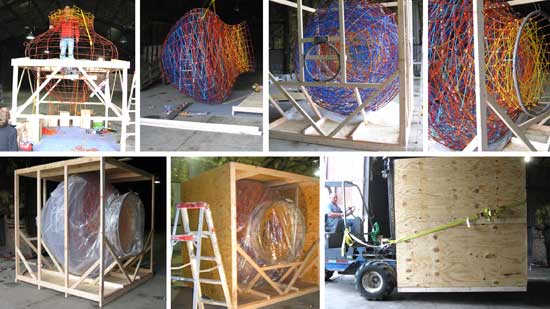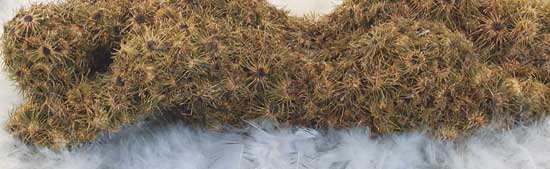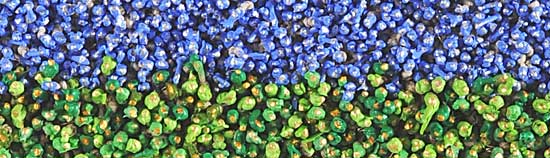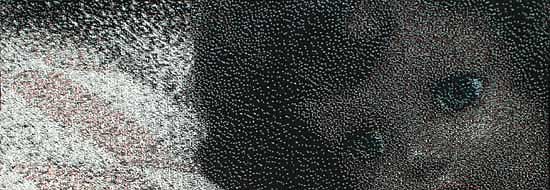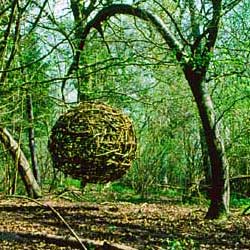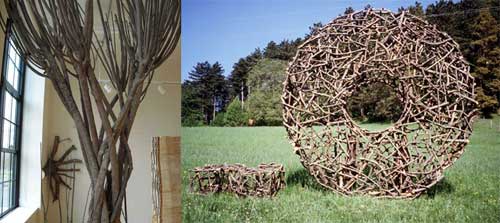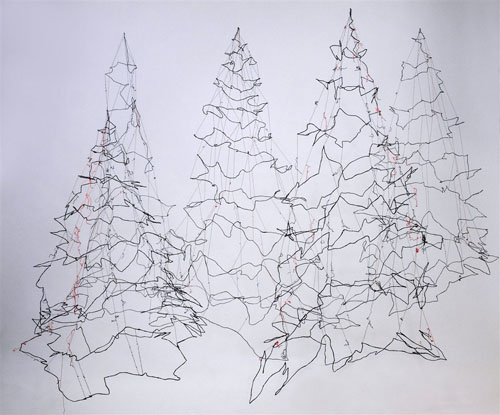
Next month, Rhode Island-based artist Wendy Wahl will exhibit branches, an imposing interactive sculpture constructed from discarded and deconstructed Encyclopedia Britannicas inside the Park Avenue Armory in New York for the Sculpture, Objects and Functional Art (SOFA) exposition. From April 15th through the 19th, branches will flank SOFA’s entrance inside the Armory and stand approximately nine-feet high, six-feet deep, and eleven-feet wide. Viewers will be encouraged to move through the sculpture, whose form and materials will serve as a contemporary reflection on the ancient idea of the Tree of Knowledge, “We are thrilled to have Wahl frame this year’s edition of SOFA New York with her provocative work that will doubtlessly energize veterans and newcomers alike,” added Mark Lyman, President, The Art Fair Company and Founder/Director of SOFA.
“I love the materiality of books,” explains Wahl, “and branches is a tribute of sorts to a medium in transition. It’s a wonderful opportunity to continue my exploration at SOFA in New York City—the center of the rapidly changing publishing industry. I want the fair’s audience to think about how they get their knowledge and to question their relationships to the natural world. What are the connections between nature and language? How does the existence of a multitude of new ways to communicate alter our understanding of meaning and significance?” The installation will continue a series that Wahl began in 2005, which addresses a set of ideas including accessibility and accumulation, synthesis and sustainability. Previous installations in the series have appeared at the Newport Art Museum and the Bristol Art Museum in Rhode Island and the Fuller Craft Museum of Art in Brockton, Massachusetts.
“Digital media has led such artists as Wendy Wahl to re-evaluate the potency of the printed word,” Akiko Busch wrote last fall in an essay in the catalog The 10th Wave III, “Wahl finds different ways to reconfigure the pages of the Encyclopedia Britannica; the leaves may be stacked into forms that suggest an alternative forest of knowledge or tightly scrolled and packed within a frame, making for a composition that suggests a cabinet of hidden knowledge, those archives of information that are at once visible and concealed, at hand and remote.”
Wahl’s work is represented by browngrotta arts of Wilton, Connecticut. The gallery will feature other examples of Wahl’s work in its SOFA New York 2010 installation in booth 204. Wendy Wahl ‘s work can be found in the permanent collection of the Cooper-Hewitt National Design Museum (New York, NY) and the American Embassy in Tashkent, Uzbekistan (through the Art in Embassies Program). She has exhibited throughout the world at venues such as the Contemporary Jewish Museum (San Francisco, CA), the Newport Art Museum (Newport, RI), the University of Wollongong (Australia), and the International Textile Convention (Kyoto, Japan).
Technorati Tags:
SOFA NY, Art Installation, Wendy Wahl, Encyclopedia Britannica


We’re leaving the ice and snow (sigh) for sunnier climes next week, where 


Check Out: “On Thin Ice: Two Russians Skate Off the Reservation,” in the WSJ
Oksana-Domnina-and-Maxim-Shabalin
Contemporary textile artists’ work is often rich in references to other cultures. Traditional techniques are used to generate new forms; images and themes from other cultures are re-envisioned and contemporized. Through her study of Peruvian gauze weavings, Lenore Tawney discovered a reed that she was able to adapt to create the innovative slits and openings that characterized her work.
Shrouded River detail by Lenore Tawney
Carol Eckert’s coiled sculptures feature animal figures that are inspired by African ceremonial head dresses of the Yorubas; Kirsten Wagle and Astrid Løvaas
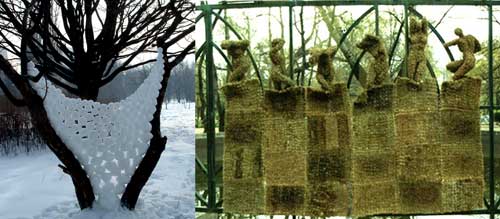
use old Norwegian tapestry techniques on unconventional materials from aluminum cladding to pantyhose;
Løvaas & Wagle create tapestries that are visually captivating, beautiful, surprising, and rich in references to art historical sources
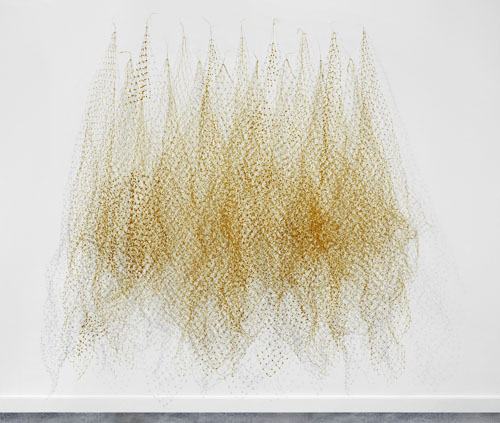
Nancy Moore Bess’s baskets are informed by her travels to Japan, most recently re-interpretations of the jakago/snake baskets used in Asia to bind stones at the edge of a river or lake to prevent soil erosion; and Jin-Sook So reinvents Korean pojagi by creating patchworks of gold-plated steel mesh instead of the traditional scraps of ramie and hemp.
(Pojagi-inspired work) by Jin-Sook So
Is there a point at which cultural “borrowing” stops being an acceptable compliment and becomes unacceptable co-option? That’s the criticism being made of Russian figure-skaters Oksana Domnina and Maxim Shabalin, whose multicultural ice-dancing theme, based on aboriginal costumes, music and dance, have drawn the ire of Australian Aboriginal activists. On January 28, 2010 in the Wall Street Journal, Eric Felten reviewed the Olympic controversy, similar arguments made about white musicians having no right to play jazz, and recent cross-cultural creations by the likes of Paul Simon and Vampire Weekend.
In “On Thin Ice: Two Russians Skate off the Reservation,” Felten cites T.S. Eliot as endorsing artistic appropriation, quoting him as saying, “bad poets deface what they take, and good poets make it into something better, or at least something different.” Felten argues that it is too much to expect “cultural interlopers” to make something better; it should be enough that the borrowing “makes for something different”. And sometimes that something different will be more than different. It will be art.