
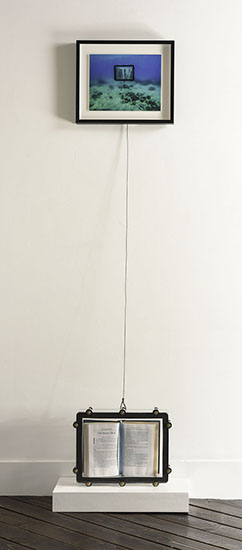
What Lies Beneath, is a mixed media sculpture. The unique water housing was created to submerge Moby Dick by Herman Melville underwater. The image was taken while the book was underwater and feathered to a rock. The artist, Lawrence LaBianca is a sculptor that takes his studio work to the outdoors. Making machine like sculptures that harness natural phoneme to generate the art. This piece is part of a larger body of work that engages aquatic environments. , Lawrence LaBianca, 40″ x 18.5″ x 8.5″, 2016. Photo by Tom Grotta
This March (2nd-6th), browngrotta arts will participate in the art on paper art fair at Pier 36 in New York City http://thepaperfair.com/ny. Among the works we will display is Lawrence LaBianca’s mixed-media sculpture, What Lies Beneath. LaBianca takes much of his studio work to the outdoors, making machine-like sculptures that harness natural phenomena to generate the art. His sculptures are extensions of the human hand through which materials are manipulated and shaped, and they are the vehicles through which information can be unearthed. “The tools we apply to nature—to contain it, shape it, understand it and categorize it,” says the artist, “also have a profound affect upon it. It is this impetus to measure, understand, contain and manipulate nature that I enact through my work.” LaBianca created the unique water housing of What Lies Beneath in order to submerge the iconic text of Moby Dick by Herman Melville underwater. The image was taken while the book was underwater and tethered to a rock.
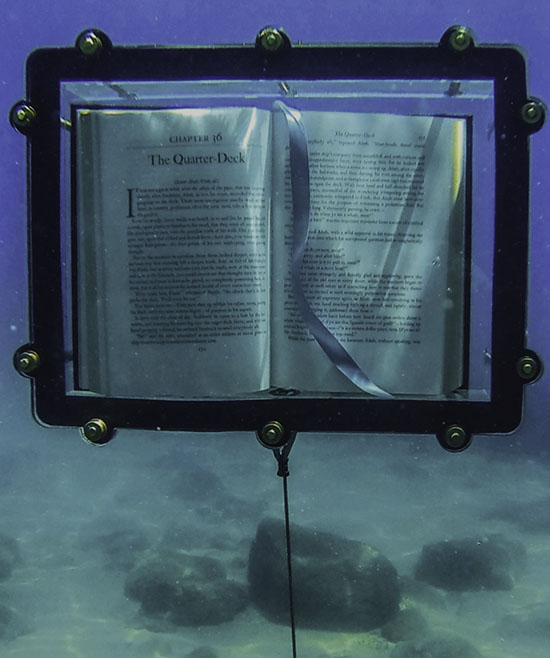
12lb What Lies Beneath, Lawrence LaBianca, Detail


 When I first held this book in the 1980s it offered a thoughtful contextualization to the real life process of gathering and recycling urban materials for my sculptures and installations. With contemporary concerns of upcycling and sustainability, Jencks’ and Silvers’ assertions seem more apt than ever.”

 Playing to the Gallery by Grayson Perry, a British ceramic artist, described by one reviewer as “a man in a frock who makes pots with rude designs.” Mary describes it as “a quirky, personal and lively journey through the issues facing the contemporary art world and a lot of it is hilarious – especially the illustrations.”


 All the World’s Futures: 56 International Art Exhibition, the catalogues for this year’s Venice Bienniale. “Most of the essays are very interesting and important,” she writes. “There were some very good pavilions in the Giardini this year, for example the Japanese Pavillon for the textile art scene.”

 The Root of Wild Madder: Chasing the History, Mystery and Lore of the Persian Carpet by Brian Murphy (Simon and Schuster). The author takes the reader on a magic carpet ride traveling in the regions of its origins and destinations to tell the stories of the dyers, weavers and sellers of this remarkable art form. At my local public library I found


 Cooper’s organic portraits will be on exhibit this Spring at the Morris Museum in New Jersey in conjunction with



It’s Never Too Early: How to Buy Art in Your 20s
Lizzie Farey($1,800), Deborah Valoma($1,700) and Stéphanie Jacques($1,200). Photo by Tom Grotta
Thanks to the DIY movement and a mass of online and cable design and decor resources, we’ve never had more encouragement to create environments that inspire and invigorate. Art can be an essential element of such an environment and investing in art need not be a bank breaker. Domino, a curated site that encourages readers to “bring your style home,” offers several tips for buying art in your 20s, including not buying too big and not being afraid to invest http://domino.com/how-to-buy-art-in-your-twenties/story-image/all. We at browngrotta arts have a few additional thoughts:
INYO (95-2), Tsuruko Tanikawa, brass and iron wire, coiled and burned, 7.5″ x 6.5″ x 14″, 1995 ($1,200)
1) Think objects: If you are in your first apartment or are fairly certain that a move is in your future, Ceramics, Art Baskets, Glass sculptures can be easier to place in your next home than a large wall piece may be.
Naomi Kobayashi Red & White Cubes ($1,000 each)
2) Invest for impact: Prints are generally less expensive than originals, editions less expensive than a one off. And you will find that some mediums are, in general, priced more accessibly than others. Art textiles and fiber sculpture are an example. Work by the best-known artists in the field go for under a million dollars, compared to tens of million dollars for paintings by well-recognized artists. You can start small with works in fiber, ceramics and wood, and create a small, but well-curated, collection. Consider Naomi Kobayashi, a Japanese textile artist whose work is in the permanent collection of many museums, including the Metropolitan Museum of Art and whose work can be acquired for $1000. Or an up-and-coming artist like Stéphanie Jacques from Belgium, whose masterful multi-media works address issues of gender and identity, and begin at prices below $1500.
GRAY WITH BLACK, Sara Brenan, wool & silks linen, 12.5” x 19”, $1,900 photo by Tom Grotta
3) Take advantage of digital placement: Reviewing art online is a great way to expose yourself to a wide variety of work, and develop your personal aesthetic. Once you’ve found a work that appeals, digital placement can give you a greater level of confidence before you press “Buy.” At browngrotta arts, we ask clients to send us a photo of the space the propose to install the work. We can digitally install the piece, to scale and with shadow, so you have a sense of how will work there.
32pc CONSTRUCTION III, Pat Campbell, rice paper, reed, 8″ x 7.5″ x 5.5″, 2002
4) Document: If the work you purchase has appeared in a book or a catalog, make sure you get a copy. Ask the seller for any information he/she has on the artist for your files. On each artist’s page on browngrotta.com, you can find a list of publications in which the artist’s work appears. The documentation is good to have for insurance and appraisal purposes and you can watch as the artist’s cv —hopefully — expands in the next several years.
5) Buy for love: It’s great to learn 10 years down the road that a work of art you purchased has appreciated and is worth more than you paid for it. We’d argue, though, that if you’ve enjoyed owning it for 10 years, and thought each time you looked at it, “I really love that piece,” you’ll have gotten your money’s worth, and enriched your life in the process.