
New this week in February was nothing if not eclectic. From Sue Lawty’s works of tiny stones to James Bassler’s reimagined yatra jacket. The works reveal diversity and intrigue.
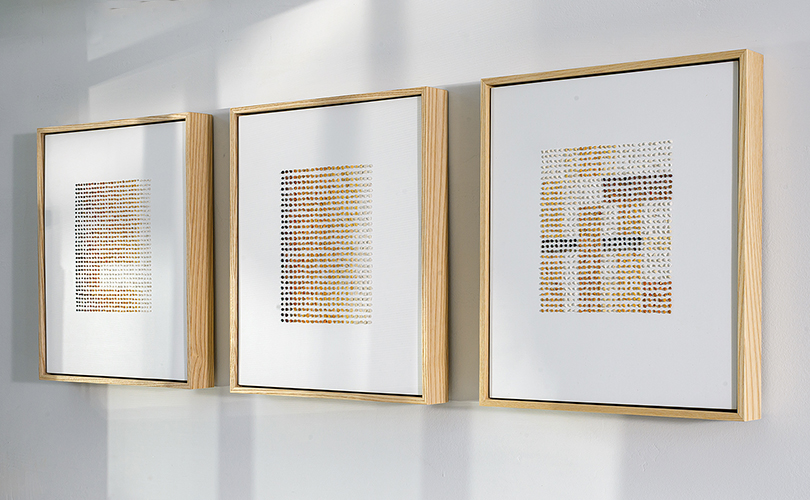
Sue Lawty is recognized as one of Britain’s foremost contemporary textile artists. Her work encompasses weavings, constructed pieces, and drawings in both two and three dimensions, exploring rhythm, repetition, and interval. Lawty creates assemblages featuring thousands of tiny stones, like Coast, East Riding of Yorkshire 1-3, each smoothed by the sea and meticulously hand sorted, Whether making drawings and assemblages using tiny stones creating a kind of pixelated cloth, or weaving in linen, hemp, raphia, or lead, she talks of the “integrity of mark making intrinsic to particular thread or structure.” Lawtywill also be running an online workshop, Rhythm & Repetition in Woven Tapestry on Sunday, April 26 and May 3, 2026 on Zoom from 2 – 5pm GMT. To book your spot, visit the selvedge website HERE.
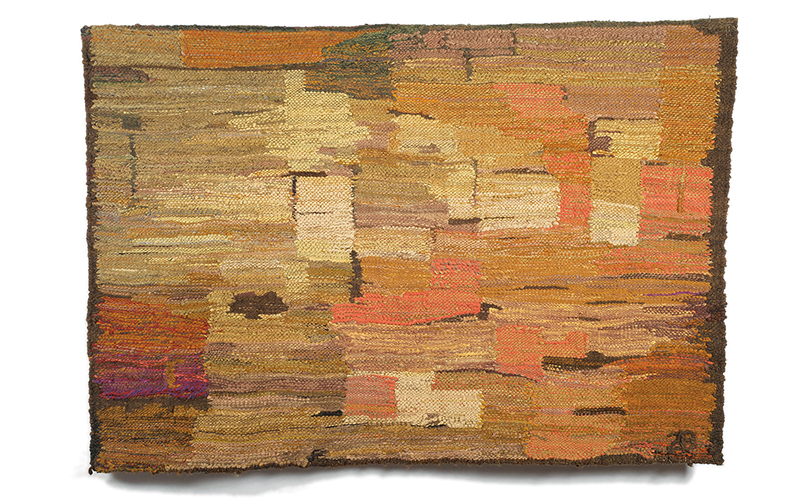
The late Polish artist, Zofia Butrymowicz emerged as one of the pioneering East European textile artists in the 1960s. Butrymowicz excelled in the wool gobelin technique, utilizing handspun wools that were often rough and irregular to create striking and textured pieces. Color was a dominant theme for Butrymowicz. She frequently emphasized color, reflecting her deep interest in experimentation and new artistic expressions. Throughout her career, Butrymowicz’s contributions to the art world were celebrated globally. Her work was included in the Museum of Modern Art’s seminal Wall Hangings exhibition. Her legacy continues to inspire.
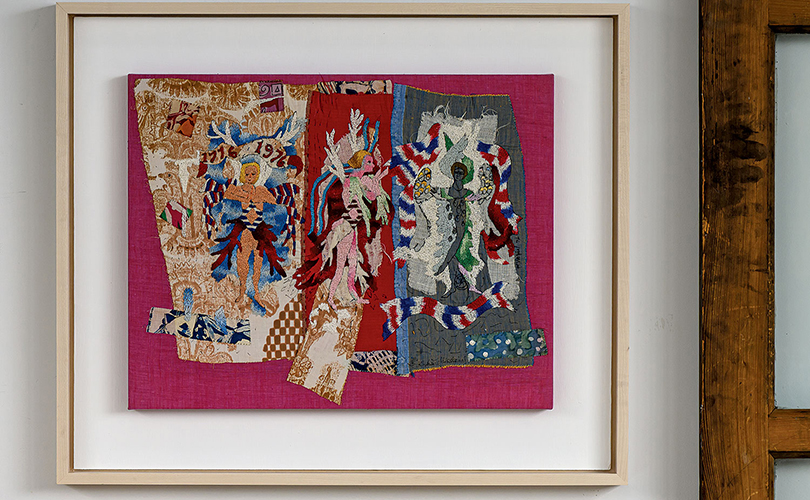
A leading figure in California’s celebrated fiber art community, Katherine Westphal was driven by boundless curiosity and creativity, exploring ceramics, quilting, fiber sculpture, photocopy collage, and wearable art with equal imagination and innovation. “Throughout her career, beginning with the batik samples she made for the commercial printed textile industry in the 1950s, [Westphal] incorporated images from her immediate world: street people in Berkeley, Japanese sculpture, Monet’s garden, Egyptian tourist groups, Chinese embroidery, images from newspaper and magazine photos, and her dogs…anything that struck her fancy wherever she happened to be at the moment – and she could put any or all of them into a repeat pattern. Her wit and whimsy [were] legendary and her lively approach also inspired her husband [Ed Rossbach] to combine imagery onto the surface of his inventive baskets and containers,” wrote Jo Ann C. Staab in 2015 (“Fiber Art Pioneers: Pushing the Pliable Plane,” Retro/Prospective: 25+ Years of Art Textiles and Sculpture, browngrotta arts, Wilton, CT 2015.) Angels captured her interest in 1976 and resulted in the energetic embroidery Bicentennial Angels. The work is well worth a lookback in 2026, America’s semiquincentennial year.
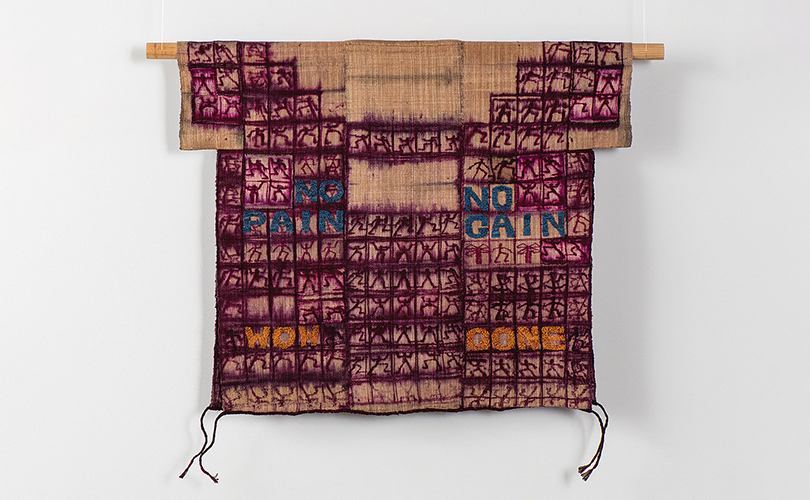
For James Bassler, the inspiration for My Letterman Yantra was an exhibition commission. He was asked by Jack Lenor Larson to create a piece in response to one in George Washington University’s Textile Museum’s collection. Bassler reviewed the museum’s digital images, doubtful that the dotted pixels on his screen, so far removed from their three-dimensional source, would prove inspirational. But he was drawn to an image of a garment from Myanmar (then Burma), a shirt, embellished with yantras, auspicious signs and symbols, associated with cosmic powers that will bring good things to shirt’s wearer. As he is a runner, they reminded him of the race shirts he had been given over the years for participating in marathons, covered with logos and corporate symbols. Why not, he thought, create a 20th-century version? The Letterman Yantra is the result, with woven fabric, and embroidered designs that include rows of running “stick figures,” the number 262 and phrases to speed the imaginary wearer and runner, on. The curator pronounced the reimagined version a great success. Larsen wrote, “The two-sided jacket of James Bassler, with ikat-like patterning, is [ ] exceptional, created with a fugitive-dyed magenta yarn wicking into the adjacent areas. If wicking prints are extremely rare, his patterning of the back side, created by clamping and steaming together the patterned front and the plain back, is a unique and primitive form of transfer printing. Bassler has been successfully sourcing museums with varied and extraordinary results for a long time, and here he seems inspired to create a technique not yet in museums!”