New this Week artworks are introduced by browngrotta arts every Monday. December 2025 featured five Mondays so our recap this month features one more artwork than usual. In this version of Art Assembled, you’ll see work by Toshio Sekiji, Gyöngy Laky, Aby Mackie, Asela Akers, and Neha Puri Dhir.
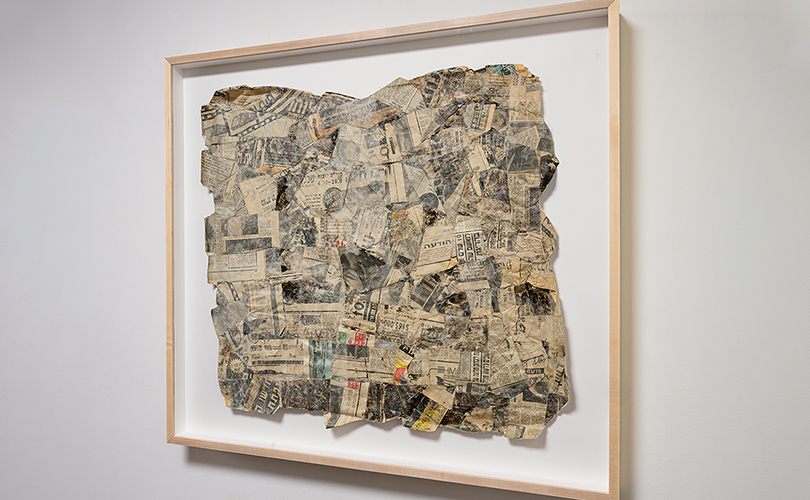
Toshio Sekiji’s Neighbors is an illustration of the woven collages for which he is known. In this case, he has plaited lacquered strips from various Israeli newspapers in order to make a plea for intergroup harmony. In other works, to make his point, Sekiji has mixed newspapers from Japanese and Korean newspapers, and used The New York Times, dust jackets from controversial books, and Indian and other Asian newspapers.
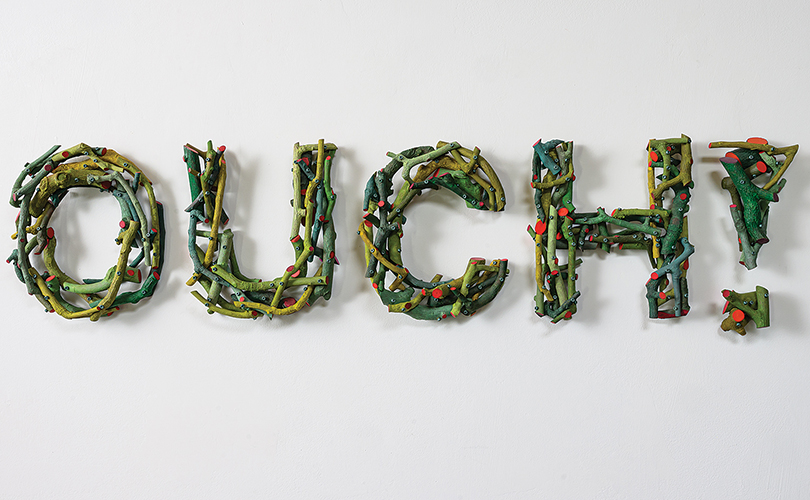
Gyöngy Laky has spent a lifetime bringing light to issues of the environment—joining branches and tree prunings — often from agricultural sites — with industrial materials. Laky’s work takes many forms, from baskets and vessels to text-based sculpture like Lie Ability (OUCH) which spell out her feelings on the current political climate in literal terms. Laky had heard many of the lies in the 2016 presidential campaign and feared the man now in charge. The title is a double entendre – a small hint to her thinking beyond the work itself. The word “OUCH” offers to viewers the opportunity to read into the work what is in their minds and hearts once Laky has attracted their attention — an example of the power of art to evade censorship.
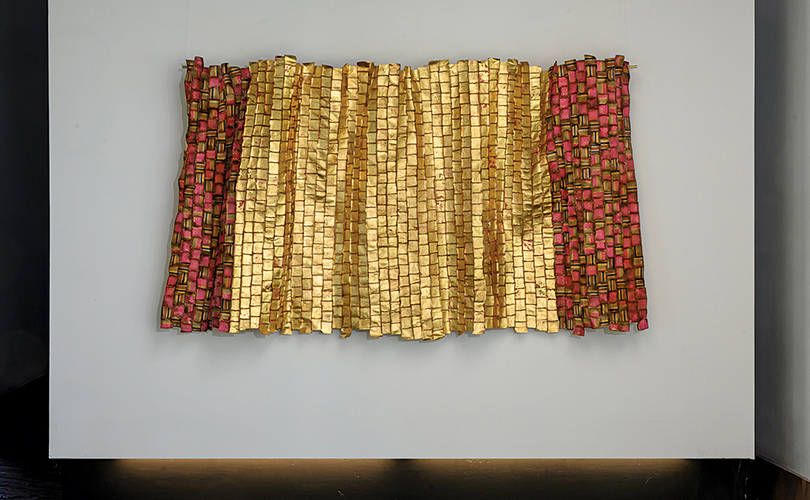
Artist Aby Mackie’s textile-based artwork engages with themes of ecology, history, and resistance through a process of reclamation and transformation. Working with discarded historic textiles, she deconstructs and reconfigures, disrupting their original function to create new meaning. In Fragments of a Life Lived 3 she uses antique-ticking fabric as both material and metaphor. Once utilitarian, worn by time and use, it is reconstructed through stitching and further manipulated with paint and gold leaf. These interventions reimagine its surface—echoing stories of erosion, endurance, and renewal. The addition of gilding speaks to the overlooked value in what is often discarded, while the act of mending becomes a gesture of care and reclamation. The viewer is invited to read between the layers— to sense the life once lived through it, and to reflect on what we choose to preserve or let go.
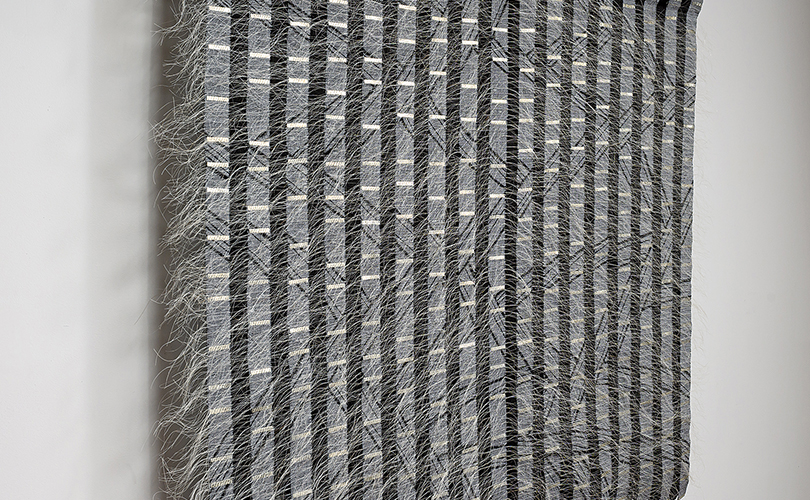
A diverse and geographically disparate range of influences grounded Adela Akers work. Akers was born in Spain, educated at the University of Havana in Cuba and inspired by her extensive travels. A trip to the Democratic Republic of the Congo, where she observed the painting process of the Mbuti women of the Ituri Forest, led to the marks in Akers’s work, Interrupted II. “I’ve always been interested in looking at patterns of other cultures and other people,” she told a San Francisco television interviewer. When she transferred her drawing of Mbuti women’s marks to a larger scale she separated the lines and they no longer lined up. “It’s fine with me if they don’t,” she said. “But by spreading it out, then I have, of course, room for this other color to be in, again to add more dimension, so that the horsehairs (use of which is on of her trademarks) float over a lot more.”
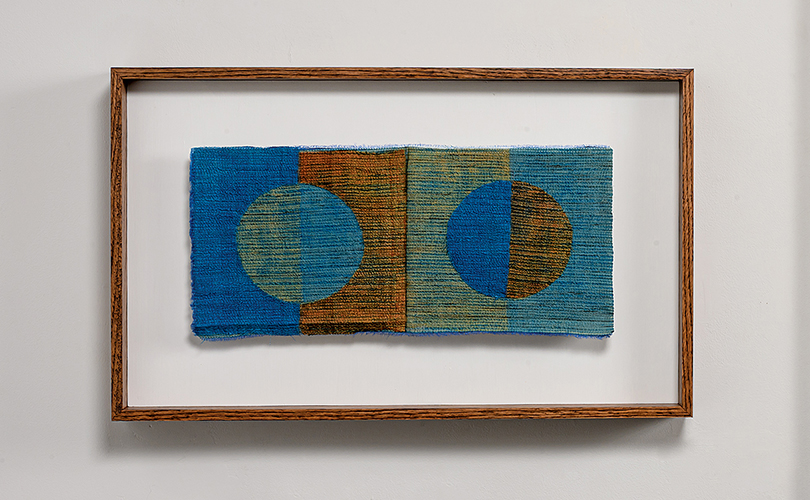
Like Toshio Sekiji’s works, Dualities by Neha Puri Dhir invites contemplation on coexistence and transformation. The work, involving stitch-resist dyeing on handwoven silk, reminds viewers of the quiet harmony that emerges when opposites are held together in a single frame – a thoughtful message for these contentious times. The two circular motifs, one in negative and another in positive space, reflect ideas of balance and contrast. The earthy browns merge into deep indigo blues, evoking cycles of day and night, fullness and emptiness, presence and absence.
Watch for more work in 2026!