Monthly archives: January, 2026

Art Assembled — New this Week in January

Off to a good start in 2026 — we’ve brought four interesting works to you attention in January. 
Polly Barton textile
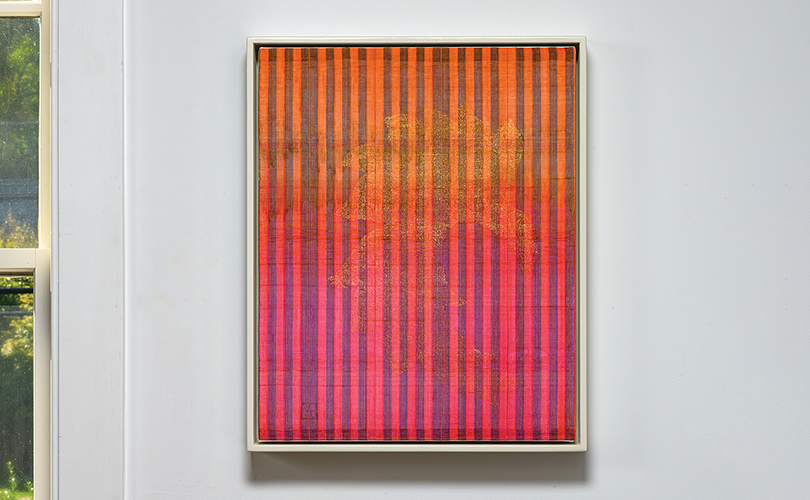
19pb Salvia Sclarea (Clary Sage), silk warp with gold leaf, silk weft around a metal core, 22.125” x 18.125” x 2.75”, 2025. Photo by Tom Grotta

We began with Polly Barton’s Salvia Sclarea (Clary Sage)In 1978, Barton went to Japan as an exchange student where she visited a weaving studio filled with incredibly colored dyed silk. She returned to Japan in 1981 to study weaving at the Oomoto School of Traditional Arts where she discovered that weaving was her calling. She learned silk weaving from the man who warped the looms of living national treasure Fukumi Shimura. As Barton developed her artistic process, she realized that seeing how painter Helen Frankenthaler — for whom Barton had served as an assistant — impregnated her canvases with pigment, gave her “permission” to build up layers of color in her woven ikat works.

In Salvia sclerea — which inspired the title of this piece is the herbaceous plant clarey sage. This work incorporates an image of the plant that moves in and out of view depending on thow the light hits it.
Laura Foster Nicholson Tapestry of Bees
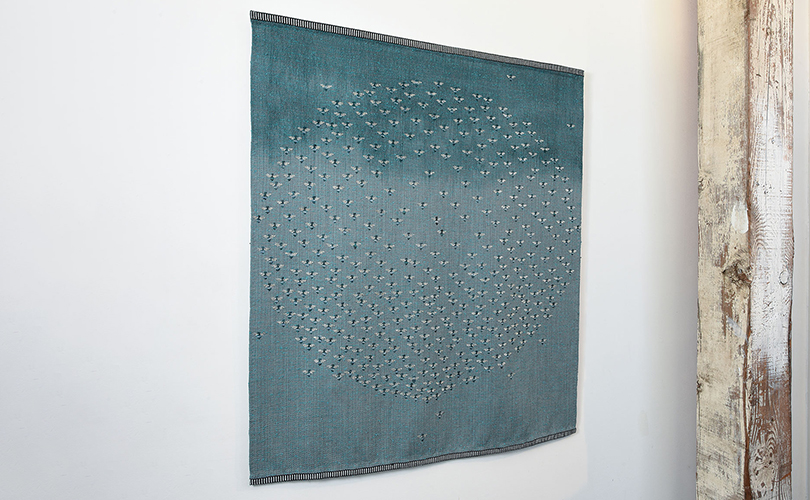
18lf Being Here, Laura Foster Nicholson, wool with metallic, 41” x 34”, 2011. Photo by Tom Grotta

Another work that connects with Nature is Laura Foster Nicholson’s Being HereBees are a metaphor for the soul, Nicholson says. Her work Being Here, is from a series of works involving bees and bee hives. Nicholson often reflects gardens and scenes of domesticity in her tapestries. “I have been a beekeeper, and always felt that it was magical and a true privilege to don a bee suit and stand among thousands of busy, humming honeybees. Being Here is the culmination of a body of work about moving through pain to the state of grace that is acceptance.  The orb of shimmering insects represents the final opening up to the transformation.”
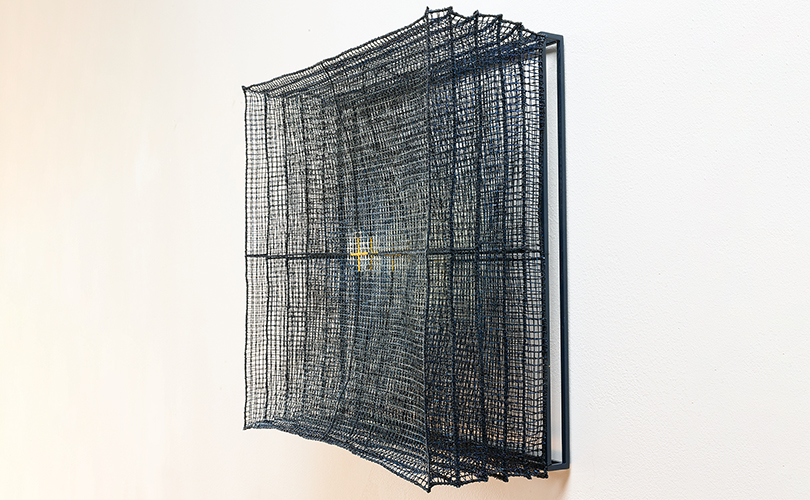
Yeonsoon Chang dimensional grid
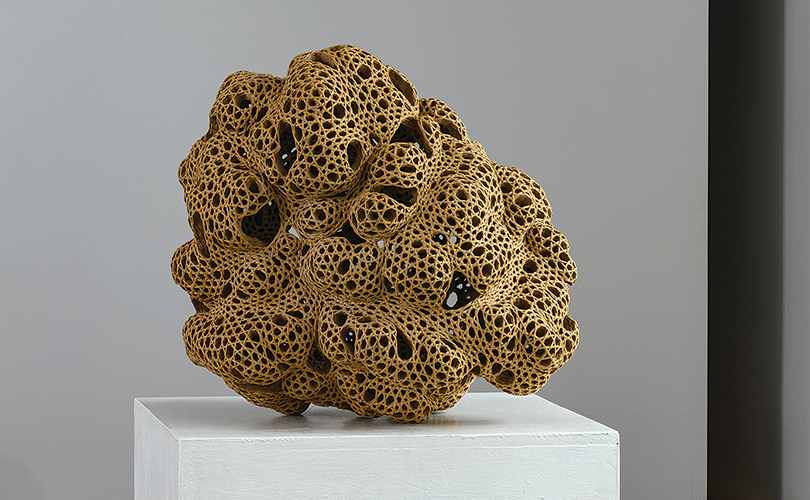
18yc Matrix III-201612, Yeonsoon Chang, polyester mesh, machine sewn, 14” x 14” x 4.75”, 2017. Photo by Tom Grotta

Yeonsoon Chang has created an eco-friendly resin to use in creating sculptural works of hemp and polyester mesh. Recurring themes in Chang’s work include time, space, and the myriad relationships that intertwine them. Chang’s process requires 12 complex and meticulous steps, including refining, dying, ironing, and sewing, all of which require considerable mental focus. She considers it her calling to bring to life the spirit of Korean craft, allowing it to breathe and resonate through works like Matrix III-201612. Chang was a Loewe Foundation Prize nominee and the first Korean artist to have her works acquired by the renowned Victoria & Albert Museum in the UK. Her work was also featured in the Cheongju Craft Biennale in 2025.
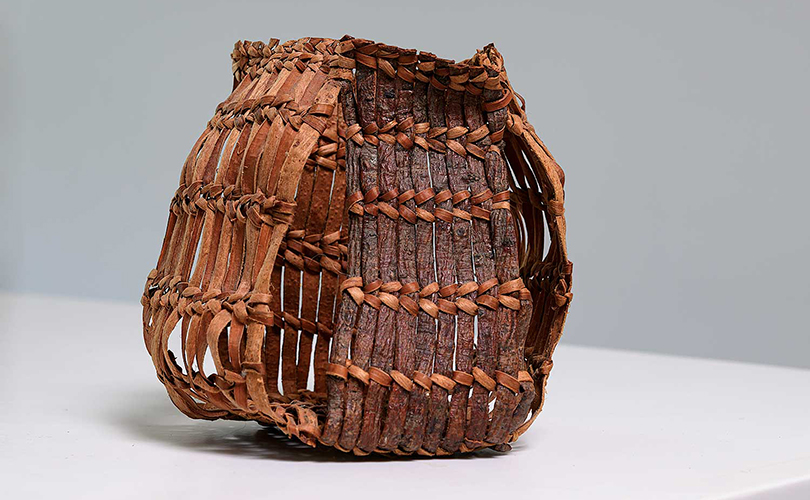
Small Dorothy Gill Barnes Pine Bark Basket
91dgb Inside-Outside, Dorothy Gill Barnes, woven pine bark, 3.5” x 3” x 3.5”, 1990’s. Photo by Tom Grotta

Inside-Outside by Dorothy Gill Barnes is an excellent illustration of the artist’s remarkable way with wood (the name of browngrotta arts’ 2023 monograph, Dorothy Gill Barnes: A Way with Wood, in fact).  Bark—from pine, spruce, elm, basswood, mulberry, and many other trees—played a seminal role in her work. She cut or tore bark in strips and wove it into basket- or vessel-like forms, folded it into rectangular boxes and windows, pulled it back like a banana peel, and wrapped it around rocks. To add tension and contrast, she paired bark from different species of trees, different textures of bark from the same tree, and peeled or unpeeled surfaces. In Inside-Outside, she has paired wood strips with bark and strips without bark, weaving them to form the base and stitching the strips to form the sides.  

More works to come in February!
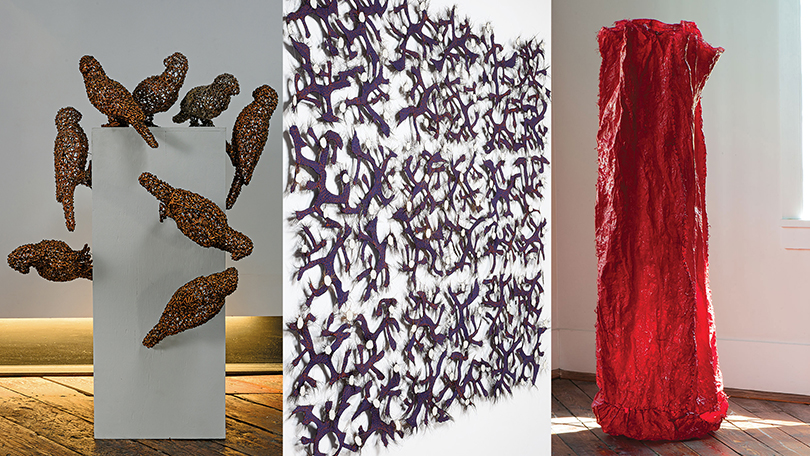

Save the Date! Transformations: Dialogues in Art and Material Opens in May
John McQueen, Marian Bijlenga, Kiyomi Iwata
works by John McQueen, Marian Bijlenga, Kiyomi Iwata. Photo by Tom Grotta

Mark your calendars! From May 9 through May 18, 2026, browngrotta arts will present Transformations: Dialogues in Art and Material, a Spring exhibition exploring the expressive power of materials and the inventive ways contemporary artists transform them.

Norie Hatekayama sculpture
24nh Complex Plaiting Series – Connection I-9609, Norie Hatekayama, paper fiber strips, 21″ x 22″ x 19″, 1996. Photo by Tom Grotta

Featuring works by more than nearly three dozen international artists, Transformations will examine materiality as a central force in artistic practice. Clay, silk, steel, bark, seaweed, bamboo, horsehair, cotton, linen, flax, and other materials are not treated as passive elements, but as active agents—each with its own history, constraints, and expressive possibilities. The exhibition highlights both the remarkable diversity of materials and the distinct outcomes achieved when artists work within the same medium.

Waxed linen wall figures by Mary Giles
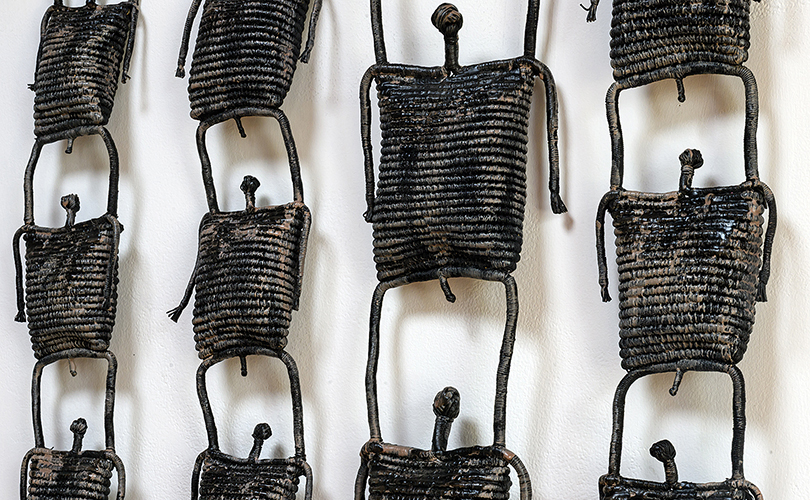
71mg Annointed Procession, Mary Giles, waxed linen, wire, 31″ x 19″, 1995. Photo by Tom Grotta

The artists in Transformations exemplify what curator and historian Glenn Adamson calls “material intelligence”: a deep understanding of the physical world and the skill to give materials new form and meaning. Through thoughtful engagement, abstract ideas are transformed into tangible, sensory experiences, bridging the conceptual and the corporeal.

“The artists inTransformations may begin with the same material but through their singular instincts and inspirations they generate strikingly different results,” says Tom Grotta, co-curator of browngrotta arts. “It’s a testament to the power of the artistic imagination.” Examples include Kiyomi Iwata who creates freestanding sculptures of spun silk and shimmering wall works of kibisio, the first silk from the cocoon and Polly Barton who weaves images from silk threads that she has bound and dyed. In cotton, Simone Pheulpin and Mercedes Vicente create objects of cotton webbing that seem to have emerged from nature — resembling coral, shells, and stones, while Kay Sekimachi uses split-ply and card-weaving techniques to create loops of cotton cord to hold shells and stones sourced from the beach. Toshiko Takaezu forms smooth columns of clay, Yasuhisa Kohyama’s clay vessels seem to have been carved directly from a mountainside, and Karen Karnes creates functional pots that incorporate color yet retain the natural cast of fired clay, defying all sense of the manmade.

Kyoko Kumai Steel tapestry
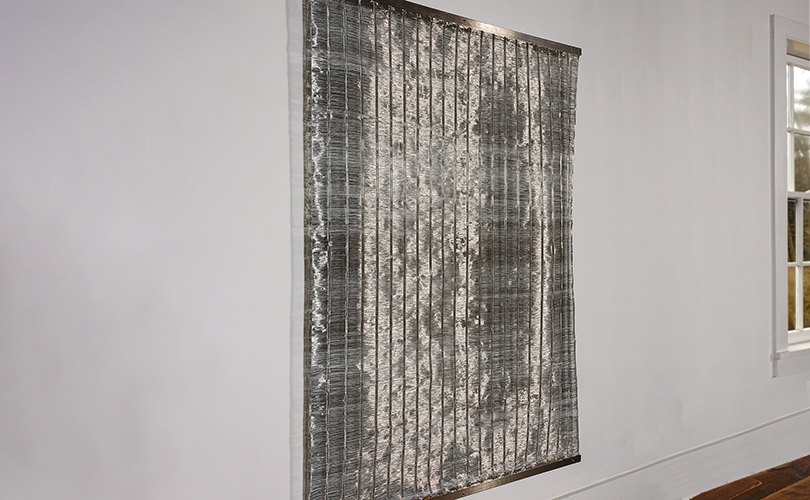
46kk Sudare, Kyoko Kumai, stainless steel, 70.75″ x 50.75″ x 2″, 2000. Photo by Tom Grotta

A full-color catalog will accompany the exhibition.

Exhibition Details

Location:
276 Ridgefield Road, Wilton, CT 06897

Dates & Hours:

  • Saturday, May 9 (Opening & Artists’ Reception): 11 am–6 pm
  • Sunday, May 10: 11 am–6 pm
  • Monday–Saturday, May 11–16: 10 am–5 pm
  • Sunday, May 17: 11 am–6 pm

Schedule Your Visit

Stay tuned for more information—and we hope you’ll join us this spring for Transformations at browngrotta arts.

Coconut Fiber weaving by Carolina Yrarrazaval
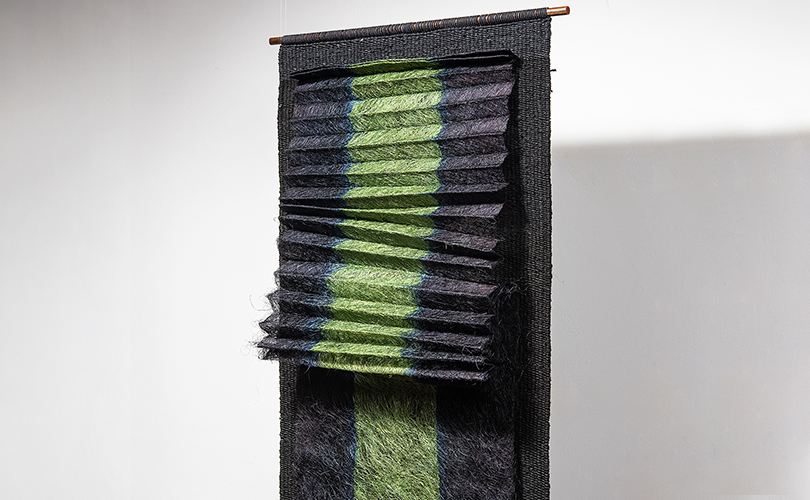
23cy.1 Verde Esperanza, Carolina Yrarrazaval, linen and coconut, 62” x 26.75”, 2022. photo by Tom Grotta

Save the Date! The Spring 2026 exhibition at browngrotta arts, Transformations: Dialogues in Art and Material, scheduled for this May 9 – 17, 2026 in Wilton, Connecticut, will take a deep dive into materiality itself. It will explore the wide range of materials artists employ—including clay, silk, steel, bark, seaweed, bamboo, and horsehair—and the varied transformations these materials undergo in talented hands, even among artists working with the same medium. Transformations: dialogues in art and material will highlight the use of diverse materials and the varied ways in which artists reshape and reimagine a single material within their practices. 

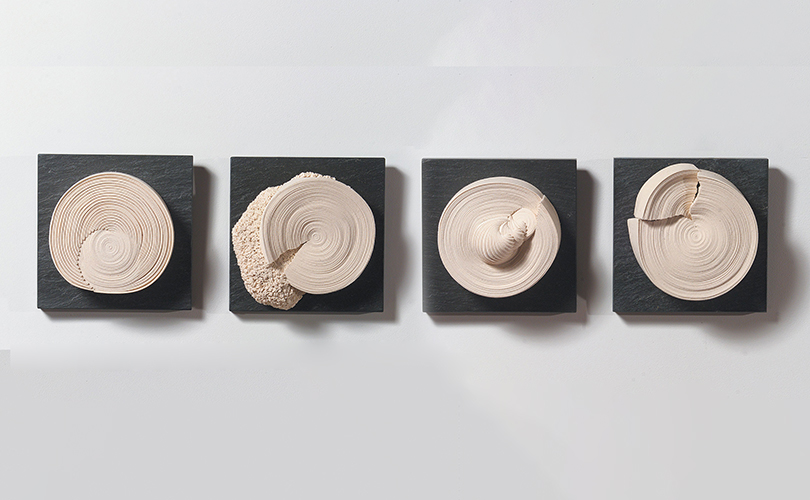
Tourbillons by Simone Pheulpin
17-20sp Tourbillons, Simone Pheulpin, cotton, slate, 7.75″ x 7.75″ x 2.25″ each , 2003. Photo by Tom Grotta

We’d like to display works by you, Polly Barton, and Kiyomi Iwata to show varying uses of silk, works by Kay Sekimachi, Simone Pheulpin, Mercedes Vicente, and Sophie Rowley in cotton, works by John McQueen, Hisako Sekimachi, Dona Look, Linda Bills and Polly Sutton in tree bark, and so on. The artists included will all meet curator and historian Glenn Adamson’s definition of material intelligence: “a deep understanding of the material world around us, an ability to read that material environment, and the know-how required to give it new form…”

Transformations examines the use of diverse materials in art and the many ways artists reshape and reimagine a single material within their practices. The Spring 2026 exhibition at browngrotta arts, Transformations: Dialogues in Art and Material, takes a deep dive into materiality itself. It highlights the wide range of materials artists employ—including clay, silk, steel, bark, seaweed, bamboo, and horsehair—and the remarkable transformations these materials undergo in their skilled hands, even among artists working with the same medium.


browngrotta arts’ 2025 Year in Review

We’ve had another busy 12 months. Below are the highlights. You can learn more about most of these events in previous arttextstyle posts or by using the search feature on our website. Thanks for being a part of another successful year celebrating art textiles, the artists that make them, and the fans that enjoy them.

Month by Month
January 2025:

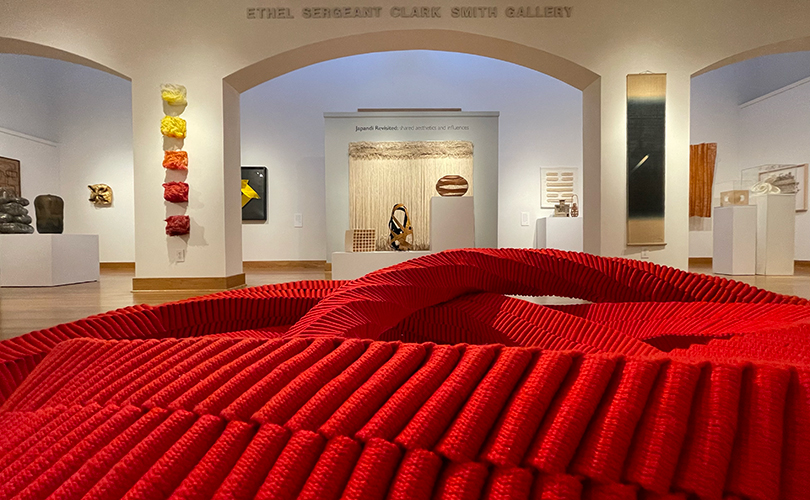
Japandí Revisited: shared aesthetics and influences, in Wayne Art Center, Pennsylvania
Japandi Revisted at the Wayne Art Center. Photo by Tom Grotta

• Japandí Revisited: shared aesthetics and influences, continued at the Wayne Art Center, Pennsylvania 

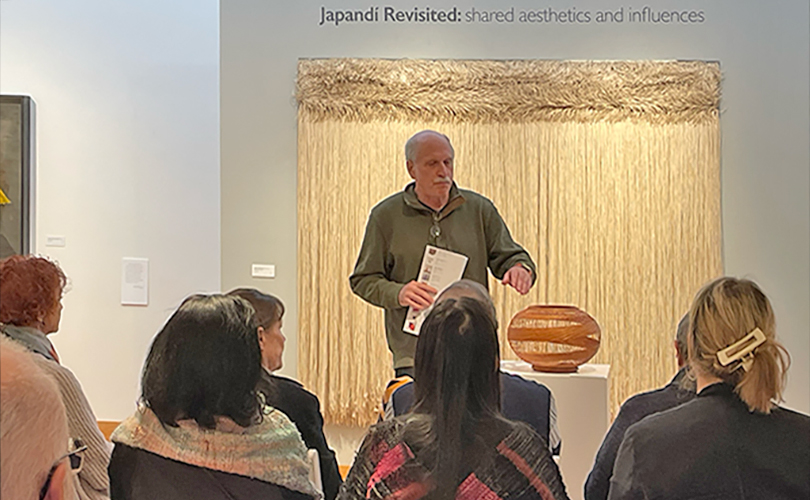
Japandí Revisited: shared aesthetics and influences walk-thru
Tom Grotta artist walkthrough, Japandi Revisted at the Wayne Art Center. Photo by Rhonda Brown

A Japandí Revisited walkthrough with Tom Grotta took place at the Wayne Art Center, Pennsylvania

February 2025:

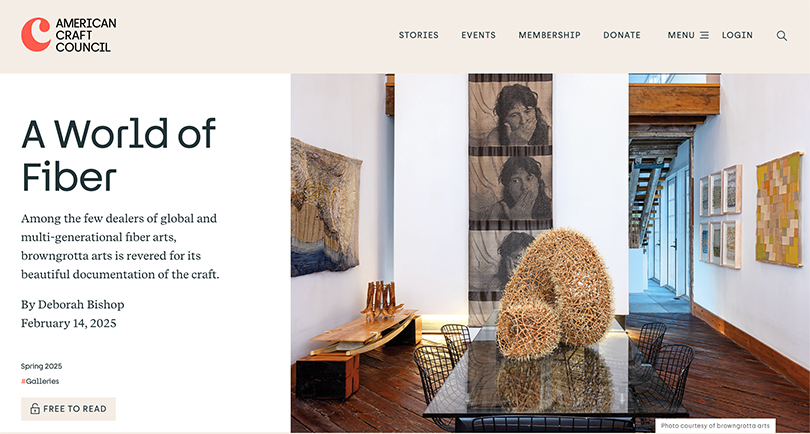
• American Craft magazine published: “A World of Fiber, browngrotta arts,” Deborah Bishop

browngrotta arts featured in American Craft Magazine
American Craft Magazine feature on browngrotta arts

March 2025:

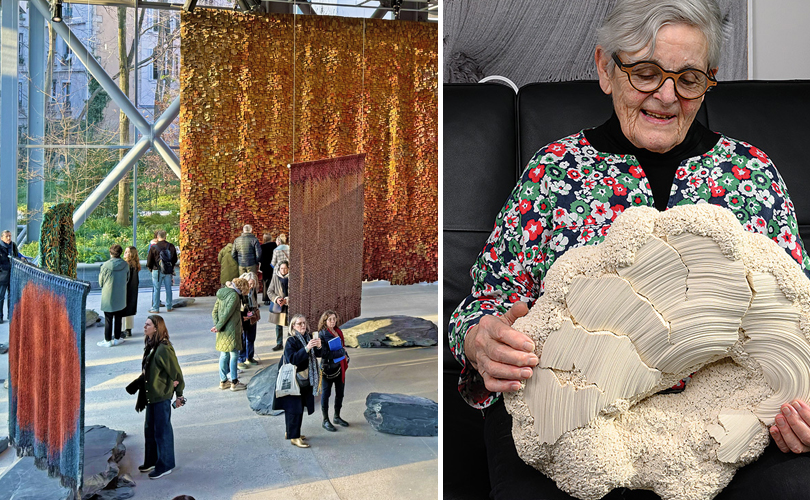
Olga de Amaral,  at the Cartier Foundation and Simone Pheulpin
Olga de Amaral Cartier Foundation exhibition and Simone Pheulpin in her studio in Paris. Photos by Tom Grotta

• Tom and Carter Grotta and Rhonda Brown visited Paris to photograph exceptional artist Simone Pheulpin and view the extraordinary exhibition, Olga de Amaral,  at the Cartier Foundation

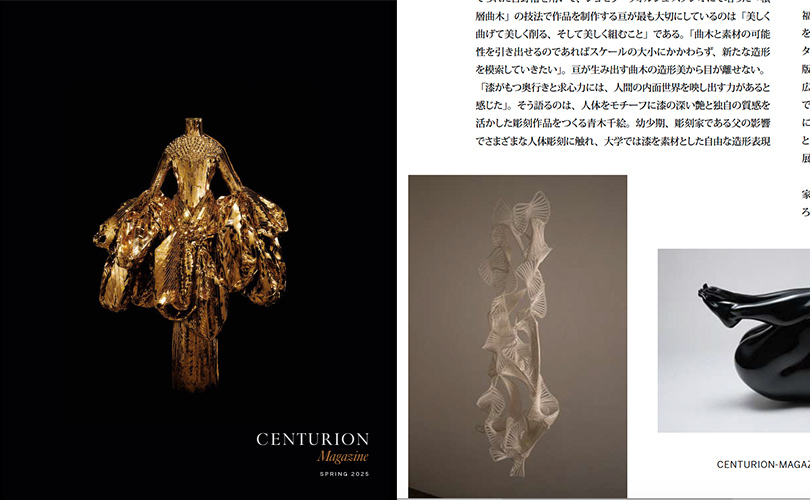
Shoko Fukuda featured in Centurion Magazine

• Centurion magazine published, “Shaping Heritage,” by Kaoru Kijima, which featured work by Shoko Fukuda

May 2025:

Three Silvermine exhibitions curated by browngrotta arts, Including Norma Minkowitz in front of her work in Masters of the Medium: CT. Photos by Tom Grotta

• The Silvermine Art Galleries in New Canaan, CT invited browngrotta arts to jury its FIBER 2025 invitational. We also installed two exhibitions in their galleries, Masters of the Medium: CT: Helena Hernmarck and Norma Minkowitz and Mastery and Materiality: International

• A FIBER 2025 walkthrough with Tom Grotta and Rhonda Brown took place at the Silvermine Art Galleries, New Canaan, CT

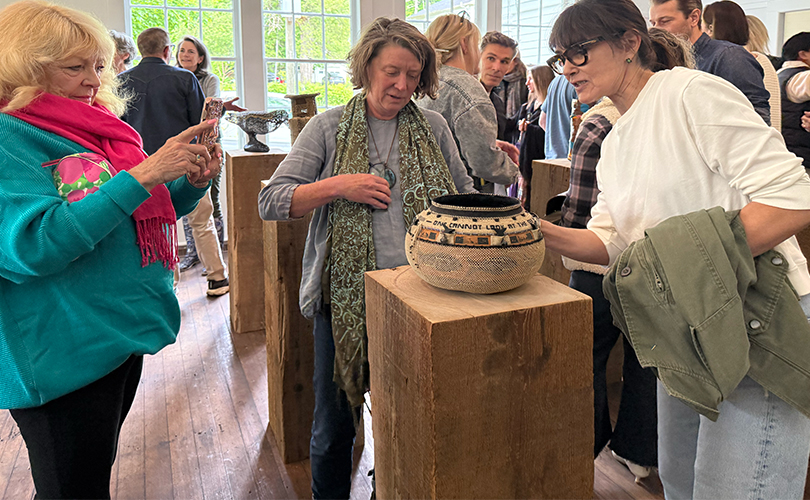
WEFAN opening reception at the Hughes Memorial Library, in West Cornwall, CT. Photo by Tom Grotta

• browngrotta arts loaned work to WEFAN, a group exhibition curated by Dina Lov Wright of Lov Art. Housed in the Hughes Memorial Library, in West Cornwall, CT, WEFAN featured works by 12 artists — including Dorothy Gill Barnes and Ed Rossbach — who work with fiber techniques and materials 

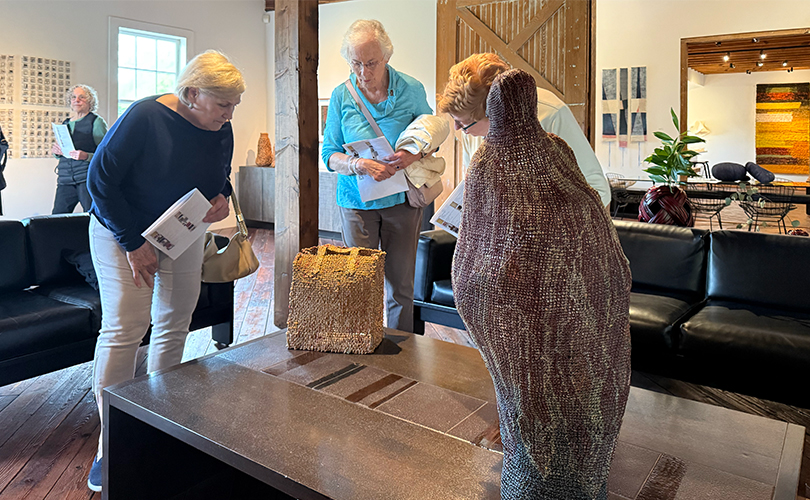
Field Notes: an art survey exhibition at browngrotta arts.
Field Notes: an art survey exhibition at browngrotta arts. Photo by Tom Grotta

• Field Notes: an art survey, browngrotta arts’ Spring Art in the Barn exhibition, opened

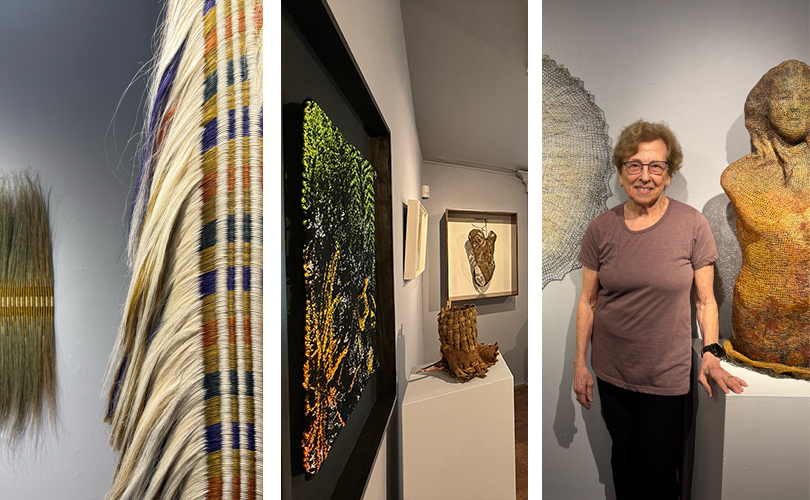
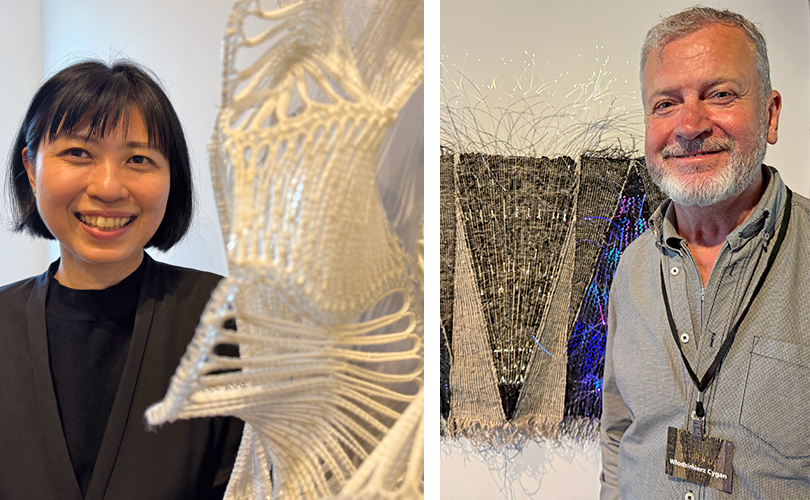
Shoko Fukuda and Włodzimierz Cygan
Shoko Fukuda and Włodzimierz Cygan at the opening of Field Notes: an art survey. Photos by Tom Grotta

• Out-of-the-area Artist Visits: Christine Joy (Montana), Wlodzimierz Cygan and granddaughter, Wiktoria (Poland), and Shoko Fukuda (Japan), visited the gallery, attending the opening of Field Notes and the artists’ dinner after.

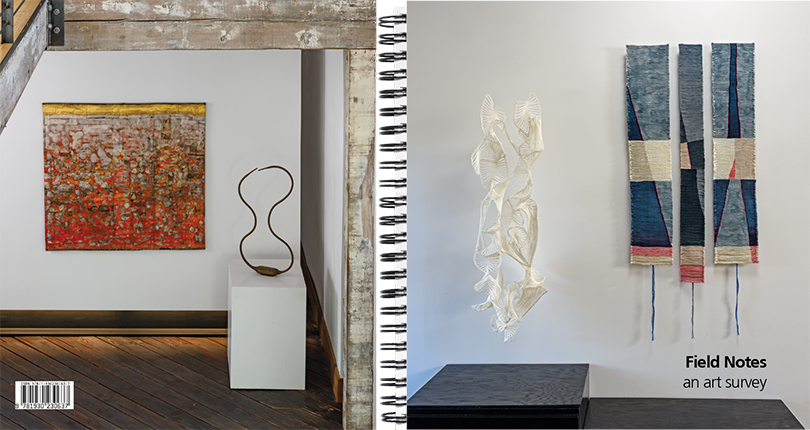
Field Notes: an art survey exhibition catalog
Field Notes: an art survey, the exhibition catalog

• Field Notes: an art survey, the catalog, is published (our 60th)

June 2025:

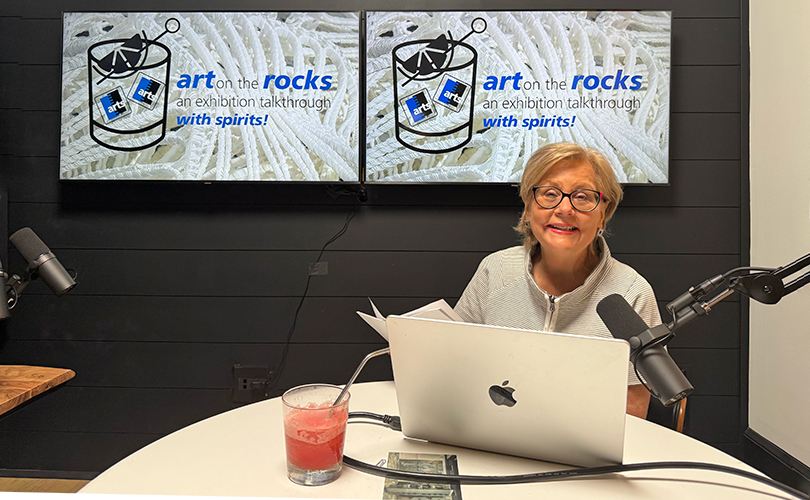
Rhonda hosts art on the rocks at studio 67 podcast studio
Rhonda hosts art on the rocks at studio 67 podcast studio. Photo by Tom Grotta

• Art on Rocks: an art walkthrough with spirits, Field Notes edition — is presented on Zoom

• Fiberworks then and now: Ruth Asawa and Kay Sekimachi and their remarkable innovations. a panel discussion with Melissa Leventon, Jill D’Alessandro, Yoshiko Wada, and Tom Grotta — was presented on Zoom

September 2025: 

Kay Sekimachi: a personal archive, a collaboration between browngrotta arts and the Andrew Kreps Gallery in New York City
Kay Sekimachi: a personal archive, a collaboration between browngrotta arts and the Andrew Kreps Gallery in New York City. Photo by Tom Grotta

• Kay Sekimachi: a personal archive, a collaboration between browngrotta arts and the Andrew Kreps Gallery in New York City opened — Sekimachi’s first solo exhibition in NYC since 1970

Yong Joo Kim in front of her work, Weight of Commitment: 4 Years Old
Yong Joo Kim in front of her work, Weight of Commitment: 4 Years Old. Photo by Tom Grotta

• Out-of-the-area Artist Visit: Yong Joo Kim, who splits her time between Chicago and Korea, visited the gallery in CT

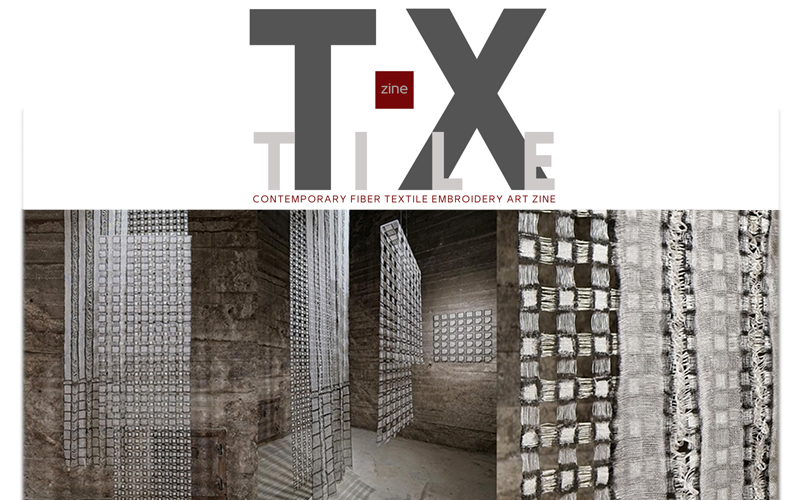
Weaves of Meaning: the Art of Anneke Klein Between Minimalism and Social Awareness, T-X txtilezine

• T-X, txtilezine  published,”Weaves of Meaning: the Art of Anneke Klein Between Minimalism and Social Awareness,” by Barbara Pavel

The Gently Monumental,” by Anneke Enquist about Helena Hernmarck in Form magazine

•  FORM magazine published “The Gently Monumental,” by Anneke Enquist, an article about artist Helena Hernmarck

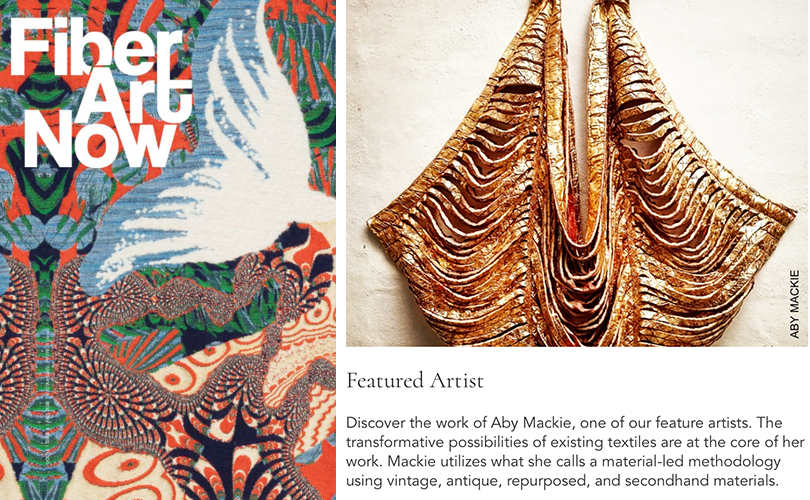
It All Starts With Materials: the Art of Aby Mackie
Fiber Art Now magazine Fall 2025 issue, It All Starts With Materials: the Art of Aby Mackie

October 2025: 

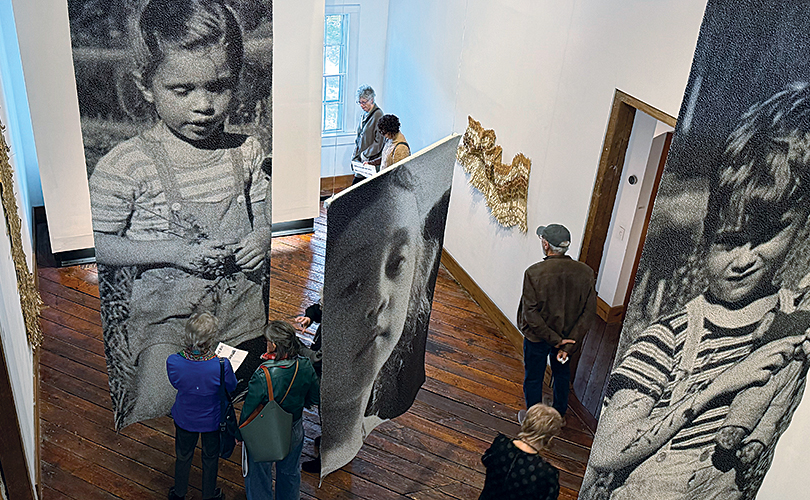
•  Beauty is Resistance: art as antidote, browngrotta arts’ Fall Art in the Barn exhibition, opened

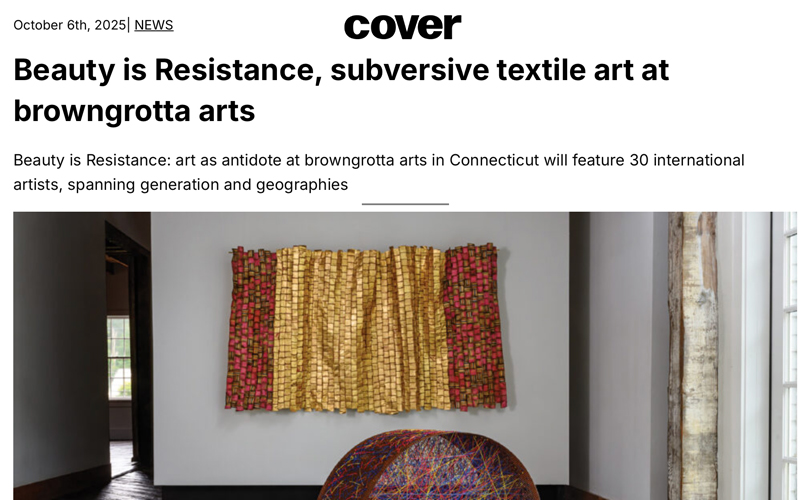
Beauty is Resistance, subversive textile art at browngrotta arts
Beauty is Resistance, subversive textile art at browngrotta arts. Photo by Tom Grotta

• Cover magazine published Beauty is Resistance, subversive textile art at browngrotta arts

Cover Magazine covers browngrotta arts Beauty is Resistance: art as antidote exhibition

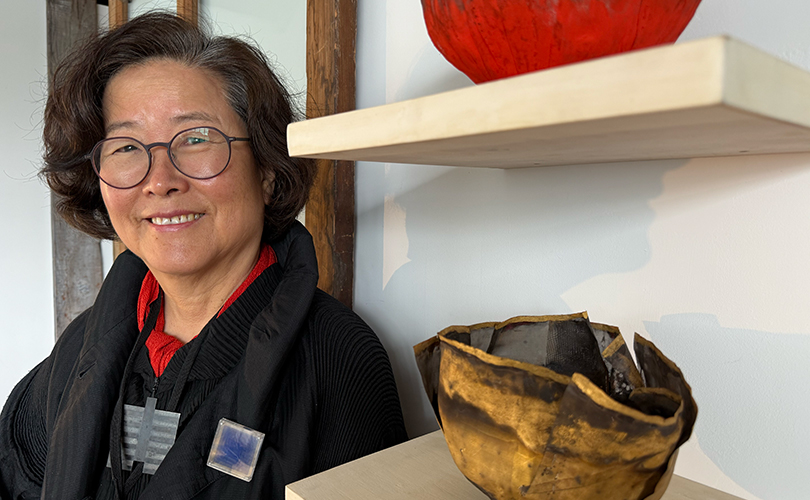
• Out-of-the-area Artist Visit: Jin-Sook So joined us at browngrotta arts for the opening of Beauty is Resistance and the artists dinner after.

Jin-Sook So besides her Soul of a Bowl series of wire mesh baskets
Jin-Sook So besides her Soul of a Bowl series of wire mesh baskets. Photo by Tom Grotta

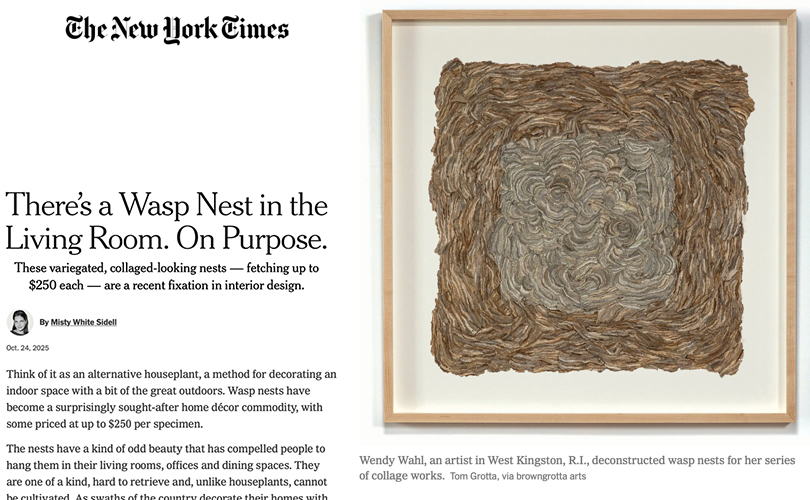
• The New York Times, publishes “There’s a Hornet’s Nest in the Living Room. On Purpose.” by Misty White Sidell, which featured Wendy Wahl and Kay Sekimachi• Beauty is Resistance: art as antidote, the catalog, is published (our 61st)

• Centurion magazine article, “A Stitch in Time,” by Jemima Sissons, is published, mentioning Kay Sekimachi, Mariette Rousseau-Vermette, Dominic DiMare, and John McQueen.

Centurion magazine article, “A Stitch in Time,” by Jemima Sisson’s

November 2025: 

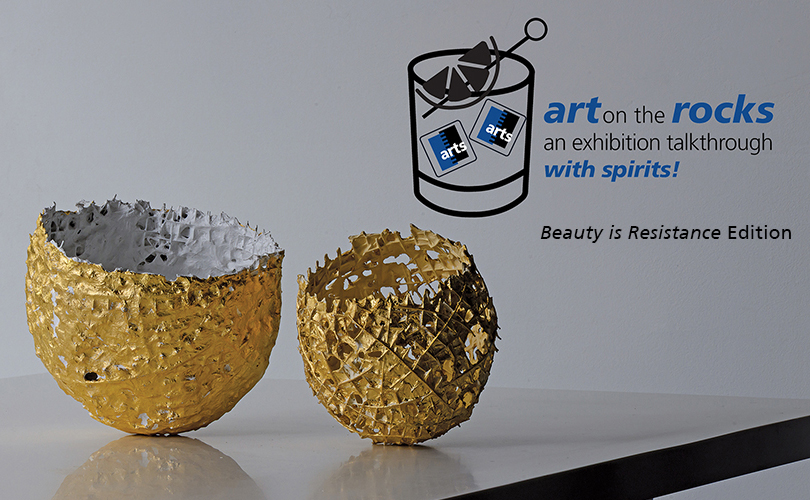
art on the rocks Beauty is Resistance edition
art on the rocks Beauty is Resistance edition, now on Zoom


• Art on Rocks: an art walkthrough with spirits, Beauty is Resistance edition — is presented on Zoom

December 2025:

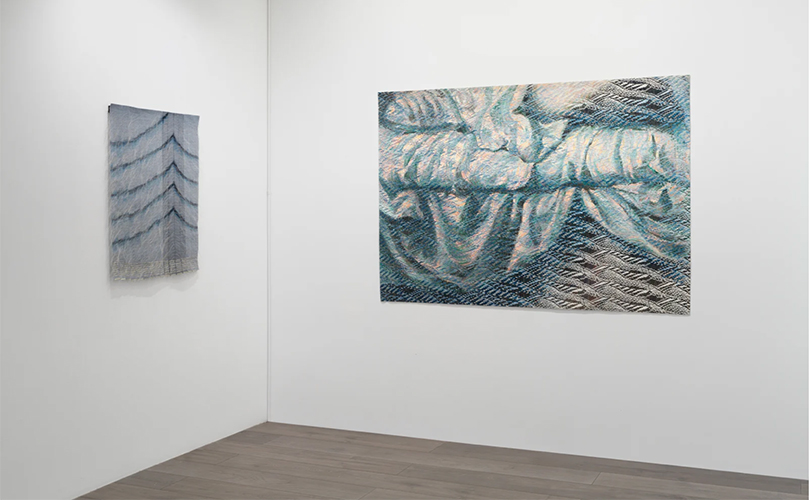
Adela Akers, Drape, 2017 and Lia Cook, Material Pleasures: Artemisia, 1993. photo courtesy of Hollis Taggart Gallery in New York City
Adela Akers, Drape, 2017 and Lia Cook, Material Pleasures: Artemisia, 1993. Photo courtesy of Hollis Taggart Gallery in New York City

• browngrotta arts loaned work by Adela Akers and Lia Cook to Drop, Cloth at Hollis Taggart Gallery in New York City. Curated by Glenn Adamson and Severin Deifs and spanning two Chelsea galleries, Drop, Cloth presented a 50-year lineage of draping in contemporary art.

Other News:
Acquisitions

Transition by Neha Puri Dhir, 2015. Photo by Tom Grotta

Transition by Neha Puri Dhir was acquired by the John and Mable Ringling Musuem in Sarasota, Florida

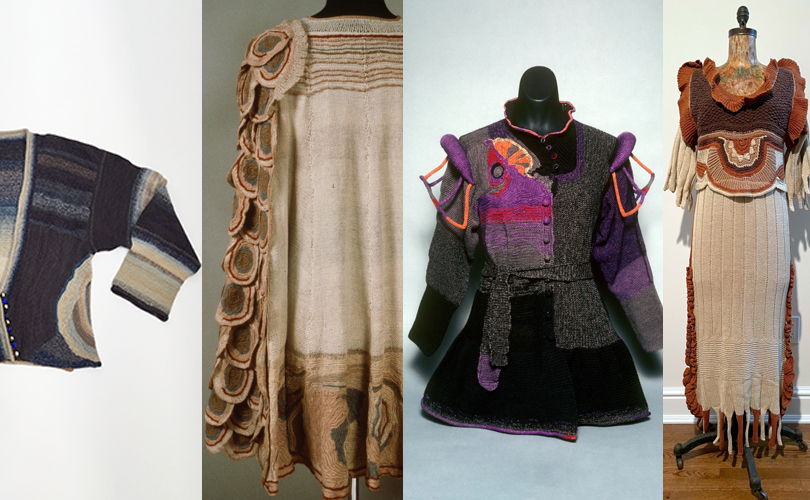
Four 1980s works of wearable art by Norma Minkowitz --  Outer Crater, Long Dress, Blue Jewel and Dusk — were acquired by the LACMA in Los Angeles, CA
Norma Minkowitz, Blue Jewel, Outer Crater, Dusk, Long Dress. 1980’s, photos courtesy of Norma Minkowitz

• Four 1980s works of wearable art by Norma Minkowitz —  Blue Jewel, Outer Crater, Long Dress, and Dusk — were acquired by the LACMA in Los Angeles, CA.

YouTube:
• browngrotta arts created 17 videos of artworks for its weekly artlive feature

• browngrotta arts created preview videos for Field Notes; Kay Sekimachi: a personal archive; and Beauty is Resistance

Social Media Outreach: 
• 31,911 emails from browngrotta arts were opened
• 41,822 people liked our Instagram content (a 14% increase over 2024)
• We gained 3,046 new followers to our Instagram account (a 90% jump over 2024)
• 24,819 people engaged with our Facebook posts (that’s a 96% increase over last year)
• We posted 52 times on arttextstyle.


Lives Well Lived: Dona Anderson

We were very sad to learn that Washington State artist Dona Anderson had passed away on December 19, 2025 at age 97. 

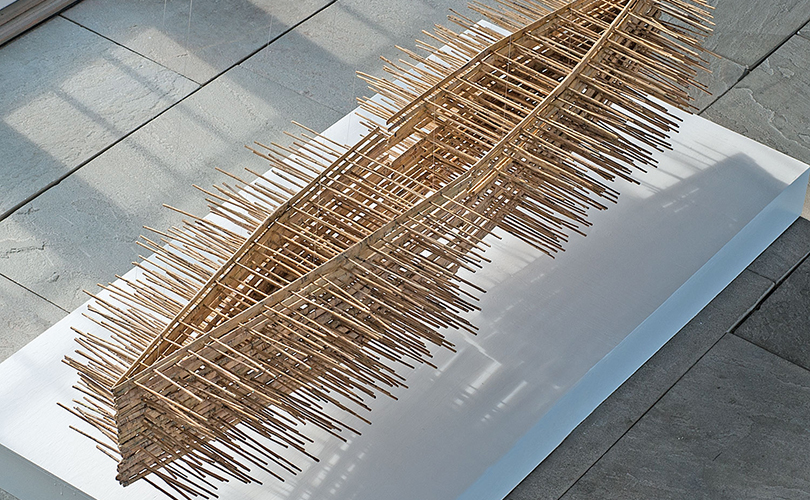
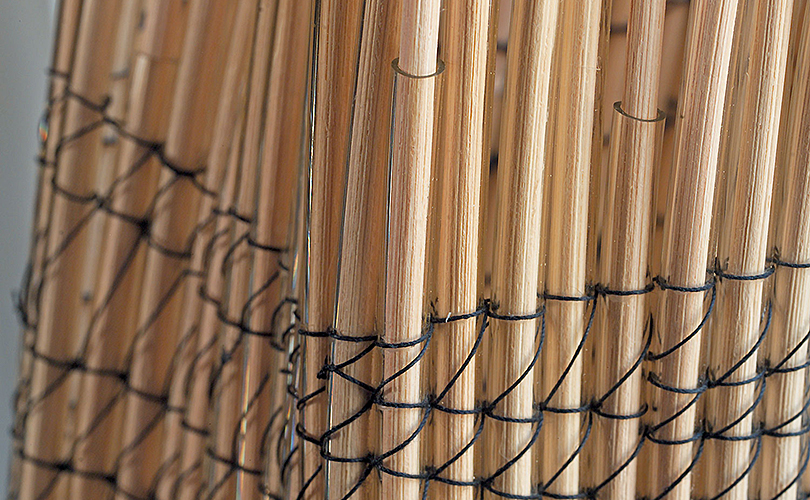
Large Bamboo stick kayak sculpture
19da Crossing Over, Dona Anderson, bamboo kendo (martial art sticks); patterned paper; thread, 15″ x 94″ x 30″ , 2008. Photo by Tom Grotta

Anderson began studying and exhibiting art in the late 1960s. She studied with Everett Community College instructor Russell Day, who mentored such noted Northwest artists as Chuck Close and Dale Chihuly. Her reputation grew steadily beyond Washington. By the 2000s she had exhibited throughout the US and in Cheongju, Korea at the International Craft Biennial. Her large boat basket form, Crossing Over, traveled to Pennsylvania, New Jersey, and Michigan as part of the browngrotta arts’ exhibition Green from the Get Go: International Contemporary Basketmakers, curated with Jane Milosch.

medical tubing sculpture
5da Oxygen, Dona Anderson, round reed, thread, medical tubing, 23″ x 13″ x 5″, 2004. Photo by Tom Grotta

Anderson was known for her her use of diverse materials, including recycled hockey sticks, surgical tubing, and dental molds. When she was selected as Snohomish County Artist of the Year in 2003, the Snohomish County Times reported that Anderson had shopped at the Boeing surplus store in Renton, Washington, buying the same material used on the skins of 747s and driving over the stuff to flatten it to create art material. She fashioned bras out of automobile parts and immersed girdles in pink artist cement. (“Late Bloomer is local Artist of the Year,’ Diane Wright, Times Snohomish County bureau, February 26, 2003.)  “I love the touch of the materials whether they are paper, reeds, cement or metal,” she said, “shaping them into an image that satisfies me.” Her ideas or inspiration came from the routine of life, everyday things that surrounded her — her house, friends, architecture, even television.

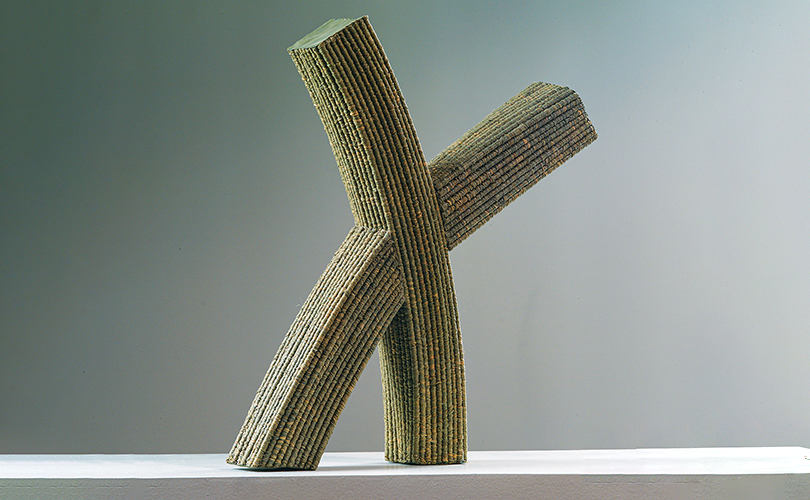
Letter X sculpture
1da X, Dona Anderson, round reed, thread, 18.5″ x 15″ x 2.75″, 2003. Photo by Tom Grotta

“In the mid-1980s when I was working with fiber,” Anderson told The Seattle Times in 2009, “I took a class in basketry at Wallingford’s Factory of Visual Arts. There we used raffia and did traditional coiling. As time went by, my work become more and more complicated.” She preferred to call her works “structures” rather than baskets.

Dress pattern paper basket
17da Undulating Surface #7, Dona Anderson, wire armature, pattern paper and polymer, 16″ x 17.5″ x 15″, 2010. Photo by Tom Grotta

A significant body of Anderson’s work involved the use of sewing patterns. “In 1988, I began using round reeds, and sewing them together to create architectural and more experimental forms,” she told The Seattle Times. “I started covering the reeds with pattern paper,…The black lines on the paper created interesting surface designs after I sewed the reeds into the desired shapes.”

tire chain basket sculpture
20da Re-Tire, Dona Anderson, tire chain, netting and window screen, 8.5″ x 16.25″ x 14.5″, 2011. Photo by Tom Grotta

For browngrotta arts’ 2011 exhibition, Stimulus: art and its inception, she turned a tire chain into a basket. ‘Walking through my neighborhood everyday,” she told us. ‘I took care to find that special something that appealed to my imagination. When I saw a rusty piece of metal wire tweaking out from a pile of dirt, my heart soared with possibilities. No one even knew what it had been until I cleaned it—a tire chain I turned into a basket.”

Anderson and her husband, Bob, were also significant promoters of the arts in their area, seeding an endowment for the visual arts among other supports. As an artist and advocate, she will be missed.


Art Assembled – New this Week in December

New this Week artworks are introduced by browngrotta arts every Monday. December 2025 featured five Mondays so our recap this month features one more artwork than usual. In this version of Art Assembled, you’ll see work by Toshio Sekiji, Gyöngy Laky, Aby Mackie, Asela Akers, and Neha Puri Dhir.

Toshio Sekiji Israeli Newspaper
24ts Neighbors, Toshio Sekiji, Israeli newspapers and lacquer, 37.125″ x 41″ x 3″, 1998. Photos by Tom Grotta

Toshio Sekiji’s Neighbors is an illustration of the woven collages for which he is known. In this case, he has plaited lacquered strips from various Israeli newspapers in order to make a plea for intergroup harmony. In other works, to make his point, Sekiji has mixed newspapers from Japanese and Korean newspapers, and used The New York Times, dust jackets from controversial books, and Indian and other Asian newspapers.

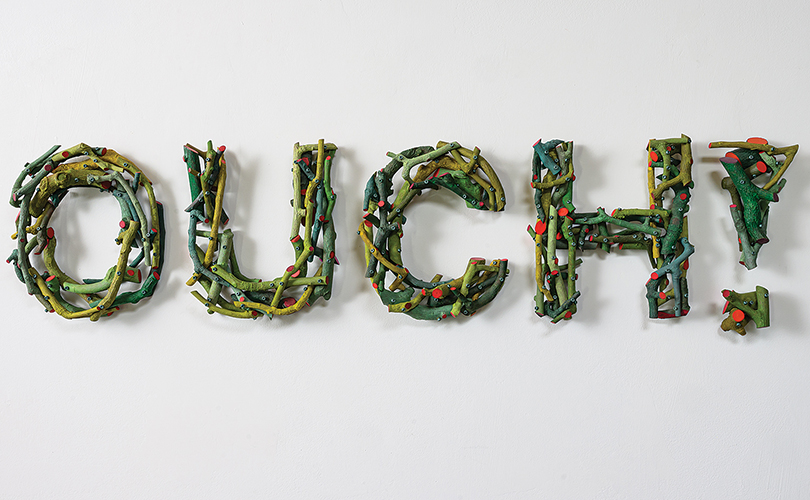
Gyöngy Laky Ouch wall sculpture
136L Lie Ability (OUCH), Gyöngy Laky, apple prunings, acrylic paint, screws, 9.5” x 42” x 2.5”, 2019. Photos by Tom Grotta

Gyöngy Laky has spent a lifetime bringing light to issues of the environment—joining branches and tree prunings — often from agricultural sites — with industrial materials. Laky’s work takes many forms, from baskets and vessels to text-based sculpture like Lie Ability (OUCH) which spell out her feelings on the current political climate in literal terms. Laky had heard many of the lies in the 2016 presidential campaign and feared the man now in charge. The title is a double entendre – a small hint to her thinking beyond the work itself. The word “OUCH” offers to viewers the opportunity to read into the work what is in their minds and hearts once Laky has attracted their attention — an example of the power of art to evade censorship.

Aby Mackie gold textiles
11am Fragments of a Life Lived 3, Aby Mackie, repurposed textile, gold leaf, shellac, 44″ X 72″ X 4″, 2025. Photos by Tom Grotta

Artist Aby Mackie’s textile-based artwork engages with themes of ecology, history, and resistance through a process of reclamation and transformation. Working with discarded historic textiles, she deconstructs and reconfigures, disrupting their original function to create new meaning. In Fragments of a Life Lived 3 she uses antique-ticking fabric as both material and metaphor. Once utilitarian, worn by time and use, it is reconstructed through stitching and further manipulated with paint and gold leaf. These interventions reimagine its surface—echoing stories of erosion, endurance, and renewal. The addition of gilding speaks to the overlooked value in what is often discarded, while the act of mending becomes a gesture of care and reclamation. The viewer is invited to read between the layers— to sense the life once lived through it, and to reflect on what we choose to preserve or let go. 

Adela Akers tapestry
68aa Interrupted II, Adela Akers, linen, horsehair, metal & paint, 44″ x 58″, 2007. Photos by Tom Grotta

A diverse and geographically disparate range of influences grounded Adela Akers work. Akers was born in Spain, educated at the University of Havana in Cuba and inspired by her extensive travels. A trip to the Democratic Republic of the Congo, where she observed the painting process of the Mbuti women of the Ituri Forest, led to the marks in Akers’s work, Interrupted II. “I’ve always been interested in looking at patterns of other cultures and other people,” she told a San Francisco television interviewer. When she transferred her drawing of Mbuti women’s marks to a larger scale she separated the lines and they no longer lined up. “It’s fine with me if they don’t,” she said. “But by spreading it out, then I have, of course, room for this other color to be in, again to add more dimension, so that the horsehairs (use of which is on of her trademarks) float over a lot more.”

Neha Puri Dhir textile
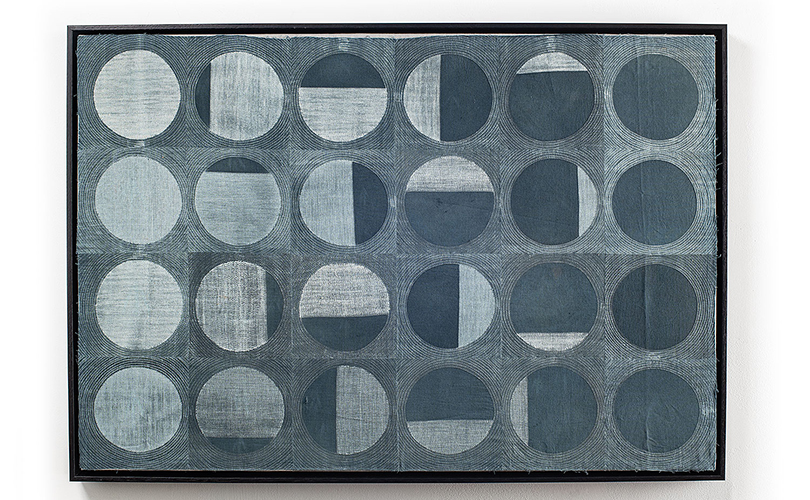
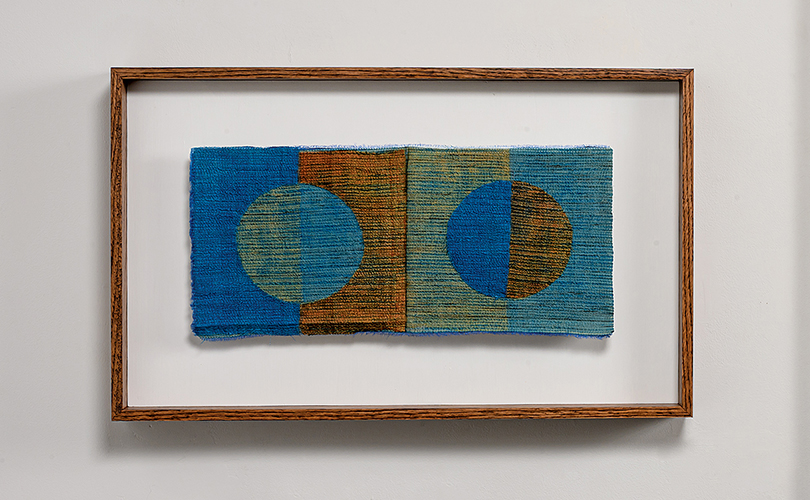
10npd Dualities, Neha Puri Dhir, stitch-resist dyeing on handwoven silk, 15″ x 25″ x 2.5″, 2024. Photos by Tom Grotta

Like Toshio Sekiji’s works, Dualities by Neha Puri Dhir invites contemplation on coexistence and transformation. The work, involving stitch-resist dyeing on handwoven silk, reminds viewers of the quiet harmony that emerges when opposites are held together in a single frame – a thoughtful message for these contentious times. The two circular motifs, one in negative and another in positive space, reflect ideas of balance and contrast. The earthy browns merge into deep indigo blues, evoking cycles of day and night, fullness and emptiness, presence and absence. 

Watch for more work in 2026!