At browngrotta arts we promote artists from more than two dozen countries and 15 of the United States. California artists are our largest US artist group with 10 artists, but New York is a close second — including artists who lived and worked in New York like Ethel Stein, Blair Tate, Nancy Koenigsberg, Lenore Tawney, and John McQueen, artists originally from New York, like Karyl Sisson, and those, like Jin-Sook So, Grethe Sørensen, and Toshio Sekiji who were mightily impressed by time spent there.
Here, we share works from this talented and diverse group of artists, works that reflect the ways in which this dynamic place influenced their art.
Jin-Sook So, 49-50jss New York Skyline I + II,, steel mesh, electroplated silver, patinated, gold leaf, thread, 33″ x 39.5″ 2.25″, 2006. Photo by Tom Grotta
Visiting New York from abroad can be eye opening. Jin-Sook So who lives in Sweden and Korea, came to New York on an O visa, for individuals of extraordinary ability and achievement. She expressed New York’s impact in the luminous New York Skyline series. The works are made of steel mesh that has been electroplated in silver, patinated wirh gold leaf and hand stitched with steel thread.
Toshio Sekiji, 15ts NY Street Map Collage, lacquered New York street maps, 29″ x 40″, 1997 and 19ts NYT Collage, lacquered NYT, 31″ x 41″, 1997. Photos by Tom Grotta
Japanese artist Toshio Sekiji was known for creating collages of newspaper torn in strips and lacquered. A visit to New York led him to create NYT Collage made from strips of The New York Times and also inspired him to transform maps of New York streets into a wall work, new York Street Map Collage.
Grethe Sørensen, 18gs Movement, cotton, 89.5″ x 64″ x 1.875″, 2016, tapestry from the arist’s video of a protesting the death of Eric Garner in NYC. Photo by Tom Grotta
Grethe Sørensen of Denmark was on Broadway in New York City while on a visit when she saw people protesting about police brutality toward a black man, Eric Garner, who died while being arrested. A photo of the scene became the tapestry Movement. Sørensen described the process, “A camera’s light-sensitive lens, held open for several seconds, recorded the protest march on the street – a stream of people with banners, placards, and signs. Their motion creates stripes which almost resemble light brushstrokes. Trash bins, newspaper vending boxes, a couple of onlookers, and a photographer stand still in the picture – a little unclear and diffuse. Meanwhile, the road’s arrows, words, and lanes appear as sharp white markings on the black asphalt. The weaving expresses motion in diverse ways: a mental, emotional, political, as well as physical movement.”
Lenore Tawney,3t Shrouded River, linen, wood, 154″ x 22″, ca. 1966-67. Photo by Tom Grotta
Adopted sons and daughters of New York are not untouched. Moving to New York from Chicago, Lenore Tawney was immediately taken by the East River, which she could see from the window of her loft in Coenties Slip in Manhattan. According to the Lenore Tawney Foundation, [The river] “became a motif in the ambitious woven forms that flowed out of her loom and puddled on the floor, where she would finish them by hand with sailor’s knots. She ordered ‘a great deal of black and white linen thread’ and described this as a thrilling time when her work ‘poured out like a fountain or a river…. The river was right out my window, and I looked at it every day.’ Even a sketch in her journal, of the Staten Island Ferry’s wake, looking back to the Manhattan skyline, evokes the delicate threads of her weaving.”
John McQueen, 47jm Site Reading (framed work of previous homes), willow, waxed string, recycled plastic, 58.75″ x 51″ x 4″, 2018. Photo by Tom Grotta
John McQueen had lived in Florida, New Mexico, and Philadelphia before moving to western New York state which he described as “far from the hubbub.” New York willow that he harvested from his yard was his material of choice. And NewYork homes he lived in — including one he built and another that began as a converted auto-repair garage — appear in Site Reading, a wall work he made of willow, waxed string, and recycled plastic.
Ethel Stein, No to Indian Point, cotton damask, 27.75” x 29.5”, 1997. Photo by Tom Grotta
New York Natives were not immune to its charms.The late Ethel Stein was born and educated in art at a progressive school outside of New York. In No to Indian Point, Stein wove an emphatic statement against the continuing operation of Indian Point, a nuclear energy facility in Buchanan, New York, not far from Stein’s home. No to Indian Point is exceptional among Stein’s weavings in its forthright political stance.
Nancy Koenigsberg arrived in New York more than 50 years ago. In the late 70s, she and five other artists formed the Textile Study Group of New York, which now has members worldwide. The works she makes of wire in black and various colors are inspired by varied topics — weather and climate change, geometry, emotions. New York is among those topics, in works like Barbican Towers and Broadway Trio.
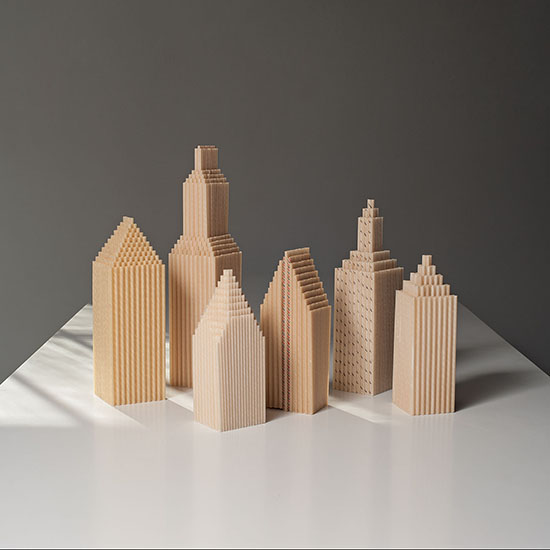
88ks Straw Skyline, Karyl Sisson, vintage paper drinking straws and polymer, 14.375″ x 32.5″ x 3″ (linear layout), 2013. Photo by Tom Grotta
88KS For even those who left New York like Karyl Sisson, born in Brooklyn but a resident of California since the 1970s, New York leaves traces. Straw Skyline, made in 2011 of vintage paper straws and polymer looks remarkably familiar to those of us on the East Coast. A testament to the power of the New York state of mind.
Karyl Sisson, Straw Skyline vintage paper drinking straws and polymer, 14.375” x 32.5” x 3”; 2013, Tom Grotta
For three days this March, browngrotta arts will present inventive works made of handmade, recycled and commercial paper by artists from North America, Europe and Asia at art on paper, Pier 36, 299 South Street, in New York City. Many artists cut, fold or print on paper. The international contemporary artists whose work browngrotta arts will exhibit at art on paper take a more immersive approach to the medium, treating it as material – stacking, molding, carving and weaving it, as others would wood, linen, clay or marble.
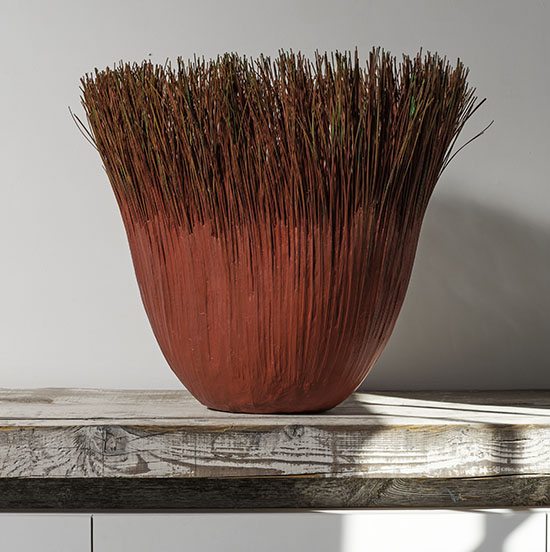
Llano (Deep orange ) 23″H x 25 x 15 Reed and paper, 2012, photo by Tom Grotta
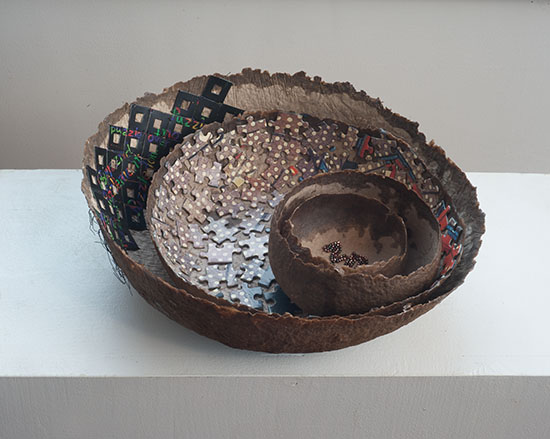
Toshio Seikiji of Japan and Chris Drury of the UK, for example, use paper like fabric — weaving, stitching and etching on newspapers, maps and other paper to create arresting assemblages. Others of the artists featured by browngrotta arts recycle to create their works, including Kazue Honma who creates object of Japanese telephone books, Dona Anderson who creates vessels of dress pattern paper and Korean artist, Jin-Sook So who creates collages using old Korean texts. Karyl Sisson’s striking New York skyline is composed of re-purposed paper straws. Hisako Sekijima of Japan and Sylvia Seventy from the US, mold paper pulp – in Seventy’s case, to create paper bowls populated with found and other objects. Scandinavians, Jane Balsgaard of Denmark and Merja Winquist of Finland, create three-dimensional sculptures. In Balsgaard’s case, she makes the paper she uses from materials gathered near her summer home in Sweden. American Mary Merkel-Hess uses gampi paper, papier-maiche and reed to create sculptural baskets forms and bas relief wall works.
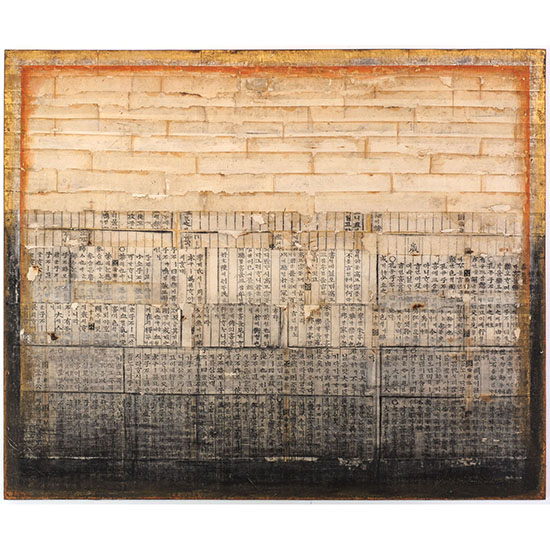
Old Paperwork Untitled, Jin-Sook So Korean schoolbook pages burnt, handmade wooden platter, gold leaf, silver leaf, painted acrylic color, 35.5” x 43.25” x .75”, 2014, Photo by tom grotta
Working alongside its Beneficiary Partner, The Brooklyn Museum, and its Presenting Partner, The Wall Street Journal, art on paper will focus on “the notion of what a work on paper can be”, says its director, Max Fishko. The fair, art on paper, is at Pier 36, 299 South Street, New York, New York. There is a preview on Thursday, March 5th from 5:30 p.m. to 8 p.m. and a VIP party that night from 8 to 10:30 p.m. Friday, Saturday and Sunday the Fair opens at 11; Friday and Saturday it closes at 7 p.m.; Sunday at 6 p.m. For more information and to purchase tickets to the preview and party, visit: http://thepaperfair.com/about/art-on-paper/. For more information on browngrotta arts’ exhibition, call Tom Grotta at browngrotta arts: 203-834-0623 or visit browngrotta.com: http://browngrotta.com/Pages/calendar.php.
18ss PUZZLES, Syllvia Seventy molded recycled paper, wax, jigsaw puzzle pieces, waxed shaped paper pieces, wire, beads, thread, 3.25″ x 11″ x 9.75″, 2011, photo by tom grotta