Tag: Norie Hatakeyama

Process Notes: Norie Hatakeyama on Basketry Beyond the Expected

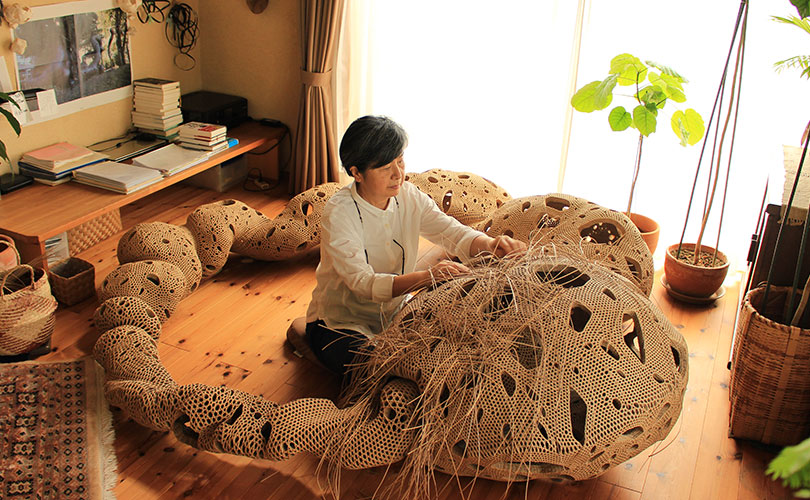
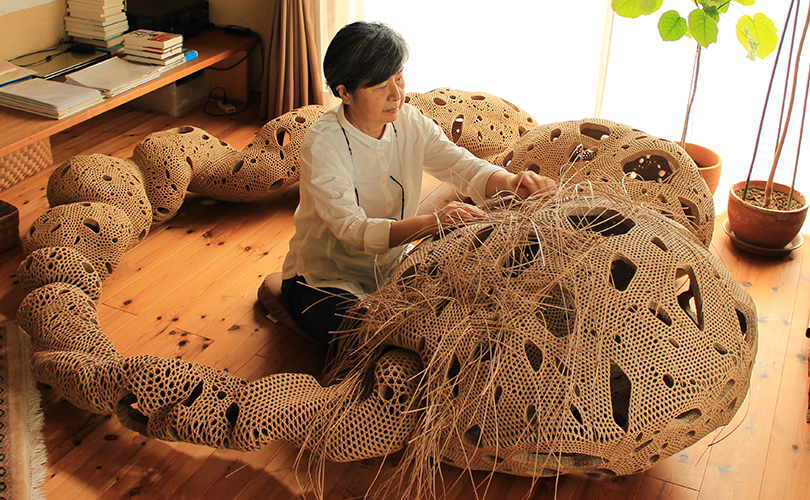
Norie Hatakeyama working on a large piece
Norie Hatakeyama at work. Photo by Ray Tanaka

In 1980, Norie Hatakeyama began studying basketmaking with Hisako Sekijima in Japan. Sekijima, who had studied basketry with Sandra Newman, John McQueen, and Ken and Kathleen Dalton in the US, was known for the innovative and nontraditional direction of her work. Hatakeyama felt “surprise and bewilderment, even joy,” when she encountered Sekijima’s methods. What most attracted her was Sekijima’s way of thinking was “that you must adopt an openminded approach to the basket.”

After a 40 prolific and successful years of art making, we’ve compiled Norie Hatakeyama’s thoughts on her basketry for this edition of Process Notes.
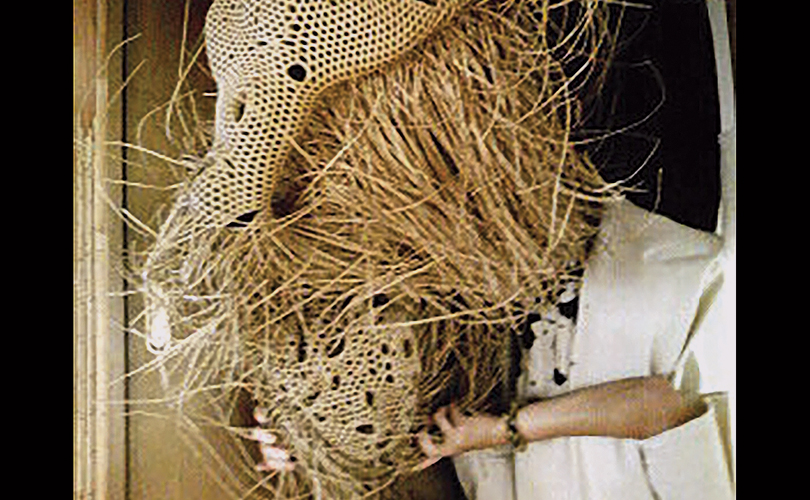
Norie Hatakeyama work in process. Photo by Ray Tanaka

My work involves creating three-dimensional forms using basketry techniques—taking materials in my hands and weaving them together. 

Basketry has a long history and has been practiced around the world using materials available in each region. The techniques themselves have changed very little over time. Because the entire process can be seen visually from beginning to end, it is easy to understand, and in principle anyone can make a basket. However, if one simply accepts and applies the technique without question, the result tends to be the same form regardless of who makes it, leaving seemingly little room for creation.
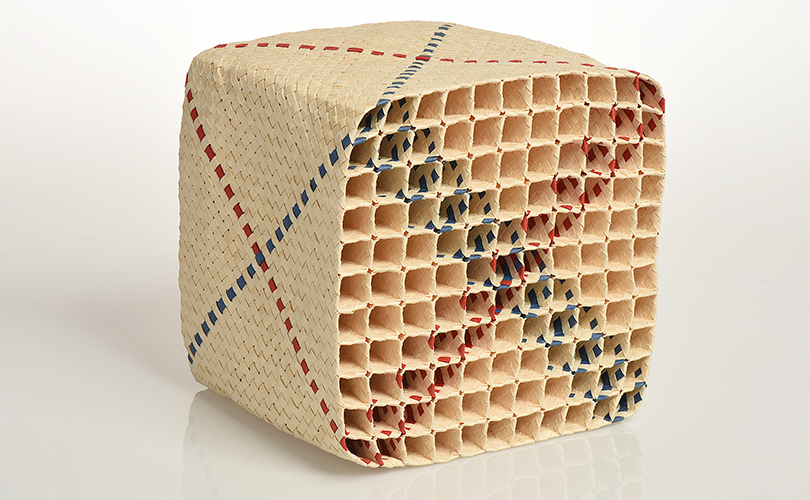
Norie Hatakeyama, Plaited Cube/242, Endless Line Series, Pits & Diagonal Lines
Norie Hatakeyama, Plaited Cube/242, Endless Line Series, Pits & Diagonal Lines, plaited Japanese rice paper, 7″ x 7″ x 6″; 1998, photo by Tom Grotta

Imitating technique is one form of learning and is highly effective for improving skill, but it offers limited potential for creating new forms. As an artist, in order to develop my own approach to form-making, I try not to be bound by fixed ideas. I question existing techniques themselves and re-examine them. While maintaining a calm and attentive eye toward what is happening in the process, I consider ways to resolve the questions that arise from within it. Through this reflection, I continue weaving.
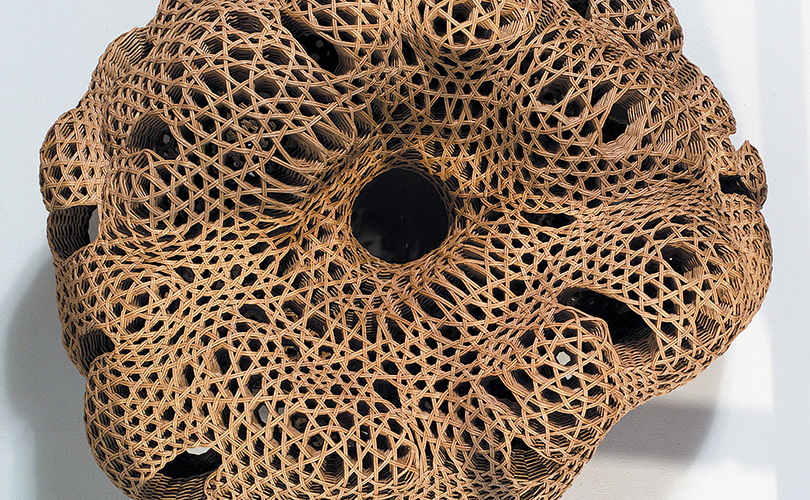
Detail Norie Hatakeyam Complex Plaiting basket
Norie Hatakeyama, Complex-Plaiting-Series, paper fiber strips, plaited, 9.5″ x 18″ x 16″, 2001, photo by Tom Grotta

Eventually, as if a dam has burst, the forms begin to change, and shapes beyond my expectations emerge. These are not forms I intentionally designed; rather, they are forms generated by the material and the method. When the material changes, the form changes, too. The forms appear—they come toward me. I feel less that I ‘made’ them, and more that I was ‘made to make’ them. In this process, the artist’s own consciousness is altered, and self-transformation occurs.
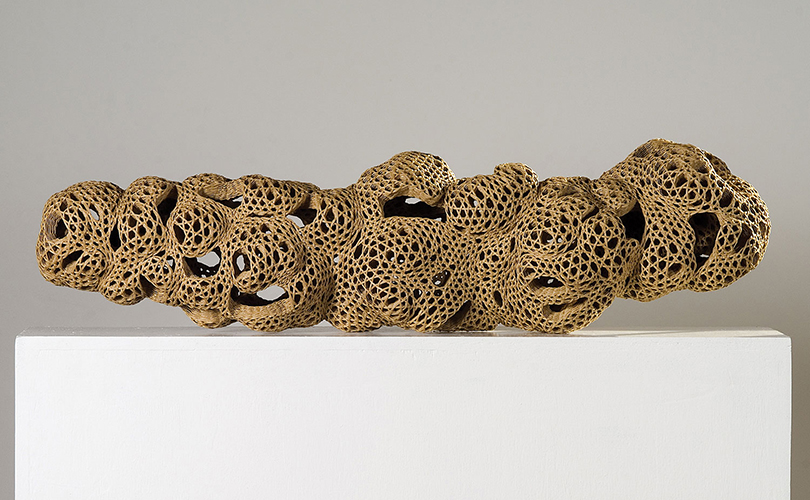
Norie Hatakeyam Complex Plaiting basket
Norie Hatakeyama, Two Holes A 104, plaited paper fiber strips, 11″ x 41″, 9″, 2001. Photo by Tom Grotta

I came to realize that the forms and formative processes of many of my works—though not created as intentional imitation—closely resemble living beings found in nature (and their generative principles). That was a moment when the activity of life and my work of making forms resonated with each other.

The accumulation of small acts of ‘re-examining methods’ has brought many realizations. That became the catalyst for the emergence of my own new approach to form-making. How rich with surprise and joy the repetition of simple actions can be. My days of creation are filled with treasures of questions and wonder. All of these rest within my hands as I continue weaving, again and again.
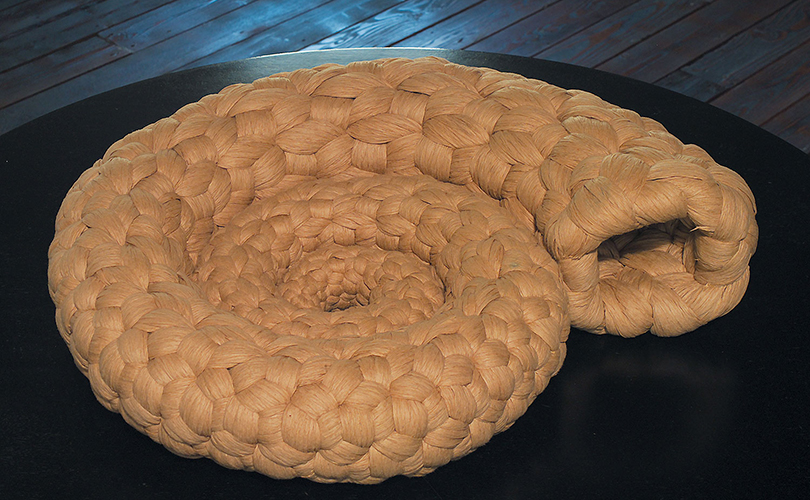
Norie Hatakeyama, Complex Hexagonal Plaiting Spiral,
Norie Hatakeyama, Complex Hexagonal Plaiting Spiral, paper, string, plaited, 7″ x 26″ x 22″, 1994. Photo by Tom Grotta

From a mathematical point of view, my baskets turn out to polyhedra shapes abstracted in pure geometry. However, that doesn’t mean I created the form using geometrical structure. It means the form has appeared as redefined. Geometry might be incorporated into the method, but it would seem that the forms come out from another world.

In basketry, the expanse is infinite. Making baskets is not just denying the chaotic world and one’s own inconsistency; it reaffirms those things. There is no point in asking whether my work is mathematics, art, or science, because I would say that the basketry formula is the very formula itself for nature.

Norie Hatakeyama
1999 and 2026
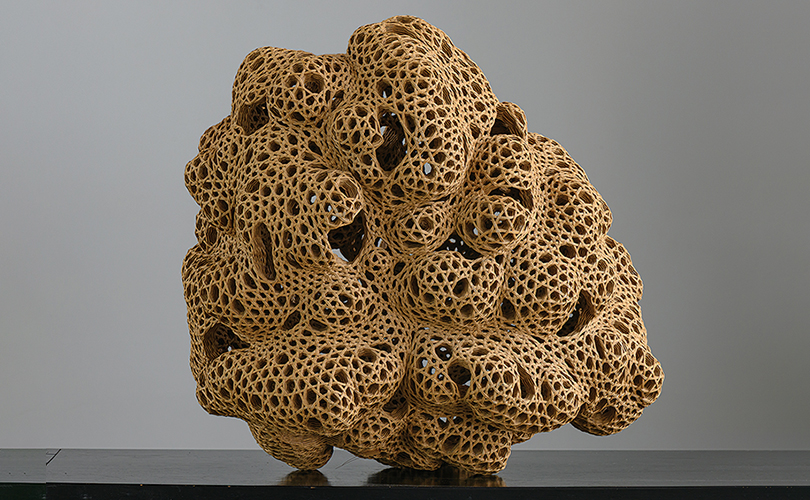
Norie Hatakeyam Complex Plaiting basket
Norie Hatakeyama, Complex Plaiting Series – Connection I-9609, paper fiber strips, 21″ x 22″ x 19″, 1996. Photo by Tom Grotta

Norie Hatakeyama’s work Complex Plaiting Series – Connection I-9609 will be included in browngrotta arts’ up coming exhibition, Transformations: dialogues in art and materials (May 9-17, 2026).

Art Assembled: New This Week in December

As this year comes to a close, we’re finishing our New This Week series with some of our favorite artists! Throughout the month of December we’ve highlighted art from notable artists like: Norie Hatakeyama, Mia Olsson, Grethe Sørensen, and Åse Ljones. Here’s a recap of all the art we’re closing out 2021 with.

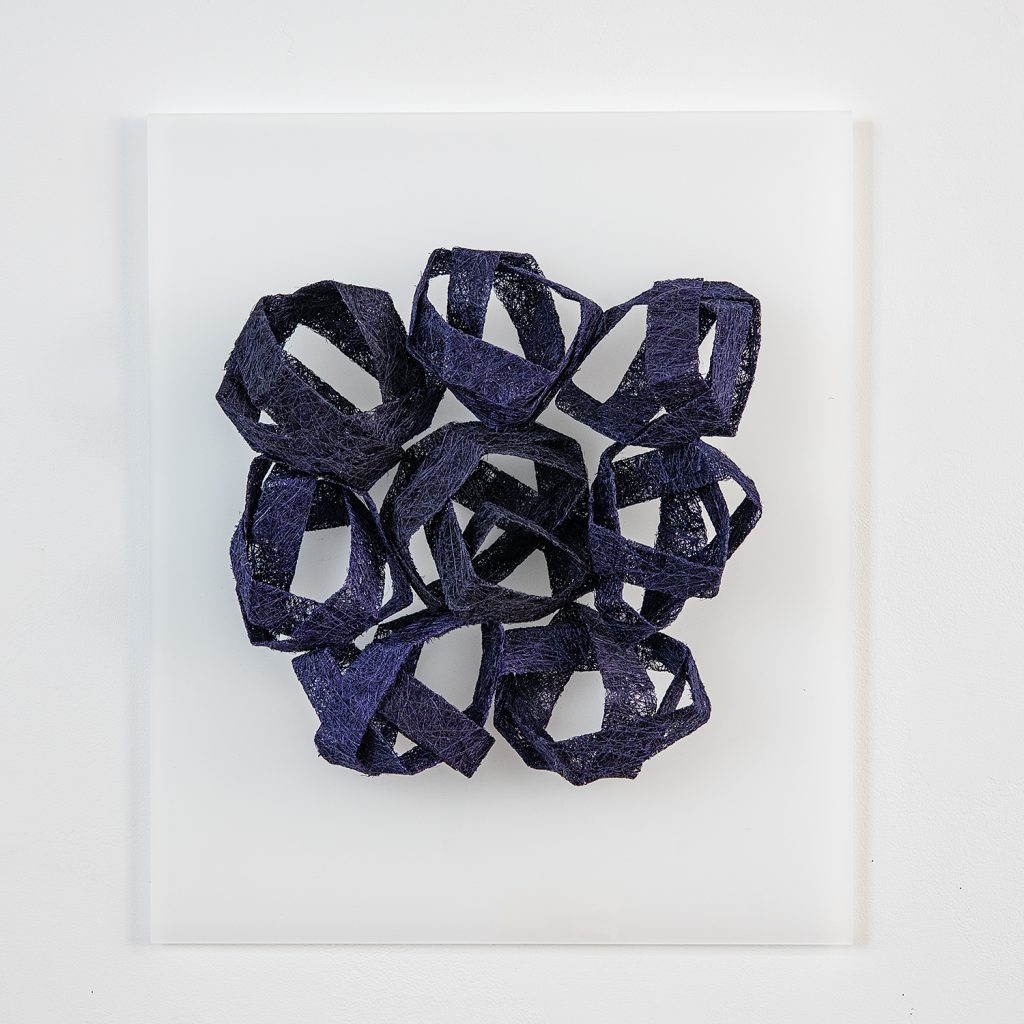
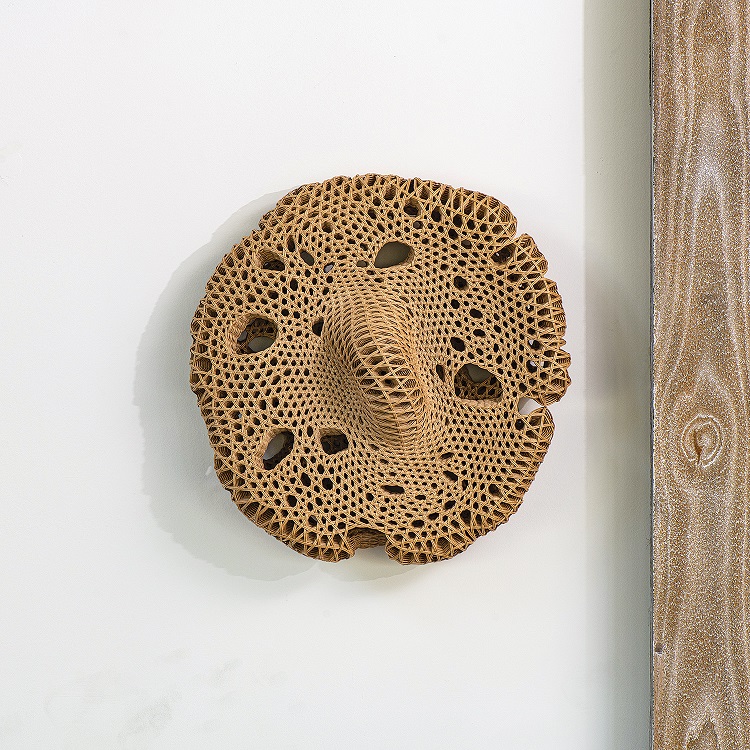
This piece comes from Japanese artist, Norie Hatakeyama. Hatakeyama is predominantly known for her contemporary and complex plaited works of paper tape. The works resemble living organisms — and, on close inspection, have no apparent starting or endpoints.

This piece comes from Swedish artist, Mia Olsson. Together is made of sisal fibers, dyed and formed in a technique unique to Olsson. The sisal fibers used are shiny and reflect the light, even more when formed in relief. The colors are richly saturated — engaging the viewer on each viewing.

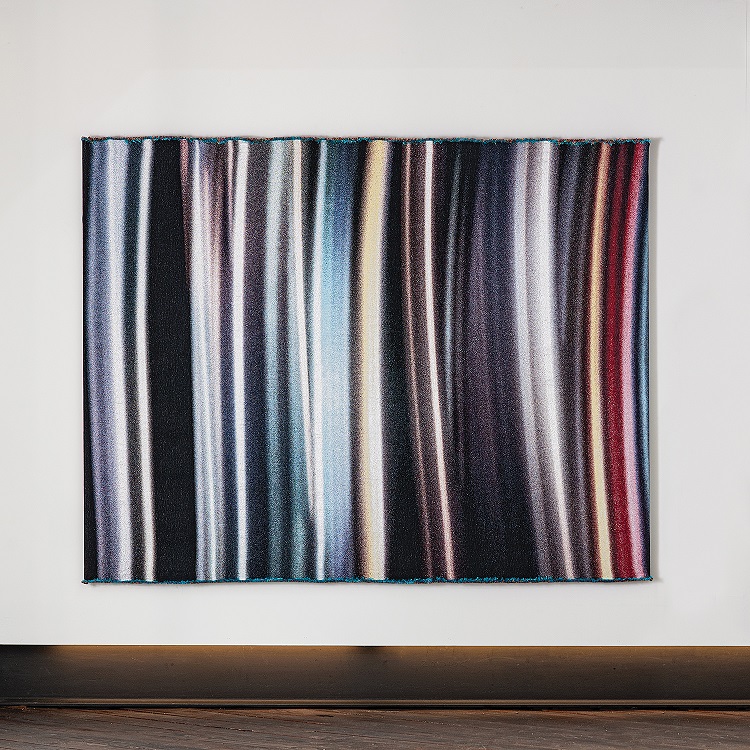
This piece comes from internationally acclaimed artist, Grethe Sørensen. Since 2004, she has been working exclusively with digital thread control/digital jacquard weaving. She is credited with revolutionizing the art of tapestry through her method of converting photographic pixels into threads. The technique allows her to create complex motifs; the city, urban landscapes, light and optical patterns are frequent inspirations for her.

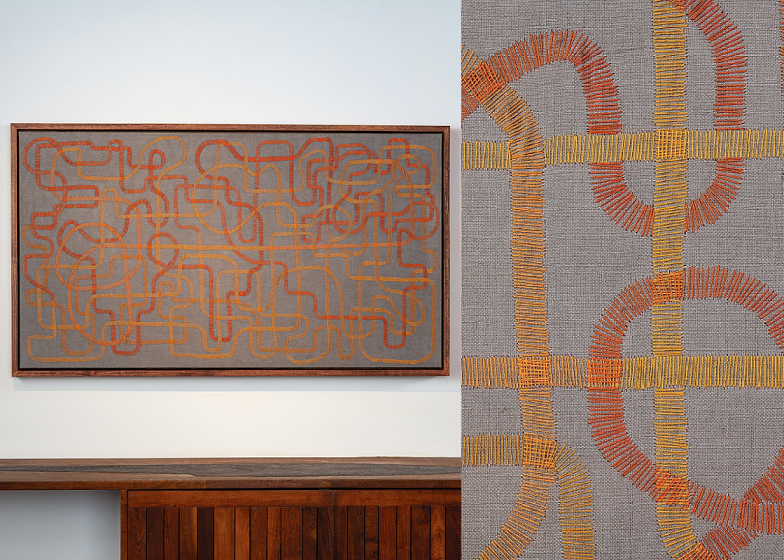
This artwork was created by talented Norwegian artist, Åse Ljones. Ljones uses a blizzard of stitches to create her works. Ljones told TextileArtist.org in an interview that, “To embroider by hand takes time. It is a slow process that gives room for silence. I seek silence. In silence, I retrieve memories and find new paths forward. In all my work as an artist I have eliminated the extraneous. I’ve cultivated simplicity to approach the core of myself, in myself, with fewer measures.” For Ljones, “the sewing needle is like the pencil is to the author,” with it, she can create pictures and tell stories.

Thank you to everyone who’s been a part of this past year at browngrotta arts. We’re going into 2022 excited for another year of art-filled fun!


We’ve been hard at work — come see the results. Japandí opens this week!

Our Japandí exhibition features 39 artists from Japan, Finland, Norway, Denmark and Sweden and over 150 individual works. Here are details about just a few of the artworks that the exhibition includes.

Ane Henrsen portrait
Ane Henriksen preparing the material for Reserve. Photo by Ole Gravesen

A striking wall work, Reserve, by Ane Henriksen of Denmark is featured in Japandí. Henriksen originally found the material covered with oil spots, washed up along the sea by the west coast of Denmark – fishermen use it, on the table in the galley, so the plates don’t slide of when they are on the high seas. The piece also incorporates webbed, rubber matting, colored with acrylic paint. The warp is silk glued together with viscose (from Japan). “Nature is threatened,” says Henriksen. “I hope this is expressed in my image, which at first glance can be seen as a peaceful, recognizable view of nature, but when you move closer and see the material, it might make you uneasy, and and spur thoughts of how human activity is a threat against nature. By framing the nature motif museum-like in a solid oak frame, I try to make you aware how we store small natural remains in reserves – in the same way we store exquisite objects from our past history in our museums.”

Birgit Birkkjaer portrait
Birgit Birkkjaer at work. Photo by Kræn Ole Birkkjær

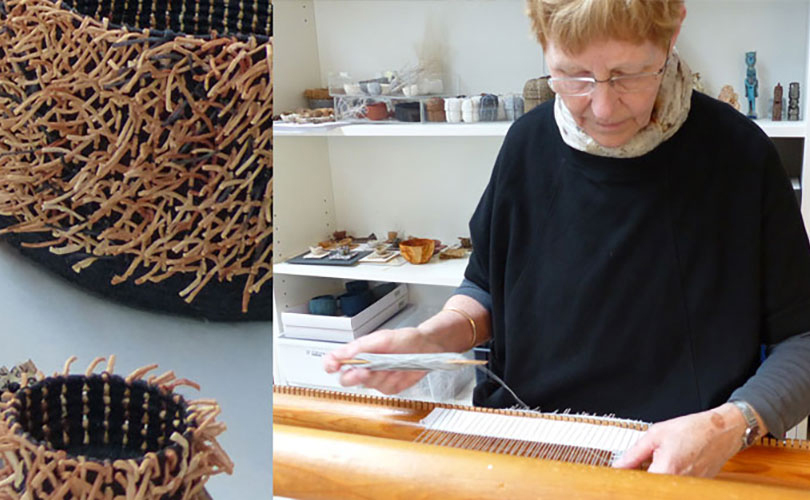
Also included in the exhibition are baskets by Danish artist Birgit Birkkjaer. They are made of black linen and Japanese tatami paper yarn (black and hand dyed with rust). “The technique I used for the structure is rya,” she reports, “which was known in Scandinavia already in the Viking Age — and from the 1950s until the 1970s as a trend started by Danish/Finnish artist collectives. So, the baskets have roots in both Japan and Scandinavia.”

Norie Hatakeyama portrait
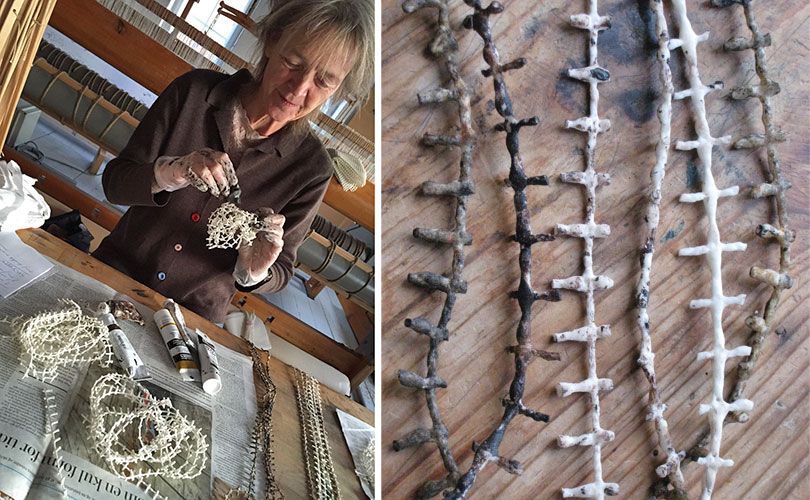
Norie Hatakeyama creating paper-plaited work. Photo by Ray Tanaka

Among the works on display from Japan are intricately plaited objects created by Norie Hatakeyama. The artist works with factory-made paper-packing tape to realize her geometric concerns. It is an experimental material that enables her to break free from traditional limitations.

“My work stems from an impulse to redefine both material and method,” says Hatakeyama. Her intricately plaited, three-dimensional works possess the energy of growing organisms. “The works ‘defy the viewer to imagine how they were accomplished,’”art critic and author Janet Koplos has observed.

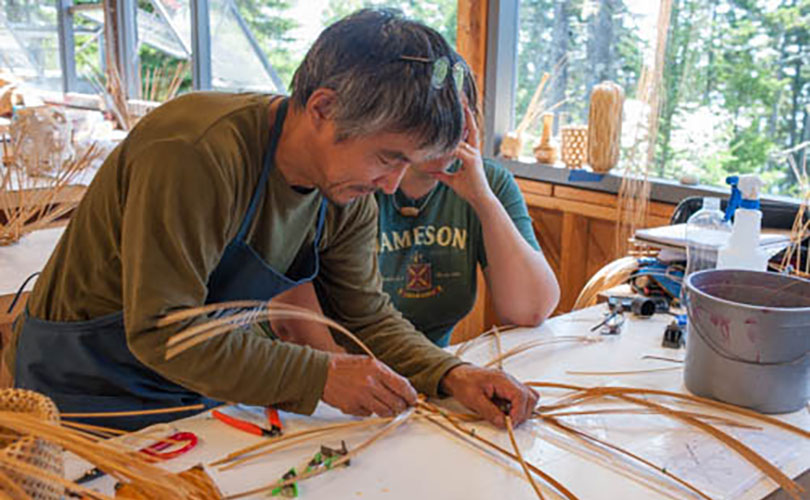
Jiro Yonezawa at Haystack Mountain School of Crafts, Deer Isle, Maine. Photo by Tom Grotta

Jiro Yonezawa is also represented in Japandí with several works. Yonezawa is known for innovative bamboo basketry based on traditional techniques. He says that his recent baskets “represent a search for the beauty and precision in nature and a way to balance the chaos evident in these times.” The search for balance and harmony is one of the elements attributed to Japandi style.

Please join us!

The hours of the exhibtion are: 

Opening and Artist Reception: Saturday, September 25th: 11 to 6

Sunday, September 26th: 11 to 6

Monday, September 27th through Saturday October 2nd: 10 to 5

Sunday, October 3rd: 11 to 6

Advanced time reservations are mandatory; Appropriate Covid protocols will be followed. Masks will be required. There is a full-color catalog, Japandi: shared aesthetics and influences, prepared for the exhibition available at for pre-order at:  https://store.browngrotta.com/japandi-shared-aesthetics-and-influences/


Art Assembled Featured in May

New this Week in May Red Ferne Jacobs

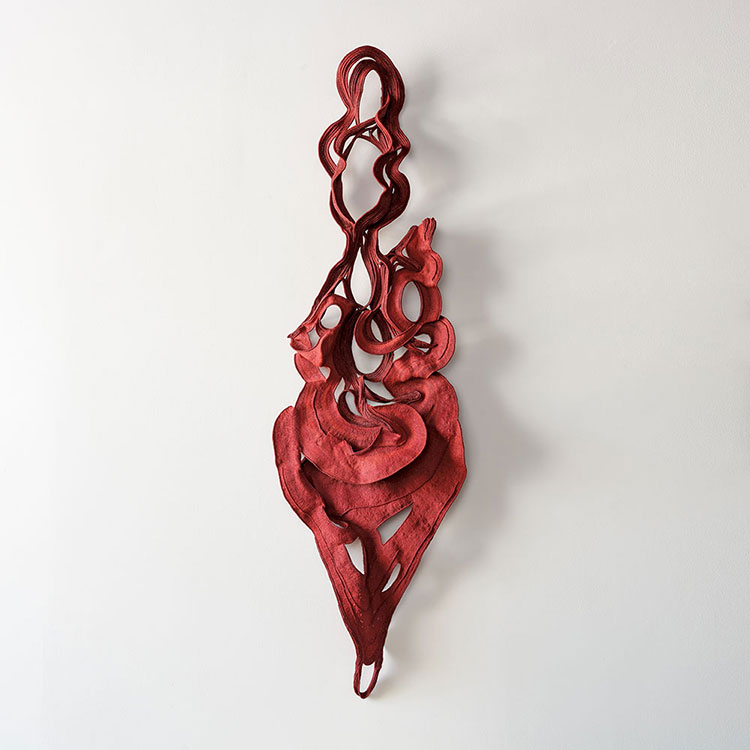
3fj Interior Passages, Ferne Jacobs, coiled and twined waxed linen thread, 54” x 16” x 4”, 2017, Photo by Tom Grotta

Tapestry and sculptural fiber were on tap in May as browngrotta arts’ New This Week selections. First up, Interior Passages, Ferne Jacob’s remarkable wall sculpture of coiled and twined wax linen, a large and complex work that speaks against the desecration of women around the world. Interior Passages needs no one to tell her who she is or what she is says the artist. “She knows her value, and I expect the world to respect this inner understanding. When it doesn’t, I think it moves toward a destructiveness that can be devastating.”

New this Week in May Helena Hernmarck Tapestry

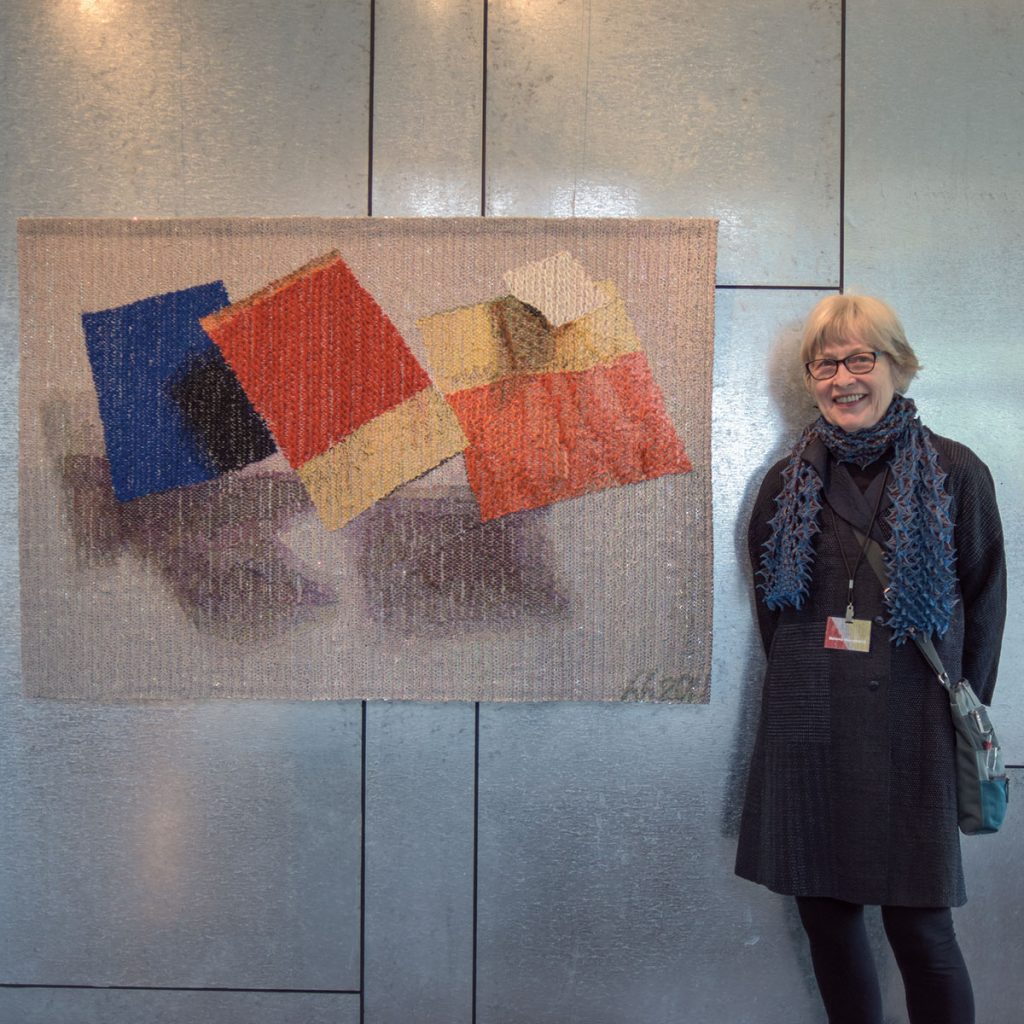
Helena Hernmarck in front of her tapestry Tabula Rasa 3, 2011, Wool, 37.5″ × 57″, Photo by Carter Grotta

Helena Hernmark’s Tabula Rasa 3 , integrates an unusual background of polyester from sequin making that adds a glimmer to the tapestry in the right light. The work is part of a series that included the first Tabula Rasa, commissioned for Yue-Kong Pao Hall, Purdue University.

New this Week in May Jo Barker Dark Shimmer

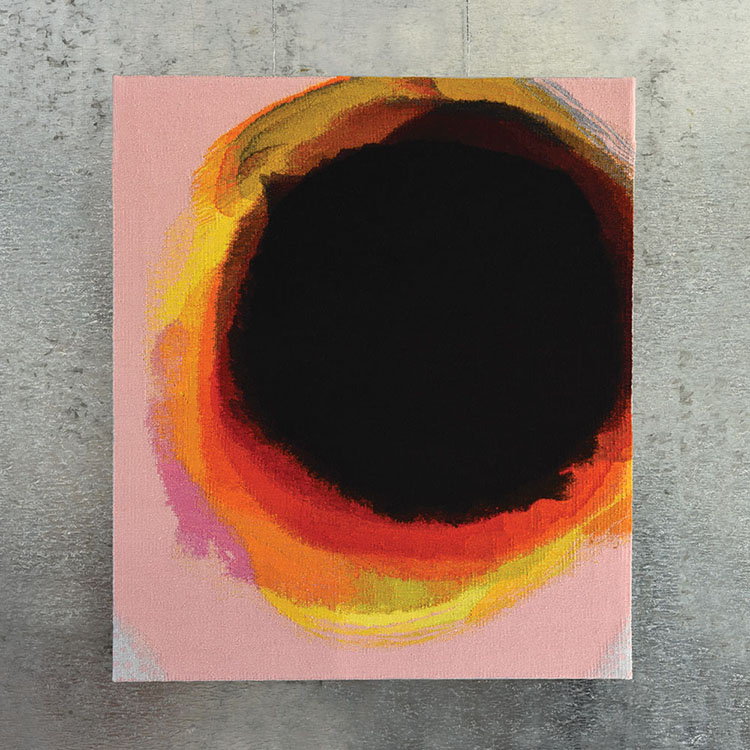
Dark Shimmer, Jo Barker , wool, cotton and embroidery threads, 34” x 29.25” x 1.25”, 2017, Photos by Tom Grotta

Dark Shimmer, by Scottish artist Jo Barker, is from the series for which she won the prestigious Cordis tapestry prize in 2016.

New this week in May Complex plaiting by Norie Hatekayama

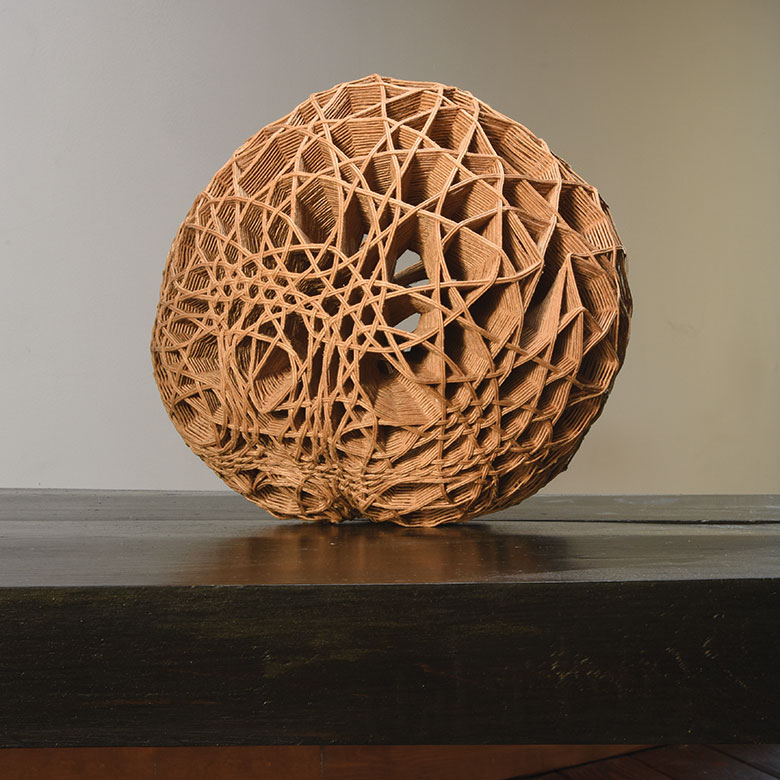
Complex Plaiting Series Pile 02, Norie Hatekayama , plaited paper fiber strips, 11” x 11” x 10”, 2002, Photo by Tom Grotta

Norie Hatakeyama’s Complex Plaiting Series, Pile 02 is made of paper tape. Hatakeyama’s plaited works reflect the complex structures that make up the universe. “Human beings explore structure in nature and create science and art,” she says. “I’ve observed that the transition of science (mathematics, geometry, etc.) and art overlaps with the direction of my work. I feel deeply that the outside world, the natural world, is a field, made up of matter and energy, repeating regeneration and radiating unremitting energy.”


Still Crazy…30 Years: The Catalog

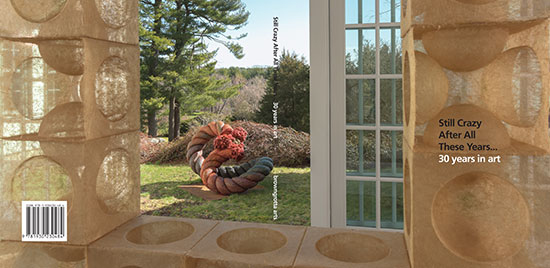
Still Crazy...30 Years: The Catalog Cover Naoko Serino and Mary Yagi

Still Crazy…30 Years: The Catalog

It’s big! It’s beautiful (if we do say so ourselves –and we do)! The catalog for our 30th anniversary is now available on our new shopping cart. The catalog — our 46th volume — contains 196 pages (plus the cover), 186 color photographs of work by 83 artists, artist statements, biographies, details and installation shots.

Still Crazy...30 Years: The Catalog

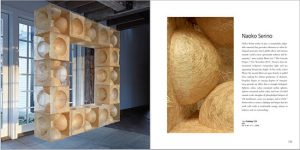
Naoko Serino Spread

Still Crazy...30 Years: The Catalog

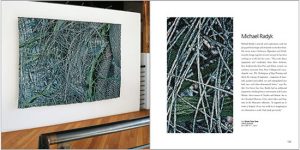
Michael Radyk Spread

Still Crazy...30 Years: The Catalog

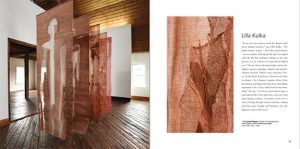
Lilla Kulka Spread

Still Crazy...30 Years: The Catalog

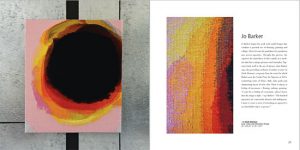
Jo Barker Spread

The essay, is by Janet Koplos, a longtime editor at Art in America magazine, a contributing editor to Fiberarts, and a guest editor of American Craft. She is the author of Contemporary Japanese Sculpture (Abbeville, 1990) and co-author of Makers: A History of American Studio Craft (University of North Carolina Press, 2010). We have included a few sample spreads here. Each includes a full-page image of a work, a detail shot and an artist’s statement. There is additional artists’ biographical information in the back of the book. Still Crazy After All These Years…30 years in art can be purchased at www.browngrotta.com http://store.browngrotta.
com/still-crazy-after-all-these-years-30-years-in-art/.
Our shopping cart is mobile-device friendly and we now take PayPal.


News Flash: browngrotta arts and artists get good press

The last couple of months have seen browngrotta arts and the artists whose work we represent make the news in periodicals online and around the world.  Lia Cook’s work graced the cover of the December 2010 issue of Textil Forum, published in Germany, as part of a fascinating article by the artist, “An investigation: Woven Faces and Neuroscience”
http://www.
exacteditions.com/
exact/browse/573/
911/7936/2/44?dps=on
(more on that project in an upcoming post).The January issue of the always striking online magazine Hand/Eye included a piece on our singular business/life model, “Living with Art,” by artist and writer Scott Rothstein

http://handeyemagazine.com/content/browngrotta-arts. The related slideshow features dozen of art works on display in our barn/gallery/home. (You can read more by Scott Rothstein on his blog, http://artfoundout.blogspot.com, in American Craft magazine and elsewhere.) Meanwhile, the January/February of the UK Crafts magazine includes images from Lizzie Farey’s solo exhibition at City Art Centre, Edinburgh, Scotland http://www.craftscouncil.org.uk/crafts-magazine/latest-issue.

The January issue of Artist Magazine from Taiwan has a several-page article about Norie Hatakeyama by Ming-Whe Liou, with photos by Tom Grotta. We can’t tell you what it says — but it looks good. http://www.artist-magazine.com.
Last, but certainly not least, the cover of the Spring 2011 issue
of The Journal of Wealth Management, features Tom Grotta’s photo
of Christine Joy’s willow sculpture, Bundle
https://www.pm-research.com.