
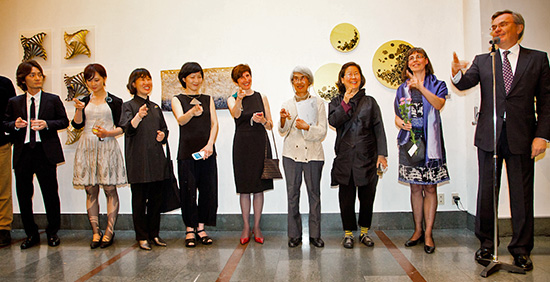
Watch the eyes of those on your gift list sparkle, when you choose one of these glimmering sculptures or wall works by artists from the US and abroad.
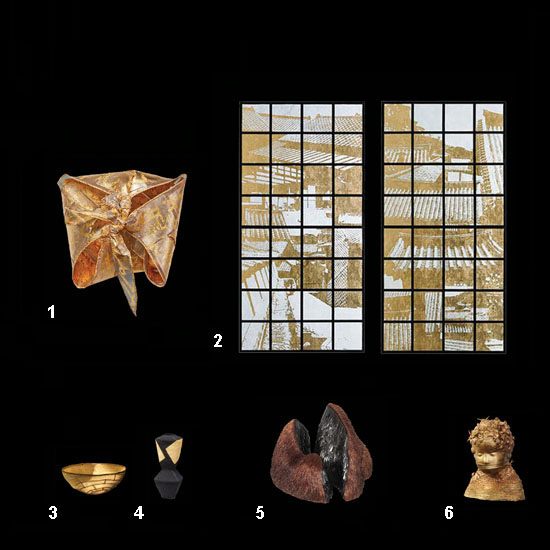
Pulguk-Sa,
Kyong-Ju
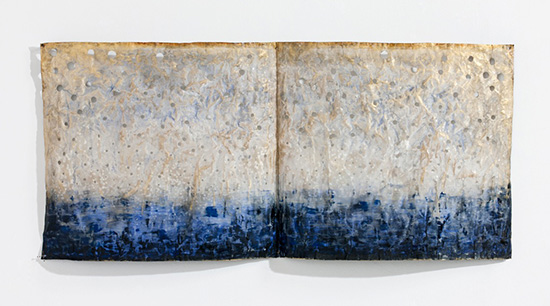
Glen Kaufman
silk damask, silver leaf; screenprint, impressed metal leaf, 48” x 24” x 1” 1990
3 Gold Bowl, Jin-Sook So, steel mesh, painted, and electroplated gold, silver leaf
2.75″ x 6″ x 6.25″, 2005
4 Untitled #8-5, Jan Buckman, waxed linen and gold leaf, 8″ x 3.375″ x 2″, 1995
6 The Golden Child, Norma Minkowitz, fiber, mixed media 12″ x 11″ x 8″, 2009
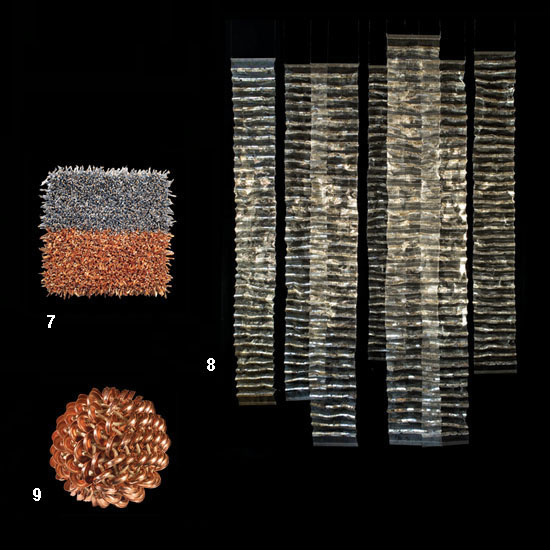
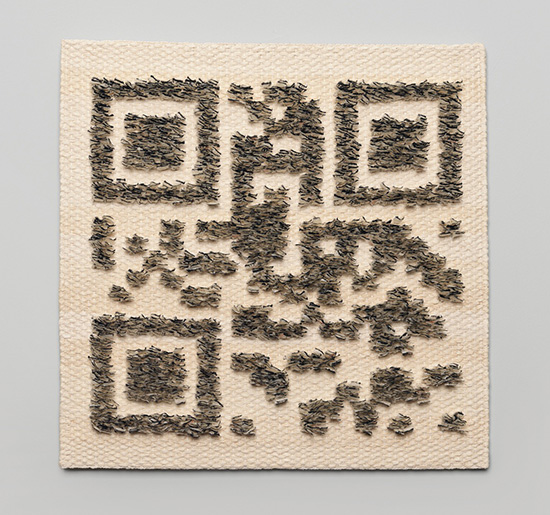
7 Reflected Haze
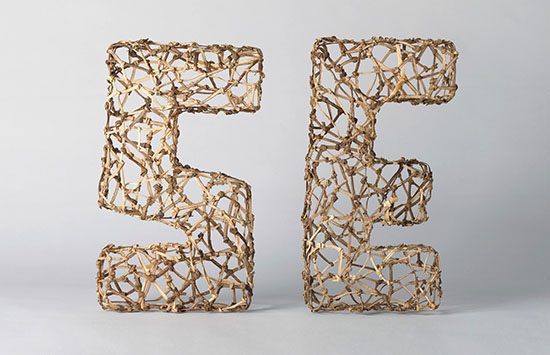
Lewis Knauss
woven, knotted hemp, linen, acrylic paint, 20.5″ x 20.5″ x 2.5″, 2010
8 En Face
Agneta Hobin
mica and steel
70” x 48”, 2007
9 Copper, Tin Sculpture
Axel Russmeyer
copper, tin, stainless steel, hemp
17″ x 17″ x 17″
2007

Check Out: “On Thin Ice: Two Russians Skate Off the Reservation,” in the WSJ
Oksana-Domnina-and-Maxim-Shabalin
Contemporary textile artists’ work is often rich in references to other cultures. Traditional techniques are used to generate new forms; images and themes from other cultures are re-envisioned and contemporized. Through her study of Peruvian gauze weavings, Lenore Tawney discovered a reed that she was able to adapt to create the innovative slits and openings that characterized her work.
Shrouded River detail by Lenore Tawney
Carol Eckert’s coiled sculptures feature animal figures that are inspired by African ceremonial head dresses of the Yorubas; Kirsten Wagle and Astrid Løvaas
use old Norwegian tapestry techniques on unconventional materials from aluminum cladding to pantyhose;
Løvaas & Wagle create tapestries that are visually captivating, beautiful, surprising, and rich in references to art historical sources
Nancy Moore Bess’s baskets are informed by her travels to Japan, most recently re-interpretations of the jakago/snake baskets used in Asia to bind stones at the edge of a river or lake to prevent soil erosion; and Jin-Sook So reinvents Korean pojagi by creating patchworks of gold-plated steel mesh instead of the traditional scraps of ramie and hemp.
(Pojagi-inspired work) by Jin-Sook So
Is there a point at which cultural “borrowing” stops being an acceptable compliment and becomes unacceptable co-option? That’s the criticism being made of Russian figure-skaters Oksana Domnina and Maxim Shabalin, whose multicultural ice-dancing theme, based on aboriginal costumes, music and dance, have drawn the ire of Australian Aboriginal activists. On January 28, 2010 in the Wall Street Journal, Eric Felten reviewed the Olympic controversy, similar arguments made about white musicians having no right to play jazz, and recent cross-cultural creations by the likes of Paul Simon and Vampire Weekend.
In “On Thin Ice: Two Russians Skate off the Reservation,” Felten cites T.S. Eliot as endorsing artistic appropriation, quoting him as saying, “bad poets deface what they take, and good poets make it into something better, or at least something different.” Felten argues that it is too much to expect “cultural interlopers” to make something better; it should be enough that the borrowing “makes for something different”. And sometimes that something different will be more than different. It will be art.