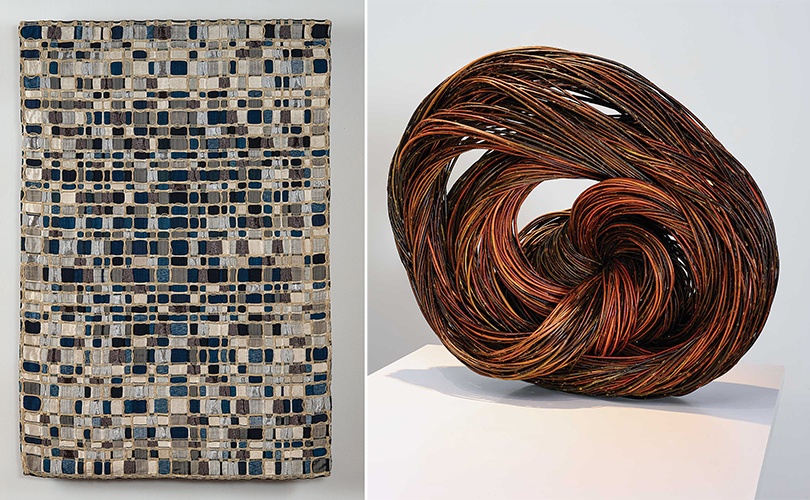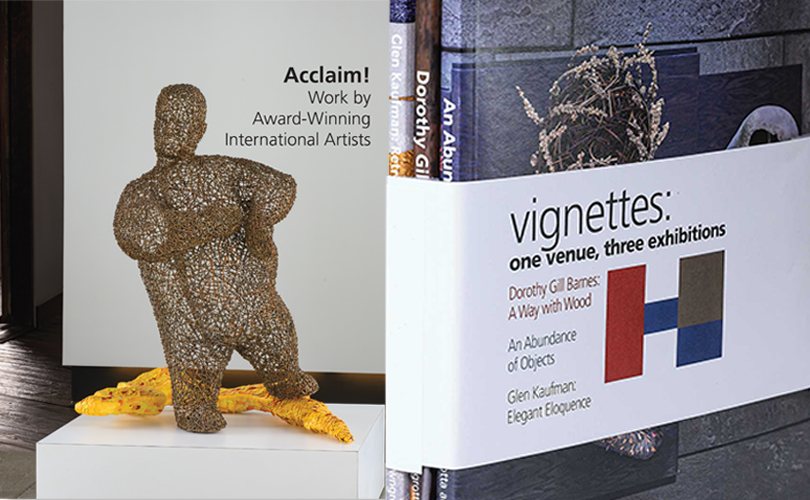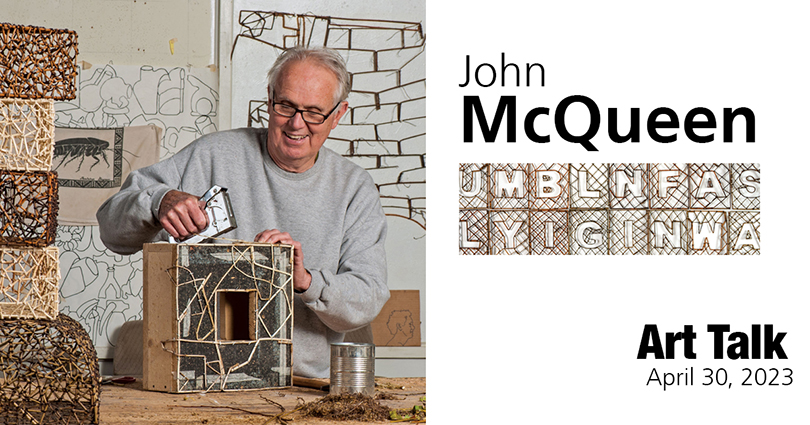
Search Results for "mcqueen"

In Memory: John McQueen

This week we share another testament to the profound influence that John McQueen has had within the art world. The recollection below is from Hideko Numata, the curator of the influential exhibitions Weaving the World: the Art of Linear Construction at the Yokohama Museum of Art in Japan in 1999.

Last month, I received the deeply saddening news from Hisako Sekijima that John McQueen had passed away. I was filled with a profound sense of sorrow and regret. Meeting John McQueen remains one of the most meaningful and unforgettable experiences of my career as a curator.

John McQueen's sketches
Twig sketches behind John McQueen’s Saratoga New York’s workbench. Photo by Tom Grotta

I first encountered John McQueen around 1997, while I was planning the 10th-anniversary exhibition at the Yokohama Museum of Art. I was responsible for the crafts section. At that time, I had the uncomfortable sense that there was a noticeable divide between fine art and crafts in the Japanese art world. Even in our museum, which focused on modern and contemporary art, the crafts section was often undervalued, and I frequently found myself frustrated by these limitations. I began to wonder whether it might be possible to curate an exhibition that transcended traditional art categories and explored the origins of artistic formation.

Hisako Sekijima’s book, The Formula of Basketry

It was during this period that I came across Hisako Sekijima’s book, The Formula of Basketry. Although Japan has a longstanding tradition of bamboo craft, her book transformed my understanding of basketry—not simply as the weaving of plant materials into containers, but as a medium of dynamic expression with limitless potential. Basketry, I realized, could incorporate not only natural elements but also paper, wire, and other materials, to create both flat and sculptural forms from linear elements.

John Mcqueen Workshop Gakugei
John McQueen Workshop in Japan, courtesy of the Yokohama Museum of Art

Hisako Sekijima began making baskets in Japan, but her time in the United States from 1975 to 1979 exposed her to basketry as an art form. She was captivated by the spirit of freedom and experimentation she found there. Participating in John McQueen’s workshop during that period was a turning point for her. Her vivid recollections in the book sparked my own interest in both McQueen’s work and the artist himself.

When I first encountered his art, I was immediately struck by its originality. McQueen used a wide range of materials and weaving techniques to create abstract forms, alphabetic characters, and large-scale figures of people and animals. His works were not functional baskets but powerful sculptures—three-dimensional expressions of contemporary art. The materials and weaving methods themselves appeared to alter the forms and movements they expressed. They overturned my preconceived notions of sculpture.

The act of weaving — strands forming two- or three-dimensional shapes — is one of the most fundamental, universal methods of making. Practiced globally since ancient times, it holds an infinite capacity for expression. I felt it could offer a way to bridge the gap between fine art and craft. This realization led me to curate the exhibition Weaving the WorldContemporary Art of Linear Construction, which brought together works from both craft fields such as basketry and textiles, and contemporary art that used linear or woven elements.

Weaving the World, Contemporary Art of Linear Construction
Installation shot of Weaving the WorldContemporary Art of Linear Construction, courtesy of the Yokohama Museum of Art

For this exhibition, John McQueen contributed one bird’s nest-like piece and two human-shaped sculptures. The bird’s nest-like structure was constructed from short wooden branches inserted and layered to form a structure that, while sturdy, appeared almost fragile—like it might collapse at any moment. The human figures were created using branches and vines secured with plastic cable ties. One figure was made by weaving taut, slender vines into an airy yet resilient human shape. It maintained a strong presence, offering glimpses through its woven mesh to the inner space and the world beyond. The other was composed by densely interweaving branches to fill the interior form. Although it was structurally solid, it lacked the gravitas of stone or bronze, instead possessing a lighthearted, even humorous character. McQueen’s work effortlessly transcended the boundaries between sculpture and craft.

Weaving the World, Contemporary Art of Linear Construction
Installation shot of Weaving the WorldContemporary Art of Linear Construction, courtesy of the Yokohama Museum of Art

The exhibition featured artists from Europe, the United States, and Japan, spanning both the craft and contemporary art worlds. These included browngrotta arts gallery artists such as Norma Minkowitz, Markku Kosonen, Toshio Sekiji, and Hisako Sekijima; sculptors like Richard Deacon and Martin Puryear; installation artists working with natural materials, including Andy Goldsworthy and Ludwika Ogorzelec; Supports/Surfaces artists like François Rouan; and conceptual artists such as Rosemarie Trockel and Margo Mensing. Though diverse in practice, they were united in their exploration of “line” as a medium – unfolding into inner landscapes, social commentary, and artistic forms Viewers could deeply appreciate the richness of art created by weaving linear materials as they moved through the exhibition space.

workshop participants Weaving Yokohama
Workshop participants Weaving Yokohama, Crossing Paths, courtesy of the Yokohama Museum of Art

During the exhibition, we held a three-day public workshop titled “Weaving Yokohama, Crossing Paths” led by John McQueen and Margo Mensing. Takahiro Kinoshita, an educator of the Yokohama Museum of Art’s education group, organized this workshop. He spent an entire year coordinating the event with the two artists. Fifty participants and twenty-three volunteers took part. On the first day, there was an introduction to the workshop, consecutive lectures from McQueen, Mensing, and Sekijima. The following two days were dedicated to creation, taking place in the museum’s open-air portico, where the public could observe the process.

Weaving Yokohama, Crossing Paths
Weaving Yokohama Crossing Paths workshop, courtesy of the Yokohama Museum of Art

The workshop used bottom trawl nets previously employed by Yokohama’s fishermen. Working in pairs, participants traced human shapes onto the nets, cut them out, and wove various materials into the forms. On the first day, they completed the human-shaped silhouettes. The second day focused on filling the interior spaces by weaving in different materials. Though more challenging than expected, the collaborative process allowed each pair to create a unique piece through trial, connection, and creativity. Even beginners were able to experience the satisfaction of shaping and completing something with their own hands. Each work reflected its creators—different in material, method, and spirit—shining with individuality.

The exhibition and workshop were warmly received by the public, and the exhibition was honored with that year’s Ringa Award for the outstanding exhibition that year. I believe that by focusing on the elemental act of weaving, visitors were able to rediscover the joy of form-making and expression—beyond the confines of any genre.

I remain deeply grateful to John McQueen. He reminded me that even the most humble materials and methods can give rise to profound beauty and meaning. His inspiration continues to live on, not only in his works but in all of us who had the honor of working with him.

May he rest in peace.
Hideko Numata
Professor, Showa University of Music
Former Chief Curator of the Yokohama Museum of Art Curator,
Weaving the World: Contemporary Art of Linear Construction, 
Yokohama Museum of Art, Japan 1999


Hisako Sekijima on John McQueen’s Impact in Flexible Forms and Words 

Hisako Sekijima with John Mcqueen in 2011
Hisako Sekijima discussed her work with John Mcqueen in 2011 at browngrotta arts. Photo by Tom Grotta

The passing of John McQueen in midsummer 2025 made me look back over the strong impact he has had on me and other artists, an impact that has never weakened. In my early days, I learned a lot from both his art work and articulate statements in teaching. Writing this remembrance has replaced my grief with my refreshed excitement of those days. In it I also want to convey deep regret about his passing from other Japanese basketmakers who studied in his courses. 

As a tribute, I have included an illustration of his workshop at Peter’s Valley Craft Center in 1978, from my book Formula for Basketry. It was republished last year, 36 years after its original in which I discussed my 10-year artistic exploration, starting with problems thrown at basketmakers by McQueen.

John Mcqueen illustration

Twelve participants of his course, including myself, triumphantly carried a group project, a big basket like a geodesic dome, on the top of a car to the auction site of the Craft Center. Requiring us to put it upside down, I now realize, symbolized very well his intent to throw us all outside of the conventions of basketmaking. At that time I lived in suburban New York City and was anxious to take his course. His Untitled Basket overwhelmed me with beautiful forms made of low processed plant materials with totally original structural mechanisms. I had visited exhibitions to see his work at the Museum of Contemporary Crafts and galleries including Hadler/Rodriguez, Florence Duhl, and Helen Drutt.

John Mcqueen Hadler Gallery Catalog

I never became a participant of one of his workshops again after Peter’s Valley, because while there, John McQueen gave me a basketful of homework that put me on a lifetime path of extremely experimental exploration. After returning to Japan in 1979, I enthusiastically set up his workshops as a planner, adviser, and assistant or interpret/moderator, in order to introduce a Japanese audience and my students to the fascinating gateway to the basket world that John McQueen was discovering.  

John Mcqueen harvesting willow
John Mcqueen harvesting willow. Photo by Tom Grotta

In 1978, John McQueen’s work was exhibited for the first time in Japan in a survey show of contemporary textile arts from Europe, America, and Japan (Part I: Fiber Works – Europe, Japan; Part II: Fiber Works – Americas, Japan). It was curated by Shigeki Fukunaga as a two-part series in 1977 and 1978 for the Museums of Modern Art in Kyoto and Tokyo. The next time McQueen’s work was exhibited in Japan was in 1989 in an exhibition of American contemporary crafts entitled The Eloquent Object which started at Philbrook Museum of Art, Tulsa Oklahoma and travelled to the Museums of Modern Art in New York, Kyoto, and Tokyo. In those years in Japan, contemporary basketmaking had just started attracting a few weavers’ attention. In narrower circles,  those who knew more about contemporary baskets as new art forms through slides or publications I brought back from America and through John McQueen’s early innovative work were intoxicated by the vast possibility of asserting modes of sculptural basketmaking. 

John McQueen installs Frieze
John McQueen installs Frieze made of willow. Photo by Tom Grotta

In the winter of 1997, I planned, with Kazue Homma, basketmaker and publisher of a mini-circulation for basketmakers, to invite John McQueen to Japan. We set up a series of events within his one-month stay: in Tokyo two-day workshop with a slide lecture, a slide lecture at Gallery Isogaya, and a joint lecture for three art schools. In Kyoto, he would conduct a 5-day workshop at Kawashima Textile School.

For Kyoto, I scheduled his course in place of a basketry course in the school’s “Hands Week” program that was scheduled annually. I had been teaching a one-week basketry course for 15 years before then. I intentionally planned his teaching to be not too conceptual but quite technical, in consideration of the preference of Japanese participants. Even so, McQueen’s method was so extraordinary and innovative that all were intrigued or taken out of their conventional thinking. For example, he taught how to transfer a vessel form step-by-step into a two-dimensional template, which was necessary for his signature method of “weaving a basket on the loom.” Just the idea shocked all in Japan, where good baskets ought to be made of stiff bamboo or akebia without any mold or shaping gears!! 

John McQueen teaching aside Hisako Sekijima in Japan
John McQueen teaching aside Hisako Sekijima in Japan. Photo courtesy of Hisako Sekijima

In Tokyo, McQueen’s course was filled instantly with 20 participants, mostly fellow artists and ex-students of mine. We financed his air fare by the admission costs paid a month ahead to reserve entry. When he showed how to join patches of tree bark, everyone was very pleased, as well as surprised, that he generously shared this technical secret. But, as Kazue Homma, wrote in her report of his workshop in Basketry News, “Being taught has two sides. A taught way would better be avoided, though the teacher said taking someone’s way is not always bad.”  She noted that he added “one’s own original [way] is much more difficult and so valuable.” One year after the workshops, participants of both venues had a group show John McQueen was there at Sembikiya Gallery in Tokyo to show each breakthrough.

John McQueen teaching in Japan
John McQueen teaching in Japan. Photo courtesy of Hisako Sekijima

In 1999, the Yokohama Art Museum presented Weaving the World: Contemporary Arts of Linear lConstruction. The curator, Hideko Numata, invited John McQueen and Margo Mensing for a joint workshop. (Hideko Numata’s recollection will appear in an upcoming arttextstyle.)  During that trip, I joined McQueen and Mensing for a three-day joint workshop at Sapporo Art Park in Hokkaido.  It was organized by the Art Park in collaboration with the Hokkaido branch of Kawashima Textile School’s alumni. Participants, mostly experienced weavers, had a choice of three projects: McQueen’s “stick project,” Mensing’s three-dimensional knitting, and my material transformation. Stick project, being well received in other workshops, was what can be called a portraying of a soft object in short, straight, linear materials: composing a free-standing new object with use of short sticks and other items in combination. What he explained to participants was that they should be conscious of portraying a certain aspect of the object, which he said was to be the subject of a new object. It was a very new experience to Japanese weavers. For them, making an object with a concrete subject was not familiar, because until then, more emotional or impressionistic expression had been preferred. This project, I think, reflected very well the new direction of his work which seemed getting more figurative and narrative year after year.        

Weaving the World catalog
Weaving the World catalog layout. Works by John McQueen. Photo by Tom Grotta

McQueen was a great educator in that he showed us “unlearning is a true learning.” I would like to say thank you and good bye to him with a following story. In the workshop at Kawashima Textile School I saw him teaching plaiting by aligning components on the edge at the beginning, but not on the bottom. He reversed the common procedure most basketry books take as basic. Everyone got “his new basic.” The reversed process made them give up the convention. I realized that John’s teaching skill had advanced since the time I studied with him at Peter’s Valley, in that he came to teach it from much more elemental point. He taught us in 1978 to start from the bottom, a conventional way. In due course, I got fixed in its convention. It took years to liberate myself from the basket “trap” until eventually I came to “discover” an approach based on reversed engineering on my own!!  Looking at this, I got another priceless lesson from McQueen: “Do not take for granted someone else’s basics.”

This is how I shall remember him always.  

Hisako Sekijima

Yokohama, Japan


Lives Well-Lived: John McQueen

John McQueen Harvesting Willow
John McQueen harvesting willow. Photo by Tom Grotta

We were deeply saddened to learn of the death of John McQueen last week. He was a remarkable artist. We had long admired his work from afar and over the years had placed several works that he showed at other galleries. We got to know him personally when he began to exhibit with browngrotta arts more than 15 years ago. He visited us in Wilton on several occasions and we traveled to upstate New York to see him and photograph him at work.

Happenstance, John McQueen
Detail: 82jm Happenstance, John McQueen, willow, waxes string,22.5″ x 8.5″ x 8.75″, 2011. Photo by Tom Grotta

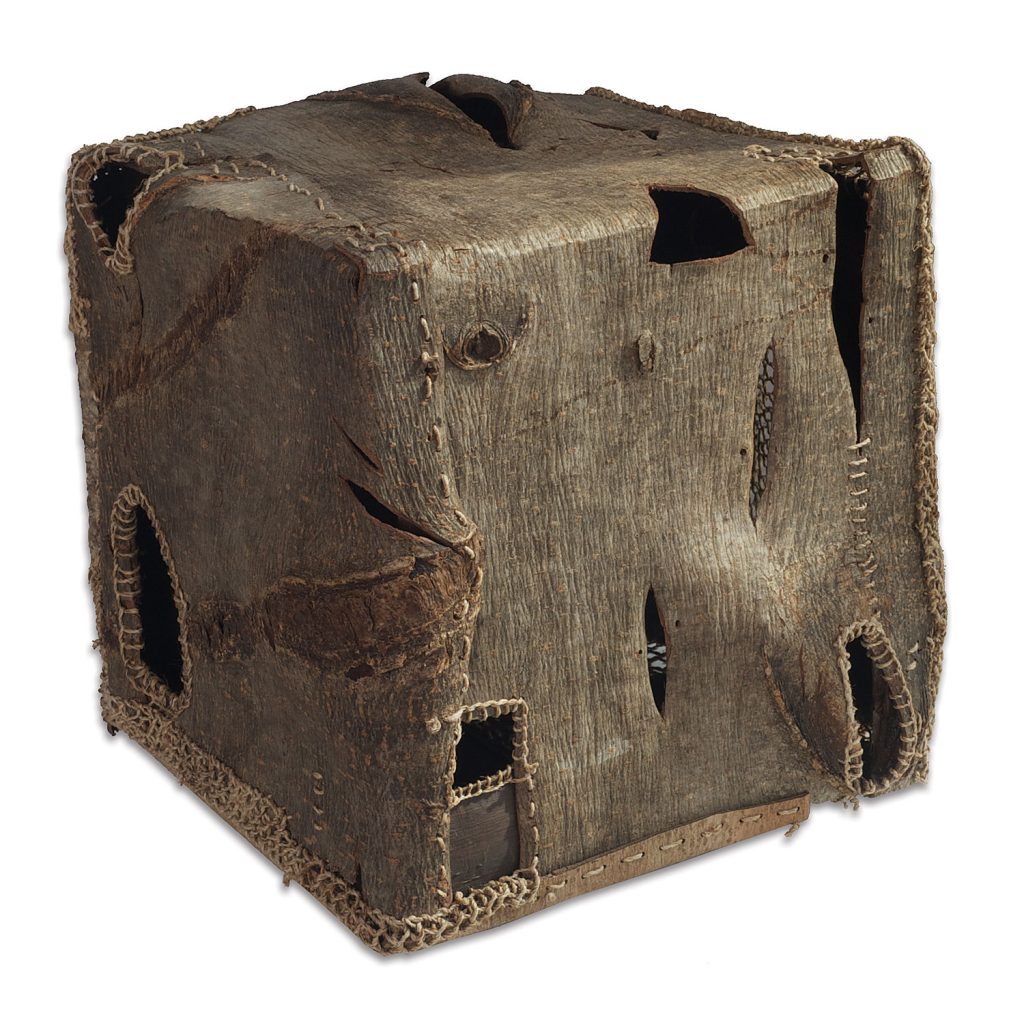
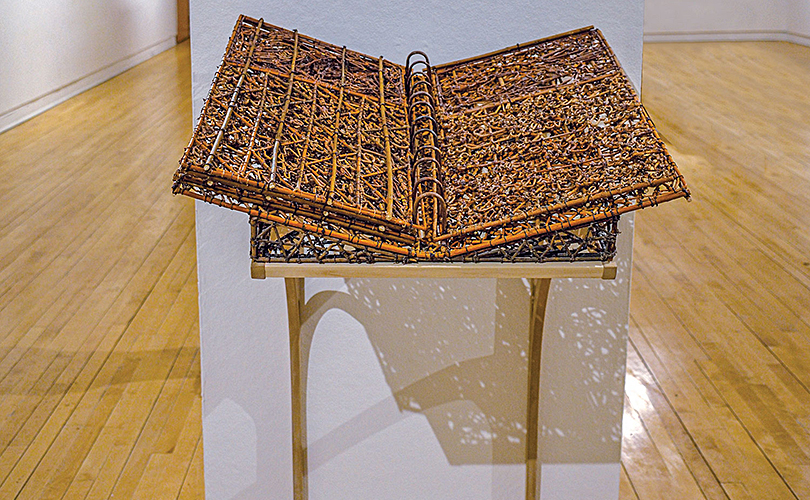
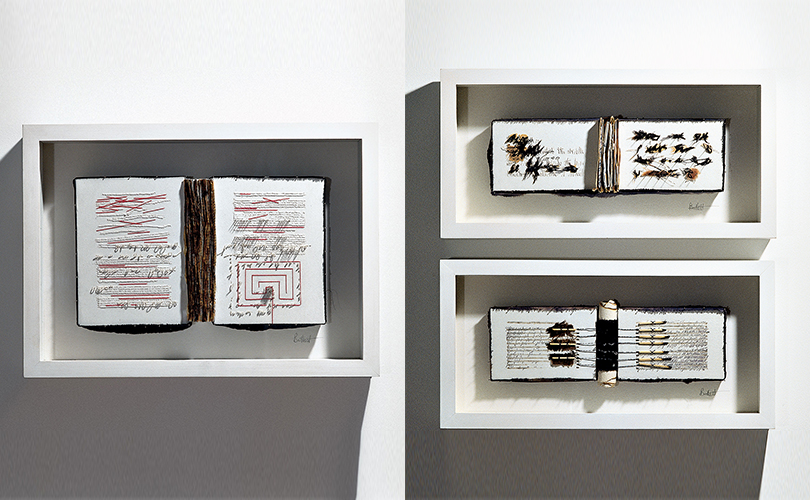
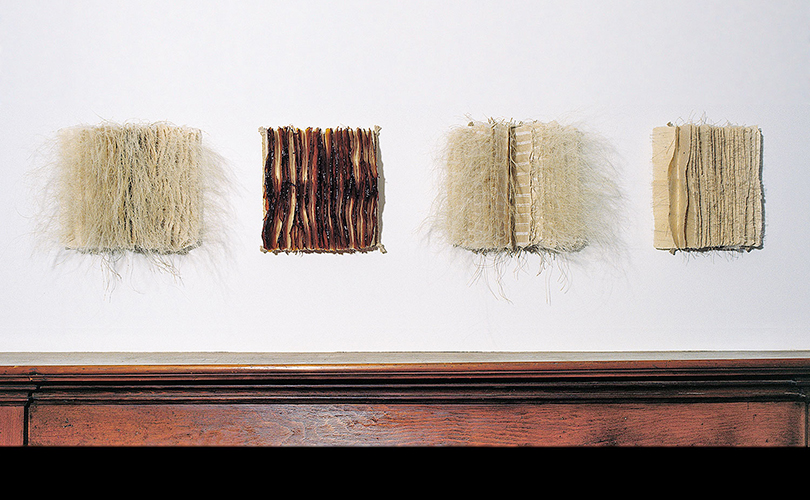
McQueen created three-dimensional items of twigs, branches, bark, and sometimes plastic and cardboard, all of material he harvested and collected. These objects included books, fish, birds, lions, and human figures, and vessels and structures, some basket like, others not.  McQueen insisted that he was not a sculptor, but a basketmaker. Containment was a consistent interest. “Baskets connect with the definition of a container — a very broad concept. This room is a container. I am a container. The earth is being contained by its atmosphere. This is so open. I don’t need to worry about reaching the end of it.” (Quoted on the relationship in the catalog for his solo exhibition at the Renwick Gallery, Smithsonian American Art Museum, The Language of Containment, in 1992).

Untitled #88, John McQueen
64jm Untitled #88, John McQueen, elm bark and maple, 14” x 14” x 10.5”, 1979. Photo by Tom Grotta

McQueen pushed the boundaries of his art form of choice throughout his working life. He created forms of pieced bark, using forms made of cardboard, “paintings” of plastic contained within frames of twigs and branches, and integrated sly and subtle messages throughout his works. Words entered his works in 1979 in Untitled #88, in which a web of words creates the container in part and conveys an idea — “Always is always a ways away.” His subsequent works abounded with puns, rebuses, and messages to be deciphered.

Falling Fruit, John McQueen
20jm Falling Fruit, John McQueen, sticks and string on a wood grid, 40” x 48” x 12”, 2014. Photo by Tom Grotta

Man’s fruitless efforts to control nature were a frequent subject of McQueen’s art. As Vicki Halper observed in The Language of Containment, for McQueen “[t]he basket becomes an agent for investigating the fragile truce between humans and nature.” In Falling Fruit, for example, tiny stick figures are mounted beside sharks and palm trees made of twigs.  We may think we can control our world, but McQueen’s camouflage-like scene suggests otherwise. As Nature does, McQueen offers surprising combinations that remind us that life is not predictable. 

1000 Leaves, John McQueen
49jm 1000 Leaves, John McQueen, willow, waxed linen, 27″ x 48″ x 48″, 2022. Photo by Tom Grotta

In 2022, McQueen decided to take on a project that would take him a year. This was an approach regularly taken by his life partner, artist Margo Mensing, who would choose a subject — generally a person — and spend a year creating artworks, poetry, performances, and multi-media installations in response. For McQueen, the result of his year’s work was 1000 Leaves, an assemblage of individually crafted structures that paid homage to trees, the source of the material that gave life to his work.

A Tree and Its Skin Again, John McQueen
78jm A Tree and Its Skin Again, John McQueen, mixed media, 30″ x 20.25″ x 8.25″, 2006. Photo by Tom Grotta

McQueen was born in Oakland, Illinois in 1943. He received a Bachelor’s degree from the University of South Florida in Tampa, Florida (where Jim Morrison was his roommate). After college he went to New Mexico where his interest in basketmaking began. Courses in weaving were a logical entry point to basketry so he enrolled in the Master’s program at Tyler School of Art in Philadelphia, where he studied with Adela Akers among others. He received many awards in his career including an artist fellowship from the New York Foundation for the Arts, a Visual Artist Fellowship from the National Endowment for the Arts, a Louis Comfort Tiffany Award, a United States/Japan Friendship Commission Fellowship, a Virginia A. Groot Foundation Award, the Master of the Medium Award from the James Renwick Alliance, and the Gold Medal from the American Craft Council. His work is found in numerous permanent collections, including that of the Museum of Arts and Design, Minneapolis Institute of Art, Philadelphia Museum of Art, the Kunstindustrimuseum, Trondheim, Norway, Detroit Institute of Art, Museum of Fine Arts Houston, and Wadsworth Atheneum Museum of Art.

Not Believable, John McQueen
59jm Not Believable, John McQueen, woven willow, plastic, 20.25″ x 41″ x 5″, 2005. Photo by Tom Grotta

McQueen’s art stirs powerful feelings in viewers, forcing them to think about construction and words, metaphysically and literally.  “McQueen’s genius lies in finding a simple declarative means of speaking about paradox, essences, and fundamental truth,” Elizabeth Broun, then-director of the National Museum of American Art observed. His genius will be greatly missed.


John McQueen: Established Artist Award Exhibition Opens in New York

John McQueen talking about his piece Teeter at the opening of TOO: Melinda R. McDaniel and John McQueen, the exhibition opening

John McQueen talking about his piece “Teeter” at the opening of TOO: Melinda R. McDaniel and John McQueen, the exhibition opening

Last May, John McQueen was surprised to learn he had been awarded the second annual Established Artist award (for artists over 40 years old) from the Arts Center of the Capital Region in Troy, New York. McQueen, who has lived in the area for more than a dozen years, was pleased, telling Amy Biancolli of The Time Union, “You don’t know you’re up for it, so [it’s] the idea that I’m just here by myself, making stuff, and no one else in the Capital Region would even know – and suddenly I’m recognized.” Recognition has come from elsewhere before now, however. McQueen’s work is found in dozens of museums and private collections, including the Museum of Arts and Design in New York, the Racine Museum of Art in Wisconsin and the Philadelphia Art Museum in Pennsylvania. He is a Fellow of the the American Craft Council and a winner of the Master of the Medium award from the James Renwick Alliance, Smithsonian Institution, National Museum of American Art, Washington D.C.
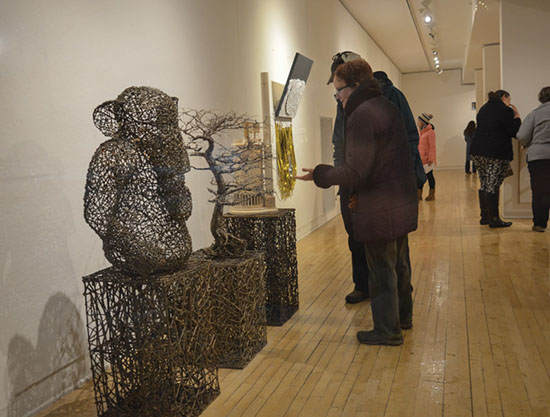
attendees viewing "Same Difference" by John McQueen

attendees viewing “Same Difference” by John McQueen

TOO: Melinda R. McDaniel and John McQueen, the exhibition that accompanies the award, opened on Friday, January 30th at the Arts Center. McDaniel is the winner of the companion Emerging Arist award for 2014. In TOO, the two artists work in repetition within their chosen materials, meticulously creating pieces that concentrate on form and texture. McQueen’s three-dimensional works are made of natural
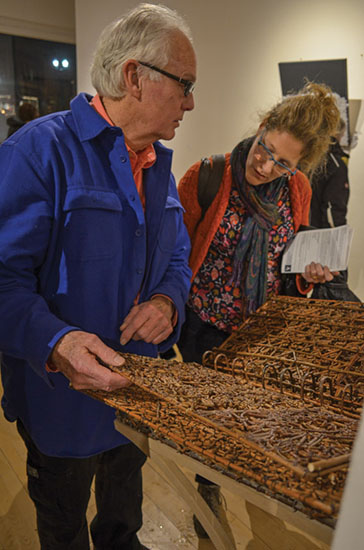
John McQueen Reading from his piece "Bird Brain" at TOO: Melinda R. McDaniel and John McQueen

John McQueen Reading from his piece “Bird Brain” at TOO: Melinda R. McDaniel and John McQueen

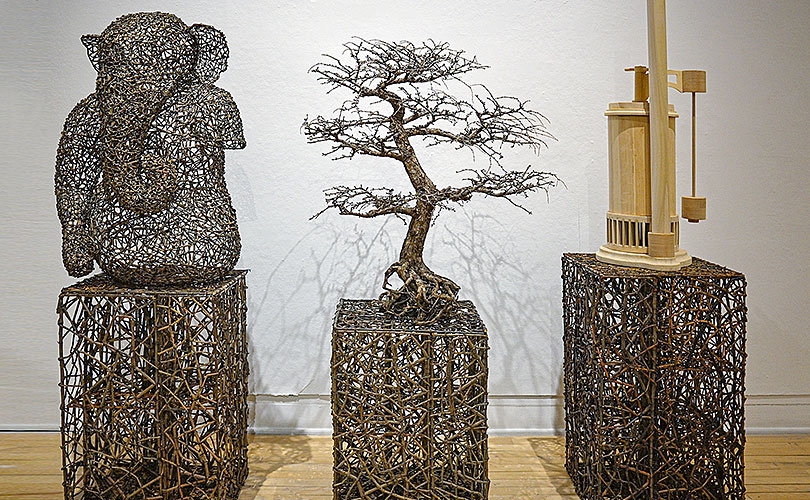
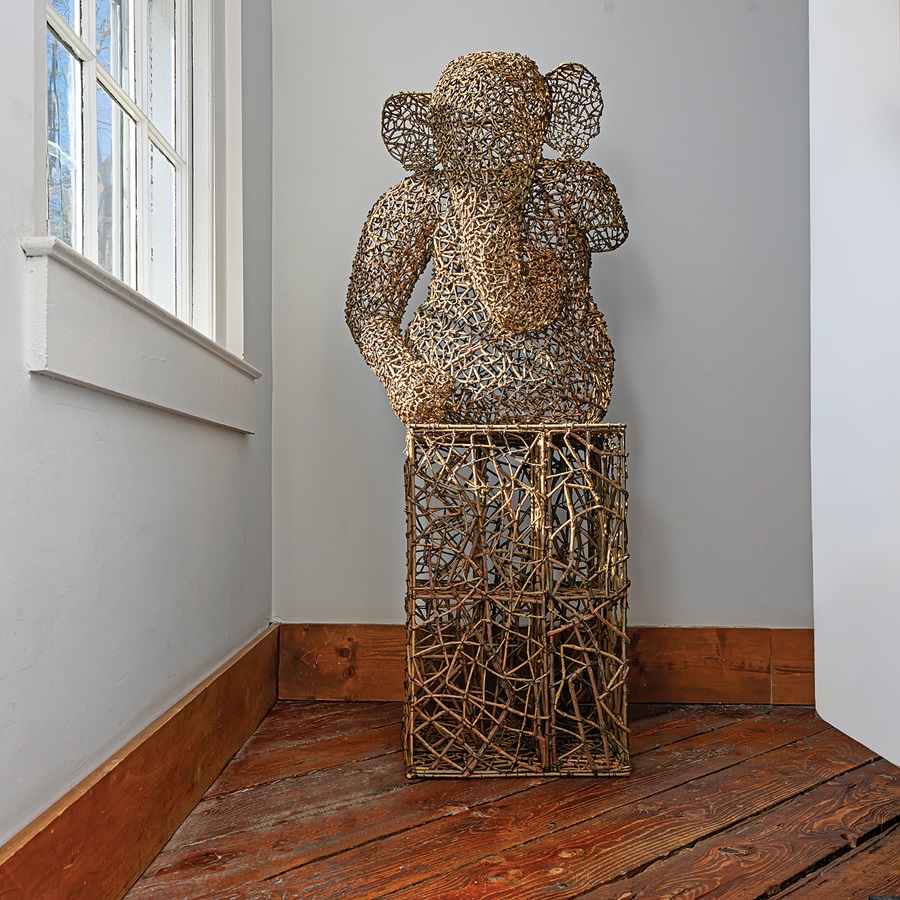
materials — twigs, bark, cardboard — he prides himself on not needing to go the arts supply store. In Too, his several-part sculpture, Teeter, includes shingles from a lake house and a hand, originally created as the mold for another project. Raillery is made of the corrugated cardboard that surrounded a Murphy bed. McQueen’s works invoke word and world associations. Some of these are made by the viewer, others are there in the artist’s intent. In Same Difference, for example, the juxtaposition of detailed sculptures of the Hindu god, Ganesh, a bonsai and a sump pump is visually engaging. When McQueen explains the simple and smart connection amongst the three —all soak up water, through a trunk, root system or a pump — the work can be appreciated on additional level. For Bird Brain, one is initially awed by the form — a book of cursive words created of tiny willow twigs tied with waxed linen — then challenged to decipher the names, like “Frogmouth,” and “Lyre bird.”

You have until March 31st to see TOO: Melinda R. McDaniel and John McQueen, http://www.artscenteronline.org/too-melinda-r-mcdaniel-john-mcqueen/13161/. Or see browngrotta arts’ online folio of the John McQueen works in the exhibition at: http://www.browngrotta.com/digitalfolios/McQueen.Digital%20Folio.2015/FLASH/index.html
25 at 25 at SOFA NY Countdown: John McQueen

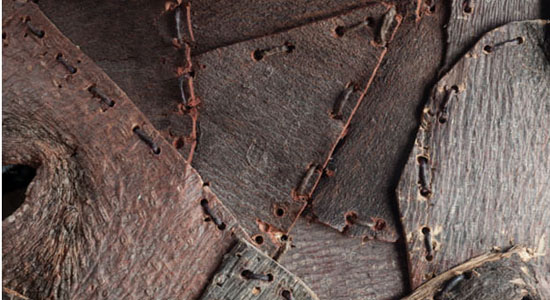
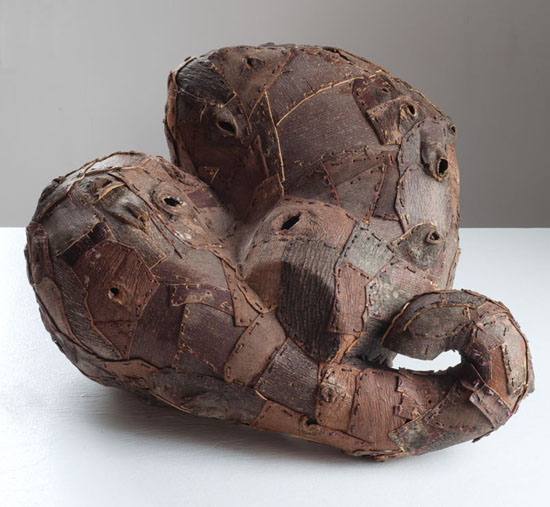
KNOT ANATOMY Detail, John McQueen, photo by Tom Grotta

At SOFA NY, browngrotta arts will  show the work of American artist, John McQueen. The sculptor began exploring abstracted basketforms of natural materials in the 70s. Each of his pieces, is complete in its expression, Elizabeth Broun, then-direcor of the of the National Museum of Art has written “[T]aken together, they constitute a new language capable of telling our most intimate concerns….His genius lies in finding a simple declarative means of speaking about paradox, excesses, and fundamental truth. Today, when abstraction is often found insufficient to our needs, McQueen proves again that abstract form can contain our deepest thoughts.” ( From John McQueen: The Language of Containment, Renwick Gallery of the National Musuem of American Art, 1992, p. 7.) McQueen has received National Endowment for the Arts fellowships  in 1977, 1979 and 1986 and is a Fellow of the American Craft Council. His work is included in a number of permanent museum collections including the Cooper-Hewitt Museum, Smithsonian Institution, New York, New York; Detroit Institute of Art, Michigan;
14jm KNOT ANATOMY, John McQueen, bark tied with string, 13″ x 25″ x 18″, 2012, photo by Tom Grotta

National Museum of Decorative Arts, Trondheim, Norway; Minneapolis Institute of Art, Minneapolis, Minnesota; Mint Museum of Craft + Design, Charlotte, North Carolina; Museum of Arts & Design, New York, New York; Philadelphia Museum of Art, Pennsylvania; Racine Art Museum, Racine, Wisconsin; Renwick Gallery, National Museum of American Art, Smithsonian Institution, Washington D.C.; Seattle Art Museum, Seattle, Washington; and the Wadsworth Athenaeum, Hartford, Connecticut. McQueen creates basket and vessel formsand wall works from materials that he finds near his rural New York State farm, including twigs, bark, flowers, weeds, and vines—anything that comes from the earth.  In other sculptures, he “draws” with sticks, creating three-dimensional letters, books and other forms. Of trees, so significant in many of his works, McQueen has written: When I go to the woods I know I am not a tree…I go to the trees knowing their names…Trees do not know their names…I undo their dimensional reality…I put them to use….


Materials Under the Microscope

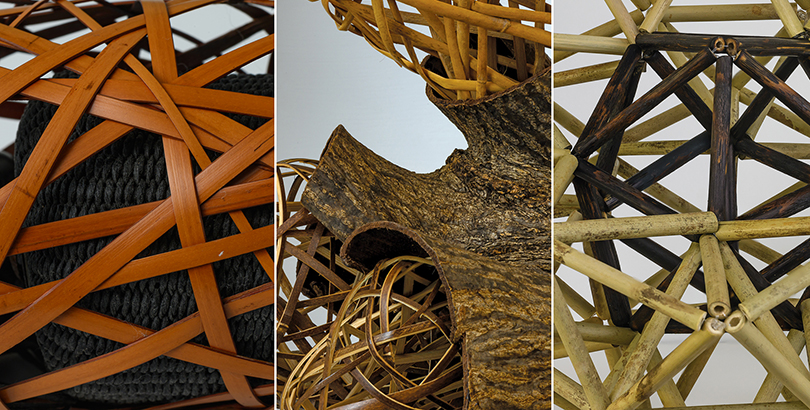
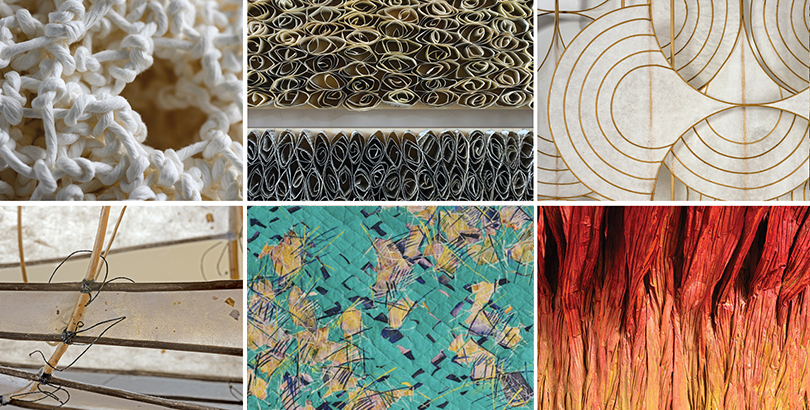
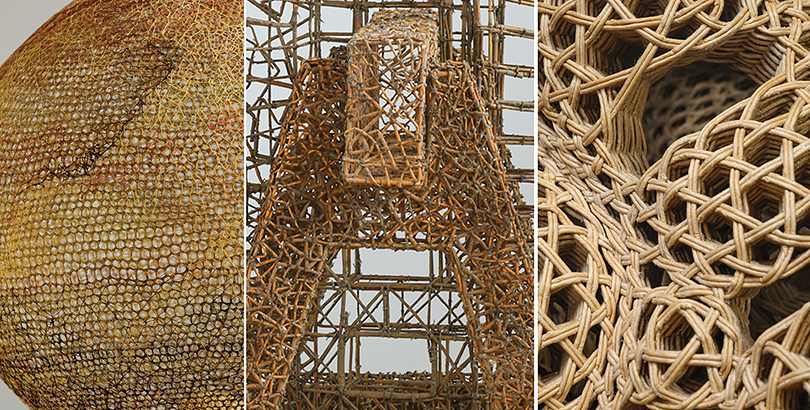
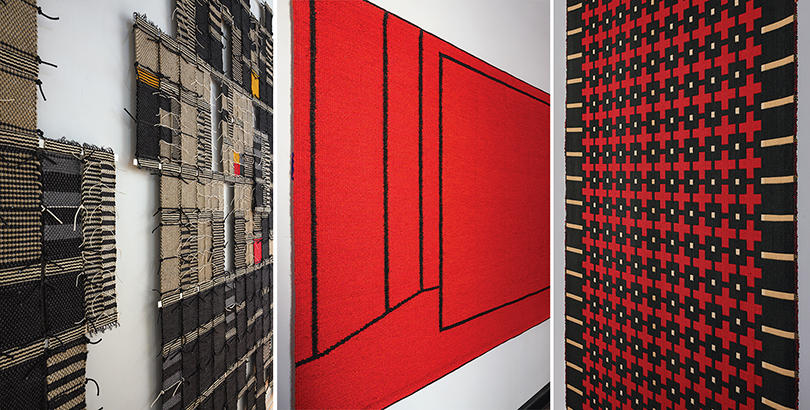
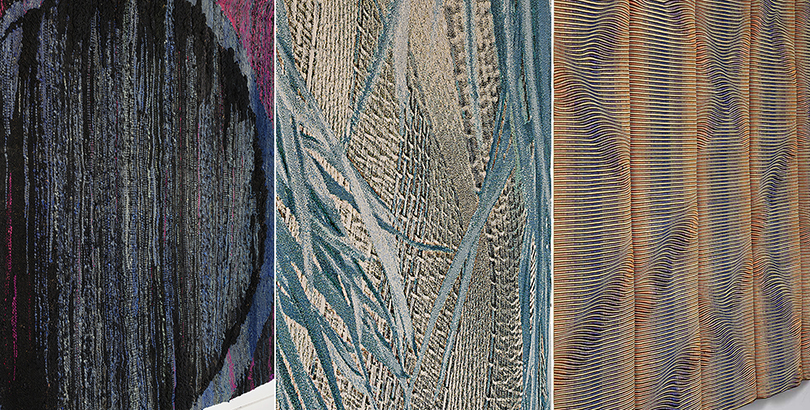
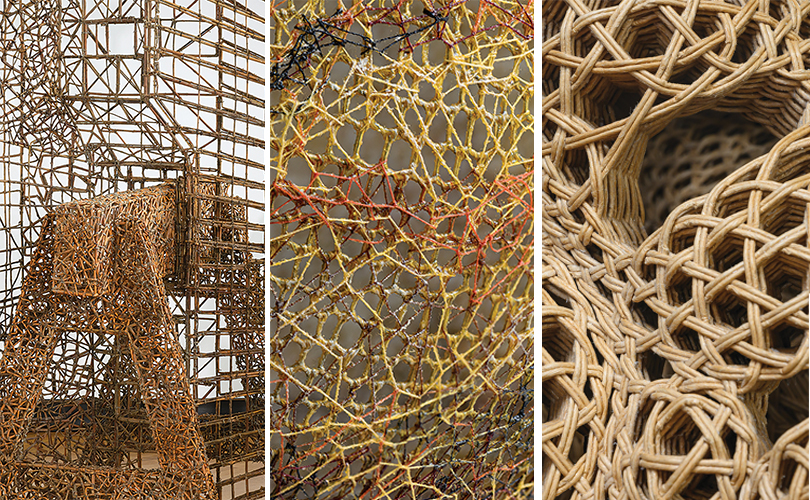
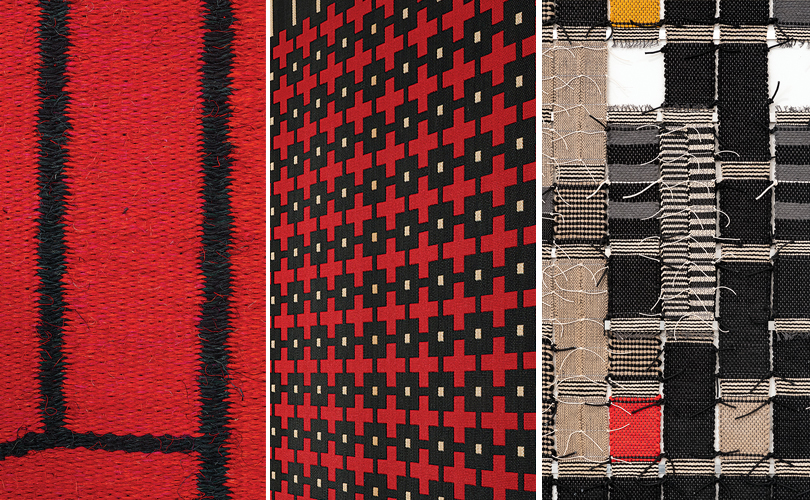
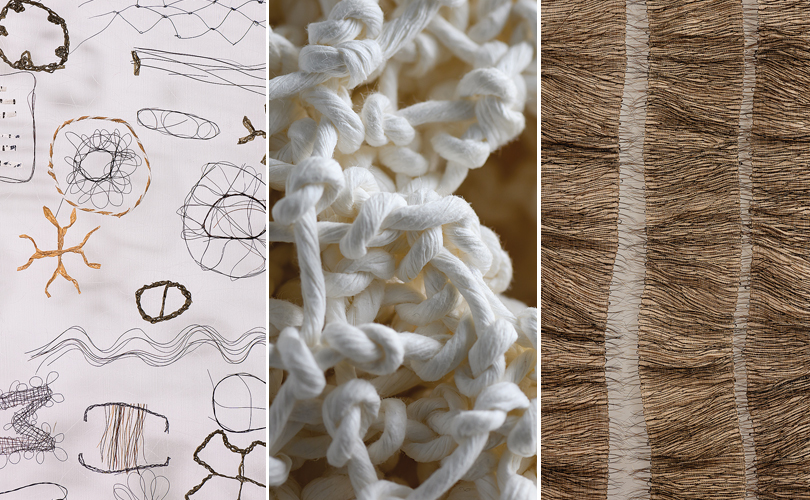
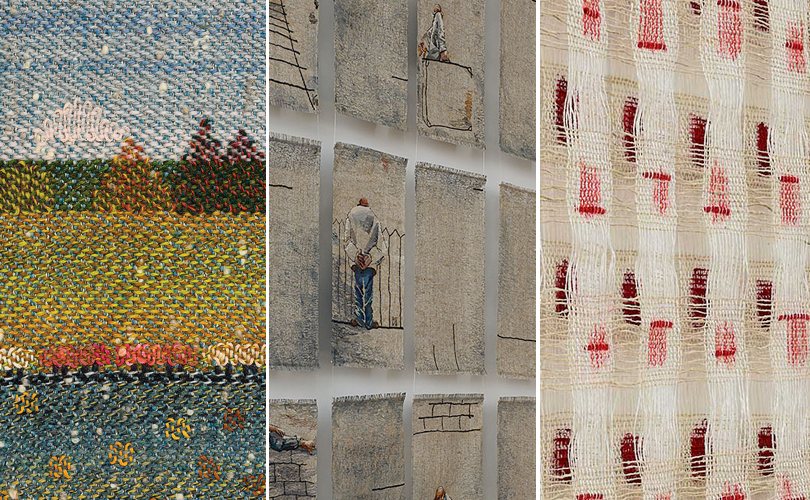
Well, not under the microscope precisely, but in this week’s arttextstyle, we take an up-close-and-personal look at some of the materials highlighted in browngrotta arts’ current exhibition, Transformations: dialogues in art and materials (May 9 – 17, 2026).

Dominic Di Mare Kyoko Kumai details
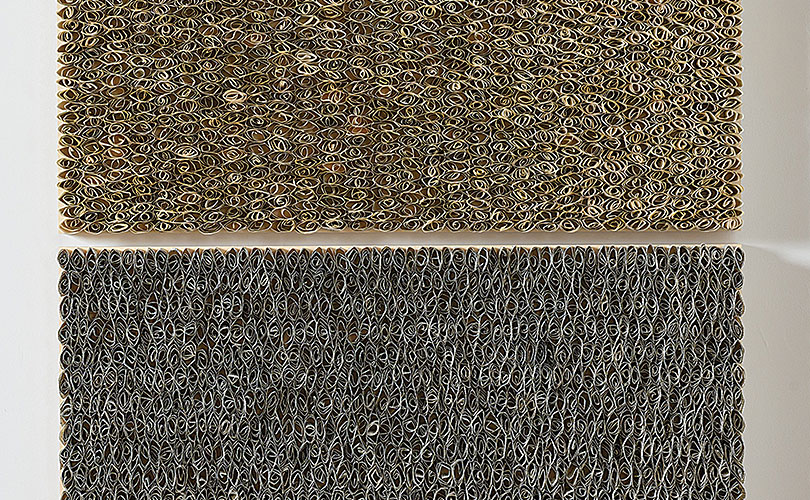
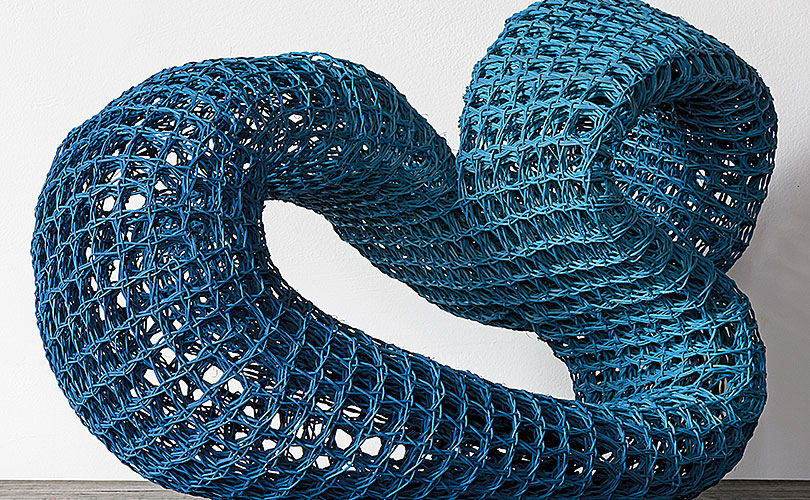
29ddm Mourning Station #4, detail, Dominic Di Mare, hawthorn, handmade paper, silk, bone, bird’s egg, feathers, gold and wood beads, 13″ x 7″ x 7″, 1981. 49kk A Beginning-Sdetail, Kyoko Kumai, stainless steel filaments, gold filaments, 6″ x 6″ x 6″, 2025. Photos by Tom Grotta

In the catalogs we produce for most exhibitions we curate (63 to date) we often include detail shots. In the volume for Transformations, however, we’ve highlighted installations — specifically, groupings of works made of the same materials, executed by different artists in strikingly different ways. We’ll take up the details here instead.

Sue Lawty and Kyoko Kumai details
43sl Coildetail, Sue Lawty, lead, 15.25″ x 12.25″ x 1.5″, 2023. 47kk Auroradetail, Kyoko Kumai, Crystal finished titanium, stainless steel, 18″ x 16″ x 4″, 1985. Photos by Tom Grotta

Feathers in art symbolize flight, spirituality and transformation. In Transformations, we’ve combined works that incorporate feathers by Chris Drury, Lewis Knauss, and Dominic Di Mare. Di Mare’s Mourning Station #4 is one of a series of altars, rune, and letter bundles. They remind of ancient ritual objects, of religious mysteries from vanished civilizations. An egg is concealed beneath the feathers. Di Mare suggests a spiritual path and also conjures memory and rebirth.

Another material we have explored in Transformations is metal, which offers unlimited options for expression. Stainless steel filaments are molded and woven by Kyoko Kumai while colored titanium is woven.

Mary Giles and Tsuruko Tanikawa details
45mg Categorical Evidence, detail, Mary Giles, copper, lead, iron on painted wood panel, 35” x 27”, 2010. 11tt Fuhkyohdetail, Tsuruko Tanikawa, linked copper, stainless steel wire, 14″ x 16.25″ x 7″, 2002. Photos by Tom Grotta

Lead becomes cryptic calligraphy in Sue Lawty’s hands and copper wire becomes figures in Mary Giles’ work and three-dimensional sculpture when layered by Tsuroko Tanikawa.

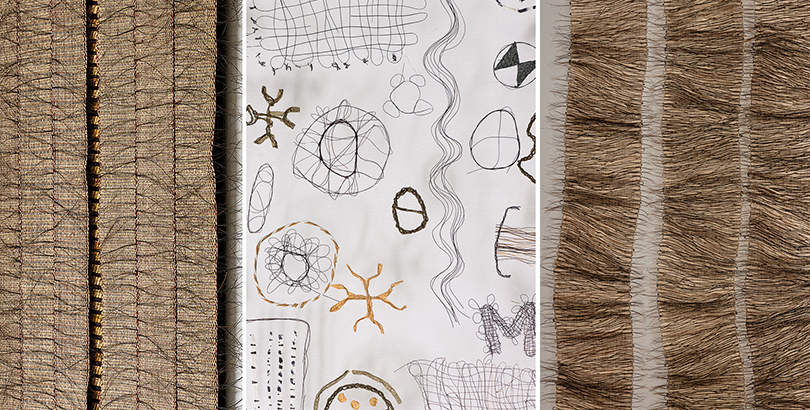
Elemental fibers are often the choice of artists at browngrotta arts. In Transformations, cotton, ramie, linen, jute are among the traditional fibers featured. Flax gets a wall of its own. Susie Gillespie and Irina Kolesnikova create fiber paintings of flax, with images of a cottage and a curious character, who Kolesnikova calls her alter ego. Also paired are a walnut bark box by Masako Yoshida stitched with flax thread and Stéphanie Jacques’ humanoid flax sculpture mounted on a copper plate. 

And there are more — seaweed (Jeannet Leendertse), clay (Toshiko Takaezu, Yasuhisa Kohyama, Valerie Pragnell, Stéphanie Jacques), stones (Christine Joy, Dorothy Gill Barnes, Stéphanie Jacques), and willow (Dail Behennah, Esmé Hofman, John McQueenStéphanie Jacques) just to name a few.

Masako Yoshida and Jeannet Leendertse details
14my Air Hole #838, detail, Masako Yoshida, walnut and flax, 8″ x 8″ x 7″, 2017. 18jle Flat Holding Vessel, Jeannet Leendertse, coiled stitched rockweed (ascophyllum nodosum), waxed linen, beeswax, tree resin, 17.5″ x 16″ x 3.25″, 2025. Photos by Tom Grotta

Join us at Transformations  through May 17th — many more images on our website: https://browngrotta.com/.


The Moon as Muse

The Guardian said it well: “If you’ve been looking up at the moon with childlike wonder these past few days, you aren’t alone. NASA’s Artemis II lunar mission has captured imaginations at a time when wonder and optimism are in short supply.” The photographs of the moon in IRL that resulted from the mission are breathtaking.

The dark side of the Moon NASA
Shadows at the Edge of Lunar Day: The edge of the Moon’s night and day creates shadows across the surface (Image credit: NASA)

Man has also looked to the moon for artistic inspiration through millennia. Artists who work with browngrotta arts not immune to celestial charm; we’ve gathered some examples here.

The travel website Fly Me to the Moon, lists possible reasons for the moon’s appeal. It could be the subconscious connection with the amorous ancient Greek goddess of the moon, Selene, or the moon’s association with fertility. 
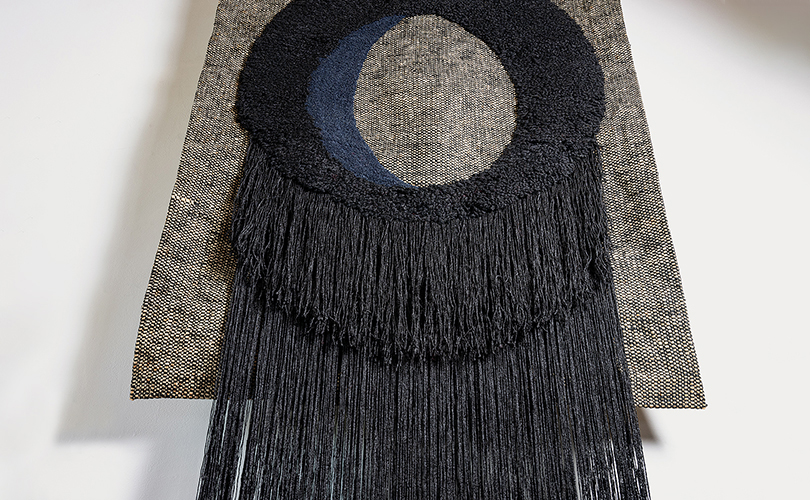
Dark Moon tapestry, Laura Foster Nicholson
19lf Dark Moon, Laura Foster Nicholson, wool with cotton, metallic, angelina fiber, ink, 34.5″ x 16″, 2017. photo by Tom Grotta

It could also be her ever changing nature that captures our attention. Her light illuminates our quietest and most contemplative hours. “In a dark sea of instability, the full moon in a richly deep blue sky is both reassuring and evocative,” says Laura Foster Nicholson. “Hints of reflective threads in Dark Moon aim to bring split seconds of insight and imagination, as do the stars.”

Or perhaps it’s simply the spectacle of moonlight. Paul Furneaux’s visit to the Norwegian fjords led to Fractured Moon, Fractured Mountain. He was particularly taken by the drama played on the fjords by the change of light, one half often shadowing the other — when translated to Fractured Moon, Fractured Mountain, it’s reminiscent of the drama of the familiar light and enigmatic sides of the moon.

Paul Furneaux sculpture
5pf Fractured Moon-Fractured Mountain, Paul Furneaux, Wood, gesso, Mokuhanga, graphite,card ,rice paste and acrylic, 15.75″ x 13.75″. photo courtesy Paul Furneaux

It’s also magical, and mystical. Golden Moon, by Norma Minkowitz, has a large, intricate orb rising up. It is a symbol of illumination, insight and mystery. “The moon is a metaphor for beauty in this world,” she says, “as well as acting as a source of light in the darkness”. Golden Moon is one of a series of vessel forms that Norma Minkowitz been creating since the 1990’s. The vessels represent containers of different thoughts: some dark, some optimistic and some, like Golden Moon, ethereal.

Norma Minkowitz Golden Moon
115nm Golden Moon, Norma Minkowitz, fiber, mixed media, 7.5” x 12” x 12”, 2024. photo by Tom Grotta

The moon has been used by artists to express “longing, change, the spiritual, the mysterious, and the sorrowful, according to WikiArt, the Visual Art Encyclopedia. In When Darkness Comes Calling, John 
McQueen wanted to capture that magical moment when a full moon comes out in a dark sky. The light and dark contrast is achieved by surrounding the white birch bark of the moon with the darker back sides of the pine and birch barks. The title of the piece comes from the lyrics of a song by Lily Kershaw, As It Seems. In The Other Side of the Moon, McQueen makes a tongue-in-cheek observation about our obsession with the moon. One side of the vessel reads: Man made up the man in the moon. The second side says: The first self-serve in no man’s land.

John McQueen moon sculptures
34jm After Dark Comes Calling, John McQueen, white pine and birch bark, 42’ x 36 x3″, 2017 and 62jm The Other Side of the Moon, Jon McQueen, bark and vine, 32″ x 18″ x 14″, 1993. photo by Tom Grotta

Works inspired by the moon that reflects a visual language that crosses geography and history. Here are moon-inspired works from artists in Venezuela and the UK. Eduardo Portillo and María Davila use indigo to illustrate the night, the moon, the sky, the clouds, the dawn; moments of every day; moments filled with blue. 

Eduardo Portillo & Maria Davila tapestry and Lizzie Farey willow sculpture
8pd Codigo Lunar (Moon Code), Eduardo Portillo & Maria Davila, silk, moriche palm fiber, alpca, silver leaf triple weave, 55.5″ x 12″, 2018   23lf Mignight Moon, Lizzie Farey, willow, wire, 33″ x 33″, 2024, photos by Tom Grotta

Wishing you many lunar interludes and the mystical magic that accompany them.


Process Notes: Norie Hatakeyama on Basketry Beyond the Expected

Norie Hatakeyama working on a large piece
Norie Hatakeyama at work. Photo by Ray Tanaka

In 1980, Norie Hatakeyama began studying basketmaking with Hisako Sekijima in Japan. Sekijima, who had studied basketry with Sandra Newman, John McQueen, and Ken and Kathleen Dalton in the US, was known for the innovative and nontraditional direction of her work. Hatakeyama felt “surprise and bewilderment, even joy,” when she encountered Sekijima’s methods. What most attracted her was Sekijima’s way of thinking was “that you must adopt an openminded approach to the basket.”

After a 40 prolific and successful years of art making, we’ve compiled Norie Hatakeyama’s thoughts on her basketry for this edition of Process Notes.

Norie Hatakeyama work in process. Photo by Ray Tanaka

My work involves creating three-dimensional forms using basketry techniques—taking materials in my hands and weaving them together. 

Basketry has a long history and has been practiced around the world using materials available in each region. The techniques themselves have changed very little over time. Because the entire process can be seen visually from beginning to end, it is easy to understand, and in principle anyone can make a basket. However, if one simply accepts and applies the technique without question, the result tends to be the same form regardless of who makes it, leaving seemingly little room for creation.

Norie Hatakeyama, Plaited Cube/242, Endless Line Series, Pits & Diagonal Lines
Norie Hatakeyama, Plaited Cube/242, Endless Line Series, Pits & Diagonal Lines, plaited Japanese rice paper, 7″ x 7″ x 6″; 1998, photo by Tom Grotta

Imitating technique is one form of learning and is highly effective for improving skill, but it offers limited potential for creating new forms. As an artist, in order to develop my own approach to form-making, I try not to be bound by fixed ideas. I question existing techniques themselves and re-examine them. While maintaining a calm and attentive eye toward what is happening in the process, I consider ways to resolve the questions that arise from within it. Through this reflection, I continue weaving.

Detail Norie Hatakeyam Complex Plaiting basket
Norie Hatakeyama, Complex-Plaiting-Series, paper fiber strips, plaited, 9.5″ x 18″ x 16″, 2001, photo by Tom Grotta

Eventually, as if a dam has burst, the forms begin to change, and shapes beyond my expectations emerge. These are not forms I intentionally designed; rather, they are forms generated by the material and the method. When the material changes, the form changes, too. The forms appear—they come toward me. I feel less that I ‘made’ them, and more that I was ‘made to make’ them. In this process, the artist’s own consciousness is altered, and self-transformation occurs.

Norie Hatakeyam Complex Plaiting basket
Norie Hatakeyama, Two Holes A 104, plaited paper fiber strips, 11″ x 41″, 9″, 2001. Photo by Tom Grotta

I came to realize that the forms and formative processes of many of my works—though not created as intentional imitation—closely resemble living beings found in nature (and their generative principles). That was a moment when the activity of life and my work of making forms resonated with each other.

The accumulation of small acts of ‘re-examining methods’ has brought many realizations. That became the catalyst for the emergence of my own new approach to form-making. How rich with surprise and joy the repetition of simple actions can be. My days of creation are filled with treasures of questions and wonder. All of these rest within my hands as I continue weaving, again and again.

Norie Hatakeyama, Complex Hexagonal Plaiting Spiral,
Norie Hatakeyama, Complex Hexagonal Plaiting Spiral, paper, string, plaited, 7″ x 26″ x 22″, 1994. Photo by Tom Grotta

From a mathematical point of view, my baskets turn out to polyhedra shapes abstracted in pure geometry. However, that doesn’t mean I created the form using geometrical structure. It means the form has appeared as redefined. Geometry might be incorporated into the method, but it would seem that the forms come out from another world.

In basketry, the expanse is infinite. Making baskets is not just denying the chaotic world and one’s own inconsistency; it reaffirms those things. There is no point in asking whether my work is mathematics, art, or science, because I would say that the basketry formula is the very formula itself for nature.

Norie Hatakeyama
1999 and 2026

Norie Hatakeyam Complex Plaiting basket
Norie Hatakeyama, Complex Plaiting Series – Connection I-9609, paper fiber strips, 21″ x 22″ x 19″, 1996. Photo by Tom Grotta

Norie Hatakeyama’s work Complex Plaiting Series – Connection I-9609 will be included in browngrotta arts’ up coming exhibition, Transformations: dialogues in art and materials (May 9-17, 2026).


Save the Date! Transformations: Dialogues in Art and Material Opens in May

John McQueen, Marian Bijlenga, Kiyomi Iwata
works by John McQueen, Marian Bijlenga, Kiyomi Iwata. Photo by Tom Grotta

Mark your calendars! From May 9 through May 18, 2026, browngrotta arts will present Transformations: Dialogues in Art and Material, a Spring exhibition exploring the expressive power of materials and the inventive ways contemporary artists transform them.

Norie Hatekayama sculpture
24nh Complex Plaiting Series – Connection I-9609, Norie Hatekayama, paper fiber strips, 21″ x 22″ x 19″, 1996. Photo by Tom Grotta

Featuring works by more than nearly three dozen international artists, Transformations will examine materiality as a central force in artistic practice. Clay, silk, steel, bark, seaweed, bamboo, horsehair, cotton, linen, flax, and other materials are not treated as passive elements, but as active agents—each with its own history, constraints, and expressive possibilities. The exhibition highlights both the remarkable diversity of materials and the distinct outcomes achieved when artists work within the same medium.

Waxed linen wall figures by Mary Giles
71mg Annointed Procession, Mary Giles, waxed linen, wire, 31″ x 19″, 1995. Photo by Tom Grotta

The artists in Transformations exemplify what curator and historian Glenn Adamson calls “material intelligence”: a deep understanding of the physical world and the skill to give materials new form and meaning. Through thoughtful engagement, abstract ideas are transformed into tangible, sensory experiences, bridging the conceptual and the corporeal.

“The artists inTransformations may begin with the same material but through their singular instincts and inspirations they generate strikingly different results,” says Tom Grotta, co-curator of browngrotta arts. “It’s a testament to the power of the artistic imagination.” Examples include Kiyomi Iwata who creates freestanding sculptures of spun silk and shimmering wall works of kibisio, the first silk from the cocoon and Polly Barton who weaves images from silk threads that she has bound and dyed. In cotton, Simone Pheulpin and Mercedes Vicente create objects of cotton webbing that seem to have emerged from nature — resembling coral, shells, and stones, while Kay Sekimachi uses split-ply and card-weaving techniques to create loops of cotton cord to hold shells and stones sourced from the beach. Toshiko Takaezu forms smooth columns of clay, Yasuhisa Kohyama’s clay vessels seem to have been carved directly from a mountainside, and Karen Karnes creates functional pots that incorporate color yet retain the natural cast of fired clay, defying all sense of the manmade.

Kyoko Kumai Steel tapestry
46kk Sudare, Kyoko Kumai, stainless steel, 70.75″ x 50.75″ x 2″, 2000. Photo by Tom Grotta

A full-color catalog will accompany the exhibition.

Exhibition Details

Location:
276 Ridgefield Road, Wilton, CT 06897

Dates & Hours:

  • Saturday, May 9 (Opening & Artists’ Reception): 11 am–6 pm
  • Sunday, May 10: 11 am–6 pm
  • Monday–Saturday, May 11–16: 10 am–5 pm
  • Sunday, May 17: 11 am–6 pm

Schedule Your Visit

Stay tuned for more information—and we hope you’ll join us this spring for Transformations at browngrotta arts.

Coconut Fiber weaving by Carolina Yrarrazaval
23cy.1 Verde Esperanza, Carolina Yrarrazaval, linen and coconut, 62” x 26.75”, 2022. photo by Tom Grotta

Save the Date! The Spring 2026 exhibition at browngrotta arts, Transformations: Dialogues in Art and Material, scheduled for this May 9 – 17, 2026 in Wilton, Connecticut, will take a deep dive into materiality itself. It will explore the wide range of materials artists employ—including clay, silk, steel, bark, seaweed, bamboo, and horsehair—and the varied transformations these materials undergo in talented hands, even among artists working with the same medium. Transformations: dialogues in art and material will highlight the use of diverse materials and the varied ways in which artists reshape and reimagine a single material within their practices. 

Tourbillons by Simone Pheulpin
17-20sp Tourbillons, Simone Pheulpin, cotton, slate, 7.75″ x 7.75″ x 2.25″ each , 2003. Photo by Tom Grotta

We’d like to display works by you, Polly Barton, and Kiyomi Iwata to show varying uses of silk, works by Kay Sekimachi, Simone Pheulpin, Mercedes Vicente, and Sophie Rowley in cotton, works by John McQueen, Hisako Sekimachi, Dona Look, Linda Bills and Polly Sutton in tree bark, and so on. The artists included will all meet curator and historian Glenn Adamson’s definition of material intelligence: “a deep understanding of the material world around us, an ability to read that material environment, and the know-how required to give it new form…”

Transformations examines the use of diverse materials in art and the many ways artists reshape and reimagine a single material within their practices. The Spring 2026 exhibition at browngrotta arts, Transformations: Dialogues in Art and Material, takes a deep dive into materiality itself. It highlights the wide range of materials artists employ—including clay, silk, steel, bark, seaweed, bamboo, and horsehair—and the remarkable transformations these materials undergo in their skilled hands, even among artists working with the same medium.


browngrotta arts’ 2025 Year in Review

We’ve had another busy 12 months. Below are the highlights. You can learn more about most of these events in previous arttextstyle posts or by using the search feature on our website. Thanks for being a part of another successful year celebrating art textiles, the artists that make them, and the fans that enjoy them.

Month by Month
January 2025:

Japandí Revisited: shared aesthetics and influences, in Wayne Art Center, Pennsylvania
Japandi Revisted at the Wayne Art Center. Photo by Tom Grotta

• Japandí Revisited: shared aesthetics and influences, continued at the Wayne Art Center, Pennsylvania 

Japandí Revisited: shared aesthetics and influences walk-thru
Tom Grotta artist walkthrough, Japandi Revisted at the Wayne Art Center. Photo by Rhonda Brown

A Japandí Revisited walkthrough with Tom Grotta took place at the Wayne Art Center, Pennsylvania

February 2025:

• American Craft magazine published: “A World of Fiber, browngrotta arts,” Deborah Bishop

browngrotta arts featured in American Craft Magazine
American Craft Magazine feature on browngrotta arts

March 2025:

Olga de Amaral,  at the Cartier Foundation and Simone Pheulpin
Olga de Amaral Cartier Foundation exhibition and Simone Pheulpin in her studio in Paris. Photos by Tom Grotta

• Tom and Carter Grotta and Rhonda Brown visited Paris to photograph exceptional artist Simone Pheulpin and view the extraordinary exhibition, Olga de Amaral,  at the Cartier Foundation

Shoko Fukuda featured in Centurion Magazine

• Centurion magazine published, “Shaping Heritage,” by Kaoru Kijima, which featured work by Shoko Fukuda

May 2025:

Three Silvermine exhibitions curated by browngrotta arts, Including Norma Minkowitz in front of her work in Masters of the Medium: CT. Photos by Tom Grotta

• The Silvermine Art Galleries in New Canaan, CT invited browngrotta arts to jury its FIBER 2025 invitational. We also installed two exhibitions in their galleries, Masters of the Medium: CT: Helena Hernmarck and Norma Minkowitz and Mastery and Materiality: International

• A FIBER 2025 walkthrough with Tom Grotta and Rhonda Brown took place at the Silvermine Art Galleries, New Canaan, CT

WEFAN opening reception at the Hughes Memorial Library, in West Cornwall, CT. Photo by Tom Grotta

• browngrotta arts loaned work to WEFAN, a group exhibition curated by Dina Lov Wright of Lov Art. Housed in the Hughes Memorial Library, in West Cornwall, CT, WEFAN featured works by 12 artists — including Dorothy Gill Barnes and Ed Rossbach — who work with fiber techniques and materials 

Field Notes: an art survey exhibition at browngrotta arts.
Field Notes: an art survey exhibition at browngrotta arts. Photo by Tom Grotta

• Field Notes: an art survey, browngrotta arts’ Spring Art in the Barn exhibition, opened

Shoko Fukuda and Włodzimierz Cygan
Shoko Fukuda and Włodzimierz Cygan at the opening of Field Notes: an art survey. Photos by Tom Grotta

• Out-of-the-area Artist Visits: Christine Joy (Montana), Wlodzimierz Cygan and granddaughter, Wiktoria (Poland), and Shoko Fukuda (Japan), visited the gallery, attending the opening of Field Notes and the artists’ dinner after.

Field Notes: an art survey exhibition catalog
Field Notes: an art survey, the exhibition catalog

• Field Notes: an art survey, the catalog, is published (our 60th)

June 2025:

Rhonda hosts art on the rocks at studio 67 podcast studio
Rhonda hosts art on the rocks at studio 67 podcast studio. Photo by Tom Grotta

• Art on Rocks: an art walkthrough with spirits, Field Notes edition — is presented on Zoom

• Fiberworks then and now: Ruth Asawa and Kay Sekimachi and their remarkable innovations. a panel discussion with Melissa Leventon, Jill D’Alessandro, Yoshiko Wada, and Tom Grotta — was presented on Zoom

September 2025: 

Kay Sekimachi: a personal archive, a collaboration between browngrotta arts and the Andrew Kreps Gallery in New York City
Kay Sekimachi: a personal archive, a collaboration between browngrotta arts and the Andrew Kreps Gallery in New York City. Photo by Tom Grotta

• Kay Sekimachi: a personal archive, a collaboration between browngrotta arts and the Andrew Kreps Gallery in New York City opened — Sekimachi’s first solo exhibition in NYC since 1970

Yong Joo Kim in front of her work, Weight of Commitment: 4 Years Old
Yong Joo Kim in front of her work, Weight of Commitment: 4 Years Old. Photo by Tom Grotta

• Out-of-the-area Artist Visit: Yong Joo Kim, who splits her time between Chicago and Korea, visited the gallery in CT

Weaves of Meaning: the Art of Anneke Klein Between Minimalism and Social Awareness, T-X txtilezine

• T-X, txtilezine  published,”Weaves of Meaning: the Art of Anneke Klein Between Minimalism and Social Awareness,” by Barbara Pavel

The Gently Monumental,” by Anneke Enquist about Helena Hernmarck in Form magazine

•  FORM magazine published “The Gently Monumental,” by Anneke Enquist, an article about artist Helena Hernmarck

It All Starts With Materials: the Art of Aby Mackie
Fiber Art Now magazine Fall 2025 issue, It All Starts With Materials: the Art of Aby Mackie

October 2025: 

•  Beauty is Resistance: art as antidote, browngrotta arts’ Fall Art in the Barn exhibition, opened

Beauty is Resistance, subversive textile art at browngrotta arts
Beauty is Resistance, subversive textile art at browngrotta arts. Photo by Tom Grotta

• Cover magazine published Beauty is Resistance, subversive textile art at browngrotta arts

Cover Magazine covers browngrotta arts Beauty is Resistance: art as antidote exhibition

• Out-of-the-area Artist Visit: Jin-Sook So joined us at browngrotta arts for the opening of Beauty is Resistance and the artists dinner after.

Jin-Sook So besides her Soul of a Bowl series of wire mesh baskets
Jin-Sook So besides her Soul of a Bowl series of wire mesh baskets. Photo by Tom Grotta

• The New York Times, publishes “There’s a Hornet’s Nest in the Living Room. On Purpose.” by Misty White Sidell, which featured Wendy Wahl and Kay Sekimachi• Beauty is Resistance: art as antidote, the catalog, is published (our 61st)

• Centurion magazine article, “A Stitch in Time,” by Jemima Sissons, is published, mentioning Kay Sekimachi, Mariette Rousseau-Vermette, Dominic DiMare, and John McQueen.

Centurion magazine article, “A Stitch in Time,” by Jemima Sisson’s

November 2025: 

art on the rocks Beauty is Resistance edition
art on the rocks Beauty is Resistance edition, now on Zoom


• Art on Rocks: an art walkthrough with spirits, Beauty is Resistance edition — is presented on Zoom

December 2025:

Adela Akers, Drape, 2017 and Lia Cook, Material Pleasures: Artemisia, 1993. photo courtesy of Hollis Taggart Gallery in New York City
Adela Akers, Drape, 2017 and Lia Cook, Material Pleasures: Artemisia, 1993. Photo courtesy of Hollis Taggart Gallery in New York City

• browngrotta arts loaned work by Adela Akers and Lia Cook to Drop, Cloth at Hollis Taggart Gallery in New York City. Curated by Glenn Adamson and Severin Deifs and spanning two Chelsea galleries, Drop, Cloth presented a 50-year lineage of draping in contemporary art.

Other News:
Acquisitions

Transition by Neha Puri Dhir, 2015. Photo by Tom Grotta

Transition by Neha Puri Dhir was acquired by the John and Mable Ringling Musuem in Sarasota, Florida

Four 1980s works of wearable art by Norma Minkowitz --  Outer Crater, Long Dress, Blue Jewel and Dusk — were acquired by the LACMA in Los Angeles, CA
Norma Minkowitz, Blue Jewel, Outer Crater, Dusk, Long Dress. 1980’s, photos courtesy of Norma Minkowitz

• Four 1980s works of wearable art by Norma Minkowitz —  Blue Jewel, Outer Crater, Long Dress, and Dusk — were acquired by the LACMA in Los Angeles, CA.

YouTube:
• browngrotta arts created 17 videos of artworks for its weekly artlive feature

• browngrotta arts created preview videos for Field Notes; Kay Sekimachi: a personal archive; and Beauty is Resistance

Social Media Outreach: 
• 31,911 emails from browngrotta arts were opened
• 41,822 people liked our Instagram content (a 14% increase over 2024)
• We gained 3,046 new followers to our Instagram account (a 90% jump over 2024)
• 24,819 people engaged with our Facebook posts (that’s a 96% increase over last year)
• We posted 52 times on arttextstyle.