<?xml version="1.0" encoding="UTF-8"?><feed
	xmlns="http://www.w3.org/2005/Atom"
	xmlns:thr="http://purl.org/syndication/thread/1.0"
	xml:lang="en-US"
	>
	<title type="text">arttextstyle</title>
	<subtitle type="text">contemporary art textiles and fiber sculpture</subtitle>

	<updated>2026-06-04T13:42:29Z</updated>

	<link rel="alternate" type="text/html" href="https://arttextstyle.com/" />
	<id>https://arttextstyle.com/feed/atom/</id>
	<link rel="self" type="application/atom+xml" href="https://arttextstyle.com/feed/atom/" />

	<generator uri="https://wordpress.org/" version="7.0">WordPress</generator>
	<entry>
		<author>
			<name>arttextstyle</name>
							<uri>http://www.browngrotta.com</uri>
						</author>

		<title type="html"><![CDATA[Art Out and About — a Busy Summer Season]]></title>
		<link rel="alternate" type="text/html" href="https://arttextstyle.com/2026/06/03/art-out-and-about-a-busy-summer-season/" />

		<id>https://arttextstyle.com/?p=14767</id>
		<updated>2026-06-04T13:42:29Z</updated>
		<published>2026-06-03T17:18:57Z</published>
		<category scheme="https://arttextstyle.com/" term="Exhibitions" /><category scheme="https://arttextstyle.com/" term="Diedrick Brackens" /><category scheme="https://arttextstyle.com/" term="Federica Luzzi" /><category scheme="https://arttextstyle.com/" term="Kay Sekimachi" /><category scheme="https://arttextstyle.com/" term="Nancy Koenigsberg" /><category scheme="https://arttextstyle.com/" term="Norma Minkowitz" /><category scheme="https://arttextstyle.com/" term="Sheila hicks" />
		<summary type="html"><![CDATA[<p>There are exciting exhibitions in diverse locales worldwide to visit this summer &#160;— from China to California, Italy to Connecticut.&#160; Federica Luzzi and Naoya Takahara: Exercises in Being Like OthersJune 4 &#8211; August 2, 2026Mattatoio di Roma, SlaughterhousePiazza Orazio Giustiniani, 400153 Romehttps://www.mattatoioroma.it/mostra/federica-luzzi-e-naoya-takahara-esercizi-per-essere-come-gli-altri Federica Luzzi, 3 giugno 2026 Mattatoio, foto Giorgio Benni 5 In Rome, sculptures,... </p>
<div class="read-more navbutton"><a href="https://arttextstyle.com/2026/06/03/art-out-and-about-a-busy-summer-season/">Read More<i class="fa fa-angle-double-right"></i></a></div>
<p><a href="https://arttextstyle.com">arttextstyle</a></p>
]]></summary>

					<content type="html" xml:base="https://arttextstyle.com/2026/06/03/art-out-and-about-a-busy-summer-season/"><![CDATA[
<p class="wp-block-paragraph">There are exciting exhibitions in diverse locales worldwide to visit this summer &nbsp;— from China to California, Italy to Connecticut.&nbsp;</p>


<p class="wp-block-paragraph"><em>Federica Luzzi and Naoya Takahara: Exercises in Being Like Others</em><br>June 4 &#8211; August 2, 2026<br>Mattatoio di Roma, Slaughterhouse<br>Piazza Orazio Giustiniani, 4<br>00153 Rome<br><a href="https://www.mattatoioroma.it/mostra/federica-luzzi-e-naoya-takahara-esercizi-per-essere-come-gli-altri">https://www.mattatoioroma.it/mostra/federica-luzzi-e-naoya-takahara-esercizi-per-essere-come-gli-altri</a></p>


<figure class="wp-block-image size-full is-resized"><img loading="lazy" decoding="async" width="810" height="500" src="https://arttextstyle.com/wp-content/uploads/2026/06/Federica-Luzzi-3-giugno-2026-Mattatoio-foto-Giorgio-Benni-5.jpg" alt="" class="wp-image-14779" style="width:810px;height:auto" srcset="https://arttextstyle.com/wp-content/uploads/2026/06/Federica-Luzzi-3-giugno-2026-Mattatoio-foto-Giorgio-Benni-5.jpg 810w, https://arttextstyle.com/wp-content/uploads/2026/06/Federica-Luzzi-3-giugno-2026-Mattatoio-foto-Giorgio-Benni-5-300x185.jpg 300w, https://arttextstyle.com/wp-content/uploads/2026/06/Federica-Luzzi-3-giugno-2026-Mattatoio-foto-Giorgio-Benni-5-768x474.jpg 768w" sizes="auto, (max-width: 810px) 100vw, 810px" /><figcaption class="wp-element-caption"><sup>Federica Luzzi, 3 giugno 2026 Mattatoio, foto Giorgio Benni 5</sup></figcaption></figure>


<p class="wp-block-paragraph">In Rome, sculptures, installations, fragile sheets, fabrics, stitching, and false monuments transform the pavilion of a former Slaughterhouse into a visual journey in which each piece is a song and a constant fear of suffering violence to the body, to one’s own body, and to its play. The two-person&nbsp;exhibition features&nbsp;<a href="https://browngrotta.com/artists/federica-luzzi">Federica Luzzi</a>, an Italian born in Rome, and Naoya Takahara, a Japanese born in Ehime but living in Rome since 1977.&nbsp;Separated (soul is never accessible), each works for the other; each dreams of the other’s respective East and West. The exhibition highlights two cultures and a shared search for propitious places —&nbsp;Luzzi through the constant trepidation of the body, the paralysing feminine sense; Naoya with the only comfort of being childlike.&nbsp;<br><br><em>Material Matters: Sheila Hicks and Shi Hui</em><br>Through August 2, 2026West Bund MuseumGallery 3<br>2600 Longteng Avenue, Xuhui District<br>Shanghai, China<br><a href="https://wbmshanghai.com/en/exhibition/1452-event-material-matters">https://wbmshanghai.com/en/exhibition/1452-event-material-matters</a></p>


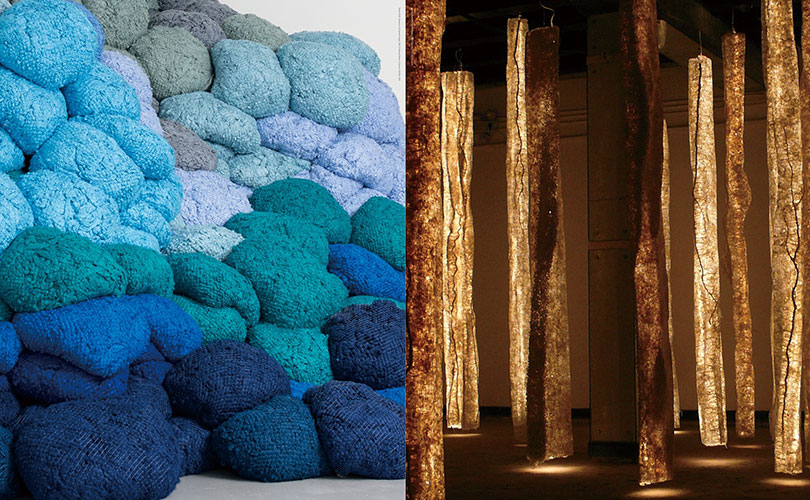
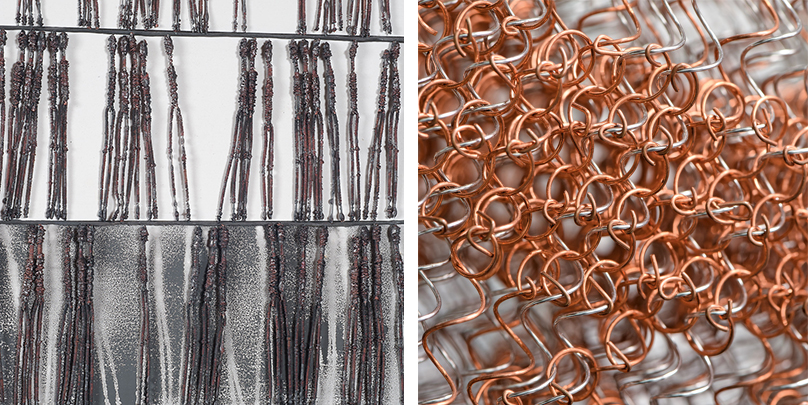
<figure class="wp-block-image size-full"><a href="https://wbmshanghai.com/en/exhibition/1452-event-material-matters"><img loading="lazy" decoding="async" width="810" height="500" src="https://arttextstyle.com/wp-content/uploads/2026/06/双手知道主视觉作品图-tG74gX-lEf8NK.jpg" alt="" class="wp-image-14772" srcset="https://arttextstyle.com/wp-content/uploads/2026/06/双手知道主视觉作品图-tG74gX-lEf8NK.jpg 810w, https://arttextstyle.com/wp-content/uploads/2026/06/双手知道主视觉作品图-tG74gX-lEf8NK-300x185.jpg 300w, https://arttextstyle.com/wp-content/uploads/2026/06/双手知道主视觉作品图-tG74gX-lEf8NK-768x474.jpg 768w" sizes="auto, (max-width: 810px) 100vw, 810px" /></a><figcaption class="wp-element-caption"><sup>Photo, Left: Sheila HICKS, Nowhere to Go (partial image), 2022©National Gallery of Victoria, NGVWA, 2024, Right: SHI Hui, Frozen Wind (partial image), 2004©Courtesy of Shi Hui, Hangzhou</sup></figcaption></figure>


<p class="wp-block-paragraph">In this pair of solo exhibitions in Shanghai, visitors are captivated by how&nbsp;<a href="https://browngrotta.com/artists/sheila-hicks">Sheila Hicks</a>&nbsp;intertwines threads, colors, and histories, and engages with softness and monumentality. At the same time, they decipher the multiple lives Shi Hui gives to paper pulp, and revel in the ways her work rekindles Chinese artistic traditions.</p>


<p class="wp-block-paragraph"><em>Subconscious Surfaced</em><br>Through August 29, 2026&nbsp;<br>Moderne Gallery&nbsp;<br>1705 N American St. STE 3,&nbsp;<br>Philadelphia, PA 19122<br><a href="https://modernegallery.com/subconscious-surfaced/?mc_cid=ebd45972ba">https://modernegallery.com/subconscious-surfaced/?mc_cid=ebd45972ba</a></p>


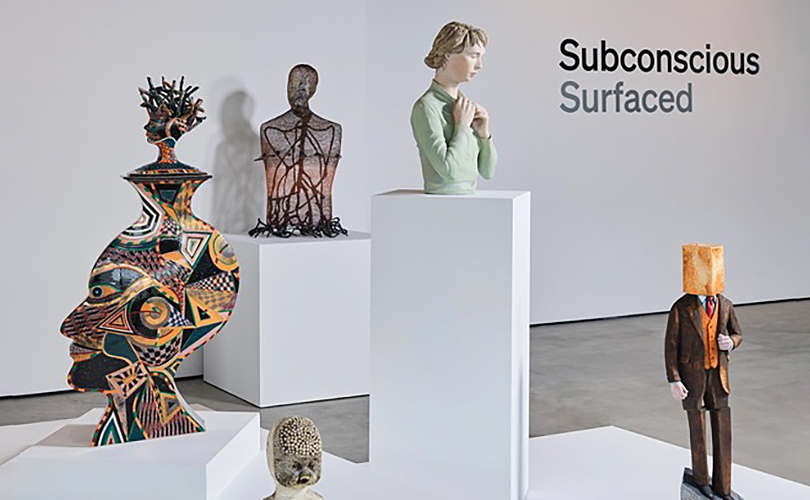
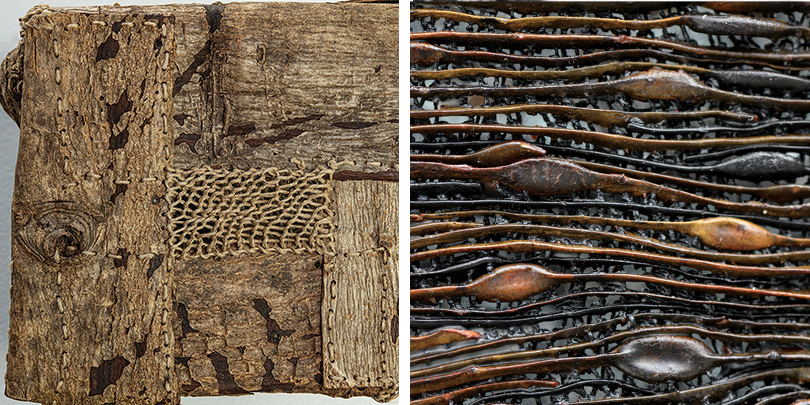
<figure class="wp-block-image size-full"><a href="https://www.mattatoioroma.it/mostra/federica-luzzi-e-naoya-takahara-esercizi-per-essere-come-gli-altri"><img loading="lazy" decoding="async" width="810" height="500" src="https://arttextstyle.com/wp-content/uploads/2026/06/Subconscious-Surfaced-Banner.jpeg" alt="" class="wp-image-14768" srcset="https://arttextstyle.com/wp-content/uploads/2026/06/Subconscious-Surfaced-Banner.jpeg 810w, https://arttextstyle.com/wp-content/uploads/2026/06/Subconscious-Surfaced-Banner-300x185.jpeg 300w, https://arttextstyle.com/wp-content/uploads/2026/06/Subconscious-Surfaced-Banner-768x474.jpeg 768w" sizes="auto, (max-width: 810px) 100vw, 810px" /></a><figcaption class="wp-element-caption"><sup>photo: Christian Giannelli for Moderne Gallery</sup></figcaption></figure>


<p class="wp-block-paragraph"><em>Subconscious Surfaced&nbsp;</em>is&nbsp;a group exhibition featuring works from the 1960s through the early 2000s. The exhibition, which includes the work of&nbsp;<a href="https://browngrotta.com/artists/norma-minkowitz">Norma Minkowitz</a>, explores a shared thread of surreal, otherworldly sculptural form across a range of expressions, techniques, and contexts. A number of works in the exhibition were acquired by Marc and Diane Grainer, renowned patrons, collectors, and champions of the arts, who assembled a singular collection over the course of more than 45 years.&nbsp;On view are works featuring figures, narratives, and compositions drawn from deep within the subconscious, emerging from a realm beyond the threshold of immediate awareness.</p>


<p class="wp-block-paragraph"><em>Diedrick Brackens: gather tender night</em><br>Through&nbsp;August 23, 2026<br>Yerba Buena Center for the Arts<br>701 Mission Street<br>San Francisco, CA<br><a href="https://ybca.org/event/diedrick-brackens-gather-tender-night/
">https://ybca.org/event/diedrick-brackens-gather-tender-night</a></p>


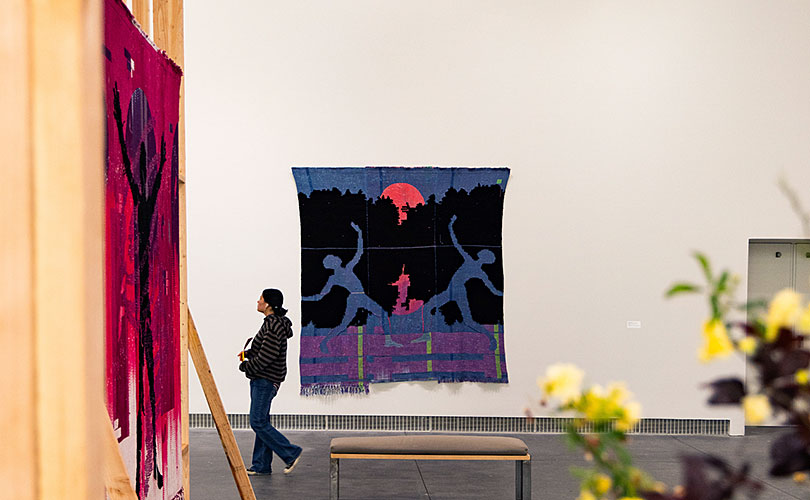
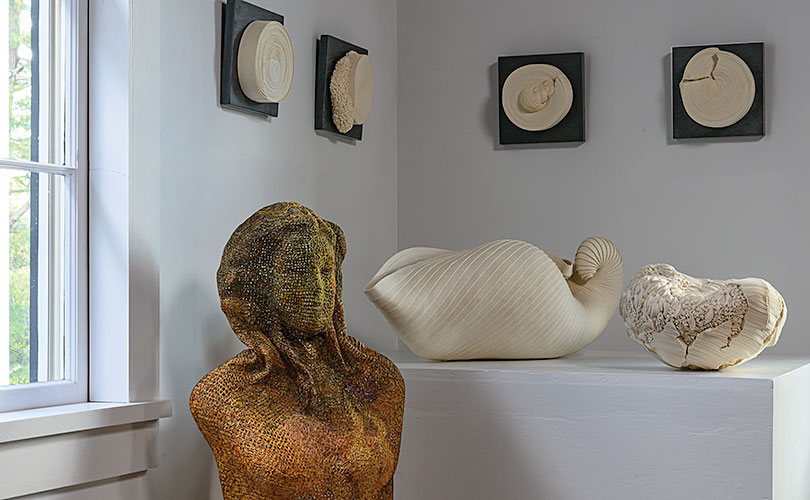
<figure class="wp-block-image size-full"><a href="https://ybca.org/event/diedrick-brackens-gather-tender-night/"><img loading="lazy" decoding="async" width="810" height="500" src="https://arttextstyle.com/wp-content/uploads/2026/06/owXthZmu.jpg" alt="" class="wp-image-14770" srcset="https://arttextstyle.com/wp-content/uploads/2026/06/owXthZmu.jpg 810w, https://arttextstyle.com/wp-content/uploads/2026/06/owXthZmu-300x185.jpg 300w, https://arttextstyle.com/wp-content/uploads/2026/06/owXthZmu-768x474.jpg 768w" sizes="auto, (max-width: 810px) 100vw, 810px" /></a><figcaption class="wp-element-caption"><sup>photo: Corey Marsau, courtesy of YBCA</sup></figcaption></figure>


<p class="wp-block-paragraph"><em>Diedrick Brackens: gather tender night</em>&nbsp;is the textile artist’s first solo exhibition in the Bay Area of California, featuring fifteen weavings created since 2020, that consider tenderness, migration, and connections with the natural world.&nbsp;Executed on the loom in hand-dyed, cotton fiber and acrylic yarn, Brackens’s works convey a masterful and meditative process of physical discovery and storytelling.</p>


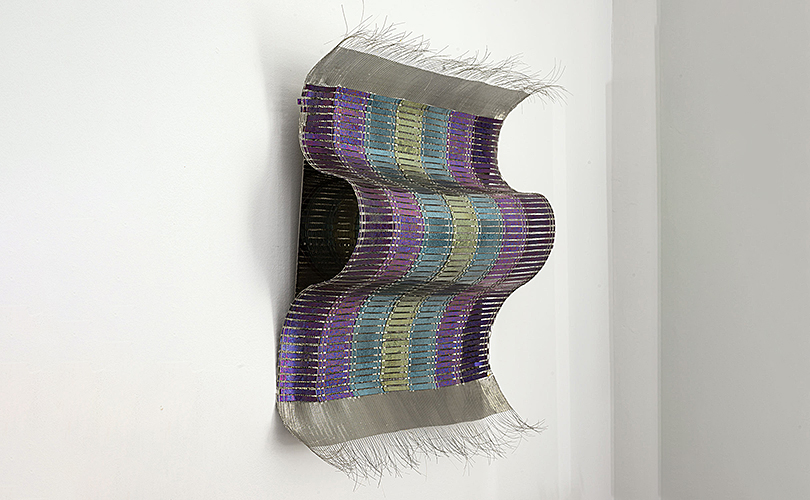
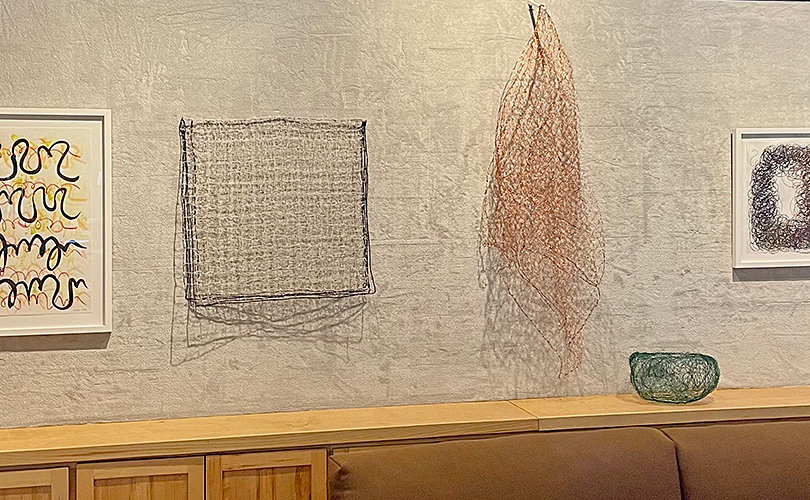
<p class="wp-block-paragraph"><em>WRIT and WEFTED: Sally Van Doren, paintings and drawings; Nancy Koenigsberg, woven wire sculptures</em><br>Through June 21st.<br>Daphne:art Gallery and Advisory<br>Bantam, CT.&nbsp;Through June 21st.&nbsp;<br>By appointment:&nbsp;<a href="mailto:daphneadeeds@gmail.com">daphneadeeds@gmail.com</a></p>


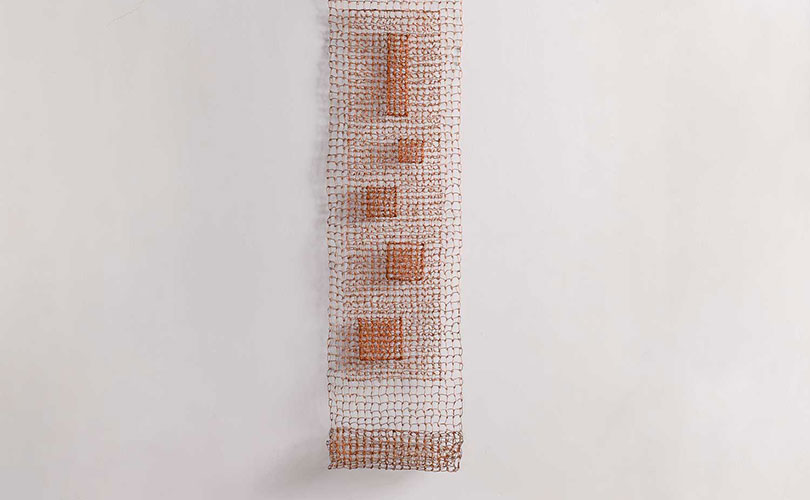
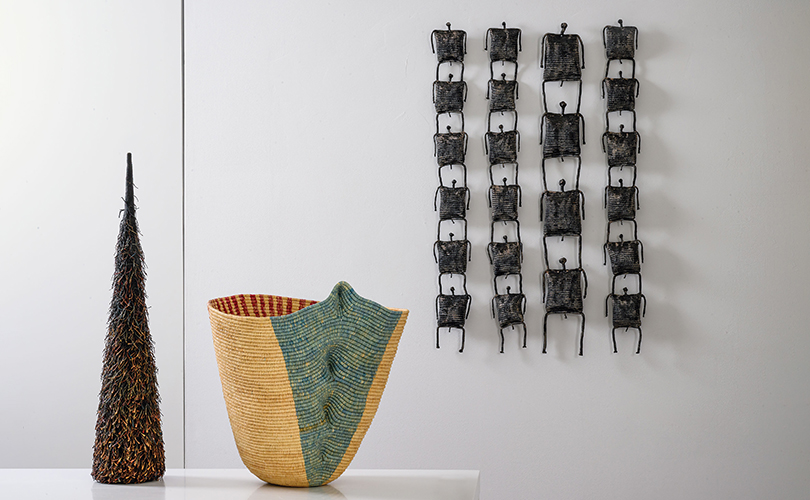
<figure class="wp-block-image size-full"><a href="https://arttextstyle.com/wp-content/uploads/2026/06/58nak-Pocket-Scroll-2.jpg"><img loading="lazy" decoding="async" width="810" height="500" src="https://arttextstyle.com/wp-content/uploads/2026/06/58nak-Pocket-Scroll-2.jpg" alt="" class="wp-image-14773" srcset="https://arttextstyle.com/wp-content/uploads/2026/06/58nak-Pocket-Scroll-2.jpg 810w, https://arttextstyle.com/wp-content/uploads/2026/06/58nak-Pocket-Scroll-2-300x185.jpg 300w, https://arttextstyle.com/wp-content/uploads/2026/06/58nak-Pocket-Scroll-2-768x474.jpg 768w" sizes="auto, (max-width: 810px) 100vw, 810px" /></a><figcaption class="wp-element-caption"><sup>58nak<a href="https://browngrotta.com/artworks/58nak1-pocket-scroll"> </a><em>Pocket Scroll</em>, Nancy Koenigsberg, twisted copper, 73.5&#8243; x 17.5&#8243; x 6&#8243;, 2007. Photo by Tom Grotta</sup></figcaption></figure>


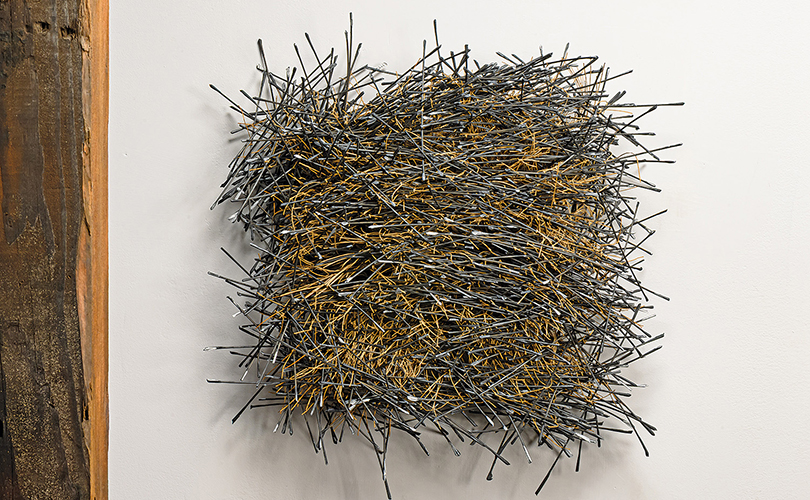
<p class="wp-block-paragraph">In reviewer Julie Durkin’s words, the exhibition pairs, “two artists who both work at the boundary between language and material.”&nbsp;Sally Van Doren is a poet who works with illegible handwriting.&nbsp;<a href="https://browngrotta.com/artists/nancy-koenigsberg">Nancy Koenigsberg</a>&nbsp;“draws”&nbsp;with wire —&nbsp;nets and mats, cubes and chains —&nbsp;that suggest fascinating interior and shadow lives</p>


<figure class="wp-block-image size-full"><a href="https://browngrotta.com/artworks/166k-haleakala-3"><img loading="lazy" decoding="async" width="810" height="500" src="https://arttextstyle.com/wp-content/uploads/2026/06/166k-Haleakala-3.jpg" alt="" class="wp-image-14774" srcset="https://arttextstyle.com/wp-content/uploads/2026/06/166k-Haleakala-3.jpg 810w, https://arttextstyle.com/wp-content/uploads/2026/06/166k-Haleakala-3-300x185.jpg 300w, https://arttextstyle.com/wp-content/uploads/2026/06/166k-Haleakala-3-768x474.jpg 768w" sizes="auto, (max-width: 810px) 100vw, 810px" /></a><figcaption class="wp-element-caption"><sup>166k <em>Haleakala-3</em>, Kay Sekimachi, linen, heat transfer print on warp, overeprinting and double weave, buckrum and stich witchery, 3.625&#8243; x 5.375&#8243; x 31&#8243;, 1999. Photo by Tom Grotta</sup></figcaption></figure>


<p class="wp-block-paragraph">Mark your calendar for the fall:&nbsp;<em><a href="https://www.barnesfoundation.org/exhibitions/noguchi-to-asawa-designing-postwar-america"><em>Noguchi to Asawa: Designing Postwar America</em></a>,&nbsp;</em>which will include work by Ruth Asawa and&nbsp;<a href="https://browngrotta.com/artists/kay-sekimachi">Kay Sekimachi</a>, among others. It will open at the Barnes Foundation in Philadelphia, Pennsylvania on September 20, 2026.</p>


<p class="wp-block-paragraph">Enjoy!</p>


<p class="wp-block-paragraph"></p>
<p><a href="https://arttextstyle.com">arttextstyle</a></p>
]]></content>
		
					<link rel="replies" type="text/html" href="https://arttextstyle.com/2026/06/03/art-out-and-about-a-busy-summer-season/#comments" thr:count="0" />
			<link rel="replies" type="application/atom+xml" href="https://arttextstyle.com/2026/06/03/art-out-and-about-a-busy-summer-season/feed/atom/" thr:count="0" />
			<thr:total>0</thr:total>
			</entry>
		<entry>
		<author>
			<name>arttextstyle</name>
							<uri>http://www.browngrotta.com</uri>
						</author>

		<title type="html"><![CDATA[Art Assembled: New Work in May]]></title>
		<link rel="alternate" type="text/html" href="https://arttextstyle.com/2026/05/27/art-assembled-new-work-in-may/" />

		<id>https://arttextstyle.com/?p=14758</id>
		<updated>2026-05-26T12:50:34Z</updated>
		<published>2026-05-27T01:00:00Z</published>
		<category scheme="https://arttextstyle.com/" term="Art Assembled" /><category scheme="https://arttextstyle.com/" term="Irina Kolesnikova" /><category scheme="https://arttextstyle.com/" term="Kay Sekimachi" /><category scheme="https://arttextstyle.com/" term="Lewis Knauss" />
		<summary type="html"><![CDATA[<p>l5lk.1 Landscape Accumulation-#11, detail, Lewis Knauss, linen, hemp, paper twine, paint and reed, 22&#8243; x 21&#8243; x 9&#8243;, 1998. Photo by Tom Grotta This May in New this Week we presaged our Spring exhibition, Transformations: dialogues in art and materials, featuring works in which artists engaged with materials in intriguing ways. Landscape Accumulation #11 by Lewis Knauss is a powerful example of the materiality... </p>
<div class="read-more navbutton"><a href="https://arttextstyle.com/2026/05/27/art-assembled-new-work-in-may/">Read More<i class="fa fa-angle-double-right"></i></a></div>
<p><a href="https://arttextstyle.com">arttextstyle</a></p>
]]></summary>

					<content type="html" xml:base="https://arttextstyle.com/2026/05/27/art-assembled-new-work-in-may/"><![CDATA[
<figure class="wp-block-image size-full"><a href="https://browngrotta.com/artworks/5lk-1-landscape-accumulation-11"><img loading="lazy" decoding="async" width="810" height="500" src="https://arttextstyle.com/wp-content/uploads/2026/05/5lk.1-Landscape-Accumulation-11-810.jpg" alt="Lewis Knauss wall hanging" class="wp-image-14760" srcset="https://arttextstyle.com/wp-content/uploads/2026/05/5lk.1-Landscape-Accumulation-11-810.jpg 810w, https://arttextstyle.com/wp-content/uploads/2026/05/5lk.1-Landscape-Accumulation-11-810-300x185.jpg 300w, https://arttextstyle.com/wp-content/uploads/2026/05/5lk.1-Landscape-Accumulation-11-810-768x474.jpg 768w" sizes="auto, (max-width: 810px) 100vw, 810px" /></a><figcaption class="wp-element-caption">l5lk.1 <em><a href="https://browngrotta.com/artworks/5lk-1-landscape-accumulation-11">Landscape Accumulation-#11</a>, detail</em>, Lewis Knauss, linen, hemp, paper twine, paint and reed, 22&#8243; x 21&#8243; x 9&#8243;, 1998. Photo by Tom Grotta </figcaption></figure>


<p class="wp-block-paragraph">This May in <em>New this Week</em> we presaged our Spring exhibition, <em>Transformations: dialogues in art and materials,</em> featuring works in which artists engaged with materials in intriguing ways.<em> Landscape Accumulation #11</em> by <a href="https://browngrotta.com/artists/lewis-knauss">Lewis Knauss</a> is a powerful example of the materiality that we explored in <em>Transformations</em>. In this work, Knauss deftly combines linen, hemp, paper twine, paint, and reed in a work that references growth and memory. Alone, away from home at college, Knauss says he &#8220;was suddenly struck with nostalgia for the fields and forests of Macungie, Pennsylvania, where I was born. Increasingly conscious of how we create feelings of comfort from familiar places, the textile medium became my vehicle for expressing ideas about the importance of landscape.”</p>


<figure class="wp-block-image size-full"><a href="https://browngrotta.com/artworks/133k-last-card-weaving"><img loading="lazy" decoding="async" width="810" height="500" src="https://arttextstyle.com/wp-content/uploads/2026/05/133k-Last-Card-Weaving-810.jpg" alt="Kay Sekimachi card weaving" class="wp-image-14761" srcset="https://arttextstyle.com/wp-content/uploads/2026/05/133k-Last-Card-Weaving-810.jpg 810w, https://arttextstyle.com/wp-content/uploads/2026/05/133k-Last-Card-Weaving-810-300x185.jpg 300w, https://arttextstyle.com/wp-content/uploads/2026/05/133k-Last-Card-Weaving-810-768x474.jpg 768w" sizes="auto, (max-width: 810px) 100vw, 810px" /></a><figcaption class="wp-element-caption">133k <em><a href="https://browngrotta.com/artworks/133k-last-card-weaving">Last Card Weaving</a></em>, <a href="https://browngrotta.com/artists/kay-sekimachi">Kay Sekimachi</a>, polished cotton, cardwoven seamless tube, c. 2021, 29.125 x 13.125 x 2.5, 2021. photos by Tom Grotta </figcaption></figure>


<p class="wp-block-paragraph">The next work we highlighted was&nbsp;<em>Last Card Weaving&nbsp;</em>&nbsp;by&nbsp;<a href="https://browngrotta.com/artists/kay-sekimachi">Kay Sekimachi</a>.&nbsp;Sekimachi is a fiber artist and weaver, known as a “weaver’s weaver” for her unusual use of the loom in constructing three-dimensional sculptural pieces. She has created tubes and handwoven strips like&nbsp;<em>Last Card Weaving</em>&nbsp;of cotton and linen using card weaving — an ancient technique traced back to the Vikings. Fibers are threaded through cards — keeping the cards in place controls the pattern. She demonstrates the technique in a short&nbsp;<a href="https://www.craftinamerica.org/technique/weaving-a-tube-on-a-card-loom">video</a>&nbsp;from<em>&nbsp;Craft in America</em>. In the video, Sekimachi uses a board to hold the threads which was made by husband, noted woodturner, Bob Stocksdale.</p>


<figure class="wp-block-image size-full"><a href="https://browngrotta.com/artworks/33ik-the-garden-of-diverging-paths-II"><img loading="lazy" decoding="async" width="810" height="500" src="https://arttextstyle.com/wp-content/uploads/2026/05/33ik-The-Garden-of-Diverging-Paths-II-810.jpg" alt="Irina Kolesnikova textile" class="wp-image-14762" srcset="https://arttextstyle.com/wp-content/uploads/2026/05/33ik-The-Garden-of-Diverging-Paths-II-810.jpg 810w, https://arttextstyle.com/wp-content/uploads/2026/05/33ik-The-Garden-of-Diverging-Paths-II-810-300x185.jpg 300w, https://arttextstyle.com/wp-content/uploads/2026/05/33ik-The-Garden-of-Diverging-Paths-II-810-768x474.jpg 768w" sizes="auto, (max-width: 810px) 100vw, 810px" /></a><figcaption class="wp-element-caption">33ik <em><a href="https://browngrotta.com/artworks/33ik-the-garden-of-diverging-paths-II">The Garden of Diverging Paths II</a></em>, <a href="https://browngrotta.com/artists/irina-kolesnikova">Irina Kolesnikova</a>, figurative wall textile, 17.25&#8243; x 14.5&#8243;, 2025. Photo by Tom Grotta </figcaption></figure>


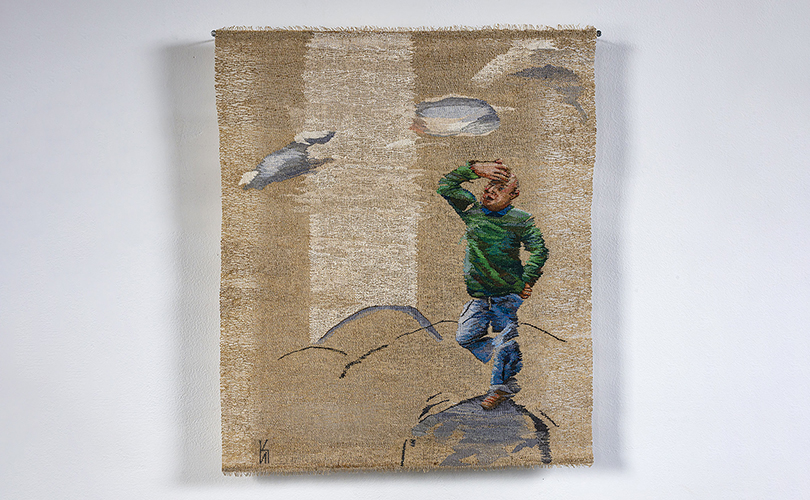
<p class="wp-block-paragraph"><em>The Garden of Diverging Paths II</em> is a recent work in flax by<a href="https://browngrotta.com/artists/irina-kolesnikova"> Irina Kolesnikova</a>. Kolesnikova had emigrated from Russia to Germany. Current world events placed the themes of time and anxiety about the various consequences of what is happening or what might happen front of mind for the artist. In <em>The Garden of Diverging Paths II, </em>Kolesnikova&#8217;s alter ego reappears. He is often unsure of himself and his abilities. It seems to him that someone important is in charge controls his destiny. Should he step forward? Or stay where he is and wait for things to resolve themselves somehow? It is that tension between uncertainty and choice that Kolesnikova depicts in her intricately woven works.</p>


<figure class="wp-block-image size-full"><a href="https://browngrotta.com/artworks/25sj-Dans-le-creux-de-ta-main"><img loading="lazy" decoding="async" width="810" height="500" src="https://arttextstyle.com/wp-content/uploads/2026/05/25sj-Dans-le-creux-de-ta-main-810.jpg" alt="Stéphanie Jacques copper and flax wall sculpture" class="wp-image-14763" srcset="https://arttextstyle.com/wp-content/uploads/2026/05/25sj-Dans-le-creux-de-ta-main-810.jpg 810w, https://arttextstyle.com/wp-content/uploads/2026/05/25sj-Dans-le-creux-de-ta-main-810-300x185.jpg 300w, https://arttextstyle.com/wp-content/uploads/2026/05/25sj-Dans-le-creux-de-ta-main-810-768x474.jpg 768w" sizes="auto, (max-width: 810px) 100vw, 810px" /></a><figcaption class="wp-element-caption">25sj <em><a href="https://browngrotta.com/artworks/25sj-Dans-le-creux-de-ta-main">Dans le creux de ta main (In the hollow of your hand)</a></em>, Stéphanie Jacques, coiled and swen flax, copper, 31.5&#8243; x 15.75&#8243; x 4.75&#8243;, 2026. Photo by Tom Grotta </figcaption></figure>


<p class="wp-block-paragraph"><em>Dans le creux de ta main (In the hollow of your hand)</em> is a compelling sculpture by <a href="https://browngrotta.com/artists/stephanie-jacques">Stéphanie Jacques</a> made of copper and flax. &#8220;If I sculpt,” Jacques says,&#8221; it is because I want to express something that I cannot manage to put into words. Sculpture is a different language (and there are plenty of other languages).” What interests Jacques about sculpture is that “it occupies space; it has an impact upon it.&#8221; Jacques also likes it when there is space within the sculpture—when there are openings, transparency. “[O]bserve [Jacques&#8217;s] voids and shadows carefully,” influential UK artist Mary Butcher tells us, of Jacques’s work, &#8220;as they are rich with meaning.” </p>


<p class="wp-block-paragraph">Enjoy these and more to come in June!</p>
<p><a href="https://arttextstyle.com">arttextstyle</a></p>
]]></content>
		
					<link rel="replies" type="text/html" href="https://arttextstyle.com/2026/05/27/art-assembled-new-work-in-may/#comments" thr:count="0" />
			<link rel="replies" type="application/atom+xml" href="https://arttextstyle.com/2026/05/27/art-assembled-new-work-in-may/feed/atom/" thr:count="0" />
			<thr:total>0</thr:total>
			</entry>
		<entry>
		<author>
			<name>arttextstyle</name>
							<uri>http://www.browngrotta.com</uri>
						</author>

		<title type="html"><![CDATA[Process Notes: Aby Mackie &#8212; A Sense of Place]]></title>
		<link rel="alternate" type="text/html" href="https://arttextstyle.com/2026/05/20/process-notes-aby-mackie-a-sense-of-place/" />

		<id>https://arttextstyle.com/?p=14740</id>
		<updated>2026-05-20T15:32:39Z</updated>
		<published>2026-05-20T15:32:36Z</published>
		<category scheme="https://arttextstyle.com/" term="artist" /><category scheme="https://arttextstyle.com/" term="Aby Mackie" /><category scheme="https://arttextstyle.com/" term="artist studio" /><category scheme="https://arttextstyle.com/" term="gold tapestry" /><category scheme="https://arttextstyle.com/" term="Process Notes" />
		<summary type="html"><![CDATA[<p>portrait photo: Aby Mackie Textile artist Aby Mackie works from a former bread factory in Barcelona&#8217;s Poblenou district, where domestic life and studio practice share the same uninterrupted space. Here are reflections on the materials, histories, and instincts that drive her work. In a fading corner of Poblenou, textile artist Aby Mackie lives inside a... </p>
<div class="read-more navbutton"><a href="https://arttextstyle.com/2026/05/20/process-notes-aby-mackie-a-sense-of-place/">Read More<i class="fa fa-angle-double-right"></i></a></div>
<p><a href="https://arttextstyle.com">arttextstyle</a></p>
]]></summary>

					<content type="html" xml:base="https://arttextstyle.com/2026/05/20/process-notes-aby-mackie-a-sense-of-place/"><![CDATA[
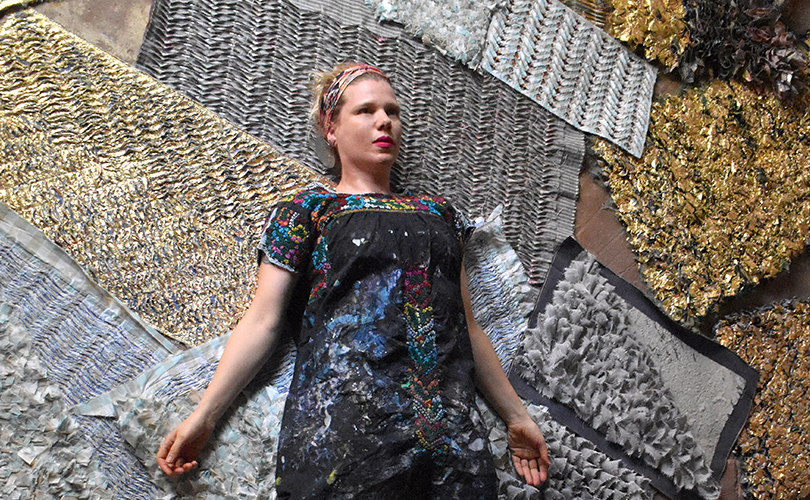
<figure class="wp-block-image size-full"><a href="https://browngrotta.com/artists/aby-mackie"><img loading="lazy" decoding="async" width="810" height="500" src="https://arttextstyle.com/wp-content/uploads/2026/05/Aby-Mackie-landacape-portrait.-810.jpg" alt="Aby Mackie portrait" class="wp-image-14747" srcset="https://arttextstyle.com/wp-content/uploads/2026/05/Aby-Mackie-landacape-portrait.-810.jpg 810w, https://arttextstyle.com/wp-content/uploads/2026/05/Aby-Mackie-landacape-portrait.-810-300x185.jpg 300w, https://arttextstyle.com/wp-content/uploads/2026/05/Aby-Mackie-landacape-portrait.-810-768x474.jpg 768w" sizes="auto, (max-width: 810px) 100vw, 810px" /></a><figcaption class="wp-element-caption"><sup>portrait photo: Aby Mackie</sup></figcaption></figure>


<p class="wp-block-paragraph"><em>Textile artist Aby Mackie works from a former bread factory in Barcelona&#8217;s Poblenou district, where domestic life and studio practice share the same uninterrupted space. Here are reflections on the materials, histories, and instincts that drive her work.</em></p>


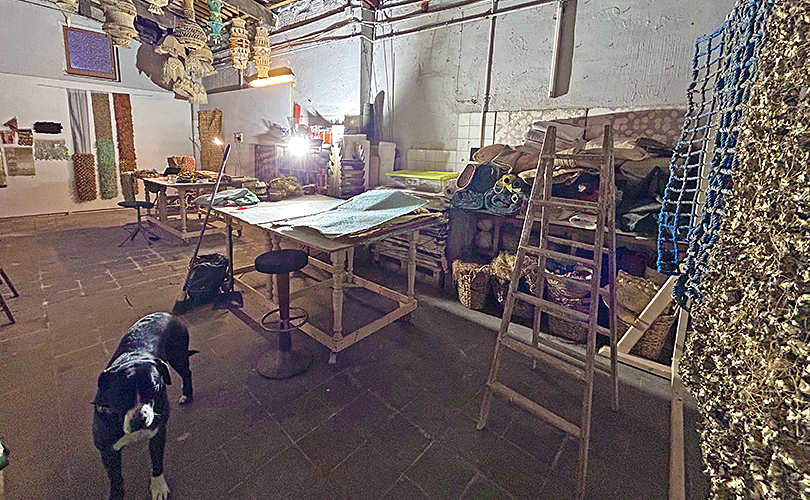
<p class="wp-block-paragraph">In a fading corner of Poblenou, textile artist Aby Mackie lives inside a former bakery where nothing is polished away, not the industrial scars, not the clutter of family life, not even the ghosts held in cloth.</p>


<figure class="wp-block-image size-full"><a href="https://browngrotta.com/artists/aby-mackie"><img loading="lazy" decoding="async" width="810" height="500" src="https://arttextstyle.com/wp-content/uploads/2026/05/19661446_original-1.jpg" alt="Aby Mackie studio" class="wp-image-14741" srcset="https://arttextstyle.com/wp-content/uploads/2026/05/19661446_original-1.jpg 810w, https://arttextstyle.com/wp-content/uploads/2026/05/19661446_original-1-300x185.jpg 300w, https://arttextstyle.com/wp-content/uploads/2026/05/19661446_original-1-768x474.jpg 768w" sizes="auto, (max-width: 810px) 100vw, 810px" /></a><figcaption class="wp-element-caption"><sup>studio photo: Aby Mackie</sup></figcaption></figure>


<p class="wp-block-paragraph">Barcelona has always known how to reinvent itself, Mackie says. Warehouses become galleries, fishermen’s quarters become boutique hotels, factories soften into loft apartments advertised in the language of “authenticity” and “creative living”. But in Poblenou, the city’s old industrial heartland, some buildings still resists the smoothness of redevelopment. For now, at least.</p>


<p class="wp-block-paragraph">On an unassuming street between construction sites and old workshops stands a former bread factory dating back to the early 1900s. It operated as a working bakery until 2015. &nbsp;Today it is home to the textile artist Aby Mackie, her husband Laurence and two teenage children, two cats, a dog, and an ever-shifting ecology of cloth, furniture, ceramics, books and salvaged objects.&nbsp;</p>


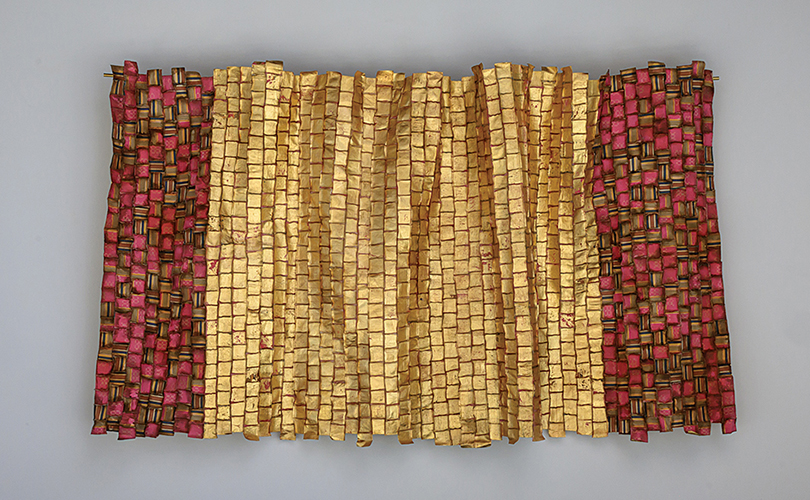
<figure class="wp-block-image size-full"><a href="https://browngrotta.com/artworks/11am-lfragments-of-a-life-lived-3"><img loading="lazy" decoding="async" width="810" height="500" src="https://arttextstyle.com/wp-content/uploads/2026/05/11am-Fragments-of-a-Life-Lived-810.jpg" alt="Aby Mackie tapestry" class="wp-image-14742" srcset="https://arttextstyle.com/wp-content/uploads/2026/05/11am-Fragments-of-a-Life-Lived-810.jpg 810w, https://arttextstyle.com/wp-content/uploads/2026/05/11am-Fragments-of-a-Life-Lived-810-300x185.jpg 300w, https://arttextstyle.com/wp-content/uploads/2026/05/11am-Fragments-of-a-Life-Lived-810-768x474.jpg 768w" sizes="auto, (max-width: 810px) 100vw, 810px" /></a><figcaption class="wp-element-caption"><sub>11am <em>Fragments of a Life Lived 3</em>, Aby Mackie, repurposed textile, gold leaf, shellac, 44&#8243; X 72&#8243; X 4&#8243;, 2025. Photo by Tom Grotta</sub></figcaption></figure>


<p class="wp-block-paragraph">“There’s never really a distinction between work and living here,” Mackie says. “The work exists inside the house, and the house exists inside the work.”</p>


<p class="wp-block-paragraph">The statement feels literal. Folded textiles spill from shelving. Fabrics wait half-stitched across large tables. Antique chairs hold piles of cloth in various states of repair and transformation. Kilim rugs overlap beneath olive-green 1960s leather seating. Mid-century shelving bows gently under the weight of books, vessels and material samples. The walls are layered salon-style with vernacular ceramics, found mirrors, tapestries, paintings and objects gathered from Barcelona’s Encants flea market or rescued from the street.</p>


<figure class="wp-block-image size-full"><a href="https://browngrotta.com/artworks/9am-between-chaos-and-order-9"><img loading="lazy" decoding="async" width="810" height="500" src="https://arttextstyle.com/wp-content/uploads/2026/05/7am-9am-side-810.jpg" alt="Aby Mackie tapestries" class="wp-image-14743" srcset="https://arttextstyle.com/wp-content/uploads/2026/05/7am-9am-side-810.jpg 810w, https://arttextstyle.com/wp-content/uploads/2026/05/7am-9am-side-810-300x185.jpg 300w, https://arttextstyle.com/wp-content/uploads/2026/05/7am-9am-side-810-768x474.jpg 768w" sizes="auto, (max-width: 810px) 100vw, 810px" /></a><figcaption class="wp-element-caption"><sup>7am <em>We Can All be Saved 77</em>, Aby Mackie, gilded gold lead decontructed and reconfigured antique textiles, 70&#8243; x 30&#8243; x .625&#8243;, 2023; 8am We<em>Can All be Saved 15</em>, Aby Mackie, mixed media, cotton, 46&#8243; x 26&#8243;, 2023; 9am <em>Between Chaos and Order 9</em>, Aby Mackie, vintage domestic cloth, deconstructed, hand cut, gold leaf, shellac, thread, 36&#8243; x 26.5&#8243; x 1&#8243;, 2023. Photo by Tom Grotta</sup></figcaption></figure>


<p class="wp-block-paragraph">That accumulation mirrors Mackie’s artistic practice. Working predominantly in textiles, she deconstructs existing fabrics, often domestic linens and once-intimate household cloths, before reassembling them into tactile works that retain visible traces of their earlier lives. Her pieces hover somewhere between fine art, archaeology, and repair.</p>


<p class="wp-block-paragraph">“There’s a history embedded in textiles that interests me enormously,” she says. “A worn edge, a repair, a stain, those things aren’t imperfections to erase. They’re evidence of life lived.” Throughout the house, evidence is everywhere.</p>


<figure class="wp-block-image size-full"><a href="https://browngrotta.com/artists/aby-mackie"><img loading="lazy" decoding="async" width="810" height="500" src="https://arttextstyle.com/wp-content/uploads/2026/05/19677690_xxl8101.jpg" alt="Antique fabrics sourced from Encants flea market" class="wp-image-14753" srcset="https://arttextstyle.com/wp-content/uploads/2026/05/19677690_xxl8101.jpg 810w, https://arttextstyle.com/wp-content/uploads/2026/05/19677690_xxl8101-300x185.jpg 300w, https://arttextstyle.com/wp-content/uploads/2026/05/19677690_xxl8101-768x474.jpg 768w" sizes="auto, (max-width: 810px) 100vw, 810px" /></a><figcaption class="wp-element-caption"><sup>Antique fabrics sourced from <em>Encants</em> flea market</sup>. <sup>Photo: Aby Mackie</sup></figcaption></figure>


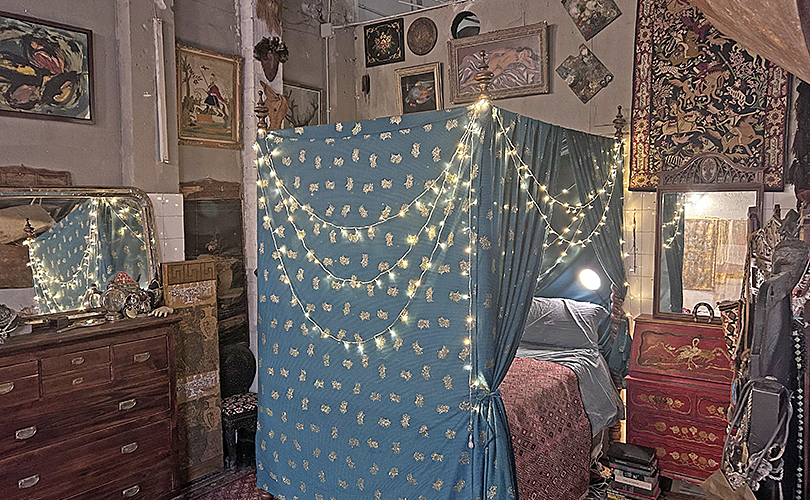
<p class="wp-block-paragraph">In the bathroom, collections of hand mirrors are hung rhythmically rather than symmetrically, multiplying reflections and fragments of light. In the open-plan living space, the skeletal base of the building’s enormous former oven remains intact, anchoring the room like an industrial ruin incorporated into domestic life. Part of the metal oven pot make an improbable lamp shade. Nearby sits a 19th-century four-poster bed, improbably grand within the old factory volume.</p>


<p class="wp-block-paragraph">Like much of Poblenou’s remaining industrial architecture, the former bakery is slated for demolition in the coming years as the neighborhood continues its transformation. Mackie understands the precariousness of occupying such a space. “There’s a temporary feeling to it now,” she says. “You know these buildings are disappearing one by one.”</p>


<p class="wp-block-paragraph">Perhaps that impermanence explains why the house feels less decorated than inhabited, less concerned with permanence than with continual adaptation.</p>


<figure class="wp-block-image size-full"><a href="https://browngrotta.com/artworks/13am-all-is-not-lost-5"><img loading="lazy" decoding="async" width="810" height="500" src="https://arttextstyle.com/wp-content/uploads/2026/05/13am-All-is-Not-Lost-5-810.jpg" alt="Aby Mackie tapestry" class="wp-image-14744" srcset="https://arttextstyle.com/wp-content/uploads/2026/05/13am-All-is-Not-Lost-5-810.jpg 810w, https://arttextstyle.com/wp-content/uploads/2026/05/13am-All-is-Not-Lost-5-810-300x185.jpg 300w, https://arttextstyle.com/wp-content/uploads/2026/05/13am-All-is-Not-Lost-5-810-768x474.jpg 768w" sizes="auto, (max-width: 810px) 100vw, 810px" /></a><figcaption class="wp-element-caption"><sup>13am <em>All is Not Lost 5</em>, Aby Mackie, repurposed fibers, gold leaf, shellac, 38&#8243; x 16&#8243; x 2&#8243;, 2024. Photo by Tom Grotta</sup></figcaption></figure>


<p class="wp-block-paragraph">Objects arrive constantly. Barcelona’s weekly ritual of leaving unwanted possessions on the street has become an informal sourcing network for the family. A discarded tapestry. A stack of ceramic plates. An abandoned chair with good bones.</p>


<p class="wp-block-paragraph">“People leave incredible things outside,” Mackie says. “Things that already contain a life.” The city itself becomes part of the work.</p>


<p class="wp-block-paragraph">Originally from Leicester, Mackie studied in Nottingham before traveling extensively in her 20s. She arrived in Barcelona 23 years ago intending only to learn Spanish before moving onwards to Mexico. She never left.“Apart from a short time living in Chile, Catalonia became home very quickly,” she says.</p>


<figure class="wp-block-image size-full"><a href="https://browngrotta.com/artworks/6am-all-is-not-lost-6"><img loading="lazy" decoding="async" width="810" height="500" src="https://arttextstyle.com/wp-content/uploads/2026/05/6am-All-is-Not-Lost-6.-810-1.jpg" alt="Aby Mackie tapestry" class="wp-image-14749" srcset="https://arttextstyle.com/wp-content/uploads/2026/05/6am-All-is-Not-Lost-6.-810-1.jpg 810w, https://arttextstyle.com/wp-content/uploads/2026/05/6am-All-is-Not-Lost-6.-810-1-300x185.jpg 300w, https://arttextstyle.com/wp-content/uploads/2026/05/6am-All-is-Not-Lost-6.-810-1-768x474.jpg 768w" sizes="auto, (max-width: 810px) 100vw, 810px" /></a><figcaption class="wp-element-caption"><sup>6am <em>All is Not Lost 6</em>, Aby Mackie, textile on gold leaf, 38&#8243; x 42&#8243; x 3.5&#8243;, 2024. photo by Tom Grotta</sup></figcaption></figure>


<p class="wp-block-paragraph">That sense of rootedness exists in tension with her practice, which is fundamentally about transformation. Cloth is cut apart, reconstructed, layered, distressed, and repaired. Histories are preserved but altered.&nbsp;Critics increasingly situate her work within conversations around sustainability, material memory and the politics of domestic labour. Yet inside the former bakery, theory feels secondary to touch.</p>


<p class="wp-block-paragraph">The atmosphere of the house is overwhelmingly tactile. Aged leather. Glazed clay. Raw wood. Woven wool. Fraying linen. Oxidised metal. Every surface invites handling.</p>


<figure class="wp-block-image size-full"><a href="https://browngrotta.com/artists/aby-mackie"><img loading="lazy" decoding="async" width="810" height="500" src="https://arttextstyle.com/wp-content/uploads/2026/05/19661434_original-1.jpg" alt="Aby Mackie bedroom" class="wp-image-14752" srcset="https://arttextstyle.com/wp-content/uploads/2026/05/19661434_original-1.jpg 810w, https://arttextstyle.com/wp-content/uploads/2026/05/19661434_original-1-300x185.jpg 300w, https://arttextstyle.com/wp-content/uploads/2026/05/19661434_original-1-768x474.jpg 768w" sizes="auto, (max-width: 810px) 100vw, 810px" /></a><figcaption class="wp-element-caption"><sup>The four poster bed, a retreat situated in one corner of the studio photo: Aby Mackie</sup></figcaption></figure>


<p class="wp-block-paragraph">Even the architecture participates in this material conversation. The factory was never aggressively renovated after the bakery closed. Rather than erasing its industrial character, Mackie and her family have adapted themselves to the building’s existing logic.</p>


<p class="wp-block-paragraph">During the day, textiles move constantly through the space. Materials are cut on dining tables. Cloth dries near bookshelves. New works lean casually against antique furniture. The boundaries between production and domesticity collapse entirely.</p>


<p class="wp-block-paragraph">“The house isn’t styled around the practice,” Mackie says. “It’s produced through it. That distinction matters.</p>


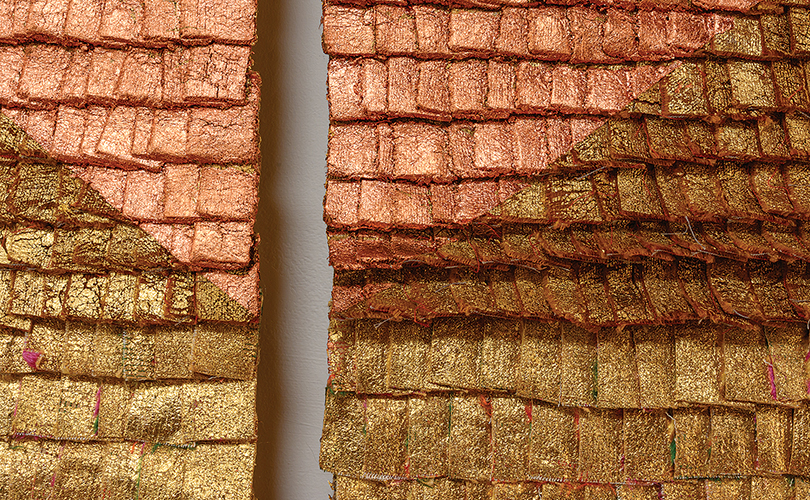
<figure class="wp-block-image size-full"><img loading="lazy" decoding="async" width="810" height="500" src="https://arttextstyle.com/wp-content/uploads/2026/05/12am-We-Can-All-Be-Saved-19-810-detail-2.jpg" alt="Aby Mackie tapestry detail" class="wp-image-14756" srcset="https://arttextstyle.com/wp-content/uploads/2026/05/12am-We-Can-All-Be-Saved-19-810-detail-2.jpg 810w, https://arttextstyle.com/wp-content/uploads/2026/05/12am-We-Can-All-Be-Saved-19-810-detail-2-300x185.jpg 300w, https://arttextstyle.com/wp-content/uploads/2026/05/12am-We-Can-All-Be-Saved-19-810-detail-2-768x474.jpg 768w" sizes="auto, (max-width: 810px) 100vw, 810px" /><figcaption class="wp-element-caption"><sup>Detail: 12am <em>We Can All Be Saved 19</em>, Aby Mackie, repurposed textile, gold and copper leaf, shellac, 79&#8243; x 35&#8243;, 2024. photo by Tom Grotta</sup></figcaption></figure>


<p class="wp-block-paragraph">Many artists speak about blurring art and life, but here the overlap feels genuinely unresolved. Family existence leaves visible marks. Teenagers move through spaces filled with fragile artworks. Pets sleep beneath unfinished pieces. Daily routines interrupt concentration. Nothing is isolated or protected from the mess of ordinary life.</p>


<p class="wp-block-paragraph">And perhaps that is what gives both the work and the house their unusual emotional texture. Textiles, after all, are among the most intimate materials humans produce. They absorb bodies, habits, histories, and time. Mackie’s practice depends upon recognizing that emotional residue rather than sanitizing it away.</p>
<p><a href="https://arttextstyle.com">arttextstyle</a></p>
]]></content>
		
					<link rel="replies" type="text/html" href="https://arttextstyle.com/2026/05/20/process-notes-aby-mackie-a-sense-of-place/#comments" thr:count="0" />
			<link rel="replies" type="application/atom+xml" href="https://arttextstyle.com/2026/05/20/process-notes-aby-mackie-a-sense-of-place/feed/atom/" thr:count="0" />
			<thr:total>0</thr:total>
			</entry>
		<entry>
		<author>
			<name>arttextstyle</name>
							<uri>http://www.browngrotta.com</uri>
						</author>

		<title type="html"><![CDATA[Materials Under the Microscope]]></title>
		<link rel="alternate" type="text/html" href="https://arttextstyle.com/2026/05/13/materials-under-the-microscope/" />

		<id>https://arttextstyle.com/?p=14725</id>
		<updated>2026-05-20T13:32:11Z</updated>
		<published>2026-05-13T17:03:42Z</published>
		<category scheme="https://arttextstyle.com/" term="Art Materials" />
		<summary type="html"><![CDATA[<p>Well, not under the microscope precisely, but in this week’s arttextstyle, we take an up-close-and-personal look at some of the materials highlighted in browngrotta arts&#8217; current exhibition, Transformations: dialogues in art and materials (May 9 &#8211; 17, 2026). 29ddm Mourning Station #4, detail, Dominic Di Mare, hawthorn, handmade paper, silk, bone, bird&#8217;s egg, feathers, gold and wood beads, 13&#8243;... </p>
<div class="read-more navbutton"><a href="https://arttextstyle.com/2026/05/13/materials-under-the-microscope/">Read More<i class="fa fa-angle-double-right"></i></a></div>
<p><a href="https://arttextstyle.com">arttextstyle</a></p>
]]></summary>

					<content type="html" xml:base="https://arttextstyle.com/2026/05/13/materials-under-the-microscope/"><![CDATA[
<p class="wp-block-paragraph">Well, not under the microscope precisely, but in this week’s arttextstyle, we take an up-close-and-personal look at some of the materials highlighted in browngrotta arts&#8217; current exhibition, <em><a href="https://browngrotta.com/exhibitions/transformations-dialogues-in-art-and-material">Transformations: dialogues in art and materials</a> </em>(May 9 &#8211; 17, 2026).</p>


<figure class="wp-block-image size-full"><a href="https://arttextstyle.com/wp-content/uploads/2026/05/29ddm-Mourning-Station-4-Kumai-810.jpg"><img loading="lazy" decoding="async" width="810" height="405" src="https://arttextstyle.com/wp-content/uploads/2026/05/29ddm-Mourning-Station-4-Kumai-810.jpg" alt="Dominic Di Mare Kyoko Kumai details" class="wp-image-14731" style="object-fit:cover" srcset="https://arttextstyle.com/wp-content/uploads/2026/05/29ddm-Mourning-Station-4-Kumai-810.jpg 810w, https://arttextstyle.com/wp-content/uploads/2026/05/29ddm-Mourning-Station-4-Kumai-810-300x150.jpg 300w, https://arttextstyle.com/wp-content/uploads/2026/05/29ddm-Mourning-Station-4-Kumai-810-768x384.jpg 768w" sizes="auto, (max-width: 810px) 100vw, 810px" /></a><figcaption class="wp-element-caption"><sup>29ddm <a href="https://browngrotta.com/artworks/29ddm-mourning-station-44"><em>Mourning Station #4</em>,</a> <em>detail, </em>Dominic Di Mare, hawthorn, handmade paper, silk, bone, bird&#8217;s egg, feathers, gold and wood beads, 13&#8243; x 7&#8243; x 7&#8243;, 1981. 49kk <em><a href="https://browngrotta.com/artworks/49kk-a-beginning-s">A Beginning-S</a></em>, <em>detail, </em>Kyoko Kumai, stainless steel filaments, gold filaments, 6&#8243; x 6&#8243; x 6&#8243;, 2025. Photos by Tom Grotta</sup></figcaption></figure>


<p class="wp-block-paragraph">In the catalogs we produce for most exhibitions we curate (63 to date) we often include detail shots. In the volume for<em> Transformations, </em>however, we’ve highlighted installations — specifically, groupings of works made of the same materials, executed by different artists in strikingly different ways. We’ll take up the details here instead.</p>


<figure class="wp-block-image size-full"><a href="https://arttextstyle.com/wp-content/uploads/2026/05/34sl-Coil-Kumai-810.jpg"><img loading="lazy" decoding="async" width="810" height="405" src="https://arttextstyle.com/wp-content/uploads/2026/05/34sl-Coil-Kumai-810.jpg" alt="Sue Lawty and Kyoko Kumai details" class="wp-image-14732" srcset="https://arttextstyle.com/wp-content/uploads/2026/05/34sl-Coil-Kumai-810.jpg 810w, https://arttextstyle.com/wp-content/uploads/2026/05/34sl-Coil-Kumai-810-300x150.jpg 300w, https://arttextstyle.com/wp-content/uploads/2026/05/34sl-Coil-Kumai-810-768x384.jpg 768w" sizes="auto, (max-width: 810px) 100vw, 810px" /></a><figcaption class="wp-element-caption"><sup>43sl <em><a href="https://browngrotta.com/artworks/34sl-coil">Coil</a></em>, <em>detail, </em>Sue Lawty, lead, 15.25&#8243; x 12.25&#8243; x 1.5&#8243;, 2023. 47kk <em><a href="https://browngrotta.com/artworks/47kk-aurora">Aurora</a></em>, <em>detail, </em>Kyoko Kumai, Crystal finished titanium, stainless steel, 18&#8243; x 16&#8243; x 4&#8243;, 1985. Photos by Tom Grotta</sup></figcaption></figure>


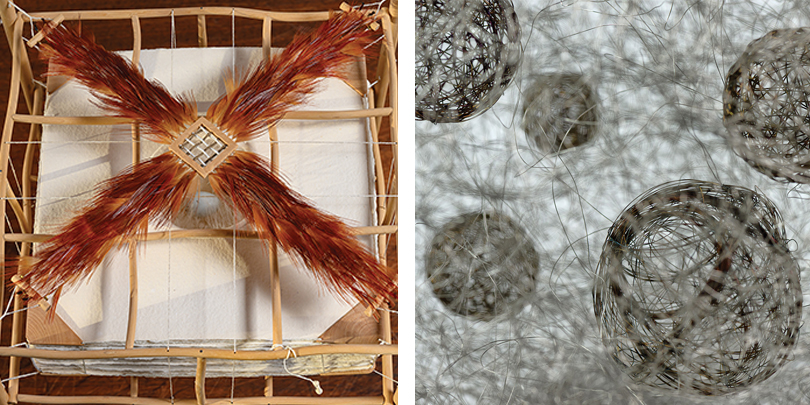
<p class="wp-block-paragraph">Feathers in art symbolize flight, spirituality and transformation. In <em>Transformations, </em>we’ve combined works that incorporate feathers by <a href="https://browngrotta.com/artists/chris-drury">Chris Drury</a>, <a href="https://browngrotta.com/artists/lewis-knauss">Lewis Knauss</a>, and <a href="https://browngrotta.com/artists/dominic-di-mare">Dominic Di Mare</a>. Di Mare’s <em>Mourning Station #4 </em>is one of a series of altars, rune, and letter bundles. They remind of ancient ritual objects, of religious mysteries from vanished civilizations. An egg is concealed beneath the feathers. Di Mare suggests a spiritual path and also conjures memory and rebirth.</p>


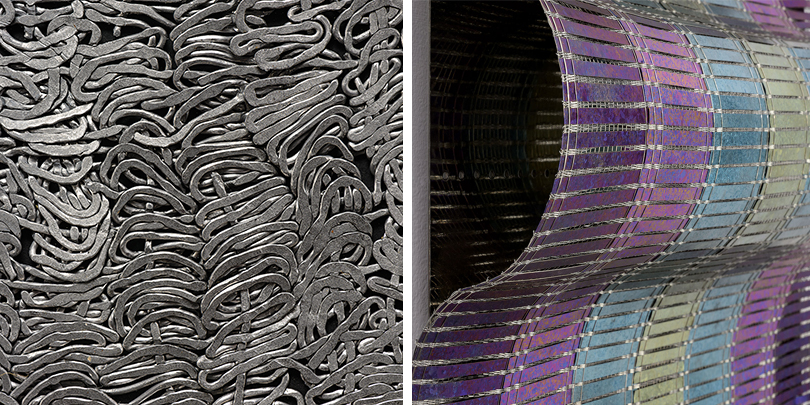
<p class="wp-block-paragraph">Another material we have explored in<em> Transformations </em>is metal, which offers unlimited options for expression. Stainless steel filaments are molded and woven by <a href="https://browngrotta.com/artists/kyoko-kumai">Kyoko Kumai</a> while colored titanium is woven.</p>


<figure class="wp-block-image size-full"><a href="https://arttextstyle.com/wp-content/uploads/2026/05/45mg-Catagorical-Evidence_810-1.jpg"><img loading="lazy" decoding="async" width="810" height="405" src="https://arttextstyle.com/wp-content/uploads/2026/05/45mg-Catagorical-Evidence_810-1.jpg" alt="Mary Giles and Tsuruko Tanikawa details" class="wp-image-14734" srcset="https://arttextstyle.com/wp-content/uploads/2026/05/45mg-Catagorical-Evidence_810-1.jpg 810w, https://arttextstyle.com/wp-content/uploads/2026/05/45mg-Catagorical-Evidence_810-1-300x150.jpg 300w, https://arttextstyle.com/wp-content/uploads/2026/05/45mg-Catagorical-Evidence_810-1-768x384.jpg 768w" sizes="auto, (max-width: 810px) 100vw, 810px" /></a><figcaption class="wp-element-caption"><sup>45mg <em><a href="https://browngrotta.com/artworks/45mg-Categorical-Evidence">Categorical Evidence</a>, detail, </em>Mary Giles, copper, lead, iron on painted wood panel, 35” x 27”, 2010. 11tt <em><a href="https://browngrotta.com/artworks/11tt-fuhkyoh">Fuhkyoh</a></em>, <em>detail,</em> Tsuruko Tanikawa, linked copper, stainless steel wire, 14&#8243; x 16.25&#8243; x 7&#8243;, 2002. Photos by Tom Grotta</sup></figcaption></figure>


<p class="wp-block-paragraph">Lead becomes cryptic calligraphy in <a href="https://browngrotta.com/artists/sue-lawty">Sue Lawty’s</a> hands and copper wire becomes figures in <a href="https://browngrotta.com/artists/mary-giles">Mary Giles</a>’ work and three-dimensional sculpture when layered by <a href="https://browngrotta.com/artists/tsuroko-tanikawa">Tsuroko Tanikawa</a>.</p>


<p class="wp-block-paragraph">Elemental fibers are often the choice of artists at browngrotta arts. In <em>Transformations, </em>cotton, ramie, linen, jute are among the traditional fibers featured. Flax gets a wall of its own. <a href="https://browngrotta.com/artists/susie-gillespie">Susie Gillespie</a> and <a href="https://browngrotta.com/artists/irina-kolesnikova">Irina Kolesnikova</a> create fiber paintings of flax, with images of a cottage and a curious character, who Kolesnikova calls her alter ego. Also paired are a walnut bark box by <a href="https://browngrotta.com/artists/masako-yoshida">Masako Yoshida</a> stitched with flax thread and Stéphanie Jacques’ humanoid flax sculpture mounted on a copper plate. </p>


<p class="wp-block-paragraph">And there are more — seaweed (<a href="https://browngrotta.com/artists/jeannet-leendertse">Jeannet Leendertse</a>), clay (<a href="https://browngrotta.com/artists/toshiko-takaezu">Toshiko Takaezu</a>, <a href="https://browngrotta.com/artists/yasuhisa-kohyama">Yasuhisa Kohyama</a>, <a href="https://browngrotta.com/artists/valerie-pragnell">Valerie Pragnell</a>, <a href="https://browngrotta.com/artists/stephanie-jacques">Stéphanie Jacques</a>), stones (<a href="https://browngrotta.com/artists/christine-joy" type="link" id="https://browngrotta.com/artists/christine-joy">Christine Joy</a>, <a href="https://browngrotta.com/artists/dorothy-gill-barnes">Dorothy Gill Barnes,</a> <a href="https://browngrotta.com/artists/stephanie-jacques">Stéphanie Jacques</a>), and willow (<a href="https://browngrotta.com/artists/dail-behennah">Dail Behennah</a>, <a href="https://browngrotta.com/artists/esme-hofman">Esmé Hofman</a>, <a href="https://browngrotta.com/artists/john-mcqueen">John McQueen</a>, <a href="https://browngrotta.com/artists/stephanie-jacques">Stéphanie Jacques</a>) just to name a few.</p>


<figure class="wp-block-image size-full is-resized"><a href="https://arttextstyle.com/wp-content/uploads/2026/05/14my-Air-Hole-838.seaweed-810.jpg"><img loading="lazy" decoding="async" width="810" height="405" src="https://arttextstyle.com/wp-content/uploads/2026/05/14my-Air-Hole-838.seaweed-810.jpg" alt="Masako Yoshida and Jeannet Leendertse details" class="wp-image-14735" style="width:810px;height:auto" srcset="https://arttextstyle.com/wp-content/uploads/2026/05/14my-Air-Hole-838.seaweed-810.jpg 810w, https://arttextstyle.com/wp-content/uploads/2026/05/14my-Air-Hole-838.seaweed-810-300x150.jpg 300w, https://arttextstyle.com/wp-content/uploads/2026/05/14my-Air-Hole-838.seaweed-810-768x384.jpg 768w" sizes="auto, (max-width: 810px) 100vw, 810px" /></a><figcaption class="wp-element-caption"><sup>14my <em><a href="https://browngrotta.com/artworks/14my-air-hole-893">Air Hole #838,</a> detail,</em> Masako Yoshida, walnut and flax, 8&#8243; x 8&#8243; x 7&#8243;, 2017. 18jle <em><a href="https://browngrotta.com/artworks/18jle-flat-holding-vessel">Flat Holding Vessel</a></em>, Jeannet Leendertse, coiled stitched rockweed (ascophyllum nodosum), waxed linen, beeswax, tree resin, 17.5&#8243; x 16&#8243; x 3.25&#8243;, 2025. Photos by Tom Grotta</sup></figcaption></figure>


<p class="wp-block-paragraph">Join us at&nbsp;<em>Transformations&nbsp;</em>&nbsp;through May 17th — many more images on our website:&nbsp;<a href="https://browngrotta.com/">https://browngrotta.com/</a>.</p>
<p><a href="https://arttextstyle.com">arttextstyle</a></p>
]]></content>
		
					<link rel="replies" type="text/html" href="https://arttextstyle.com/2026/05/13/materials-under-the-microscope/#comments" thr:count="0" />
			<link rel="replies" type="application/atom+xml" href="https://arttextstyle.com/2026/05/13/materials-under-the-microscope/feed/atom/" thr:count="0" />
			<thr:total>0</thr:total>
			</entry>
		<entry>
		<author>
			<name>arttextstyle</name>
							<uri>http://www.browngrotta.com</uri>
						</author>

		<title type="html"><![CDATA[Materials in Conversation: Transformations Opens this Week]]></title>
		<link rel="alternate" type="text/html" href="https://arttextstyle.com/2026/05/07/materials-in-conversation-transformations-opens-this-week/" />

		<id>https://arttextstyle.com/?p=14717</id>
		<updated>2026-05-20T13:32:52Z</updated>
		<published>2026-05-07T14:03:11Z</published>
		<category scheme="https://arttextstyle.com/" term="Art" /><category scheme="https://arttextstyle.com/" term="Carol Shaw-Sutton" /><category scheme="https://arttextstyle.com/" term="Gyöngy Laky" /><category scheme="https://arttextstyle.com/" term="Kyoko KumaI" /><category scheme="https://arttextstyle.com/" term="Marian Bijlenga" /><category scheme="https://arttextstyle.com/" term="Marianne Kemp" /><category scheme="https://arttextstyle.com/" term="Mary Giles" /><category scheme="https://arttextstyle.com/" term="Mercedes Vicente" /><category scheme="https://arttextstyle.com/" term="Norma Minkowitz" /><category scheme="https://arttextstyle.com/" term="Simone Pheulpin" /><category scheme="https://arttextstyle.com/" term="Toshiko Takaezu" /><category scheme="https://arttextstyle.com/" term="Transformations" /><category scheme="https://arttextstyle.com/" term="Yashusia Kohyama" />
		<summary type="html"><![CDATA[<p>In the right hands, a strip of bark becomes a narrative. Linen becomes landscape. Seaweed becomes an accent, steel mesh becomes a tapestry, and a cloth measuring tape — repurposed, reimagined — becomes art.&#160; Cotton works by Simone Pheulpin, Mercedes Vicente, Norma Minkowitz. Photo by Tom Grotta This is the animating premise of&#160;Transformations: dialogues in... </p>
<div class="read-more navbutton"><a href="https://arttextstyle.com/2026/05/07/materials-in-conversation-transformations-opens-this-week/">Read More<i class="fa fa-angle-double-right"></i></a></div>
<p><a href="https://arttextstyle.com">arttextstyle</a></p>
]]></summary>

					<content type="html" xml:base="https://arttextstyle.com/2026/05/07/materials-in-conversation-transformations-opens-this-week/"><![CDATA[
<p class="wp-block-paragraph">In the right hands, a strip of bark becomes a narrative. Linen becomes landscape. Seaweed becomes an accent, steel mesh becomes a tapestry, and a cloth measuring tape — repurposed, reimagined — becomes art.&nbsp;</p>


<figure class="wp-block-image size-full"><a href="https://browngrotta.com/exhibitions/transformations-dialogues-in-art-and-material"><img loading="lazy" decoding="async" width="810" height="500" src="https://arttextstyle.com/wp-content/uploads/2026/05/mailchimp-cotton.jpg" alt="Simone Pheulpin, Mercedes Vicente, Norma Minkowitz" class="wp-image-14721" srcset="https://arttextstyle.com/wp-content/uploads/2026/05/mailchimp-cotton.jpg 810w, https://arttextstyle.com/wp-content/uploads/2026/05/mailchimp-cotton-300x185.jpg 300w, https://arttextstyle.com/wp-content/uploads/2026/05/mailchimp-cotton-768x474.jpg 768w" sizes="auto, (max-width: 810px) 100vw, 810px" /></a><figcaption class="wp-element-caption"><sup>Cotton works by <a href="https://browngrotta.com/artists/simone-pheulpin">Simone Pheulpin</a>, <a href="https://browngrotta.com/artists/mercedes-vicente">Mercedes Vicente</a>, <a href="https://browngrotta.com/artists/norma-minkowitz">Norma Minkowitz</a>. Photo by Tom Grotta</sup></figcaption></figure>


<p class="wp-block-paragraph">This is the animating premise of&nbsp;<em><a href="https://browngrotta.com/exhibitions/transformations-dialogues-in-art-and-material">Transformations: dialogues in art and material</a></em><a href="https://browngrotta.com/exhibitions/transformations-dialogues-in-art-and-material">&nbsp;</a>which opens this Saturday, May 9th at browngrotta arts. The exhibition that asks a deceptively simple question: what happens when artists stop treating materials as additives and start treating them as collaborators? The answer, it turns out, is profound.</p>


<p class="wp-block-paragraph"><strong>Material Is Not Neutral</strong><br>We tend to think of materials as passive — the stuff through which ideas pass on their way to becoming art. The artists in <em>Transformations</em> challenge that assumption at every turn. In the contemporary art context, materiality isn&#8217;t just about physical substance. It encompasses everything a material carries with it: weight, surface, history, cultural memory, expressive charge. A piece of linen isn&#8217;t just woven thread. It&#8217;s centuries of labor, landscape, and touch.</p>


<figure class="wp-block-image size-full"><a href="https://browngrotta.com/exhibitions/transformations-dialogues-in-art-and-material"><img loading="lazy" decoding="async" width="810" height="500" src="https://arttextstyle.com/wp-content/uploads/2026/05/linen-3.jpg" alt="linen works work by " class="wp-image-14718" srcset="https://arttextstyle.com/wp-content/uploads/2026/05/linen-3.jpg 810w, https://arttextstyle.com/wp-content/uploads/2026/05/linen-3-300x185.jpg 300w, https://arttextstyle.com/wp-content/uploads/2026/05/linen-3-768x474.jpg 768w" sizes="auto, (max-width: 810px) 100vw, 810px" /></a><figcaption class="wp-element-caption"><sup>Linen works by <a href="https://browngrotta.com/artists/jane-sauer">Jane Sauer</a>, <a href="https://browngrotta.com/artists/carol-shaw-sutton">Carol Shaw-Sutton</a>, <a href="https://browngrotta.com/artists/mary-giles">Mary Giles</a>. Photo by Tom Grotta</sup></figcaption></figure>


<p class="wp-block-paragraph"><strong>System and Surprise</strong><br><em>Transformations </em>proves that<em> </em>the range of works that a simple material can inspire is nearly endless. Carol Shaw-Sutton, Chiyoko Tanaka, Sara Brennan, Mary Giles, Merja Keskinen, and Jane Sauer all work with Linen. In Shaw-Sutton&#8217;s hands the material becomes a molded vessel. Under Chiyoko Tanaka&#8217;s ministrations, woven linen fabric is returned to its essential threads, transformed into an artifact. For Sara Brennan, woven linen serves as a canvas. From a distance, her works appear to be abstract paintings. A close up view reveals a textured weaving using dozens of shades. For Jane Sauer and Mary Giles, linen is a sculptural medium.</p>


<figure class="wp-block-image size-full"><a href="https://browngrotta.com/exhibitions/transformations-dialogues-in-art-and-material"><img loading="lazy" decoding="async" width="810" height="500" src="https://arttextstyle.com/wp-content/uploads/2026/05/Kumai-Laky.jpg" alt="Gyöngy Laky, Kyoko Kumai" class="wp-image-14719" srcset="https://arttextstyle.com/wp-content/uploads/2026/05/Kumai-Laky.jpg 810w, https://arttextstyle.com/wp-content/uploads/2026/05/Kumai-Laky-300x185.jpg 300w, https://arttextstyle.com/wp-content/uploads/2026/05/Kumai-Laky-768x474.jpg 768w" sizes="auto, (max-width: 810px) 100vw, 810px" /></a><figcaption class="wp-element-caption"><sup>Metal works by <a href="https://browngrotta.com/artists/gyongy-laky">Gyöngy Laky</a>, <a href="https://browngrotta.com/artists/kyoko-kumai">Kyoko Kumai</a>. Photo by Tom Grotta</sup></figcaption></figure>


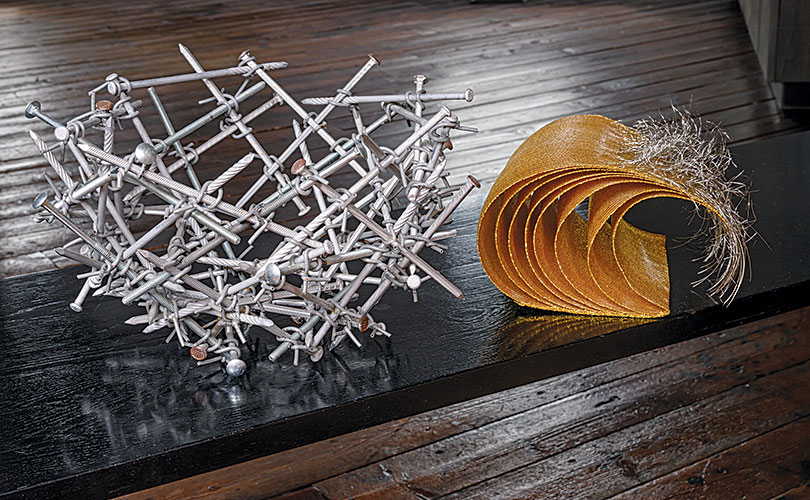
<p class="wp-block-paragraph"><strong>Material as More</strong><br>Metal is a canopied category in <em>Transformations.</em> Artists consider it as thread— from gold filaments, to lead extrusions, to bent wire of copper and brass. Kyoko Kumai&#8217;s spun steel threads float. Gyöngy Laky turns nails and wire into an artful assemblage. Sue Lawty weaves with bast fibers — raffia, hemp, nettle, linen — and elemental lead, and assembles carefully ordered stones drawn from beaches and riverbeds. She pursues qualities inherently given by the chosen substance, seeking &#8220;an understated restraint, balance, tension, rhythm: an essential stillness.&#8221;</p>


<figure class="wp-block-image size-full"><a href="https://browngrotta.com/exhibitions/transformations-dialogues-in-art-and-material"><img loading="lazy" decoding="async" width="810" height="500" src="https://arttextstyle.com/wp-content/uploads/2026/05/Ceramic.jpg" alt="Yasuhisa Kohyama and Toshiko Takaezu" class="wp-image-14720" srcset="https://arttextstyle.com/wp-content/uploads/2026/05/Ceramic.jpg 810w, https://arttextstyle.com/wp-content/uploads/2026/05/Ceramic-300x185.jpg 300w, https://arttextstyle.com/wp-content/uploads/2026/05/Ceramic-768x474.jpg 768w" sizes="auto, (max-width: 810px) 100vw, 810px" /></a><figcaption class="wp-element-caption"><sup>Clay works by <a href="https://browngrotta.com/artists/yasuhisa-kohyama">Yasuhisa Kohyama</a>, <a href="https://browngrotta.com/artists/toshiko-takaezu">Toshiko Takaezu</a>. Photo by Tom Grotta</sup></figcaption></figure>


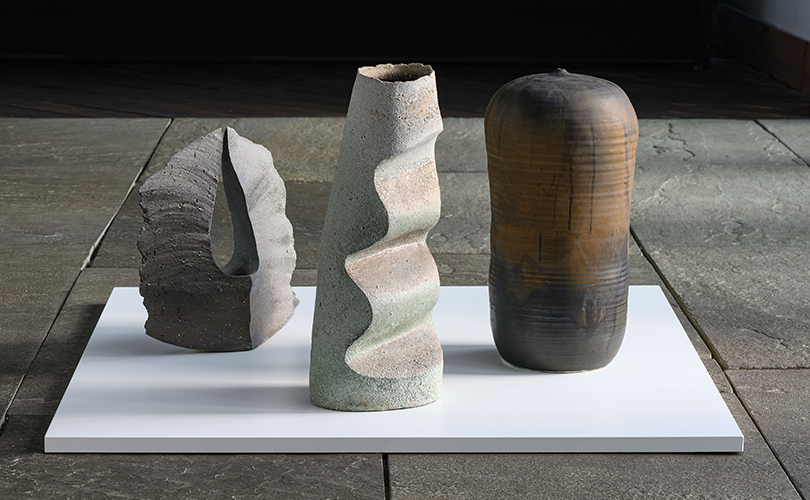
<p class="wp-block-paragraph"><strong>Same Input, Different Outcome</strong><br>Toshiko Takaezu and Yasuhisa Kohyama both devoted their lives to clay, but their practices reveal just how vast the distance can be within a single medium. Takaezu&#8217;s closed ceramic forms — rounded, glazed, often containing a small stone or rattle sealed inside — are intimate and quietly mysterious, their surfaces richly colored and their shapes suggesting the human body. There is a sense of the maker&#8217;s hand coaxing something from the earth. Kohyama, by contrast, surrenders control to the fire itself. He builds by hand and fires with wood, never applying glaze; color and surface are entirely the product of ash movement and the object&#8217;s position within the kiln. Where Takaezu brings clay close — shaping it into vessels that hold secrets — Kohyama sends it into an elemental process and receives back something ancient and unpredictable.</p>


<figure class="wp-block-image size-full"><a href="https://browngrotta.com/exhibitions/transformations-dialogues-in-art-and-material"><img loading="lazy" decoding="async" width="810" height="500" src="https://arttextstyle.com/wp-content/uploads/2026/05/Horsehair.jpg" alt="Marian Bijlenga, Marianne Kemp" class="wp-image-14722" srcset="https://arttextstyle.com/wp-content/uploads/2026/05/Horsehair.jpg 810w, https://arttextstyle.com/wp-content/uploads/2026/05/Horsehair-300x185.jpg 300w, https://arttextstyle.com/wp-content/uploads/2026/05/Horsehair-768x474.jpg 768w" sizes="auto, (max-width: 810px) 100vw, 810px" /></a><figcaption class="wp-element-caption"><sup>Horsehair works by <a href="https://browngrotta.com/artists/marian-bijlenga">Marian Bijlenga</a>, <a href="https://browngrotta.com/artists/marianne-kemp">Marianne Kemp.</a> Tom Grotta</sup></figcaption></figure>


<p class="wp-block-paragraph"><strong>What These Works Carry</strong><br>What unites the artists in <em>Transformations</em> isn&#8217;t a shared aesthetic or a shared geography. It&#8217;s a shared conviction: that choosing a material is a serious act, that working with it is as meaningful as the finished object, and that what results carries something more than form.</p>


<p class="wp-block-paragraph">It carries thought. History. Culture. The trace of a hand that knew exactly what it was doing — and trusted the material to meet it halfway.</p>


<p class="wp-block-paragraph">Join us at&nbsp;<em><a href="https://browngrotta.com/exhibitions/transformations-dialogues-in-art-and-material">Transformations: dialogues in art and material</a></em>&nbsp;(May 9-17) at browngrotta arts in Wilton, CT. Or order the 164-page catalog from&nbsp;<a href="https://store.browngrotta.com/c-57-transformations-dialogues-in-art-and-material/">browngrotta.com</a>.</p>
<p><a href="https://arttextstyle.com">arttextstyle</a></p>
]]></content>
		
					<link rel="replies" type="text/html" href="https://arttextstyle.com/2026/05/07/materials-in-conversation-transformations-opens-this-week/#comments" thr:count="0" />
			<link rel="replies" type="application/atom+xml" href="https://arttextstyle.com/2026/05/07/materials-in-conversation-transformations-opens-this-week/feed/atom/" thr:count="0" />
			<thr:total>0</thr:total>
			</entry>
		<entry>
		<author>
			<name>arttextstyle</name>
							<uri>http://www.browngrotta.com</uri>
						</author>

		<title type="html"><![CDATA[Art Assembled: New this Week in April]]></title>
		<link rel="alternate" type="text/html" href="https://arttextstyle.com/2026/04/29/art-assembled-new-this-week-in-april-4/" />

		<id>https://arttextstyle.com/?p=14708</id>
		<updated>2026-04-29T18:32:52Z</updated>
		<published>2026-04-29T18:32:45Z</published>
		<category scheme="https://arttextstyle.com/" term="Uncategorized" />
		<summary type="html"><![CDATA[<p>Four Mondays in April; four highlighted works for review. 45w Burning Bush, Katherine Westphal, natural and synthetic raffia, 13.5” x 7.25” x 7.25”, 2000. Photo by Tom Grotta First this month was&#160;Burning Bush&#160;by&#160;American Katherine Westphal. Westphal concentrated on surface, pattern, and decoration in textiles, quilts and clothing, as well as vessels. The use of fractured and random... </p>
<div class="read-more navbutton"><a href="https://arttextstyle.com/2026/04/29/art-assembled-new-this-week-in-april-4/">Read More<i class="fa fa-angle-double-right"></i></a></div>
<p><a href="https://arttextstyle.com">arttextstyle</a></p>
]]></summary>

					<content type="html" xml:base="https://arttextstyle.com/2026/04/29/art-assembled-new-this-week-in-april-4/"><![CDATA[
<p class="wp-block-paragraph">Four Mondays in April; four highlighted works for review.</p>


<figure class="wp-block-image size-full"><a href="https://browngrotta.com/artworks/45w-burning-bush"><img loading="lazy" decoding="async" width="810" height="500" src="https://arttextstyle.com/wp-content/uploads/2026/04/45w-Burning-Bush.2.jpg" alt="Katherine Westphal raffia basket" class="wp-image-14709" srcset="https://arttextstyle.com/wp-content/uploads/2026/04/45w-Burning-Bush.2.jpg 810w, https://arttextstyle.com/wp-content/uploads/2026/04/45w-Burning-Bush.2-300x185.jpg 300w, https://arttextstyle.com/wp-content/uploads/2026/04/45w-Burning-Bush.2-768x474.jpg 768w" sizes="auto, (max-width: 810px) 100vw, 810px" /></a><figcaption class="wp-element-caption"><sup>45w <em><a href="https://browngrotta.com/artworks/45w-burning-bush">Burning Bush</a>,</em> Katherine Westphal, natural and synthetic raffia, 13.5” x 7.25” x 7.25”, 2000. Photo by Tom Grotta</sup></figcaption></figure>


<p class="wp-block-paragraph">First this month was<em>&nbsp;Burning Bush</em>&nbsp;by&nbsp;American <a href="https://browngrotta.com/artists/katherine-westphal">Katherine Westphal</a>. Westphal concentrated on surface, pattern, and decoration in textiles, quilts and clothing, as well as vessels. The use of fractured and random images, as featured in&nbsp;<em>Burning Bush,</em>&nbsp;became a signature of her work. In the catalog for the&nbsp;<em>OBJECTS USA</em>&nbsp;exhibition in 1970, Westphal wrote, “I was trained as a painter. I see things from that viewpoint. I build up; I destroy. I let the textile grow, never knowing where it is going or when it will be finished. It is cut up, sewn together, embroidered, quilted, embellished with tapestry or fringes, until my intuitive and visual senses tell me it is finished and the message complete.”</p>


<figure class="wp-block-image size-full"><a href="https://browngrotta.com/artworks/47kk-aurora"><img loading="lazy" decoding="async" width="810" height="500" src="https://arttextstyle.com/wp-content/uploads/2026/04/47kk-Aurora-810.jpg" alt="Kyoko Kumai purple titanium wall sculpture" class="wp-image-14710" srcset="https://arttextstyle.com/wp-content/uploads/2026/04/47kk-Aurora-810.jpg 810w, https://arttextstyle.com/wp-content/uploads/2026/04/47kk-Aurora-810-300x185.jpg 300w, https://arttextstyle.com/wp-content/uploads/2026/04/47kk-Aurora-810-768x474.jpg 768w" sizes="auto, (max-width: 810px) 100vw, 810px" /></a><figcaption class="wp-element-caption"><sup>47kk <em><a href="https://browngrotta.com/artworks/47kk-aurora">Aurora</a>,</em> Kyoko Kumai, Crystal finished titanium, stainless steel, 18&#8243; x 16&#8243; x 4&#8243;, 1985. Photo by Tom Grotta</sup></figcaption></figure>


<p class="wp-block-paragraph">Next up was <em>Aurora</em>, an intriguing piece in titanium by <a href="https://browngrotta.com/artists/kyoko-kumai">Kyoko Kumai</a> of Japan. In 1975, Kumai began using metallic thread for the warp in her tapestries. She started first with with stainless steel, then added titanium, which comes in many colors. <em>Aurora, </em>which is featured in <em>Transformations: dialogues in art and materials</em> (May 9-17), the upcoming exhibition at browngrotta arts, is made of crystal-finished titanium in artfully blended colors. “I am supremely happy if these works create a rich environment that surrounds the viewer,” she says, &#8220;arousing various mental images and liberating the spirit.” </p>


<figure class="wp-block-image size-full is-resized"><a href="https://browngrotta.com/artworks/13jb-paper-sculpture-4"><img loading="lazy" decoding="async" width="810" height="500" src="https://arttextstyle.com/wp-content/uploads/2026/04/13jb-Paper-Sculpture-4-810.jpg" alt="Jane Balsgaard paper sculpture" class="wp-image-14711" style="width:810px;height:auto" srcset="https://arttextstyle.com/wp-content/uploads/2026/04/13jb-Paper-Sculpture-4-810.jpg 810w, https://arttextstyle.com/wp-content/uploads/2026/04/13jb-Paper-Sculpture-4-810-300x185.jpg 300w, https://arttextstyle.com/wp-content/uploads/2026/04/13jb-Paper-Sculpture-4-810-768x474.jpg 768w" sizes="auto, (max-width: 810px) 100vw, 810px" /></a><figcaption class="wp-element-caption"><sub>13jb <em><a href="https://browngrotta.com/artworks/13jb-paper-sculpture-4">Paper Sculpture 4,</a></em> Jane Balsgaard, wood, plant paper, cotton thread, piasava, 22&#8243; x 22&#8243; x 22&#8243;, 2000. Photo by Tom Grotta</sub></figcaption></figure>


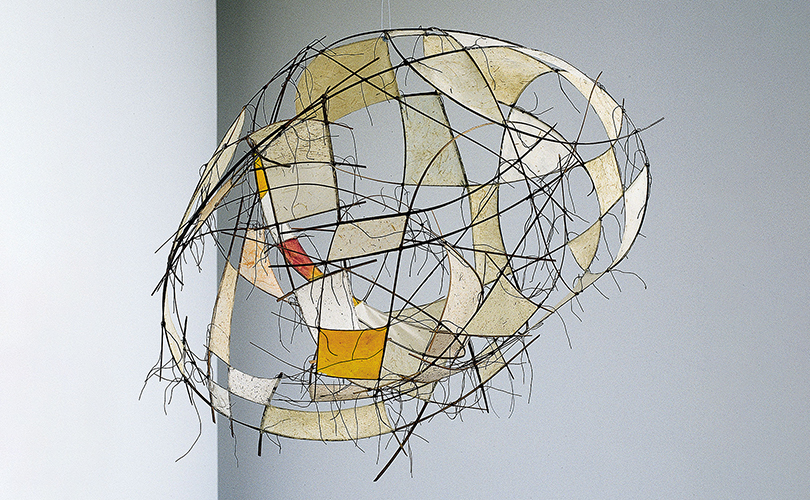
<p class="wp-block-paragraph"><a href="https://browngrotta.com/artists/jane-balsgaard">Jane Balsgaard</a> is a Danish sculptor and painter Initially, working with paper did not interest her, but its potential for flight and refracting light captured her attention. Balsgaard spent time in Japan in the 90s, preparing for exhibits there. Works of paper and twigs, like <em>Paper Sculpture 4</em>, were the result. In her work, white paper often contrasts the dark color of the willow twigs, the skeleton framing the paper. Balsgaard is the recipient of an Artist&#8217;s Lifetime Grant from the Government of Denmark.</p>


<figure class="wp-block-image size-full"><a href="https://arttextstyle.com/wp-content/uploads/2026/04/7bo-Between-two-sunsets-810.jpg"><img loading="lazy" decoding="async" width="810" height="500" src="https://arttextstyle.com/wp-content/uploads/2026/04/7bo-Between-two-sunsets-810.jpg" alt="Baiba Osite, driftwood tapestry" class="wp-image-14712" srcset="https://arttextstyle.com/wp-content/uploads/2026/04/7bo-Between-two-sunsets-810.jpg 810w, https://arttextstyle.com/wp-content/uploads/2026/04/7bo-Between-two-sunsets-810-300x185.jpg 300w, https://arttextstyle.com/wp-content/uploads/2026/04/7bo-Between-two-sunsets-810-768x474.jpg 768w" sizes="auto, (max-width: 810px) 100vw, 810px" /></a><figcaption class="wp-element-caption"><sup>7bo<strong> </strong><em>Between Two Sunsets,</em> <a href="https://browngrotta.com/artists/baiba-osite">Baiba Osite</a>, driftwood tapestry, 63&#8243; x 71&#8243; x 2&#8243;, 2025. Photo by Tom Grotta</sup></figcaption></figure>


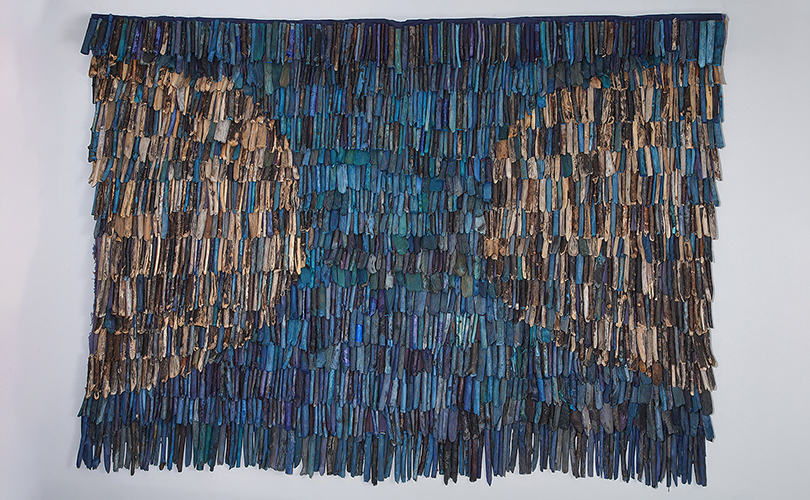
<p class="wp-block-paragraph"><em>Between Two Sunsets </em>by <a href="https://browngrotta.com/artists/baiba-osite">Baiba Osite</a> explores the fragile threshold between collapse and regeneration, using materials that carry ecological and emotional weight. Driftwood washed ashore and fragments of plastic collected after the destructive floods in Jūrmala in Latvia become markers of the intertwined vulnerability of humans and nature. These remnants of civilization return as a visual reminder of the layers of pollution that shape our environment. Osite is known for her work with different fiber materials including driftwood, glass beads, wire, metal spirals, wool, and linen. Reconstruction is a means to new possibilities, multiple paths to renewal, she says. Osite’s work incorporating metal springs will be featured in <em>Transformations.</em></p>


<p class="wp-block-paragraph">See more at <em>Transformations</em> at browngrotta arts this May 9 -17: https://browngrotta.com/exhibitions/transformations-dialogues-in-art-and-material</p>


<p class="wp-block-paragraph"></p>
<p><a href="https://arttextstyle.com">arttextstyle</a></p>
]]></content>
		
					<link rel="replies" type="text/html" href="https://arttextstyle.com/2026/04/29/art-assembled-new-this-week-in-april-4/#comments" thr:count="0" />
			<link rel="replies" type="application/atom+xml" href="https://arttextstyle.com/2026/04/29/art-assembled-new-this-week-in-april-4/feed/atom/" thr:count="0" />
			<thr:total>0</thr:total>
			</entry>
		<entry>
		<author>
			<name>arttextstyle</name>
							<uri>http://www.browngrotta.com</uri>
						</author>

		<title type="html"><![CDATA[Making a day of it: Visit Transformations in May, See More Art on the Way]]></title>
		<link rel="alternate" type="text/html" href="https://arttextstyle.com/2026/04/22/making-a-day-of-it-visit-transformations-in-may-see-more-art-on-the-way/" />

		<id>https://arttextstyle.com/?p=14700</id>
		<updated>2026-04-22T18:43:39Z</updated>
		<published>2026-04-22T18:43:16Z</published>
		<category scheme="https://arttextstyle.com/" term="Uncategorized" /><category scheme="https://arttextstyle.com/" term="Art" /><category scheme="https://arttextstyle.com/" term="Daphne:art" /><category scheme="https://arttextstyle.com/" term="extraORDINARY things" /><category scheme="https://arttextstyle.com/" term="Flinn Gallery" /><category scheme="https://arttextstyle.com/" term="Jazz + The Blues" /><category scheme="https://arttextstyle.com/" term="Make a Day of It" /><category scheme="https://arttextstyle.com/" term="Museum of Contemporary Art" /><category scheme="https://arttextstyle.com/" term="Nancy Koenigsberg" /><category scheme="https://arttextstyle.com/" term="Rina Banerjee:" /><category scheme="https://arttextstyle.com/" term="Yale Art Gallery" />
		<summary type="html"><![CDATA[<p>Our Spring exhibition, Transformations: dialogues in art and materials (May 9 &#8211; 17) opens at browngrotta arts, Wilton, Connecticut, in less than a month. For those of you coming by car, there are interesting art stops you might want to make on your way. Below are exhibition suggestions in Westport, Bantam, Greenwich, and New Haven,... </p>
<div class="read-more navbutton"><a href="https://arttextstyle.com/2026/04/22/making-a-day-of-it-visit-transformations-in-may-see-more-art-on-the-way/">Read More<i class="fa fa-angle-double-right"></i></a></div>
<p><a href="https://arttextstyle.com">arttextstyle</a></p>
]]></summary>

					<content type="html" xml:base="https://arttextstyle.com/2026/04/22/making-a-day-of-it-visit-transformations-in-may-see-more-art-on-the-way/"><![CDATA[
<p class="wp-block-paragraph">Our Spring exhibition,<em> </em><a href="https://browngrotta.com/exhibitions/transformations-dialogues-in-art-and-material"><em>Transformations</em>:<em> dialogues in art and materials</em></a> (May 9 &#8211; 17) opens at browngrotta arts, Wilton, Connecticut, in less than a month. For those of you coming by car, there are interesting art stops you might want to make on your way. Below are exhibition suggestions in Westport, Bantam, Greenwich, and New Haven, Connecticut.  See you next month!</p>


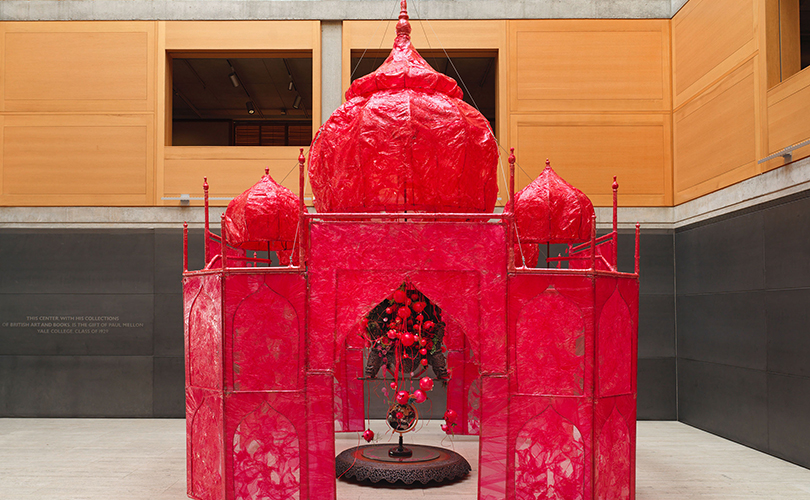
<p class="wp-block-paragraph"><strong><em>Rina Banerjee: Take me, take me, take me … to the Palace of love</em></strong><br>Through September 13th<br>Yale Center for British Art<br>1080 Chapel Street<br>New Haven, CT<br><a href="https://britishart.yale.edu/exhibitions-programs/rina-banerjee-take-me-take-me-take-me-palace-love">https://britishart.yale.edu/exhibitions-programs/rina-banerjee-take-me-take-me-take-me-palace-love</a></p>


<figure class="wp-block-image size-full"><a href="https://arttextstyle.com/wp-content/uploads/2026/04/04_rina_banerjee_photo_by_richard_caspole.jpg"><img loading="lazy" decoding="async" width="810" height="500" src="https://arttextstyle.com/wp-content/uploads/2026/04/04_rina_banerjee_photo_by_richard_caspole.jpg" alt="Rina Banerjee installation" class="wp-image-14702" srcset="https://arttextstyle.com/wp-content/uploads/2026/04/04_rina_banerjee_photo_by_richard_caspole.jpg 810w, https://arttextstyle.com/wp-content/uploads/2026/04/04_rina_banerjee_photo_by_richard_caspole-300x185.jpg 300w, https://arttextstyle.com/wp-content/uploads/2026/04/04_rina_banerjee_photo_by_richard_caspole-768x474.jpg 768w" sizes="auto, (max-width: 810px) 100vw, 810px" /></a><figcaption class="wp-element-caption"><sup>Rina Banerjee, born in Kolkata, India, 1963; lived in England; lives and works in New York (Yale M.F.A. 1995). © The Artist. Image © Yale Center for British Art. Photo: Richard Caspole</sup></figcaption></figure>


<p class="wp-block-paragraph">In an art journey that include Transformations&#8217; exploration of materials at browngrotta arts, in Wilton, CT, Rina Banerjee’s<em> Take me, take me, take me … to the Palace of love </em>at the Yale Center for British Art in New Haven, CT would be an appropriate add on. It&#8217;s an amalgam of materials. Banerjee’s structure reimagines the Taj Mahal, a grand 17th century Mughal mausoleum, in ephemeral industrial materials: a frame of copper and steel is encased in vibrant pink plastic, creating a translucent ghost of the opulent marble façade of the original. The interior of the sculpture reveals an antique Anglo-Indian Bombay chair hovering above a globe, and a chandelier composed of expendable goods—pink foam balls, plastic beads, and artificial birds. As the gallery notes: &#8220;These objects challenge our ideas of value, pointing to a global system that produces things to be alternately fetishized or quickly thrown away.” The piece tells two stories, like the Taj does, as a somber tomb and a monument to love. </p>


<p class="wp-block-paragraph"><em><strong>WRIT and WEFTED: </strong></em><br><em><strong>Sally Van Doren, paintings and drawings; Nancy Koenigsberg, woven wire sculptures </strong></em><br>Through June 21st. <br>Daphne:art Gallery and Advisory<br>55 West Morris Road<br>Bantam, Connecticut </p>


<p class="wp-block-paragraph">By appointment: <a href="mailto:daphneadeeds@gmail.com">daphneadeeds@gmail.com</a></p>


<figure class="wp-block-image size-full"><a href="https://arttextstyle.com/wp-content/uploads/2026/04/IMG_4803.jpg"><img loading="lazy" decoding="async" width="810" height="500" src="https://arttextstyle.com/wp-content/uploads/2026/04/IMG_4803.jpg" alt="Writ and Wefted installation" class="wp-image-14703" srcset="https://arttextstyle.com/wp-content/uploads/2026/04/IMG_4803.jpg 810w, https://arttextstyle.com/wp-content/uploads/2026/04/IMG_4803-300x185.jpg 300w, https://arttextstyle.com/wp-content/uploads/2026/04/IMG_4803-768x474.jpg 768w" sizes="auto, (max-width: 810px) 100vw, 810px" /></a><figcaption class="wp-element-caption"><sup><em>Writ and Wefted</em> installation. photo courtesy  Daphne:art Gallery and Advisory</sup></figcaption></figure>


<p class="wp-block-paragraph">In reviewer Julie Durkin’s words, the exhibition pairs, &#8220;two artists who both work at the boundary between language and material.” Sally Van Doren is a poet who works with illegible handwriting. <a href="https://browngrotta.com/artists/nancy-koenigsberg">Nancy Koenigsberg</a> “draws” with wire — nets and mats, cubes and chains — that suggest fascinating interior and shadow lives.</p>


<p class="wp-block-paragraph"><strong>extraORDINARY things</strong><br>through June 17th<br>Flinn Gallery <br>Greenwich Library<br>101 West Putnam Avenue<br>Second Floor<br>Greenwich, CT <a href="https://flinngallery.org/events/extraordinary-things/">https://flinngallery.org/events/extraordinary-things/</a></p>


<figure class="wp-block-image size-full"><a href="https://arttextstyle.com/wp-content/uploads/2026/04/4.-Kunstadt-PRESSING-ON-No.-157-antique-sad-iron-scorched-linen-thread-and-paper-1795-6.75-x-3.75-x-18in.-2026-.jpg"><img loading="lazy" decoding="async" width="810" height="500" src="https://arttextstyle.com/wp-content/uploads/2026/04/4.-Kunstadt-PRESSING-ON-No.-157-antique-sad-iron-scorched-linen-thread-and-paper-1795-6.75-x-3.75-x-18in.-2026-.jpg" alt="Carole Kunstadt" class="wp-image-14706" srcset="https://arttextstyle.com/wp-content/uploads/2026/04/4.-Kunstadt-PRESSING-ON-No.-157-antique-sad-iron-scorched-linen-thread-and-paper-1795-6.75-x-3.75-x-18in.-2026-.jpg 810w, https://arttextstyle.com/wp-content/uploads/2026/04/4.-Kunstadt-PRESSING-ON-No.-157-antique-sad-iron-scorched-linen-thread-and-paper-1795-6.75-x-3.75-x-18in.-2026--300x185.jpg 300w, https://arttextstyle.com/wp-content/uploads/2026/04/4.-Kunstadt-PRESSING-ON-No.-157-antique-sad-iron-scorched-linen-thread-and-paper-1795-6.75-x-3.75-x-18in.-2026--768x474.jpg 768w" sizes="auto, (max-width: 810px) 100vw, 810px" /></a><figcaption class="wp-element-caption"><sup><em>PRESSING ON No. 157</em>, Carole Kunstadt, antique sad iron, scorched linen thread and paper: pages by Hannah More dated 1795, 6.75 x 3.75 x 18 in., 2026 . photo courtesy of the artist</sup></figcaption></figure>


<p class="wp-block-paragraph">Four artists —&nbsp;Qingjun Huang, Carole Kunstadt, Cheryl R. Riley, and Rob Strati&nbsp;&#8212;reimagine domestic items into vessels of memory, metaphor, and identity through photo essays, altered appliances, heirlooms, and keepsakes.</p>


<p class="wp-block-paragraph"><em><strong>Art, Jazz + The Blues</strong></em><br>through June 7th<br>Museum of Contemporary Art<br>19 Newtown Turnpike<br>Westport, CT</p>


<figure class="wp-block-image size-full"><a href="https://arttextstyle.com/wp-content/uploads/2026/04/Screenshot-2026-04-22-at-9.07.06-AM.jpg"><img loading="lazy" decoding="async" width="810" height="500" src="https://arttextstyle.com/wp-content/uploads/2026/04/Screenshot-2026-04-22-at-9.07.06-AM.jpg" alt="Delta Dawn" class="wp-image-14701" srcset="https://arttextstyle.com/wp-content/uploads/2026/04/Screenshot-2026-04-22-at-9.07.06-AM.jpg 810w, https://arttextstyle.com/wp-content/uploads/2026/04/Screenshot-2026-04-22-at-9.07.06-AM-300x185.jpg 300w, https://arttextstyle.com/wp-content/uploads/2026/04/Screenshot-2026-04-22-at-9.07.06-AM-768x474.jpg 768w" sizes="auto, (max-width: 810px) 100vw, 810px" /></a><figcaption class="wp-element-caption"><sup><em>Delta Dawn</em> by Eric von Schmidt, oil on canvas, 2002</sup></figcaption></figure>


<p class="wp-block-paragraph"><em>Art, Jazz + The Blues, </em> at the Museum of Contemporary Art, Westport, CT explores the intersections between visual art, jazz, and the blues, musical forms deeply rooted in African American traditions,  drawing from the rich holdings of the Westport Public Art Collections (WestPAC). The exhibition centers on <em>Giants of the Blues</em>, a sweeping series of seven group portraits by Westport native Eric von Schmidt (1931–2007) honoring blues, jazz, and folk musicians from the 1920s to the 1960s. Complementing von Schmidt’s paintings are over fifty artworks from the WestPAC collection depicting musicians, inspired by musical themes, or exploring the resonances between musical and visual forms. A selection of important loans from ACA Galleries, The Brubeck Collection at Wilton Library, Eric Chiang, Michael Cummings, Fairfield University Art Museum, Housatonic Museum of Art, Tudor Maier, Mark &amp; Ellen Naftalin, Larry Silver, the Westport Library Collection, and private collections deepen the conversation. As the jazz great Charlie Parker once said, the show invites visitors to “hear with your eyes and see with your ears.”</p>


<p class="wp-block-paragraph">Last but certainly, not least<em>:</em> <em> Transformations: dialogues in art and materials </em>(May 9 &#8211; 17). Schedule your visit here: https://browngrotta.com/exhibitions/transformations-dialogues-in-art-and-material</p>
<p><a href="https://arttextstyle.com">arttextstyle</a></p>
]]></content>
		
					<link rel="replies" type="text/html" href="https://arttextstyle.com/2026/04/22/making-a-day-of-it-visit-transformations-in-may-see-more-art-on-the-way/#comments" thr:count="0" />
			<link rel="replies" type="application/atom+xml" href="https://arttextstyle.com/2026/04/22/making-a-day-of-it-visit-transformations-in-may-see-more-art-on-the-way/feed/atom/" thr:count="0" />
			<thr:total>0</thr:total>
			</entry>
		<entry>
		<author>
			<name>arttextstyle</name>
							<uri>http://www.browngrotta.com</uri>
						</author>

		<title type="html"><![CDATA[The Moon as Muse]]></title>
		<link rel="alternate" type="text/html" href="https://arttextstyle.com/2026/04/15/the-moon-as-muse/" />

		<id>https://arttextstyle.com/?p=14689</id>
		<updated>2026-04-15T14:02:15Z</updated>
		<published>2026-04-15T14:01:45Z</published>
		<category scheme="https://arttextstyle.com/" term="Art" /><category scheme="https://arttextstyle.com/" term="Artemis II" /><category scheme="https://arttextstyle.com/" term="Eduardo Portillo &amp; Mariá Eugenia Dávila" /><category scheme="https://arttextstyle.com/" term="John McQueen" /><category scheme="https://arttextstyle.com/" term="Laura Foster Nicholson" /><category scheme="https://arttextstyle.com/" term="Lizzie Farey" /><category scheme="https://arttextstyle.com/" term="NASA" /><category scheme="https://arttextstyle.com/" term="Norma Minkowitz" /><category scheme="https://arttextstyle.com/" term="Paul Furneaux" />
		<summary type="html"><![CDATA[<p>The Guardian said it well: &#8220;If you’ve been looking up at the moon with childlike wonder these past few days, you aren’t alone. NASA’s Artemis II lunar mission has captured imaginations at a time when wonder and optimism are in short supply.” The photographs of the moon in IRL that resulted from the mission are breathtaking. Shadows at the Edge... </p>
<div class="read-more navbutton"><a href="https://arttextstyle.com/2026/04/15/the-moon-as-muse/">Read More<i class="fa fa-angle-double-right"></i></a></div>
<p><a href="https://arttextstyle.com">arttextstyle</a></p>
]]></summary>

					<content type="html" xml:base="https://arttextstyle.com/2026/04/15/the-moon-as-muse/"><![CDATA[
<p class="wp-block-paragraph"><em>The</em> <em>Guardian </em>said it well: &#8220;If you’ve been looking up at the moon with childlike wonder these past few days, you aren’t alone. NASA’s Artemis II lunar mission has captured imaginations at a time when wonder and optimism are in short supply.” The <a href="https://www.digitalcameraworld.com/photography/astrophotography/one-moon-32-cameras-10-000-photos-as-a-photographer-im-awed-by-the-artemis-ii-photo-album-these-are-the-best-ones-so-far?utm_source=colossalnews&amp;utm_medium=email&amp;utm_term=Mon+Apr+13+2026&amp;utm_campaign=Light+and+Shadows">photographs</a> of the moon in IRL that resulted from the mission are breathtaking.</p>


<figure class="wp-block-image size-full"><a href="https://arttextstyle.com/wp-content/uploads/2026/04/YcDNUeTGV94BJYDExaQZGj-1200-80.jpg"><img loading="lazy" decoding="async" width="810" height="500" src="https://arttextstyle.com/wp-content/uploads/2026/04/YcDNUeTGV94BJYDExaQZGj-1200-80.jpg" alt="The dark side of the Moon NASA" class="wp-image-14690" srcset="https://arttextstyle.com/wp-content/uploads/2026/04/YcDNUeTGV94BJYDExaQZGj-1200-80.jpg 810w, https://arttextstyle.com/wp-content/uploads/2026/04/YcDNUeTGV94BJYDExaQZGj-1200-80-300x185.jpg 300w, https://arttextstyle.com/wp-content/uploads/2026/04/YcDNUeTGV94BJYDExaQZGj-1200-80-768x474.jpg 768w" sizes="auto, (max-width: 810px) 100vw, 810px" /></a><figcaption class="wp-element-caption"><sup>Shadows at the Edge of Lunar Day: The edge of the Moon&#8217;s night and day creates shadows across the surface (Image credit: NASA)<br></sup><br>Man has also looked to the moon for artistic inspiration through millennia. Artists who work with browngrotta arts not immune to celestial charm; we’ve gathered some examples here.<br><br>The travel website <a href="https://flymetothemoontravel.com/moon-timeless-source-inspiration/#:~:text=A%20celestial%20body%20of%20magic,Red%20Figure%20pottery,%20signed%20Brygos">Fly Me to the Moon</a>, lists possible reasons for the moon’s appeal. It could be the subconscious connection with the amorous ancient Greek goddess of the moon, Selene, or the moon’s association with fertility. </figcaption></figure>


<figure class="wp-block-image size-full"><a href="https://browngrotta.com/artworks/19lfn-dark-moon"><img loading="lazy" decoding="async" width="810" height="500" src="https://arttextstyle.com/wp-content/uploads/2026/04/19lg-Dark-Moon.jpg" alt="Dark Moon tapestry, Laura Foster Nicholson" class="wp-image-14691" srcset="https://arttextstyle.com/wp-content/uploads/2026/04/19lg-Dark-Moon.jpg 810w, https://arttextstyle.com/wp-content/uploads/2026/04/19lg-Dark-Moon-300x185.jpg 300w, https://arttextstyle.com/wp-content/uploads/2026/04/19lg-Dark-Moon-768x474.jpg 768w" sizes="auto, (max-width: 810px) 100vw, 810px" /></a><figcaption class="wp-element-caption"><sup>19lf <em><a href="https://browngrotta.com/artworks/19lfn-dark-moon">Dark Moon</a></em>, Laura Foster Nicholson, wool with cotton, metallic, angelina fiber, ink, 34.5&#8243; x 16&#8243;, 2017. photo by Tom Grotta</sup></figcaption></figure>


<p class="wp-block-paragraph">It could also be her ever changing nature that captures our attention. Her light illuminates our quietest and most contemplative hours. “In a dark sea of instability, the full moon in a richly deep blue sky is both reassuring and evocative,” says Laura Foster Nicholson. &#8220;Hints of reflective threads in <em>Dark Moon </em>aim to bring split seconds of insight and imagination, as do the stars.&#8221;</p>


<p class="wp-block-paragraph">Or perhaps it’s simply the spectacle of moonlight. Paul Furneaux’s visit to the Norwegian fjords led to <em>Fractured Moon, Fractured Mountain.</em> He was particularly taken by the drama played on the fjords by the change of light, one half often shadowing the other — when translated to <em>Fractured Moon, Fractured Mountain,</em> it’s reminiscent of the drama of the familiar light and enigmatic sides of the moon.</p>


<figure class="wp-block-image size-full"><a href="https://browngrotta.com/artworks/5pf-Fractured-Moon-Fractured-Mountain"><img loading="lazy" decoding="async" width="810" height="500" src="https://arttextstyle.com/wp-content/uploads/2026/04/5pf-Fractured-moon-fractured-mountain.jpg" alt="Paul Furneaux sculpture" class="wp-image-14692" srcset="https://arttextstyle.com/wp-content/uploads/2026/04/5pf-Fractured-moon-fractured-mountain.jpg 810w, https://arttextstyle.com/wp-content/uploads/2026/04/5pf-Fractured-moon-fractured-mountain-300x185.jpg 300w, https://arttextstyle.com/wp-content/uploads/2026/04/5pf-Fractured-moon-fractured-mountain-768x474.jpg 768w" sizes="auto, (max-width: 810px) 100vw, 810px" /></a><figcaption class="wp-element-caption"><sup>5pf <em><a href="https://browngrotta.com/artworks/5pf-Fractured-Moon-Fractured-Mountain">Fractured Moon-Fractured Mountain</a></em>, Paul Furneaux, Wood, gesso, Mokuhanga, graphite,card ,rice paste and acrylic, 15.75&#8243; x 13.75&#8243;. photo courtesy Paul Furneaux</sup></figcaption></figure>


<p class="wp-block-paragraph">It’s also magical, and mystical. <em>Golden Moon, </em>by Norma Minkowitz, has a large, intricate orb rising up. It is a symbol of illumination, insight and mystery. &#8220;The moon is a metaphor for beauty in this world,&#8221; she says, &#8220;as well as acting as a source of light in the darkness&#8221;. <em>Golden Moon</em> is one of a series of vessel forms that Norma Minkowitz been creating since the 1990’s. The vessels represent containers of different thoughts: some dark, some optimistic and some, like <em>Golden Moon,</em> ethereal.</p>


<figure class="wp-block-image size-full"><a href="https://browngrotta.com/artworks/115nm-golden-moon"><img loading="lazy" decoding="async" width="810" height="500" src="https://arttextstyle.com/wp-content/uploads/2026/04/115nm-Golden-Moon-top.jpg" alt="Norma Minkowitz Golden Moon " class="wp-image-14693" srcset="https://arttextstyle.com/wp-content/uploads/2026/04/115nm-Golden-Moon-top.jpg 810w, https://arttextstyle.com/wp-content/uploads/2026/04/115nm-Golden-Moon-top-300x185.jpg 300w, https://arttextstyle.com/wp-content/uploads/2026/04/115nm-Golden-Moon-top-768x474.jpg 768w" sizes="auto, (max-width: 810px) 100vw, 810px" /></a><figcaption class="wp-element-caption"><sup>115nm <em><a href="https://browngrotta.com/artworks/115nm-golden-moon">Golden Moon</a></em>, Norma Minkowitz, fiber, mixed media, 7.5” x 12” x 12”, 2024. photo by Tom Grotta</sup></figcaption></figure>


<p class="wp-block-paragraph">The moon has been used by artists to express &#8220;longing, change, the spiritual, the mysterious, and the sorrowful, according to <a href="https://www.wikiart.org/news/how-artists-use-the-moon-as-a-symbol-across-cultures/#:~:text=The%20moon%20has%20been%20used,symbolic%20meaning%20to%20the%20moon">WikiArt, the Visual Art Encyclopedia</a>. In <em>When Darkness Comes Calling, </em>John <br>McQueen wanted to capture that magical moment when a full moon comes out in a dark sky. The light and dark contrast is achieved by surrounding the white birch bark of the moon with the darker back sides of the pine and birch barks. The title of the piece comes from the lyrics of a song by Lily Kershaw, <em>As It Seems. </em>In<em> The Other Side of the Moon,</em> McQueen makes a tongue-in-cheek observation about our obsession with the moon. One side of the vessel reads: <em>Man made up the man in the moon. </em>The second side says: <em>The first self-serve in no man’s land.</em></p>


<figure class="wp-block-image size-full"><a href="https://browngrotta.com/artworks/62jm-the-other-side-of-the-moon"><img loading="lazy" decoding="async" width="810" height="500" src="https://arttextstyle.com/wp-content/uploads/2026/04/Man-in-the-Moon-instagram.jpg" alt="John McQueen moon sculptures" class="wp-image-14694" srcset="https://arttextstyle.com/wp-content/uploads/2026/04/Man-in-the-Moon-instagram.jpg 810w, https://arttextstyle.com/wp-content/uploads/2026/04/Man-in-the-Moon-instagram-300x185.jpg 300w, https://arttextstyle.com/wp-content/uploads/2026/04/Man-in-the-Moon-instagram-768x474.jpg 768w" sizes="auto, (max-width: 810px) 100vw, 810px" /></a><figcaption class="wp-element-caption"><sup>34jm <em>After Dark Comes Calling</em>, John McQueen, white pine and birch bark, 42’ x 36 x3&#8243;, 2017 and 62jm <em><a href="https://browngrotta.com/artworks/62jm-the-other-side-of-the-moon">The Other Side of the Moon</a></em>, Jon McQueen, bark and vine, 32&#8243; x 18&#8243; x 14&#8243;, 1993. photo by Tom Grotta</sup></figcaption></figure>


<p class="wp-block-paragraph">Works inspired by the moon that reflects a visual language that crosses geography and history. Here are moon-inspired works from artists in Venezuela and the UK. Eduardo Portillo and María Davila use indigo to illustrate the night, the moon, the sky, the clouds, the dawn; moments of every day; moments filled with blue. </p>


<figure class="wp-block-image size-full"><a href="https://browngrotta.com/artworks/23lf-midnight-moon"><img loading="lazy" decoding="async" width="810" height="500" src="https://arttextstyle.com/wp-content/uploads/2026/04/8pd-Codigo-Lunar-Moon-Code23llfMidnight-Moon.jpg" alt="Eduardo Portillo &amp; Maria Davila tapestry and Lizzie Farey willow sculpture" class="wp-image-14695" srcset="https://arttextstyle.com/wp-content/uploads/2026/04/8pd-Codigo-Lunar-Moon-Code23llfMidnight-Moon.jpg 810w, https://arttextstyle.com/wp-content/uploads/2026/04/8pd-Codigo-Lunar-Moon-Code23llfMidnight-Moon-300x185.jpg 300w, https://arttextstyle.com/wp-content/uploads/2026/04/8pd-Codigo-Lunar-Moon-Code23llfMidnight-Moon-768x474.jpg 768w" sizes="auto, (max-width: 810px) 100vw, 810px" /></a><figcaption class="wp-element-caption"><sup>8pd <em><a href="https://browngrotta.com/artworks/8pd-Codigo-Lunar-Moon-Code">Codigo Lunar (Moon Code)</a></em>, Eduardo Portillo &amp; Maria Davila, silk, moriche palm fiber, alpca, silver leaf triple weave, 55.5&#8243; x 12&#8243;, 2018   23lf <em><a href="https://browngrotta.com/artworks/23lf-midnight-moon">Mignight Moon</a></em>, Lizzie Farey, willow, wire, 33&#8243; x 33&#8243;, 2024, photos by Tom Grotta</sup></figcaption></figure>


<p class="wp-block-paragraph">Wishing you many lunar interludes and the mystical magic that accompany them.<br><br></p>
<p><a href="https://arttextstyle.com">arttextstyle</a></p>
]]></content>
		
					<link rel="replies" type="text/html" href="https://arttextstyle.com/2026/04/15/the-moon-as-muse/#comments" thr:count="0" />
			<link rel="replies" type="application/atom+xml" href="https://arttextstyle.com/2026/04/15/the-moon-as-muse/feed/atom/" thr:count="0" />
			<thr:total>0</thr:total>
			</entry>
		<entry>
		<author>
			<name>arttextstyle</name>
							<uri>http://www.browngrotta.com</uri>
						</author>

		<title type="html"><![CDATA[Materials Matter: Indigo at Transformations this May (9-17)]]></title>
		<link rel="alternate" type="text/html" href="https://arttextstyle.com/2026/04/08/materials-matter-indigo-at-transformations-this-may-9-17/" />

		<id>https://arttextstyle.com/?p=14674</id>
		<updated>2026-04-08T19:07:43Z</updated>
		<published>2026-04-08T19:07:10Z</published>
		<category scheme="https://arttextstyle.com/" term="Uncategorized" />
		<summary type="html"><![CDATA[<p>William Morris, pillar of the arts-and-crafts movement in the 1880s opined, “There is only one real dye: indigo.” Polly Barton and Eduardo Portillo &#38; Mariá Dávila working with indigo. Photos courtesy of the artists. Transformations: dialogues in art and material this May 9 &#8211; 17th at browngrotta arts will feature works from Japan, Korea, Venezuela, the... </p>
<div class="read-more navbutton"><a href="https://arttextstyle.com/2026/04/08/materials-matter-indigo-at-transformations-this-may-9-17/">Read More<i class="fa fa-angle-double-right"></i></a></div>
<p><a href="https://arttextstyle.com">arttextstyle</a></p>
]]></summary>

					<content type="html" xml:base="https://arttextstyle.com/2026/04/08/materials-matter-indigo-at-transformations-this-may-9-17/"><![CDATA[
<p class="wp-block-paragraph">William Morris, pillar of the arts-and-crafts movement in the 1880s opined, “There is only one real dye: indigo.”</p>


<figure class="wp-block-image size-full"><a href="https://arttextstyle.com/wp-content/uploads/2026/04/Bano-de-Indigo-and-portillo.jpg"><img loading="lazy" decoding="async" width="810" height="500" src="https://arttextstyle.com/wp-content/uploads/2026/04/Bano-de-Indigo-and-portillo.jpg" alt="Polly Barton and Eduardo Portillo &amp; Mariá Dávila working with indigo" class="wp-image-14684" srcset="https://arttextstyle.com/wp-content/uploads/2026/04/Bano-de-Indigo-and-portillo.jpg 810w, https://arttextstyle.com/wp-content/uploads/2026/04/Bano-de-Indigo-and-portillo-300x185.jpg 300w, https://arttextstyle.com/wp-content/uploads/2026/04/Bano-de-Indigo-and-portillo-768x474.jpg 768w" sizes="auto, (max-width: 810px) 100vw, 810px" /></a><figcaption class="wp-element-caption"><sup>Polly Barton and Eduardo Portillo &amp; Mariá Dávila working with indigo. Photos courtesy of the artists.</sup></figcaption></figure>


<p class="wp-block-paragraph"><em><a href="Transformations: dialogues in art and material">Transformations: dialogues in art and material</a> </em>this May 9 &#8211; 17th at browngrotta arts will feature works from Japan, Korea, Venezuela, the UK, and the US that incorporate indigo. Every culture that discovered indigo seems to have felt the transformation as something more than chemical: the cloth goes into the vat one color and emerges another, steeped in a blue that belongs simultaneously to sky and sea and shadow. The plant&#8217;s leaves are dark green, and the mystical blue color is unveiled through a fermentation process — when a dyed article is exposed to air, the color transition occurs, starting from yellow to green, and ultimately resulting in the well-known indigo shade. </p>


<p class="wp-block-paragraph">What connects the artists in&nbsp;<em>Transformations&nbsp;</em>&nbsp;who work in indigo — across continents and generations and very different formal concerns — is a relationship with the material that goes beyond color preference. Each has submitted to the discipline the dye demands. Indigo is not a paint you squeeze from a tube. It requires a living vat, careful chemistry, patience, and what practitioners often describe as ritual. It is a dye that demands discipline to use, with some indigo textiles taking thousands of hours to produce, requiring prolonged concentration akin to a meditative state.&nbsp;</p>


<figure class="wp-block-image size-full"><a href="https://browngrotta.com/artworks/33hsh-wall-hanging"><img loading="lazy" decoding="async" width="810" height="500" src="https://arttextstyle.com/wp-content/uploads/2026/04/34hsh-Wall-Hanging-810.jpg" alt="Wall Hanging, Hiroyuki Shindo" class="wp-image-14676" srcset="https://arttextstyle.com/wp-content/uploads/2026/04/34hsh-Wall-Hanging-810.jpg 810w, https://arttextstyle.com/wp-content/uploads/2026/04/34hsh-Wall-Hanging-810-300x185.jpg 300w, https://arttextstyle.com/wp-content/uploads/2026/04/34hsh-Wall-Hanging-810-768x474.jpg 768w" sizes="auto, (max-width: 810px) 100vw, 810px" /></a><figcaption class="wp-element-caption"><sup>34hsh <em><a href="https://browngrotta.com/artworks/33hsh-wall-hanging">Wall Hanging</a></em>, Hiroyuki Shindo, linen, indigo, 72.5&#8243; x 19&#8243;, 1990s. Photo by Tom Grotta</sup></figcaption></figure>


<p class="wp-block-paragraph"><a href="https://browngrotta.com/artists/hiroyuki-shindo">Hiroyuki Shindo </a>discovered the dye as a student: he first encountered indigo while at Kyoto City University of Fine Arts in Japan in the late 1960s, when an older artisan told him he was the last of 14 generations of indigo dyers. Shindo was determined to prevent the art form&#8217;s extinction. Over decades, Shindo maintained indigo vats in Kyoto and developed a distinctive technique entirely his own. He developed his own system, utilizing wide flat troughs in which he laid small stones, watching carefully as the indigo was drawn slowly into the fabric, creating gradations of hue — from nearly invisible shadows to areas of nearly black — through a combination of natural process and his own invention. The white of the cloth, Shindo insisted, was as important as the dyed portions.</p>


<figure class="wp-block-image size-full"><a href="https://browngrotta.com/artworks/3jbas-cumbe"><img loading="lazy" decoding="async" width="810" height="500" src="https://arttextstyle.com/wp-content/uploads/2026/04/3jbas-Cumbe-810.jpg" alt="James Bassler, Cumbe" class="wp-image-14677" srcset="https://arttextstyle.com/wp-content/uploads/2026/04/3jbas-Cumbe-810.jpg 810w, https://arttextstyle.com/wp-content/uploads/2026/04/3jbas-Cumbe-810-300x185.jpg 300w, https://arttextstyle.com/wp-content/uploads/2026/04/3jbas-Cumbe-810-768x474.jpg 768w" sizes="auto, (max-width: 810px) 100vw, 810px" /></a><figcaption class="wp-element-caption"><sup>3jb James Bassler, <em><a href="https://browngrotta.com/artworks/3jbas-cumbe">Cumbe</a></em>, linen, balance plain weave; discontinuous warp, synthetic and natural dye (indigo); 40.5&#8243; x 40.5” including natural color linen binding around entire perimeter, 2009. Photo by Tom Grotta</sup></figcaption></figure>


<p class="wp-block-paragraph"><a href="https://browngrotta.com/artists/james-bassler">James Bassler</a> took a journey to indigo. In 1960, a voyage home from a civilian job in England via a cargo ship through Asia proved transformative. On this journey he witnessed the importance of world crafts and their essential role in cultures — a spinning and weaving demonstration in Bombay and the dyeing processes of Indonesia and Japan. Bassler has since explored the wedge-weave structure of the Navajo, shibori from Japan, and the scaffold weave of pre-Columbian cultures in his textile work. Indigo is threaded through decades of his practice. In works, such as <em>Cumbe, </em>he has used indigo-dyed silk and linen warps in combination with an array of other natural fibers — ramie, sisal, pineapple, nettles — creating textiles that feel like accumulated knowledge made visible.</p>


<figure class="wp-block-image size-full"><a href="https://browngrotta.com/artworks/1pb-synapse"><img loading="lazy" decoding="async" width="810" height="500" src="https://arttextstyle.com/wp-content/uploads/2026/04/1pb-Synapse_framed-detail.810.jpg" alt="Synapse, Polly Barton" class="wp-image-14680" srcset="https://arttextstyle.com/wp-content/uploads/2026/04/1pb-Synapse_framed-detail.810.jpg 810w, https://arttextstyle.com/wp-content/uploads/2026/04/1pb-Synapse_framed-detail.810-300x185.jpg 300w, https://arttextstyle.com/wp-content/uploads/2026/04/1pb-Synapse_framed-detail.810-768x474.jpg 768w" sizes="auto, (max-width: 810px) 100vw, 810px" /></a><figcaption class="wp-element-caption"><sup>1pb <em><a href="https://browngrotta.com/artworks/1pb-synapse">Synapse</a></em>, Polly Barton, silk, double ikat, 56” x 31”, 2016. photo by Tom Grotta</sup></figcaption></figure>


<p class="wp-block-paragraph">Japan and paint were <a href="https://browngrotta.com/artists/polly-barton">Polly Barton&#8217;s</a> route to indigo. As a young artist, she worked as a personal assistant to abstract expressionist painter Helen Frankenthaler, from whom Barton says she gained &#8220;permission&#8221; to build up layers of color in her own work. In 1981, she moved to Kameoka, Japan to study with master weaver Tomohiko Inoue, living in the religious heart of the Oomoto Foundation. Barton has spent over four decades exploring ikat, the ancient technique of binding skeins of yarn in calculated patterns before dyeing, which produces the distinctive blurred, feathered color transitions characteristic of the form. Indigo is central to her palette. Her work uses indigo alongside pigment, sumi ink, soy milk, and metal and silver leaf — materials that she layers to create luminous, meditative surfaces.</p>


<figure class="wp-block-image size-full"><a href="https://browngrotta.com/artworks/194r-double-ikats"><img loading="lazy" decoding="async" width="810" height="500" src="https://arttextstyle.com/wp-content/uploads/2026/04/194r-Blue-Edge-Ikats-810.jpg" alt="Blue Edge Ikats, Ed Rossbach" class="wp-image-14681" srcset="https://arttextstyle.com/wp-content/uploads/2026/04/194r-Blue-Edge-Ikats-810.jpg 810w, https://arttextstyle.com/wp-content/uploads/2026/04/194r-Blue-Edge-Ikats-810-300x185.jpg 300w, https://arttextstyle.com/wp-content/uploads/2026/04/194r-Blue-Edge-Ikats-810-768x474.jpg 768w" sizes="auto, (max-width: 810px) 100vw, 810px" /></a><figcaption class="wp-element-caption"><sup>194r <em><a href="https://browngrotta.com/artworks/194r-double-ikats">Blue Edge Ikats</a></em>, Ed Rossbach, ikat, 43.5&#8243; x 21&#8243; x .625&#8243;, c 1970. Photo by Tom Grotta</sup></figcaption></figure>


<p class="wp-block-paragraph">One of the foundational figures of American fiber art — and one of its great iconoclasts &#8212; <a href="https://browngrotta.com/artists/ed-rossbach">Ed Rossbach</a> taught for nearly three decades at the University of California, Berkeley, where he created works in almost every known textile technique during his five-decade-long career, experimenting with labor-intensive techniques such as Andean discontinuous warp weaving, Native American coiled basketry, European lace, and Indonesian ikat. Indigo appeared in his work as part of his deep engagement with global textile traditions. He used the dye not as an element in a restlessly curious practice that moved between the ethnographic and the anarchic — making a basket from plastic, a hanging from newspaper, a piece from tundra grass. Indigo was part of that global inventory, a dye he understood as one of humanity&#8217;s great shared materials.</p>


<figure class="wp-block-image size-full"><a href="https://browngrotta.com/artworks/13yc-matrix-II-201022"><img loading="lazy" decoding="async" width="810" height="500" src="https://arttextstyle.com/wp-content/uploads/2026/04/13yc-Matrix-II-201022_detail.810.jpg" alt="Detail: 13yc " class="wp-image-14682" srcset="https://arttextstyle.com/wp-content/uploads/2026/04/13yc-Matrix-II-201022_detail.810.jpg 810w, https://arttextstyle.com/wp-content/uploads/2026/04/13yc-Matrix-II-201022_detail.810-300x185.jpg 300w, https://arttextstyle.com/wp-content/uploads/2026/04/13yc-Matrix-II-201022_detail.810-768x474.jpg 768w" sizes="auto, (max-width: 810px) 100vw, 810px" /></a><figcaption class="wp-element-caption"><sup>Detail: 13yc <em><a href="https://browngrotta.com/artworks/13yc-matrix-II-201022">Matrix II 201022</a></em>, Chang Yeonsoon, indigo dyed fiber, 51.75&#8243; x 10&#8243; x 12.75&#8243;, 2010. Photo by Tom Grotta</sup></figcaption></figure>


<p class="wp-block-paragraph"><a href="https://browngrotta.com/artists/yeonsoon-change">Yeonsoon Chang</a>&nbsp;takes indigo into the realm of philosophy. The Korean artist is known for creating ethereal works of starched indigo and was named Artist of the Year at the National Museum of Contemporary Art in Seoul in 2008.&nbsp;Chang&#8217;s signature material is abaca — a fiber derived from a species of banana plant — which she subjects to an elaborate 12-step process that includes starching,&nbsp;In her&nbsp;<em>Matrix III</em>&nbsp;series, she dyes the abaca fabric with indigo blue over thirty times, creating tightly stiffened material that pays homage to its disciplined creation. The&nbsp;<em>Matrix</em>&nbsp;series, she has said, illustrates the Asian perspective of the human mind and body as unified rather than separate — and the repeated dyeing, the compulsive labor, the rigid geometry are all in service of that idea.</p>


<figure class="wp-block-image size-full"><a href="https://browngrotta.com/artists/Eduardo-Maria-Davila-portillo"><img loading="lazy" decoding="async" width="810" height="500" src="https://arttextstyle.com/wp-content/uploads/2026/04/14pd-Clev-1-810.jpg" alt="Clev 1, Eduardo Portillo &amp; Mariá Dávila" class="wp-image-14683" srcset="https://arttextstyle.com/wp-content/uploads/2026/04/14pd-Clev-1-810.jpg 810w, https://arttextstyle.com/wp-content/uploads/2026/04/14pd-Clev-1-810-300x185.jpg 300w, https://arttextstyle.com/wp-content/uploads/2026/04/14pd-Clev-1-810-768x474.jpg 768w" sizes="auto, (max-width: 810px) 100vw, 810px" /></a><figcaption class="wp-element-caption"><sup>Detail: 14 pd <em>Clev 1</em>, <a href="https://browngrotta.com/artists/Eduardo-Maria-Davila-portillo">Eduardo Portillo &amp; Mariá Dávila</a>, silk, alpaca, moriche, metallic fiber, silver leaf, natural dyes, 82.25” x 24.75”, 2019. Photo by Tom Grotta.</sup></figcaption></figure>


<p class="wp-block-paragraph">The Venezuelan partnership of <a href="https://browngrotta.com/artists/Eduardo-Maria-Davila-portillo">Eduardo Portillo and María Dávila </a>may have traveled the furthest — literally and conceptually — to arrive at indigo. Working together since 1983, they have been dedicated to exploring the intricacies of the material production of textiles, traveling extensively in China and India to study the traditional techniques of indigo dye making, silk sericulture, and hand-weaving. Indigo became central to a pivotal body of work rooted in place and longing. Looking for blue in their mountain landscape and realizing they could only find it in the sky, they merged their previous projects — the silk, the vegetable fibers, the natural dyes — into a series called <em>Azul Indigo</em>, exhibited in 2012, recreating the hours of the day: sunrise, noon, sunset, night, and the night&#8217;s shadows — their interest in blue shifting with the intensity of light according to the hour. </p>


<p class="wp-block-paragraph">That labor-intensive nature of indigo, paradoxically, is part of its appeal for contemporary artists working in an era of infinite digital speed. The vat slows you down. It insists on process. It connects you — through fermented indigo leaves and wooden mallets and resist-tied threads — to every dyer who has stood at a vat in Kano or Kyoto or the Carolina Lowcountry, watching cloth transform in the air. William Morris was right. There is only one real blue dye. And in the hands of artists like these, its presence is spell binding.</p>


<p class="wp-block-paragraph">Join us to see their work at&nbsp;<em><a href="https://browngrotta.com/exhibitions/transformations-dialogues-in-art-and-material">Transformations:dialogues in art and material&nbsp;</a></em>(May 9-17).&nbsp;</p>
<p><a href="https://arttextstyle.com">arttextstyle</a></p>
]]></content>
		
					<link rel="replies" type="text/html" href="https://arttextstyle.com/2026/04/08/materials-matter-indigo-at-transformations-this-may-9-17/#comments" thr:count="0" />
			<link rel="replies" type="application/atom+xml" href="https://arttextstyle.com/2026/04/08/materials-matter-indigo-at-transformations-this-may-9-17/feed/atom/" thr:count="0" />
			<thr:total>0</thr:total>
			</entry>
		<entry>
		<author>
			<name>arttextstyle</name>
							<uri>http://www.browngrotta.com</uri>
						</author>

		<title type="html"><![CDATA[Art Assembled for March]]></title>
		<link rel="alternate" type="text/html" href="https://arttextstyle.com/2026/04/01/art-assembled-for-march/" />

		<id>https://arttextstyle.com/?p=14662</id>
		<updated>2026-04-01T12:09:37Z</updated>
		<published>2026-04-01T12:09:14Z</published>
		<category scheme="https://arttextstyle.com/" term="Art Assembled" /><category scheme="https://arttextstyle.com/" term="Aby Mackie" /><category scheme="https://arttextstyle.com/" term="Dorothy Gill Barnes" /><category scheme="https://arttextstyle.com/" term="John Garrett" /><category scheme="https://arttextstyle.com/" term="Karyl Sisson" /><category scheme="https://arttextstyle.com/" term="Lizzie Farey" /><category scheme="https://arttextstyle.com/" term="Mariette Rousseau-Vermette" /><category scheme="https://arttextstyle.com/" term="Simone Pheulpin" />
		<summary type="html"><![CDATA[<p>Our&#160;New this Week&#160;instagrams and browngrotta-created&#160;artlive&#160;videos in March were populated with works that evidence singular intention and mastery of a variety of materials. The featured artists reinvisioned everything from paper straws, to repurposed textiles, to willow branches with catkins intact.&#160; 93ks Pepsi Cola Faux Pot, Karyl Sisson, vintage paper drinking straws and polymer, 5.75&#8243; x 6&#8243;... </p>
<div class="read-more navbutton"><a href="https://arttextstyle.com/2026/04/01/art-assembled-for-march/">Read More<i class="fa fa-angle-double-right"></i></a></div>
<p><a href="https://arttextstyle.com">arttextstyle</a></p>
]]></summary>

					<content type="html" xml:base="https://arttextstyle.com/2026/04/01/art-assembled-for-march/"><![CDATA[
<p class="wp-block-paragraph">Our&nbsp;<em>New this Week</em>&nbsp;instagrams and browngrotta-created&nbsp;<em>artlive</em>&nbsp;videos in March were populated with works that evidence singular intention and mastery of a variety of materials. The featured artists reinvisioned everything from paper straws, to repurposed textiles, to willow branches with catkins intact.&nbsp;</p>


<figure class="wp-block-image size-full"><a href="https://browngrotta.com/artworks/93ks-pepsi-cola-faux-pot"><img loading="lazy" decoding="async" width="810" height="500" src="https://arttextstyle.com/wp-content/uploads/2026/03/93ks-Pepsi-Cola-Faux-Pot-810.jpg" alt="Pepsi Cola Faux Pot by Karyl Sisson" class="wp-image-14664" srcset="https://arttextstyle.com/wp-content/uploads/2026/03/93ks-Pepsi-Cola-Faux-Pot-810.jpg 810w, https://arttextstyle.com/wp-content/uploads/2026/03/93ks-Pepsi-Cola-Faux-Pot-810-300x185.jpg 300w, https://arttextstyle.com/wp-content/uploads/2026/03/93ks-Pepsi-Cola-Faux-Pot-810-768x474.jpg 768w" sizes="auto, (max-width: 810px) 100vw, 810px" /></a><figcaption class="wp-element-caption"><sup>93ks <em><a href="https://browngrotta.com/artworks/93ks-pepsi-cola-faux-pot">Pepsi Cola Faux Pot</a></em>, Karyl Sisson, vintage paper drinking straws and polymer, 5.75&#8243; x 6&#8243; x 6&#8243;, 2015. photo by Tom Grotta</sup></figcaption></figure>


<p class="wp-block-paragraph">The first work we highlighted was&nbsp;<a href="https://browngrotta.com/artists/karyl-sisson">Karyl Sisson&#8217;s</a>&nbsp;<em>Pepsi Faux Pot.&nbsp;</em>For years, Karyl Sisson has been collecting things like sewing notions —&nbsp;buttons and zippers, womenʼs vanity items —&nbsp;bobby pins, hair pins, and curlers, and paper drinking straws like the straws in&nbsp;<em>Pepsi Cola Faux Pot.&nbsp;</em>&#8220;I like the idea and practice of recycling and am drawn to undervalued and overlooked materials,&#8221; Sisson says. &#8220;These common, manufactured objects, reminiscent of my childhood, are the building blocks of my sculptures and wall art, while simple interlocking techniques found in basketry and needlework are usually the method of construction.”</p>


<figure class="wp-block-image size-full"><a href="https://browngrotta.com/artworks/42sp-tom"><img loading="lazy" decoding="async" width="810" height="500" src="https://arttextstyle.com/wp-content/uploads/2026/03/42sp-Tom-810.jpg" alt="Simone Pheulpin cotton sculpture" class="wp-image-14663" srcset="https://arttextstyle.com/wp-content/uploads/2026/03/42sp-Tom-810.jpg 810w, https://arttextstyle.com/wp-content/uploads/2026/03/42sp-Tom-810-300x185.jpg 300w, https://arttextstyle.com/wp-content/uploads/2026/03/42sp-Tom-810-768x474.jpg 768w" sizes="auto, (max-width: 810px) 100vw, 810px" /></a><figcaption class="wp-element-caption"><sup>42sp <em><a href="https://browngrotta.com/artworks/42sp-tom">Tom</a></em>, Simone Pheulpin, cotton, 17.75” x 14.5” x 11.25”, 2023. Photo by Tom Grotta</sup></figcaption></figure>


<p class="wp-block-paragraph">Our video of <a href="https://browngrotta.com/artists/simone-pheulpin">Simone Pheulpin’s</a> <em>Nova, </em>part of the <em>Eclipse </em>series, gives viewers an opportunity to see up close the remarkable alchemy involved in this artist’s work. In Pheulpin’s hands humble strips of cotton become remarkable objects that evoke natural phenomena. She uses a method of her own devising, using neither glue or stitches. &#8220;I&#8217;m very, very interested in the roots, the layers, everything that is natural,&#8221; Pheulpin says. &#8220;The concretions, the accumulations, I love that, that&#8217;s the basic nature, the basis of my inspiration. I really like everything that is linear, everything that is repeated, piles of wood, walls. I love the walls, also by the sea, for example, the flowing water, the marks in the sand, the desert, the dunes, all that.” Pheulpin’s work will be part of a deep dive into materials in our upcoming exhibition, <em>Transformations: dialogues in art and materials (</em>May 9 &#8211; 17, 2026). </p>


<figure class="wp-block-image size-full"><a href="https://browngrotta.com/artworks/10am-between-chaos-and-order-6"><img loading="lazy" decoding="async" width="810" height="500" src="https://arttextstyle.com/wp-content/uploads/2026/03/10am-Between-Order-and-Chaos-6-810.jpg" alt="Aby Mackie textile" class="wp-image-14665" srcset="https://arttextstyle.com/wp-content/uploads/2026/03/10am-Between-Order-and-Chaos-6-810.jpg 810w, https://arttextstyle.com/wp-content/uploads/2026/03/10am-Between-Order-and-Chaos-6-810-300x185.jpg 300w, https://arttextstyle.com/wp-content/uploads/2026/03/10am-Between-Order-and-Chaos-6-810-768x474.jpg 768w" sizes="auto, (max-width: 810px) 100vw, 810px" /></a><figcaption class="wp-element-caption"><sup>10am <em><a href="https://browngrotta.com/artworks/10am-between-chaos-and-order-6">Between Order and Chaos</a></em>, Aby Mackie, reconstructed domestic textiles 6, 83&#8243; x 37&#8243; x 6&#8243;, 2022. Photo by Tom Grotta</sup></figcaption></figure>


<p class="wp-block-paragraph">Barcelona-based artist <a href="https://browngrotta.com/artists/aby-mackie">Aby Mackie</a> also approaches “humble” material in innovative ways — in her case, discarded textiles and household remnants are repurposed as fine art. Sourced from the streets of Barcelona, in works like <em>Between Order and Chaos, </em>she reimagines overlooked materials as powerful reflections on memory and value. In Barcelona, the contents of entire homes are often either thrown into the streets or auctioned off at Encants Vells market. The creation of Mackie’s work is driven by the selection and repurposing of objects and textiles from these sources in order to explore ongoing cultural themes, including materialism and consumerism. Mackie’s work will also be included in <em>Transformations </em>in May.</p>


<figure class="wp-block-image size-full"><a href="https://browngrotta.com/artworks/3lf-1-willow-ball-2"><img loading="lazy" decoding="async" width="810" height="500" src="https://arttextstyle.com/wp-content/uploads/2026/03/3lf.1-Willow-Ball-2-810.jpg" alt="Lizzie Farey Willow basket" class="wp-image-14666" srcset="https://arttextstyle.com/wp-content/uploads/2026/03/3lf.1-Willow-Ball-2-810.jpg 810w, https://arttextstyle.com/wp-content/uploads/2026/03/3lf.1-Willow-Ball-2-810-300x185.jpg 300w, https://arttextstyle.com/wp-content/uploads/2026/03/3lf.1-Willow-Ball-2-810-768x474.jpg 768w" sizes="auto, (max-width: 810px) 100vw, 810px" /></a><figcaption class="wp-element-caption"><sup>3lf.1 <em><a href="https://browngrotta.com/artworks/3lf-1-willow-ball-2">Willow Ball 2,</a></em> Lizzie Farey, willow, 18” x 18” x 18”, 2000. Photo by Tom Grotta</sup></figcaption></figure>


<p class="wp-block-paragraph">The inspiration for <a href="https://browngrotta.com/artists/lizzie-farey">Lizzie Farey&#8217;s</a> work comes from the inherent qualities found in the natural materials around her Scotland location. Using willow, birch, heather, bog myrtle, and many other locally grown woods, her work ranges form traditional to organic sculptural forms — much of it pushing the boundaries of traditional technique.  In <em>Willow Ball &#8211; 2</em> and <em>Pussy</em> <em>Willow Bowl, </em>willow seems to have been plucked unchanged from its natural surroundings, yet, with shape and color, the artist adds more. The works achieve Farey’s aim, to create baskets as reminders of the intense pleasure of nature – taking viewers to a place and a time that is universal.</p>


<figure class="wp-block-image size-full"><a href="https://browngrotta.com/artworks/600mr-verticles-dans-le-bleu"><img loading="lazy" decoding="async" width="810" height="500" src="https://arttextstyle.com/wp-content/uploads/2026/03/600mr-Verticles-dans-le-Bleu-810.jpg" alt="Mariette Rousseau-Vermette tapestry" class="wp-image-14667" srcset="https://arttextstyle.com/wp-content/uploads/2026/03/600mr-Verticles-dans-le-Bleu-810.jpg 810w, https://arttextstyle.com/wp-content/uploads/2026/03/600mr-Verticles-dans-le-Bleu-810-300x185.jpg 300w, https://arttextstyle.com/wp-content/uploads/2026/03/600mr-Verticles-dans-le-Bleu-810-768x474.jpg 768w" sizes="auto, (max-width: 810px) 100vw, 810px" /></a><figcaption class="wp-element-caption"><sup>600mr <em><a href="https://browngrotta.com/artworks/600mr-verticles-dans-le-bleu">Verticles mdans le Bleu</a></em>, Mariette Rousseau-Vermette, wool and aluminum , 38” x 38”, 1995. Photo by Tom Grotta</sup></figcaption></figure>


<p class="wp-block-paragraph"><a href="https://browngrotta.com/artists/mariette-rousseau-vermette">Mariette Rousseau-Vermette</a> was a noted Quebec-based Canadian tapestry artist who pioneered innovations in fiber art during the 1960s, 70s and 80s. Rousseau-Vermette created weavings in which she experimented with scale, form, material, and color, which became known as tapestry-paintings. In <em>Verticles dans le bleu</em> the artist incorporates metal tubes wrapped in wool to create dimension and interest. Rousseau-Vermette’s work mixing optical fibers and wool will be included in<em>Transformations </em>in May.</p>


<figure class="wp-block-image size-full"><a href="https://browngrotta.com/artworks/38jg-charred-black-2"><img loading="lazy" decoding="async" width="810" height="500" src="https://arttextstyle.com/wp-content/uploads/2026/03/38jg-Charred-Black-2-810.jpg" alt="John Garrett basket" class="wp-image-14668" srcset="https://arttextstyle.com/wp-content/uploads/2026/03/38jg-Charred-Black-2-810.jpg 810w, https://arttextstyle.com/wp-content/uploads/2026/03/38jg-Charred-Black-2-810-300x185.jpg 300w, https://arttextstyle.com/wp-content/uploads/2026/03/38jg-Charred-Black-2-810-768x474.jpg 768w" sizes="auto, (max-width: 810px) 100vw, 810px" /></a><figcaption class="wp-element-caption"><sup>38jg <a href="https://browngrotta.com/artworks/38jg-charred-black-2">Charred Black 2</a>, John Garrett, Hardware cloth scrap, paper pulp, acrylic paint, rebar tie circles, aluminum rings, black rubber lacing, plastic covered electrical wire, 6.5&#8243; x 8&#8243; x 8&#8243;, 2025. Photo by Tom Grotta</sup></figcaption></figure>


<p class="wp-block-paragraph">In <em>Charred Black 2</em>, part of his <em>Seven Baskets</em> series, <a href="https://browngrotta.com/artists/john-garrett">John Garrett</a> fashions welded wire mesh into a vessel shaped by conflict and renewal. Inspired by images of war-torn landscapes, layers of paint, metal leaf, and bound wire evoke structures scarred and rebuilt, holding both destruction and resilience within their forms. “I had seen many pictures of the destruction of wars in Sudan, Ukraine, Israel, and Gaza,&#8230; Piles of debris littered landscapes,&#8221; Garrett says. &#8220;My painted paper baskets looked to me like structures distressed and damaged and covered in dust.”  Forms were painted and repainted and became new again while speaking of horrors between the layers. Shiny metal leaf covered the interiors and exteriors of others. <em>Charred Black 2 </em>was wrapped with rings of plied wire and tied down with more wire or fabric, bringing to mind a structure awaiting more layers of concrete or plaster. </p>


<figure class="wp-block-image size-full"><a href="https://browngrotta.com/artworks/102dgb-spalted-maple-looking-glass"><img loading="lazy" decoding="async" width="810" height="500" src="https://arttextstyle.com/wp-content/uploads/2026/03/102dgb-102dgb-Spalted-Maple-Looking-Glass-810.jpg" alt="Dorothy Gill Barneslooking glass sculpture" class="wp-image-14669" srcset="https://arttextstyle.com/wp-content/uploads/2026/03/102dgb-102dgb-Spalted-Maple-Looking-Glass-810.jpg 810w, https://arttextstyle.com/wp-content/uploads/2026/03/102dgb-102dgb-Spalted-Maple-Looking-Glass-810-300x185.jpg 300w, https://arttextstyle.com/wp-content/uploads/2026/03/102dgb-102dgb-Spalted-Maple-Looking-Glass-810-768x474.jpg 768w" sizes="auto, (max-width: 810px) 100vw, 810px" /></a><figcaption class="wp-element-caption"><sup>102dgb <em><a href="https://browngrotta.com/artworks/102dgb-spalted-maple-looking-glass">Spalted Maple Looking Glass</a></em>, Dorothy Gill Barnes, spalted maple, glass lens, 9” x 18” x 14”, 2005-2013. Photo by Tom Grotta</sup></figcaption></figure>


<p class="wp-block-paragraph">In the 1970s, when she was in her 40s and early 50s,&nbsp;<a href="https://browngrotta.com/artists/dorothy-gill-barnes">Dorothy Gill Barnes</a>&nbsp;taught herself basketry through books, independent study,&nbsp;occasional classes, and connections with traditional makers, also drawing inspiration from contemporary artists and emerging developments in the field. Within a decade, her strikingly original works—crafted from natural materials—gained national and international recognition.&nbsp;Barnes delighted in revealing the ingenuity of nature,&nbsp;from animal-made forms to processes of growth and decay.&nbsp;Her work invites viewers to slow down and truly notice.&nbsp;In&nbsp;<em>Spalted Maple Looking Glass</em>, she has created an interactive experience:&nbsp;a glass lens, frames a small twig, magnifying both the object and its hollow.&nbsp;Through the lens, the tiny scene appears vast — refashioning something ordinary into a moment of wonder.</p>


<figure class="wp-block-image size-full"><a href="https://browngrotta.com/artworks/41mh-Maple-Tree-Branch-Basket-165"><img loading="lazy" decoding="async" width="810" height="500" src="https://arttextstyle.com/wp-content/uploads/2026/03/41mh-165r-810.jpg" alt="" class="wp-image-14670" srcset="https://arttextstyle.com/wp-content/uploads/2026/03/41mh-165r-810.jpg 810w, https://arttextstyle.com/wp-content/uploads/2026/03/41mh-165r-810-300x185.jpg 300w, https://arttextstyle.com/wp-content/uploads/2026/03/41mh-165r-810-768x474.jpg 768w" sizes="auto, (max-width: 810px) 100vw, 810px" /></a><figcaption class="wp-element-caption"><sup>41mh <em><a href="https://browngrotta.com/artworks/41mh-Maple-Tree-Branch-Basket-165">#165r</a></em>, Marion Hildebrandt, black sisal twine, brown waxed linen warp, hand twined rush, ash strip, wood rounds with leather ties, 9.5&#8243; x 8&#8243; x 8&#8243;, 2000. Photo by Tom Grotta</sup></figcaption></figure>


<p class="wp-block-paragraph"><a href="https://browngrotta.com/artists/marion-hildebrandt">Marion Hildebrandt</a> studied at the University of California, where she received degrees in the decorative arts and home economics. The artist lived and worked in Napa Valley, California, where she collected the plants — grasses, branches, pine needles, and bark &#8212; that she used to make her baskets. She employed the same materials that Native Americans used when they inhabited the area. Like them, Hildebrandt appreciated the natural materials that surrounded her, utilizing her artistic vision to create artistic art forms into structural objects like <em>#r165.</em></p>
<p><a href="https://arttextstyle.com">arttextstyle</a></p>
]]></content>
		
					<link rel="replies" type="text/html" href="https://arttextstyle.com/2026/04/01/art-assembled-for-march/#comments" thr:count="0" />
			<link rel="replies" type="application/atom+xml" href="https://arttextstyle.com/2026/04/01/art-assembled-for-march/feed/atom/" thr:count="0" />
			<thr:total>0</thr:total>
			</entry>
	</feed>